 Skip to content
You may be a stepparent in Corpus Christi who has raised a child for years, a grandparent caring for a relative, a foster parent ready to pursue permanency, or a birth parent trying to understand consent and openness. Each situation involves love, uncertainty, and legal decisions that can shape a child's identity and future. Searching for an adoption attorney in Corpus Christi is often the first sign that you're ready for clear answers, but the right answers depend on the type of adoption, the child's circumstances, and the status of parental rights.
Texas adoption law doesn't follow one universal checklist. A stepparent case can differ sharply from a DFPS adoption, while an adult adoption may involve entirely different eligibility rules. The purpose of this guide is to help you identify your legal path, understand the major steps, and prepare thoughtful questions for a Texas adoption lawyer.
Understanding Adoption Law in Corpus Christi
Maria and Daniel have lived in Corpus Christi for several years. Daniel is Maria's spouse, and he has helped raise her child since kindergarten. They want Daniel to become a legal parent, but they're unsure whether they need a home study, whether the other parent must consent, and when the court can issue a final decree. A relative caring for a niece or nephew might face similar uncertainty, but the necessary filings and parental-rights issues could be different.
Texas adoption cases are generally shaped by Family Code Chapters 162 through 166. Chapter 162 addresses adoption, consent, termination of parental rights, residence requirements, and adult adoption provisions. The surrounding chapters can affect related parent-child matters, records, and procedures. An attorney's first job is to determine which rules apply instead of treating every family as if it were pursuing the same kind of adoption.
Corpus Christi cases may involve local district courts, Nueces County filing procedures, DFPS personnel, home-study professionals, and deadlines that must be coordinated carefully. Local familiarity helps counsel identify where documents should be filed, communicate with the appropriate participants, and prepare families for hearings. It doesn't replace the governing Texas statutes, but it can make the process easier to manage.
Practical rule: The best interests of the child should guide every decision, including whether adoption, guardianship, reunification, or another legal arrangement is the safest and most stable option.
Texas adoption has a long records history. The state issued amended adoption birth certificates beginning in 1935 and sealed original birth certificates in 1957. Texas later developed procedures allowing adult adoptees to seek access under specific conditions, which is one reason adoption affects far more than a courtroom ceremony. This overview of Texas adoption laws can help families understand why legal documents, identity records, and court orders deserve careful attention.
What Adoption Attorneys Do in Texas
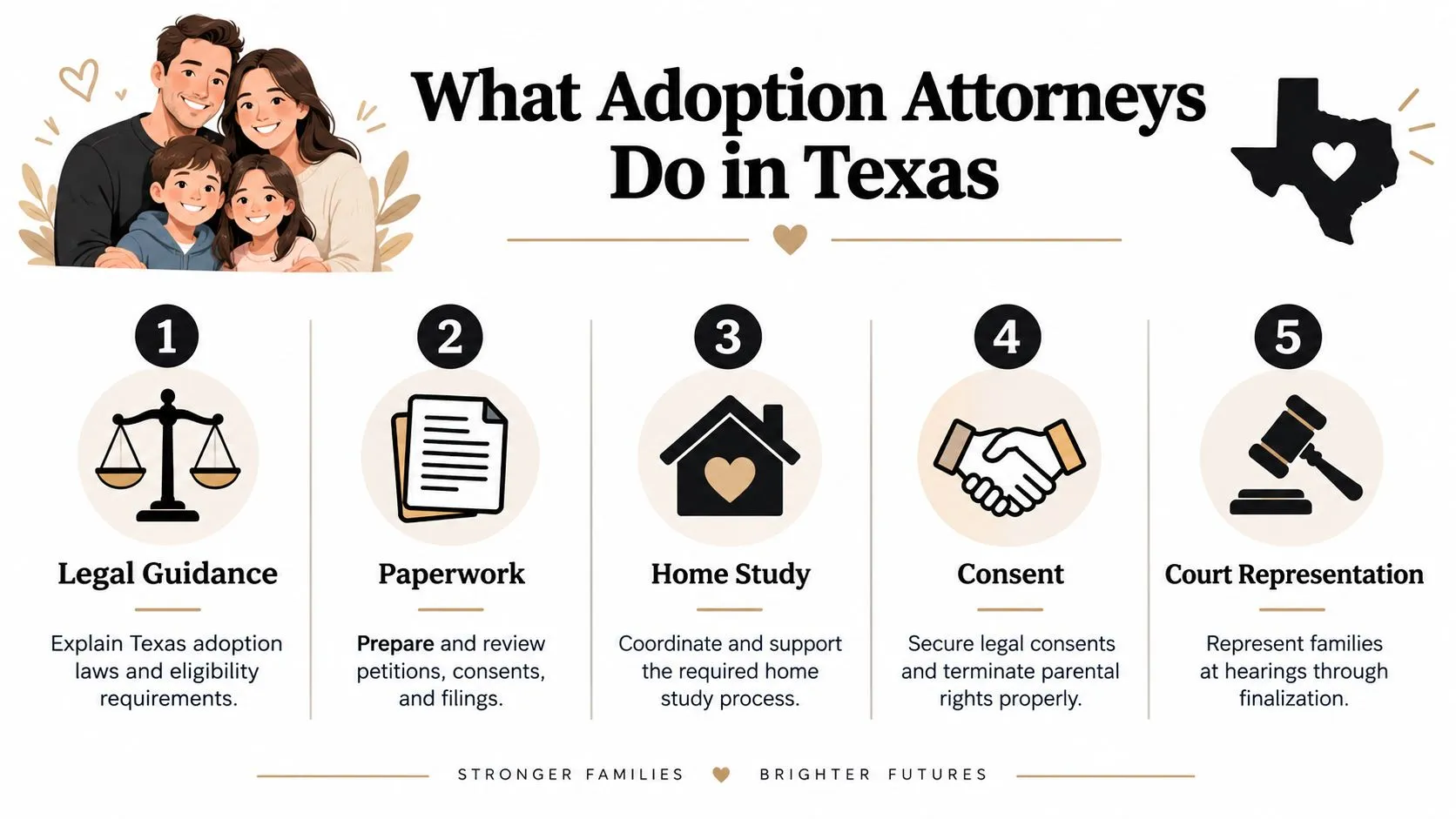
An adoption attorney serves as a legal guide, document manager, problem solver, and courtroom advocate. Think of the attorney as a GPS for a trip with changing roads. The destination may be finalization, but the route can change when a consent is missing, a home study needs an update, or a parent contests termination.
The legal work before filing
The first conversation should identify the adoption type and any unresolved parental-rights issue. Counsel may ask about the child's age, current living arrangement, legal parents, prior court orders, marital or stepparent relationship, DFPS involvement, and whether any parent has signed a valid consent.
The attorney then helps gather and review materials such as:
- Identity records: Birth certificates, marriage records, divorce documents, and prior court orders may establish the family relationship and legal history.
- Home-study information: The family must understand who will be evaluated and whether the study remains current when placement occurs.
- Consent documents: Written consents must comply with Texas requirements. An incomplete or improperly handled consent can delay the case.
- Petition materials: The adoption petition tells the court who the parties are, what relief is requested, and why the adoption serves the child's best interests.
Termination of parental rights is often a necessary first step before an adoption can proceed. Families dealing with that issue may review Termination of Parental Rights Before Adoption for a plain-language explanation of why the two legal matters are connected.
Court representation and final records
After filing, counsel tracks notices, hearings, consents, evidence, and court requirements. At finalization, the judge generally needs enough information to determine that the adoption is legally proper and serves the child's best interests. The attorney prepares the family for questions, confirms that required documents are available, and helps address the final decree and amended birth-certificate process.
Texas adoption activity shows why this work is a recurring part of family law. In 2023, an estimated 7,168 children were adopted in Texas, with foster-care adoptions accounting for 58.33% and private domestic adoptions accounting for 39.96% of the total, according to Texas adoption data included in a Corpus Christi budget document. Those figures reflect a broad legal field involving public, private, relative, stepparent, and other family arrangements.
Comparing Adoption Types and Legal Paths
The first question for a prospective client isn't always, “Which attorney should I hire?” It may be, “Which adoption process applies to my family?” The answer determines which documents, consents, evaluations, and court steps deserve attention first.

| Adoption path | Common legal focus | Timing considerations |
|---|---|---|
| Stepparent adoption | The spouse seeks legal parent status, often requiring attention to the other parent's consent or termination. | The child's residence and court requirements can control when finalization is available. |
| Kinship or relative adoption | A grandparent, aunt, uncle, or other relative seeks permanency while preserving family connections when appropriate. | Existing custody orders, parental rights, and the child's living history may affect the route. |
| Private domestic adoption | Birth-parent consent, placement, counseling, home-study compliance, and court filings are central. | Matching and placement timing can affect whether evaluations remain current. |
| Foster-care adoption | DFPS approval, background checks, training, placement, permanency planning, and finalization must be coordinated. | The case may involve ongoing agency and court activity before adoption becomes possible. |
| LGBTQIA+ adoption | LGBTQIA+ parents and couples generally need the same careful attention to eligibility, parentage, consent, and court procedure as other families. | The legal path depends on the family structure and adoption type, not on a generic label. |
| International adoption | The family must address Texas court requirements alongside foreign-country and immigration rules. | Cross-border documents and immigration steps can add layers that require early coordination. |
| Adult adoption | The adult adoptee's consent and the petitioner's qualifying relationship or caregiving history are important. | The statutory eligibility facts should be confirmed before filing. |
Adult adoption has a particularly specific threshold. An adult petitioner may proceed after serving as managing conservator or having actual care, possession, and control of the adoptee for six months. A former stepparent may qualify under a different rule involving one year of managing conservatorship or actual care, possession, and control before filing, as explained in the Texas adult adoption FAQs.
A child's voice also matters. Texas generally requires a child age 12 or older to consent in writing or in court, unless the judge waives that requirement because doing so serves the child's best interests, as summarized in Texas consent guidance for adoption. That rule can be especially significant in a stepparent or kinship case where the child has meaningful relationships with several adults.
Step-by-Step Adoption Process and Timelines
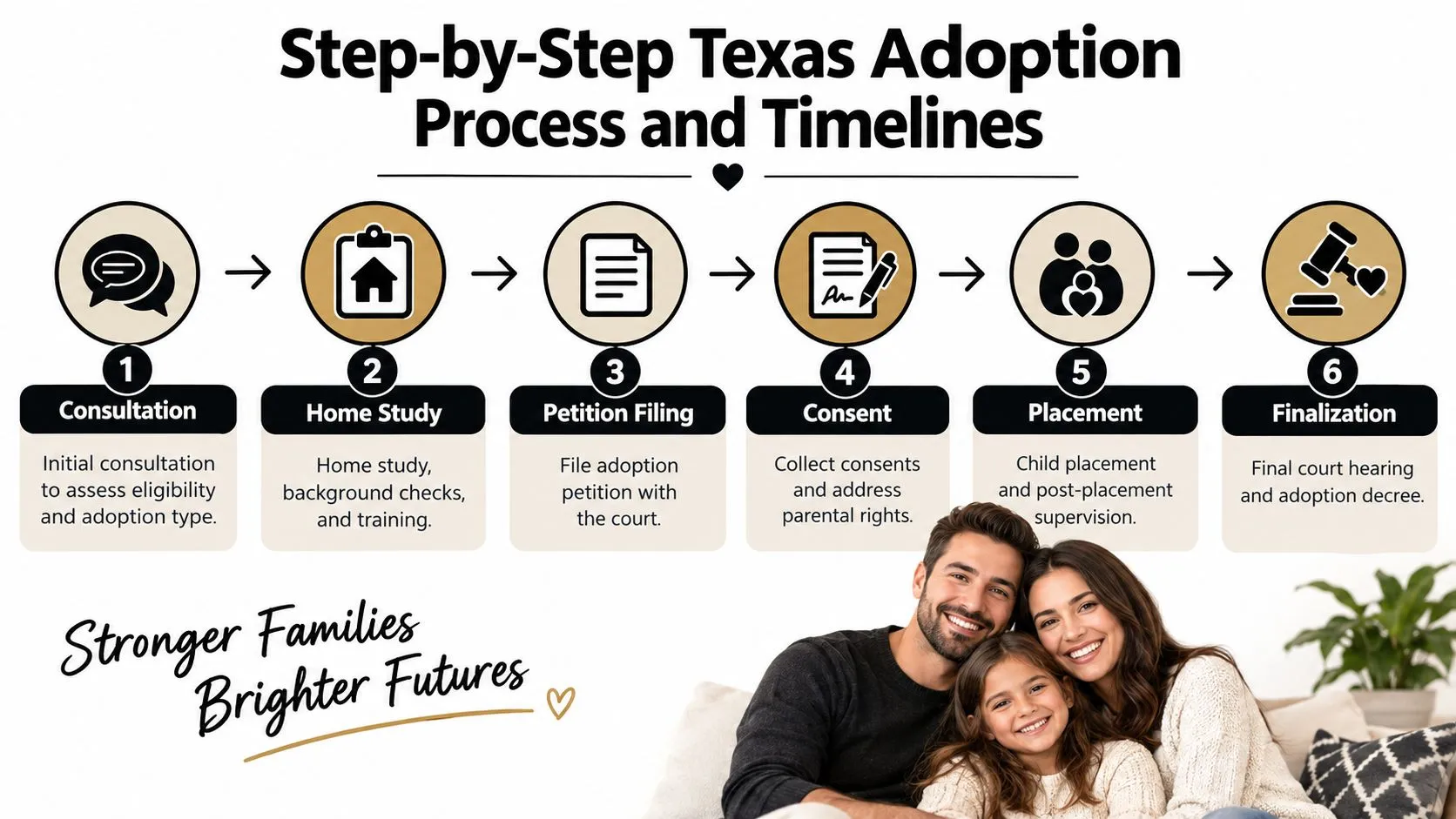
Families often want a calendar, but adoption timing depends on the legal path and whether the case is contested. A private placement, stepparent matter, foster-care case, and adult adoption won't move through identical stages. The sequence below gives you a practical framework without promising a fixed result.
Start with legal classification
During the initial consultation, the attorney identifies whether the matter involves stepparent adoption, kinship adoption, private domestic placement, foster-care permanency, international adoption, adult adoption, or a parental-rights dispute that must be addressed first. Bring every relevant order and record you have, even if you believe it's unrelated. A prior custody order or support case can affect the adoption strategy.
The attorney should also discuss whether adoption is the best option for the child. In some families, guardianship or another custody arrangement may provide protection while preserving legal relationships that adoption would change.
Complete the home study and readiness review
Texas requires a pre-adoption home study in nearly all cases. The evaluation includes the applicant, household members, and a review of home safety. DFPS foster and adoptive families also complete background checks and training requirements.
The home study is not a judgment about whether a family is perfect. It helps professionals assess whether the home is safe, stable, and prepared for the child's needs. Be honest about household members, caregiving challenges, medical needs, and support systems. Surprises discovered late can create more stress than candid information shared early.
A special timing rule matters if placement is delayed. If the child doesn't move in within six months after the preplacement evaluation, Texas requires an update within 30 days before placement, as provided in Texas Family Code Section 264.207.
File the petition and address consent
The adoption petition begins the court process. The filing must identify the parties, explain the legal basis for adoption, and request the necessary orders. The attorney reviews whether each required person has consented and whether any consent may be waived or challenged.
Texas Family Code Chapter 162 generally requires written consent from a managing conservator unless that person is the petitioner. A court may waive consent when it was refused or revoked without good cause. A child 12 or older generally must also consent in writing or in court, subject to a best-interests waiver under Texas law. These safeguards protect the child and prevent adoption from being treated as a simple paperwork transaction.
Track placement and residence
Texas generally requires the child to live with the petitioner for six months before the court may grant an adoption. The court can waive that residence requirement when waiver serves the child's best interests, as described in Texas Family Code Section 162.009.
Placement can involve adjustment, grief, loyalty conflicts, or uncertainty. A child may love a prospective adoptive parent and still miss another caregiver. Families should give children age-appropriate explanations, maintain safe routines, and ask counsel before making promises about contact with birth relatives.
Prepare for finalization
At finalization, the judge reviews the petition, consents, home-study materials, residence information, and evidence about the child's best interests. The child and adults may be asked questions. The hearing may be brief, but the legal consequences are permanent, so preparation matters.
Use this video as a general visual introduction to the process, then rely on advice specific to your own facts.
After the decree, the family may need to complete administrative steps involving the amended birth certificate and other records. The attorney can explain which documents to request and how the final order affects parental rights, inheritance, medical decision-making, and family identity.
Typical Costs and Fees for Texas Adoptions
Adoption expenses vary widely, and the exact amount depends on the case type, the professionals involved, travel, court activity, and whether parental rights are contested. Because the verified information available for this guide doesn't establish reliable fee ranges, families shouldn't rely on generic online dollar estimates.
A useful budget separates legal costs from process costs. Legal costs may include attorney time for consultation, drafting, negotiation, court filings, hearings, and finalization. Process costs may include a home study, background checks, agency services, counseling, document certification, travel, and post-placement supervision.
Questions to ask about fees
Ask for a written explanation of what the fee covers and what may be billed separately. You should understand whether the arrangement includes one hearing or multiple hearings, uncontested or contested work, communications with agencies, and follow-up for amended records.
Discuss these issues before signing:
- Scope of representation: Confirm which adoption type the attorney is handling and whether termination or custody litigation is included.
- Additional hearings: Ask how the firm handles unexpected court settings, contested consents, or requests for more evidence.
- Third-party expenses: Clarify whether home-study, agency, filing, travel, and record fees are paid directly by you.
- Payment timing: Learn when payments are due and whether the firm offers written arrangements that fit your circumstances.
- Fee waivers: Ask whether you may qualify for any court-based waiver or reduced-cost public service, without assuming approval.
A family adopting through DFPS may have a different financial experience from a family pursuing a private domestic adoption. A stepparent case may involve fewer outside services but become more complex if the other parent objects. A cross-border adoption can add translation, authentication, and immigration work.
For a practical discussion of expense categories, review the Texas adoption cost guide. Treat any estimate as a starting point, not a promise. The most useful consultation is one that identifies the likely legal path and explains which facts could change the budget.
Choosing and Hiring the Right Adoption Attorney
The right attorney should understand the adoption type you're pursuing and communicate clearly about the risks. A lawyer who handles private infant adoptions may not approach a contested stepparent case the same way a lawyer handles DFPS permanency or adult adoption.
Look for counsel who can explain the process in ordinary language. You should leave the consultation knowing what must happen first, which facts create risk, what documents are missing, and what decisions belong to you.
Questions for the first consultation
Bring a written list so stress doesn't make you forget important topics:
- Which legal path fits my family? Ask whether your facts suggest stepparent, kinship, foster-care, private, international, LGBTQIA+, or adult adoption.
- What parental-rights issue must be resolved? Find out whether consents are available, whether termination may be necessary, and whether a parent could contest the case.
- What must happen before filing? Ask about home studies, background checks, training, residence, and child consent.
- What happens if placement or finalization is delayed? Confirm how the firm monitors deadlines and updates.
- Who will communicate with me? Learn whether you'll work directly with the attorney, a paralegal, or a team.
- What is included in the fee agreement? Request a written scope and ask how additional work is handled.
A responsive legal team should be able to explain uncertainty without making guarantees. Be cautious if someone promises a result before reviewing the records, minimizes the child's adjustment, or can't explain how the case fits Texas law.
Corpus Christi families can also compare counsel through this guide to choosing an adoption attorney in Texas. The goal isn't to find the closest office. It's to find a lawyer whose experience matches the legal and emotional needs of your family.
CPS and Foster Care Adoption Considerations
Foster-care adoption begins with readiness and agency review, not with a private placement agreement. DFPS evaluates whether caregivers can provide a safe, stable home and meet the child's needs. The process may also involve reunification efforts, permanency hearings, visitation questions, and changing court orders.
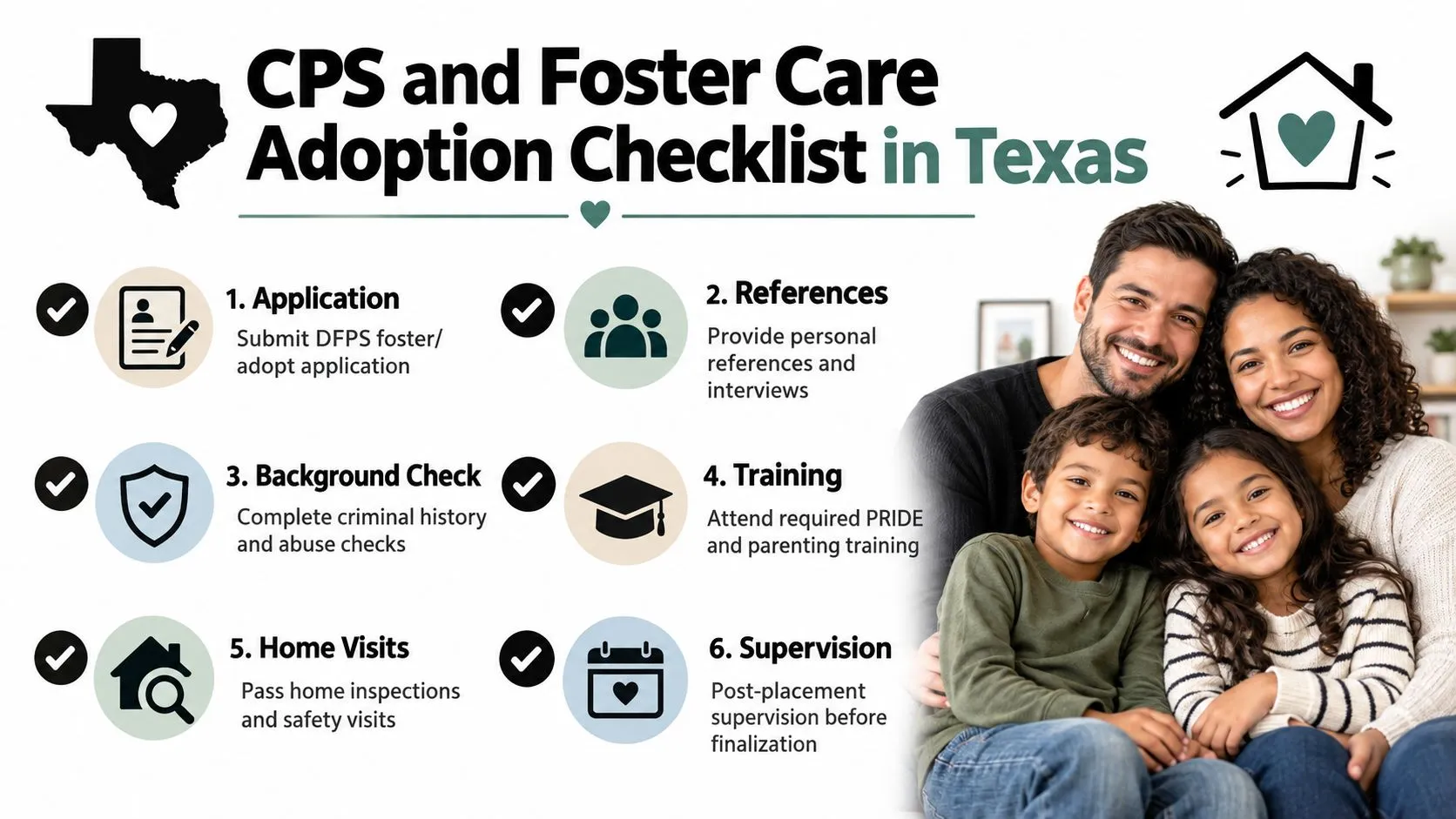
DFPS requirements include an application, references, proof of marital or divorce status when applicable, a home study with visits involving household members, criminal-history and abuse or neglect checks on adults, and training before placement, according to DFPS foster and adoptive family requirements.
Organize the approval process
Families can reduce avoidable delays by treating the requirements as connected tasks rather than waiting for one item to finish before starting the next.
- Submit the application: Provide complete and consistent information from the beginning.
- Gather references: Tell references to expect questions about caregiving, stability, and family support.
- Complete background checks: Arrange required checks for adult household members and disclose issues promptly.
- Attend training: Use training to prepare for trauma, attachment, grief, behavior, and age-specific needs.
- Prepare the home: Make safety changes before the home visit instead of treating the inspection as a final surprise.
- Coordinate legal questions: Ask an attorney about custody orders, visitation disputes, parental rights, and finalization requirements.
A foster parent may already feel like a child's parent while reunification remains the legal goal. That emotional tension deserves respect. Adoption counsel can explain what decisions belong to DFPS, what the court controls, and how the family can support the child without making promises that the legal process cannot yet support.
Statewide reporting has also shown that foster-care adoption activity can change over time. One recent report cited 2,789 children adopted and 3,301 waiting to be adopted, along with a 23.92% decrease in adoptions from care from fiscal year 2023 to 2024, as reported in Texas foster-care adoption coverage. These figures don't predict an individual Corpus Christi case, but they show why families need current, case-specific guidance rather than a generic checklist.
Sample Documents Courtroom Expectations and FAQs
An adoption file usually brings together several documents that answer different legal questions. The petition asks the court to grant the adoption. Consents address whether required adults and, when applicable, the child agree. The home-study report describes household readiness, while the final decree creates the legal parent-child relationship.
At the hearing, the judge may ask the petitioner about the child's living arrangement, care, relationship with the adults, and best interests. The child may participate depending on age and circumstances. Parents should answer truthfully, listen carefully, and avoid coaching a child to give a preferred response.
Common questions families ask
When does an adoption become final?
It becomes final when the court signs the adoption decree. The timing depends on the legal path, residence requirements, consents, home-study status, and whether any issue is contested.
Can open adoption agreements be enforced?
Openness should be discussed carefully with counsel before anyone makes promises. The legal effect of contact arrangements depends on the agreement, the circumstances, and Texas law. A written plan cannot replace the court's focus on the child's best interests.
What happens to the birth certificate?
Texas began issuing amended adoption birth certificates in 1935 and sealed original birth certificates in 1957. Today, adult adoptees age 18 and older may apply to access sealed records when the birth parents' names are known, subject to applicable procedures, as described in Texas adoption records history.
Should a relative consider guardianship instead?
Sometimes. Adoption usually changes the legal parent-child relationship more permanently, while guardianship may address safety and care without making the same legal changes. A lawyer can compare both options using the child's needs, parental involvement, and long-term stability.
What should I do before meeting an attorney?
Collect court orders, birth and marriage records, DFPS paperwork, contact information for legal parents, and any home-study materials. Write down your biggest concerns, including safety, consent, family contact, timing, and the child's wishes.
The Law Office of Bryan Fagan, PLLC helps Texas families evaluate adoption, guardianship, parental-rights, and foster-care issues with guidance focused on the child's best interests. Schedule a free consultation through Law Office of Bryan Fagan, PLLC to discuss your Corpus Christi adoption path, prepare the right documents, and understand the next step with greater confidence.

