 Skip to content
You may be preparing for an adoption hearing while wondering whether a possible biological father must be found, served, or asked to consent. That uncertainty can feel heavy, especially when everyone wants the child to have a safe, permanent home. Texas law gives courts a structured way to address an alleged father's notice rights, but the details matter.
The phrase family code 160.409 termination without notice unregistered father often appears in searches about this issue. In practice, the answer usually requires reading several provisions together, including Texas Family Code §§160.402, 160.404, 160.409, and 161.002. The child's age, the father's registry status, any established legal relationship, and any pending paternity case can all affect the result.
Understanding Notice Rights in Texas Adoptions
A family may reach the final stages of an adoption with a nursery ready, relatives gathered, and a child already strongly attached to the prospective parents. Then a question arises: has every person with possible parental rights received the legally required notice? Texas notice rules exist to protect a person's opportunity to assert rights, but they also help children reach permanent homes without indefinite uncertainty.

Why notice matters
Notice is not the same as proving that someone is a legal parent. An alleged father may be a man who could have fathered the child, but whose legal paternity hasn't been established. Texas gives such a man a way to protect his opportunity to receive notice by registering a Notice of Intent to Claim Paternity with the Texas Paternity Registry.
The registry records his assertion and his desire to receive notice. It doesn't, by itself, establish biological or legal paternity. This distinction is important for birth parents and adoptive parents because a registry search answers a procedural question, not every question about parentage. The Texas Department of State Health Services explains the registry process through its Texas Paternity Registry information.
Practical rule: Treat the registry as an early legal checkpoint, not as a substitute for a complete parentage review.
A father who acts promptly may preserve notice rights even if he hasn't yet completed a paternity case. A man who doesn't register may lose the automatic route to notice, although statutory exceptions can still apply. Readers who want broader context about parenting rights for fathers may also benefit from reviewing how parentage and notice issues can affect a father's legal position.
What “unregistered” means
An unregistered alleged father is generally a man who may have fathered the child but didn't file the required notice with the registry within the statutory period. That label doesn't prove he isn't the biological father. It describes whether he took the specific legal step Texas law uses to preserve automatic notice rights.
For families assessing a private infant adoption, kinship placement, stepparent adoption, or foster-care matter, the registry can help create a clear record. A practical overview of the Texas putative father registry can help readers understand what information the registry is designed to capture. Legal counsel should still review the complete facts, because a registry result doesn't eliminate the need to examine acknowledgments, court orders, and pending proceedings.
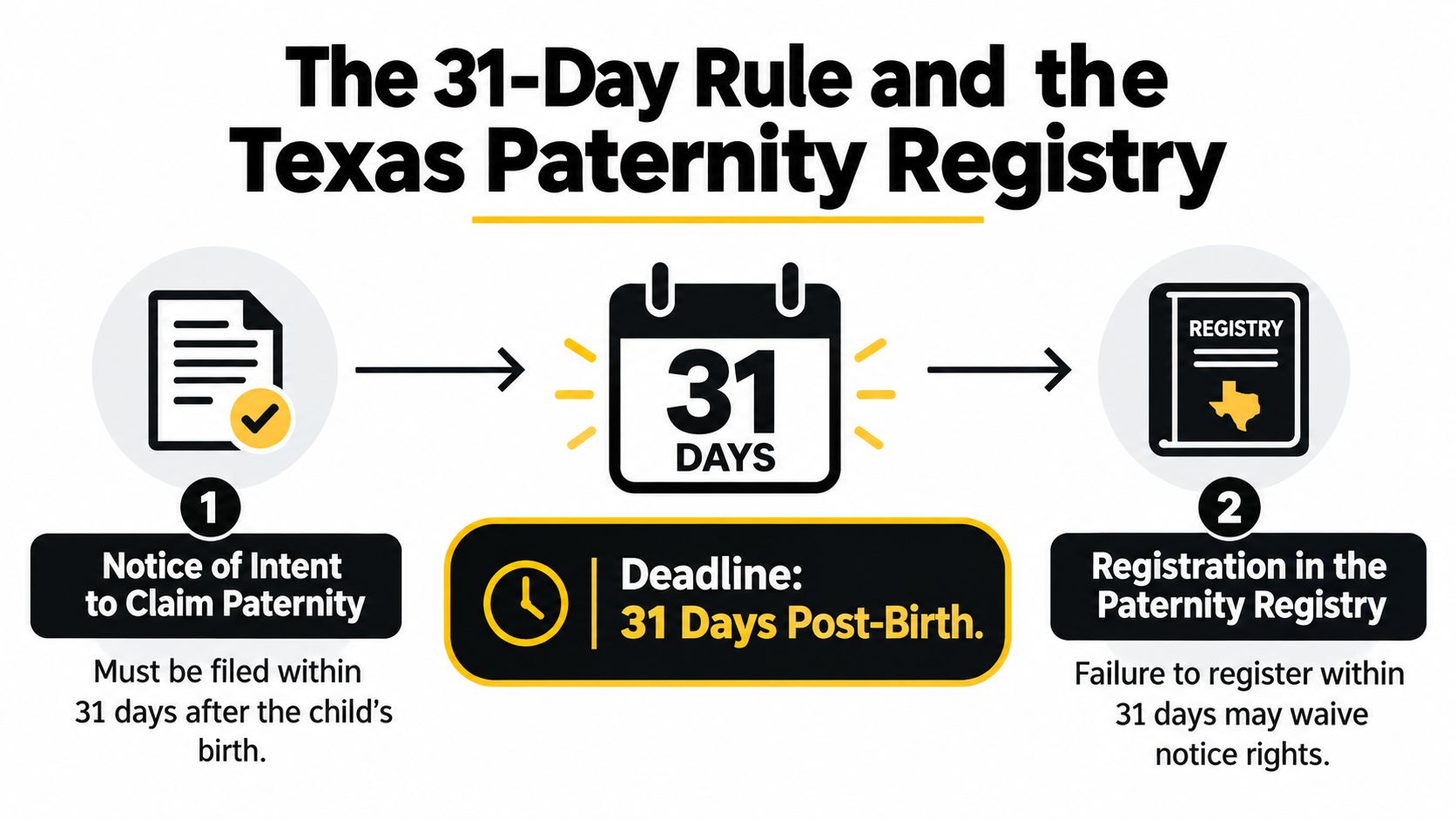
The 31-Day Rule and the Texas Paternity Registry
Texas gives an alleged father a short period to protect automatic notice rights. Under Texas Family Code §160.402, he must file a Notice of Intent to Claim Paternity before the child's birth or no later than the 31st day after birth. The deadline is tied to the child's birth, so families should identify the date carefully and preserve confirmation of any filing.
Registration protects notice, not parentage
Registration works much like putting your name on an official alert list. It tells the state that the man may be the biological father and wants notice of an adoption or termination proceeding. It doesn't decide whether he is the father, award custody, or create a parent-child relationship by itself.
That distinction can prevent two common misunderstandings. First, registration doesn't guarantee that the man will prevail in a paternity dispute. Second, failure to register doesn't establish that he isn't the biological father. Instead, it generally limits the procedural protection that automatic notice would otherwise provide.
The Texas statute and registry guidance should be read together with the surrounding parentage provisions. A detailed discussion of the Texas Family Code 160.404 thirty-one-day deadline can help families see why a prompt filing matters.
A simple way to track the deadline
Families can use this sequence to avoid treating the registry as an afterthought:
- Identify the birth date. Confirm the date from reliable records and calculate the filing window from that date.
- Ask whether a possible father has filed. A registry search can show whether an intent to claim paternity was recorded.
- Separate registration from legal parentage. Review acknowledgments, adjudications, and other documents independently.
- Check for active litigation. A paternity proceeding started before termination can affect notice rights even if registry registration is absent.
- Preserve the records. Keep the registry results and related documents in the adoption file for court review.
A missed deadline can have serious consequences. The Department of State Health Services warns that a man who doesn't register within the required period generally may not assert an interest in the child unless he files a paternity action before parental rights are terminated. The law therefore places responsibility on an alleged father to act affirmatively, while giving adoptive families a process for moving toward finality.
For families considering Stepparent Adoption in Texas, the registry question may arise alongside existing family relationships and prior court orders. Those facts require careful review rather than assumptions based only on the absence of a registry filing.
How Termination Without Notice Works
Texas Family Code §161.002 provides a pathway that may allow termination of an unregistered alleged father's rights without personal notice, but it isn't an automatic result. The court must apply the correct subsection, review the child's age when the petition is filed, and confirm whether an exception gives the alleged father a right to notice.
The most important age distinction concerns whether the child is under one year old or older than one year when the adoption or termination petition is filed. That filing date matters. A child's age on the hearing date doesn't replace the statutory focus on the age at filing.
Children under one year old
When the child is under one year old at filing, §161.002(b)(3) may permit termination without personal service if the alleged father hasn't registered and no legally established father-child relationship or timely paternity proceeding applies. The statute also addresses the absence of a requirement for personal service or citation by publication in qualifying cases rendered on or after January 1, 2008.
The court must receive a certificate showing the results of a Paternity Registry search before entering termination under the relevant provisions. That certificate is a documentary safeguard. It confirms that the registry was searched and records whether a man registered an intent to claim paternity.
Children older than one year
The analysis becomes more demanding when the child is older than one year. Under §161.002(b)(2), the petitioner generally must exercise due diligence to identify and locate the alleged father when relying on a no-notice termination pathway. The statute addresses situations in which the father's identity or location remains unknown, or the known father can't be located despite the required efforts.
The petitioner isn't required to search forever or identify a man who failed to register when the statute's conditions are met. Still, the file should show the work performed and the facts supporting the court's authority. Counsel should also examine known addresses, prior records, communications, and any information supplied by the birth mother or agency.
| Child's Age at Filing | Petitioner's Burden | Court Requirement |
|---|---|---|
| Under one year old | Establish the applicable statutory conditions, including failure to register and the absence of a qualifying exception | Receive the required Paternity Registry search certificate and review the termination findings |
| Older than one year | Exercise due diligence when the alleged father's identity or location is unknown or the known father can't be found | Review the registry result, due-diligence evidence, and any statutory exception before proceeding |
Why the record matters
An adoption file should preserve the petition-filing date, the child's exact age at filing, the registry-search certificate, and information about any possible legal parentage. A court must address termination and adoption requirements, and the parties should not rely on the phrase “without notice” as though it removes every procedural safeguard.
Families can review the practical meaning of terminating parental rights in Texas while working with counsel. The goal is not only to move quickly. It is to establish a legally secure result that protects the child's permanent relationship with the adoptive family.
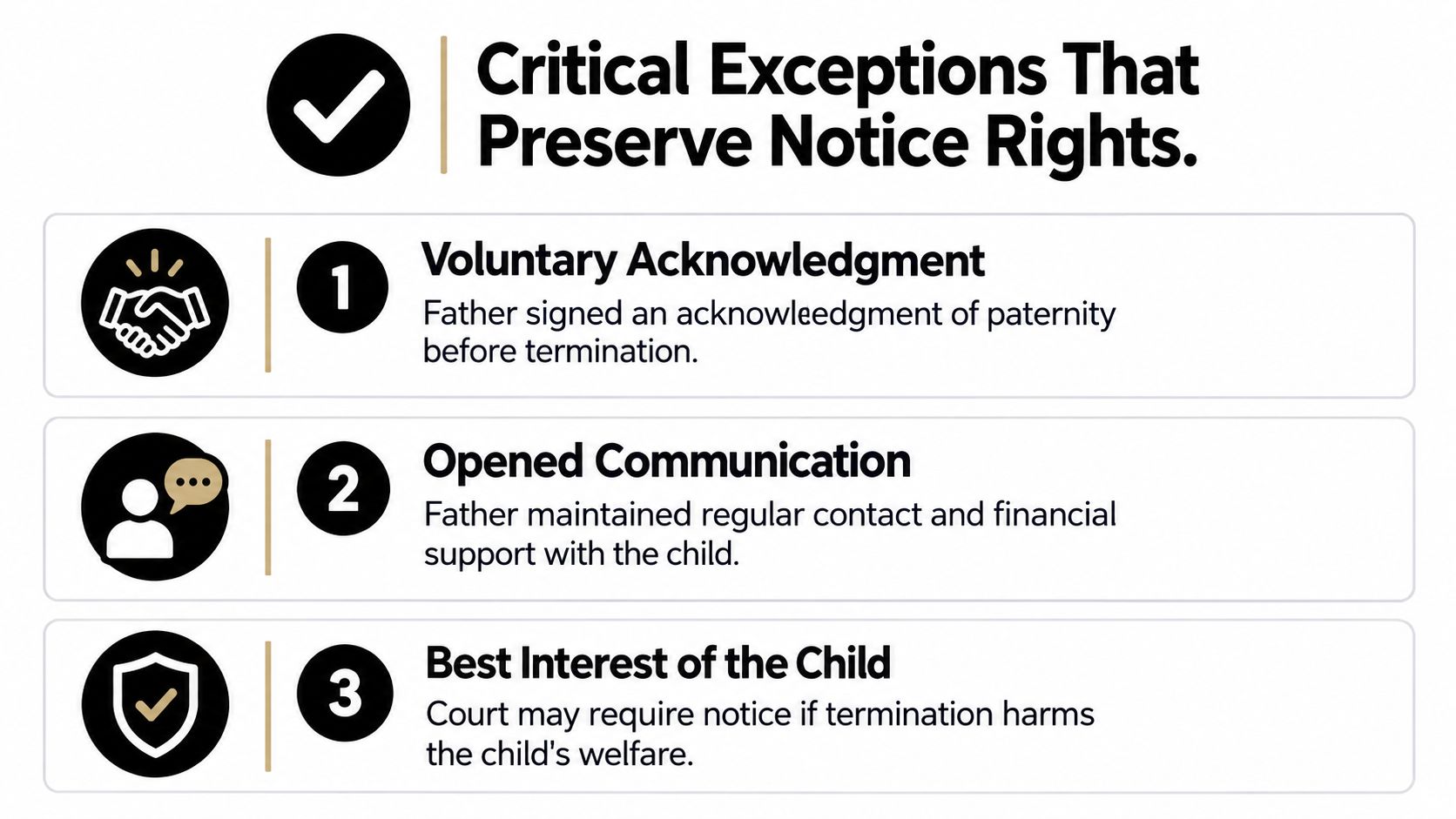
Critical Exceptions That Preserve Notice Rights
The no-notice pathway has important limits. An unregistered man may still have notice rights when the law already recognizes a father-child relationship or when he has taken timely steps to ask a court to determine paternity.
Established legal parentage
If a father-child relationship has already been legally established, the registry deadline doesn't erase that relationship. An acknowledgment, adjudication, or another legally effective parentage record may change the analysis. The adoption team should gather and review those documents before relying on a registry search.
The key question isn't only whether a man registered. It is also whether Texas law already recognizes him as a legal father. A registry search should therefore be one part of a broader parentage investigation.
A paternity case filed before termination
A man may preserve an avenue to notice by beginning a proceeding to adjudicate paternity before parental rights are terminated. Timing matters here as well. A pending or timely filed paternity action can prevent the parties from treating the man as though he has no legally relevant claim merely because the registry contains no filing.
Contact and welfare concerns require careful legal review
The required statutory exceptions focus on legally established parentage and a timely paternity proceeding. Facts such as communication, financial support, or a voluntary acknowledgment may be important evidence, but they don't automatically create the same legal result in every case. A court must examine the governing statute and the documents before it.
For adoptive parents, raising a possible exception early is protective, not disruptive. It gives counsel time to determine whether service, consent, adjudication, or another court step is required. For a birth father, sharing documents and seeking legal advice promptly can help preserve options before a termination order is entered.
A quiet registry result isn't the same as a complete answer about legal parentage.
These safeguards reflect a balance. Texas wants children to reach permanent homes, but it also recognizes that an established legal father or a man actively pursuing paternity may be entitled to participate. The child's best interests remain central, and a final order should rest on a complete, accurate record.
Practical Steps for Adoptive and Birth Families
The safest approach is to treat paternity questions as an early adoption task, not a problem to solve at the courthouse door. Each person involved has a different responsibility, but all parties benefit from accurate dates, complete records, and candid communication.
For hopeful adoptive parents
Start by giving your attorney or agency every known detail about possible fathers, prior relationships, acknowledgments, court filings, and addresses. Ask for a registry search and preserve the certificate or other official result in the case file.
Then confirm the child's age on the petition-filing date. If the child is older than one year, ask counsel how the due-diligence requirement applies and what evidence should be retained. Avoid contacting a possible father in a way that could create confusion or conflict without legal guidance.
Your broader adoption roadmap should also include the home study, required consents or notices, the petition, hearings, and finalization. Texas Family Code Chapter 162 provides that an adoption order creates the parent-child relationship for all purposes. When termination and adoption are joined, the court must address the requirements for both and make separate best-interest findings for each determination. The Texas Family Code Chapter 162 PDF contains the governing statutory text.
For birth mothers and relatives
Be honest with counsel about every person who may be the biological father, even if the relationship was brief or communication has ended. Share messages, letters, acknowledgments, support records, and information about prior court proceedings. This isn't about assigning blame. It helps the court protect the child from a later challenge based on an overlooked legal relationship.
Relatives and kinship caregivers should also distinguish adoption from guardianship. Each option creates different legal arrangements, so a family should discuss the child's long-term needs, family connections, and permanency goals before choosing a path.
For a possible biological father
If you believe you may have fathered a child and want notice, act promptly. File the Notice of Intent to Claim Paternity before birth or no later than the 31st day after birth, and speak with a Texas family law attorney about whether a paternity proceeding is needed.
Keep copies of filings and confirmations. If you believe legal paternity has already been established, collect the acknowledgment, order, or other supporting record and seek advice immediately. A digital secure family law client portal can help a family organize documents and communications, but it doesn't replace legal advice or a court filing.
Securing Your Family's Future with Legal Guidance
A paternity registry search is only one piece of an adoption case. The court must connect that result with the child's age at filing, the statutory notice rules, any established father-child relationship, and any paternity proceeding begun before termination. Careful preparation protects both the child's need for permanence and the legal boundaries surrounding parental rights.
For adoptive parents, that preparation can bring reassurance. For birth parents and possible fathers, it provides a clear opportunity to understand and assert rights before a final order. The process may involve difficult conversations, but respectful and complete legal work helps families avoid preventable uncertainty.
Texas Family Code Chapter 162 also places the final adoption order at the center of the new legal family relationship. Once the court completes the required findings and enters the order, the adoptive parent-child relationship is established for all purposes. That permanence deserves a record built with patience, accuracy, and compassion.
The Law Office of Bryan Fagan, PLLC helps Texas families with registry reviews, notice questions, termination proceedings, home studies, and adoption finalization. Visit Law Office of Bryan Fagan, PLLC to schedule a free consultation and discuss the facts that shape your child's path to a secure, permanent family.

