 Skip to content
A lot of people start in the same place. You love this child. You've been showing up for school pickups, doctor visits, bedtime stories, and hard days. Or maybe you're a grandparent, aunt, uncle, or foster parent wondering whether the law will let you make that role permanent. Then you search for Family Code 162.001 who is eligible to adopt in Texas, and the legal language feels heavier than the hope you walked in with.
That confusion is normal. Texas adoption law is detailed because adoption changes a child's legal family forever. Chapters 162 through 166 of the Texas Family Code govern much of that process, from who may file, to required evaluations, to court approval and finalization. The good news is that the law does give clear pathways. What matters is understanding which path fits your family, what legal standing you have, and what steps come next.
Understanding Your Adoption Journey Begins Here
Maria had raised her grandson for months before she ever called a lawyer. His parents were struggling, and she was the one making sure he got to school and had dinner every night. She didn't begin with a legal question. She began with a family question: “Can I protect him permanently?”
That's where many Texas families begin. A stepparent wants legal rights equal to the parent already in the home. A foster parent wants to know if the placement can become permanent. A single adult is ready to adopt but worries whether being unmarried matters. A married couple wonders whether both spouses must file together.

Texas law answers those questions by starting with a gateway rule. Section 162.001 of the Texas Family Code is often the first place lawyers look when deciding whether someone may file an adoption case. It doesn't answer every issue by itself, but it tells you whether the courthouse door is open.
Why families get stuck here
The hardest part is that eligibility isn't only about being loving or prepared. Texas also looks at your legal relationship to the child, whether parental rights have been ended or can be ended, and whether your case fits one of the recognized adoption pathways.
That can feel cold on paper. In real life, it's about protecting children and making sure the right adult is asking the court for permanent parental rights.
If you're just starting out, a practical first step is learning the basic sequence of the process, such as petition, evaluation, consent or termination issues, and final hearing. A plain-language overview at how to start the adoption process in Texas can help you place your own situation on the map.
Adoption law can feel personal and procedural at the same time. Both parts matter.
What to keep in mind early
- Your role matters: A relative, stepparent, foster parent, or conservator may enter the process differently.
- The child's status matters too: Some cases can move forward only after parental rights are terminated, unless a narrow exception applies.
- Your family structure matters: Being single, married, or part of a blended family can affect how the petition is filed.
Many worried families already have more of the foundation than they realize. The key is identifying the correct legal path.
What Family Code 162.001 Says About Adoption Eligibility
Texas Family Code § 162.001 is the statutory gateway for who may petition to adopt. The Texas State Law Library explains that this section allows an adult with legal standing to petition to adopt, and that standing can include relatives, stepparents, foster parents, managing conservators, and prospective adoptive parents named by a biological parent, as summarized in the Texas State Law Library's adoption overview.
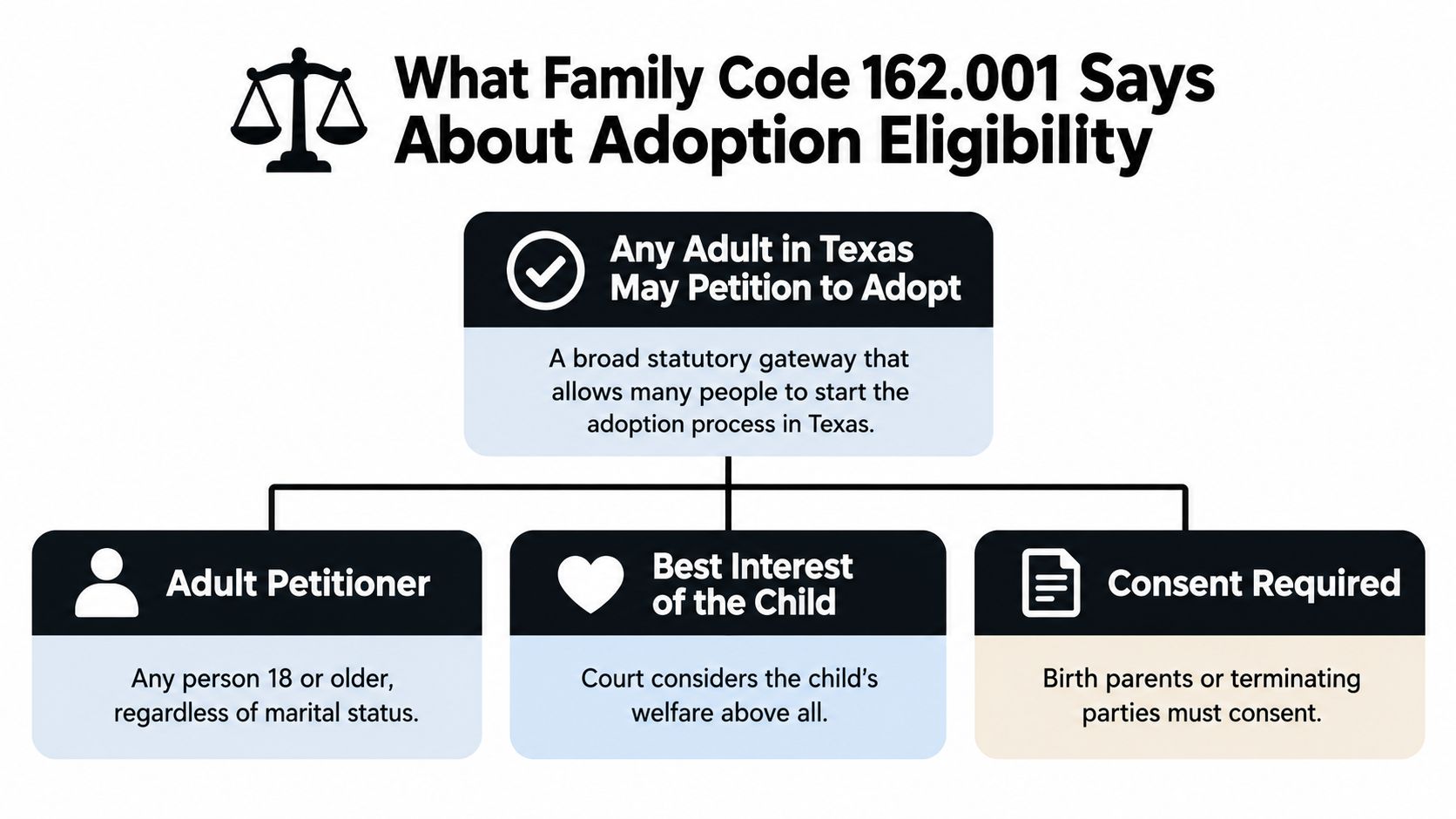
In plain English, that means Texas doesn't limit adoption petitions to one narrow type of family. The law recognizes that children may need permanence through many different adult relationships.
Who usually fits under the statute
Some examples make this easier:
- A stepparent: You're married to the child's parent and want legal parent status too.
- A grandparent or aunt: You've become the child's day-to-day caregiver and want permanency.
- A foster parent: You've cared for the child through the child welfare system and hope to finalize adoption.
- A managing conservator: You already have a court-recognized caretaking role.
- An adult chosen in a consent-based placement: A biological parent may designate a prospective adoptive parent in some situations.
This is one reason Texas adoption and the Family Code essentials for parents matters so much. The statute opens the door, but your case still has to fit Texas procedure from Chapters 162 through 166.
Later in the section, many readers also look more closely at Stepparent Adoption in Texas, which is the most common Texas adoption and how it works.
After you understand the basic categories, this short video helps put the legal framework into everyday terms.
The part families often miss
The Child Welfare Information Gateway's Texas profile adds an important baseline. Generally, any adult may adopt a child, but the child's parents' rights must be terminated, or the case must fit a narrow exception such as stepparent adoption or a consent-based adoption scenario, as described in the Texas eligibility profile from Child Welfare Information Gateway.
That same profile explains that one common pathway requires the child to be at least 2 years old, one parent's rights terminated, and the petitioner to have been the managing conservator or to have had actual care, possession, and control for 6 months, unless the petitioner is a former stepparent, in which case a 1-year caregiving period can apply in that scenario.
Practical rule: Wanting to adopt isn't enough by itself. Texas asks whether you fit a recognized legal relationship and timing requirement.
This is why two families who love a child equally may face very different legal answers. The law is structured. It looks at status, timing, consent, and the child's legal circumstances before a case can move toward finalization.
General Requirements All Adoptive Parents Must Meet
Once a person has a valid path to file, Texas turns to another question. Is this home ready for adoption approval?
The home study and evaluation stage is where many families feel anxious, but it helps to know what the state is looking for. Texas guidance says prospective adoptive applicants must generally be age 21 or older, financially able to provide for the family and the adoptee, healthy enough to parent, willing to respect the adoptee's religious affiliation, and able to accept and parent an adopted child, according to the Texas home study requirements summary.
What the evaluation usually includes
A home study is more than a walk-through of your living room. It is an evaluation of whether the placement serves the child's best interests.
Texas guidance says the evaluation must include:
- Individual interviews with each adoptive parent
- Interviews with each child age 4 or older in the home
- Interviews with certain other household members
- At least one home visit where all household members are present
Those requirements matter because they show the court wants a full picture of daily life in the home, not just paperwork.
Why these requirements exist
Families sometimes hear “financially able” and worry they need wealth. That's not the point. The court and evaluator want to see stability, planning, and the ability to meet a child's needs. The same is true of health. Texas isn't asking for perfection. It's asking whether you can safely and consistently parent.
A home study often touches several parts of life at once:
| Focus area | What evaluators are usually trying to understand |
|---|---|
| Daily care | Who gets the child to school, appointments, and activities |
| Household relationships | Whether the home feels safe, steady, and appropriate |
| Parenting readiness | How you understand trauma, attachment, discipline, and support |
| Practical stability | Whether the family can meet ordinary needs over time |
For a closer look at the process itself, many families benefit from reading Texas adoption home study requirements.
The home study isn't designed to trap families. It's designed to help the court decide whether this child will enter a safe, lasting home.
A few common points of confusion
- Married petitioners: If the petitioner is married, both spouses must join the adoption petition, according to the Child Welfare Information Gateway summary discussed earlier in the article.
- Child consent: For child adoptions, Texas requires consent from a child age 12 or older, unless the court waives that requirement because waiver is in the child's best interest, as noted in the same earlier source.
- Adult adoption: Texas also allows an adult residing in Texas to adopt another adult, but the adult adoptee must provide written consent, as noted in that same profile.
If you're worried about whether your home “looks perfect enough,” take a breath. Evaluators usually care more about honesty, safety, and preparedness than appearances.
Different Adoption Types and Their Specific Eligibility Rules
Not every adoption case follows the same road. The rules shift depending on your connection to the child and how the child enters the case.

Stepparent and kinship cases
A stepparent adoption often feels emotionally simple because the child is already part of the household. Legally, though, one major issue usually stands in the middle of the case. The other parent's rights must usually be terminated unless the case fits a recognized exception. That's why these cases often combine family history, consent questions, and best-interest analysis.
A kinship or relative adoption usually begins from a place of family continuity. A grandmother, sibling, aunt, or uncle may already be caring for the child. Courts often view family continuity as important, but relatives still need a valid legal pathway and still must satisfy the court that adoption serves the child's best interests.
Foster care and agency pathways
Foster care adoption adds child welfare procedures on top of adoption law. The Texas Department of Family and Protective Services says prospective foster or adoptive parents may be single or married, must be at least 21, must provide background and lifestyle information, must submit to criminal history and abuse or neglect checks for all adults in the household, and must attend free training, according to the DFPS foster and adopt requirements page.
That same DFPS guidance also says the agency does not charge a home study fee to prospective families. For many families comparing adoption paths, that's a meaningful detail because the home study is one of the first major approval steps.
Here's a simple side-by-side comparison:
| Adoption type | What often drives eligibility questions |
|---|---|
| Stepparent | Marriage to the child's parent and the status of the other parent's rights |
| Relative or kinship | Existing caregiving role, legal standing, and permanency need |
| Foster care adoption | DFPS approval steps, background checks, training, and placement history |
| Private or consent-based | Whether the placement fits Texas consent and standing rules |
LGBTQ plus individuals and couples
Texas eligibility rules focus on adult status, standing, consent, and best interests. In practical terms, LGBTQ+ individuals and couples are assessed under the same adoption framework as other prospective adoptive parents. The legal questions remain the same: who is petitioning, what is their legal relationship to the child, have necessary rights been terminated or consented to, and does the adoption serve the child's best interests?
Families come in many forms. Texas courts still return to the same central concern, whether this adoption protects and serves the child.
This is why one family may move through a stepparent route, another through kinship adoption, and another through CPS or foster care finalization. The destination is similar. The legal doorway differs.
Real Stories From Families Who Successfully Adopted in Texas
The law makes more sense when you see how it works in ordinary homes.
A grandmother caring for two grandchildren may spend months believing she has to “wait until things get worse” before asking about adoption. In reality, her caregiving history, legal standing, and the status of the parents' rights may already place her on a path worth evaluating. Her story is often less about sudden action and more about formalizing the stability she has already provided.

A stepparent story looks different. The child may already call the stepparent “Mom” or “Dad.” The family may function as a unit in every practical sense. But when school forms, medical consent, inheritance, or emergency decisions arise, everyone sees the gap between emotional reality and legal status. Adoption closes that gap if the case can satisfy Texas requirements.
What these stories have in common
Even when the facts differ, successful families often move through the same emotional stages:
- Uncertainty first: They don't know whether they qualify.
- Paperwork second: They gather records, court documents, and background information.
- Evaluation next: They complete interviews, checks, and home-study tasks.
- Court approval last: A judge decides whether the adoption should be finalized.
A foster parent's story may carry another layer. There may be grief, reunification efforts, and long periods of uncertainty before adoption becomes the permanency plan. When finalization becomes possible, the legal process often feels less like “winning” and more like finally giving the child a stable legal home.
The lesson inside the examples
These examples aren't promises about outcome. Every case depends on its own facts.
But they do show something important. Eligibility questions are rarely abstract. They grow out of caregiving, attachment, responsibility, and whether the law recognizes the family relationship that already exists.
Some families begin with biology, some with marriage, some with caregiving, and some through foster care. Adoption law steps in when permanence needs legal protection.
That's why families often feel relief once they stop asking only, “Can we adopt?” and start asking the better question: “Which Texas adoption path fits our family's facts?”
Your Next Steps Toward Building Your Family
Suppose you are a stepparent ready to make your relationship with a child permanent, or a relative caring for a child whose parents cannot provide a stable home. Your next step depends on the legal facts surrounding your family, not only on your desire to adopt. Texas adoption law works like a map: your relationship to the child, parental rights, and required evaluations determine which route you should follow.
Texas adoption commonly involves legal and practical steps under Chapters 162 through 166. These may include identifying the proper petitioners, addressing consent or termination, completing required evaluations, filing with the court, and attending a final hearing. The order can differ by adoption type, so handle one decision at a time.
A practical roadmap
Identify your legal role
Are you a stepparent, relative, foster parent, single adult, married couple, or current conservator? That role helps determine how § 162.001 applies to your situation and what filings may be available.
Clarify parental rights
Adoption usually cannot reach finalization until the other parent's rights have been terminated, consent has been provided, or a recognized exception applies. Missing, unknown, or contested parents can change the process significantly.
Prepare for screening and evaluation
Collect household information, background details, court records, and other documents requested for a home study or agency review. Early preparation can reduce delays when an evaluator or court asks for supporting information.
Include the child's perspective
In some cases, the child's consent has legal significance. In every case, the child's adjustment, understanding, and emotional needs matter to the family's preparation and to the court's focus on the best interests of the child.
Get legal guidance when the facts are complicated
A missing parent, contested rights, CPS involvement, earlier court orders, or conflict in a blended family can affect eligibility and timing. Advice at the beginning may prevent avoidable filings, delays, and difficult surprises.
When extra support makes sense
Some families can manage straightforward paperwork. Others are dealing with conservatorship, termination, adoption, and post-adoption planning at the same time. Depending on the circumstances, support may come from a private attorney, a licensed child-placing agency, DFPS in a foster-care matter, or a family law firm that handles adoption filings and court preparation.
One option Texas families may consider is Law Office of Bryan Fagan, PLLC, which handles adoption and guardianship matters at different stages of the Texas process.
Before filing, ask:
- Has the correct person been named as petitioner?
- If I am married, should my spouse join the petition?
- Is a home study required for this adoption type?
- Which court orders and family law records should I gather?
- Does the child need to consent, or could a waiver issue arise?
If you are sorting out Family Code 162.001 and who is eligible to adopt in Texas, the attorneys at the Law Office of Bryan Fagan, PLLC help families evaluate standing, home-study requirements, consent issues, and court procedures. A consultation can help you match your family's facts to the appropriate path before you file. Uncertainty does not mean you are unready. It often means you are taking the child's future seriously.

