
Somewhere in Texas, a couple is standing in a nursery that isn't finished yet. One hand rests on a crib box still waiting to be assembled. The other holds a phone full of bookmarked agency pages, attorney websites, and late-night notes about what private adoption might look like for their family. They feel hopeful. They also feel nervous, because the process seems full of forms, timelines, and legal words that don't always sound human.
That mix of joy and uncertainty is normal.
Private adoption in Texas can be a beautiful path to building a family, but it helps to see it for what it is. It's not a shortcut, and it isn't a mystery if someone takes the time to explain it clearly. Private adoption typically means an adoption arranged outside the foster care system, often involving a newborn or infant and completed through a licensed agency or an attorney handling an independent adoption.
Starting Your Texas Adoption Journey with Hope
Maria and James had been talking about adoption for years before they ever filled out a form. What finally moved them forward wasn't a perfect plan. It was the moment they realized they didn't need to know everything at once. They just needed to understand the next step.
That's often where families begin with private adoption in Texas. They want to grow their family through a more direct adoption path, often with some level of communication, matching, or planning with an expectant mother. This is different from foster care adoption, where the child is in state custody and the legal path centers on child welfare proceedings before adoption becomes possible.

Families often ask whether this path is common. It is. In 2023, Texas recorded 2,864 private adoptions, out of 7,168 total adoptions, and that private adoption figure represented a 7% increase from the prior year, according to reporting on private adoption trends in Texas.
What private adoption usually looks like
In plain English, the journey often includes:
- Choosing a path: You may work with a licensed agency or pursue an independent adoption through an attorney.
- Completing a home study: A social worker reviews your home, background, and readiness to parent.
- Creating a family profile: This helps an expectant mother learn who you are.
- Matching and placement: If a match happens, legal planning begins around birth, consent, and placement.
- Court finalization: A judge makes the adoption legally permanent after the required process is complete.
A steady process can feel easier than a fast one. Each legal step exists to protect the child, the birth parents' rights, and your future family.
A lot of confusion starts because people read five different websites and get five different versions of the same answer. If you're still at the beginning, it may help to start with questions to ask before starting an adoption. The right questions can save you stress long before any paperwork is filed.
Texas Family Code Chapters 162 through 166 shape much of the adoption process families encounter, including who may adopt, what the court needs to see, and how an adoption becomes legally final. That legal framework may sound formal, but the purpose is personal. The law is trying to make sure a child enters a safe, stable, lasting home.
Eligibility and Choosing Your Adoption Path
People often worry they'll be disqualified for ordinary reasons. They won't. Texas is looking for safety, stability, and readiness, not perfection.
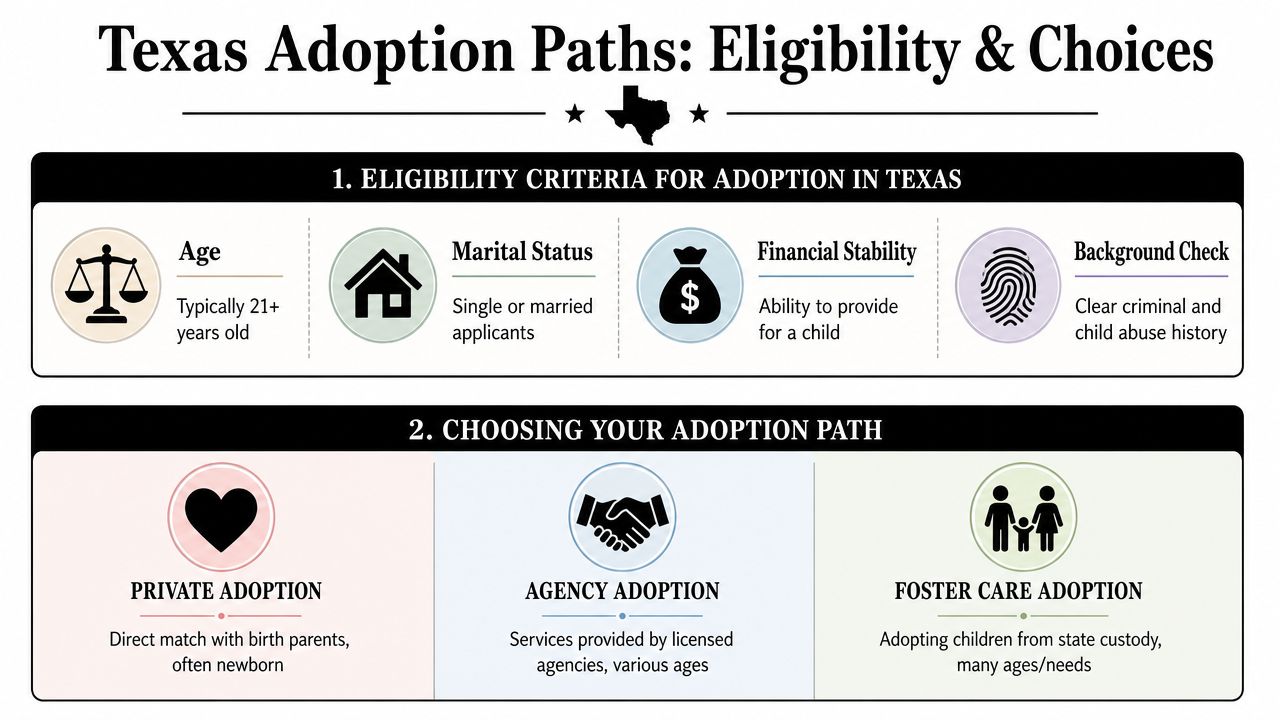
Adults pursuing private adoption generally need to meet basic requirements. In plain terms, Texas expects adoptive parents to be at least 21 years old, financially stable, able to pass criminal history and abuse or neglect background checks, and willing to complete a home study. These rules aren't there to make family building harder. They're there because the court's central concern is the child's best interests.
Basic eligibility in plain language
A prospective adoptive parent usually needs to show:
- Age and maturity: Texas generally requires adoptive parents to be 21 or older.
- Financial stability: You don't need to be wealthy, but you do need to show you can provide for a child.
- Safe background: Every adult in the home will face screening for criminal and child abuse history.
- Home study approval: A licensed professional must evaluate the home and family.
Agency or independent adoption
This is one of the first major decisions you'll make. Both paths can lead to a lawful, loving adoption. They just work differently.
| Path | How it works | What families often like | What needs careful attention |
|---|---|---|---|
| Agency adoption | A licensed agency helps with screening, matching, education, and support | More structure and often more support for everyone involved | Less direct control over some parts of the process |
| Independent adoption | An attorney helps manage a private placement | More flexibility and direct involvement | Families need to be careful about legal compliance and support planning |
Texas families also compare cost when choosing a path. Private adoptions in Texas typically cost between $15,000 and $50,000, with agency-led adoptions often in the upper range because they may include broader services such as counseling and legal coordination, while some independent adoptions may cost less but carry different risks, as explained in this overview of how private adoption works in Texas.
Some families want the structure of an agency. Others value the flexibility of an attorney-led plan. Neither choice is automatically right for everyone.
If you're weighing those options, this comparison of private adoption vs. agency adoption can help you sort out what level of involvement and support fits your situation.
A family that's looking at licensed placement services may also want to review Agency and Private Adoption in Texas, which addresses adopting a newborn or child through a licensed agency.
A real-life way to think about the choice
Consider two different families. One wants regular guidance, birth parent counseling built into the process, and a defined matching system. That family may feel more comfortable with an agency. Another already has a potential match through a personal connection and wants an attorney to handle the legal side carefully. That family may lean toward an independent adoption.
The right path is the one that protects the child, respects the birth parents, and gives your family enough support to move through the process responsibly.
The Home Study and Connecting with Birth Parents
For many hopeful parents, the home study is the part they fear most. They imagine a white-glove inspection or a social worker searching for reasons to say no. In practice, a home study is usually much more human than that.
It is a preparation process. A social worker wants to understand your home, your background, your relationships, your health history, and your plan for parenting. They are not looking for designer furniture or a perfect life. They are looking for safety, honesty, and readiness.
What the home study usually involves
Most home studies include several moving parts:
Paperwork and records
You'll gather identification documents, financial information, medical records, references, and family background details.Interviews
The social worker will usually speak with household members about your history, values, support system, and reasons for adopting.Home safety review
They will look for a safe environment for a child. That can mean working smoke detectors, secure storage for medications, and age-appropriate sleeping arrangements.Education and discussion
Many social workers use the process to talk through realistic parenting expectations, openness in adoption, and how to support a child's story over time.
One practical challenge is timing. Families often think the home study will be finished quickly, then feel blindsided by delay. In Texas, DFPS aims to complete home studies within 90 days, but regional caseworker capacity can push delays to 4 to 12 months, which can postpone when a family is ready to enter the matching pool.
What social workers are really looking for
They aren't asking whether your life has been easy. They want to know whether you can provide stability to a child whose life began with loss, change, or uncertainty.
Practical rule: Be candid about your past and clear about your support system. A home study is easier to navigate when families answer openly instead of trying to sound flawless.
If you're preparing for this stage, these Texas adoption home study requirements can help you understand what documents and issues usually come up.
Creating a profile that feels real
After approval, many families move into the matching stage. This can involve a profile book, online profile, or short video that introduces your family to an expectant mother considering adoption.
The strongest profiles usually do three things well:
- They sound like real people. Share your daily life, your values, your home, and the kind of childhood you hope to offer.
- They show respect for the birth mother's role. Adoption isn't only your story. It's also hers, and eventually your child's.
- They avoid overpromising. If you hope for openness, say what you can realistically maintain.
A helpful profile doesn't need to be polished like an advertisement. A couple cooking together, reading on the couch, talking about family traditions, or explaining why they feel called to adopt often says more than a formal statement ever could.
One family might write about Sunday dinners with grandparents nearby. Another might share that they are a single parent with a close circle of siblings and friends ready to help. Both can be compelling, because authenticity matters more than trying to fit a certain image.
The Legal Heart of Adoption Consent and Filings
The emotional center of private adoption is often the legal center too. Here, families learn that consent is not just a moment. It's a process with strict rules, protected rights, and serious consequences if someone gets careless.
Texas adoption law requires careful attention to parental rights before an adoption can move toward final approval. In many private infant adoptions, that means voluntary relinquishment of parental rights by the birth mother, and attention to the legal status and rights of the birth father as well. If a father's rights must be addressed, the court and the attorneys involved need to do that correctly. This isn't paperwork for paperwork's sake. It protects the child and reduces the chance of future legal challenges.
The consent timeline that families need to understand
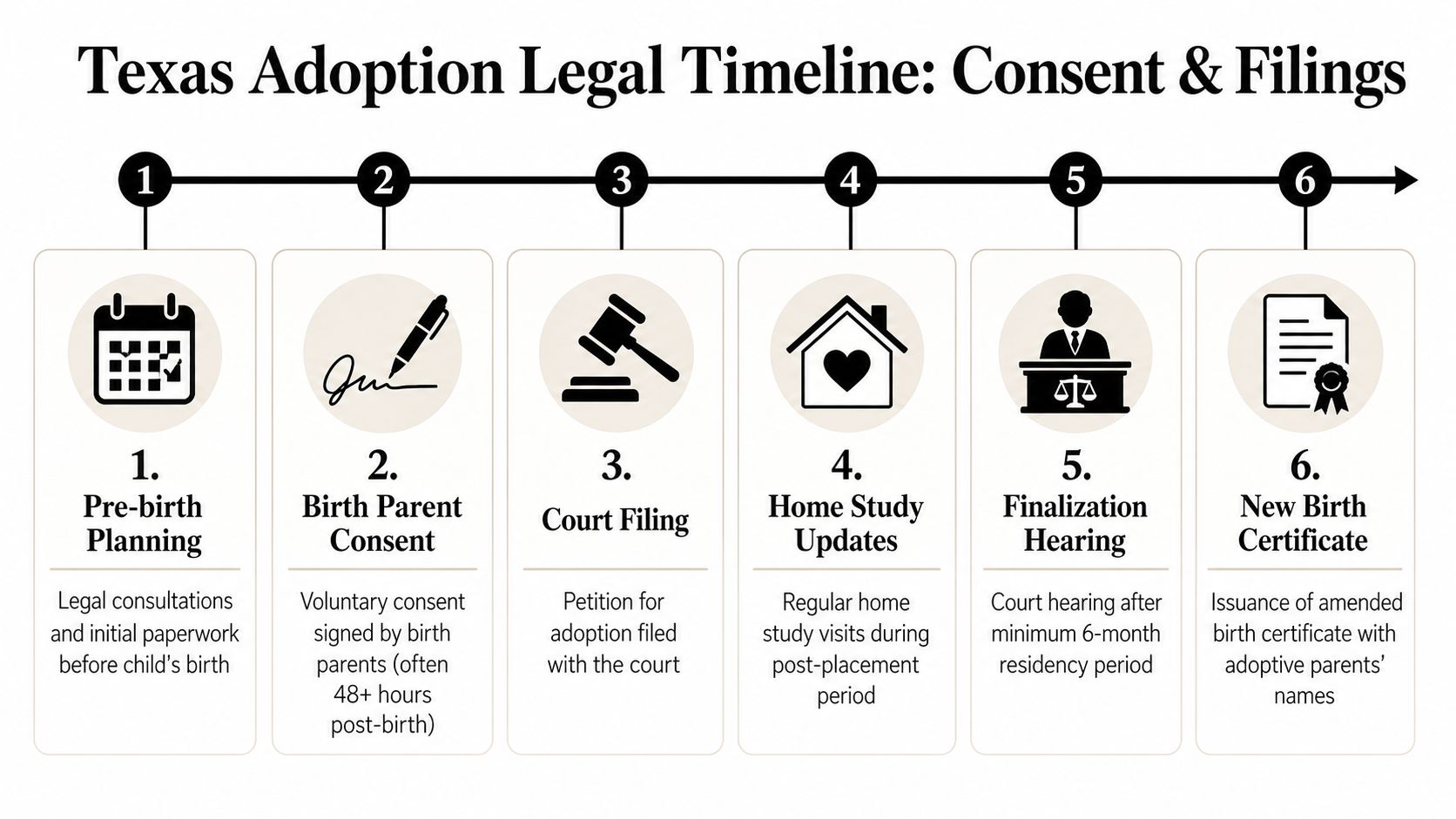
One of the most important rules in Texas is also one of the most misunderstood. A birth mother cannot legally sign consent to adoption until 48 hours after the child's birth, and after signing, she has a 10-day, non-waivable period to revoke that consent, as outlined in this Texas adoption consent overview.
That means hopeful adoptive parents need to understand something difficult but necessary. Even after placement, there is a legal window in which the adoption plan can change.
The 10-day revocation period is not a technical footnote. It is one of the most emotionally important parts of the process for everyone involved.
For birth parents, this rule protects time for reflection after childbirth. For adoptive parents, it means careful emotional and legal planning matters. Families should know what the placement arrangement means during those days, what communication should look like, and how to avoid assumptions that could make a hard situation even harder.
Court filings that matter
Several filings usually appear in a Texas private adoption matter. The exact list depends on the facts of the case, but common legal documents include:
- Petition to adopt: This asks the court to approve the adoption.
- Documents addressing parental rights: These show voluntary relinquishment or other lawful resolution of parental rights.
- Home study materials and updates: The court wants evidence that the placement has been reviewed and monitored.
- Child history documentation: Unless the adoptive parent is a grandparent, aunt, uncle, or stepparent, Texas Family Code §162.005(a) requires a Health, Social, Educational, and Genetic History report, often called an HSEGH report, that must be filed and maintained for a very long time under the law, as described in the Texas adoption bench book.
Where Chapters 162 through 166 matter most
Texas Family Code Chapter 162 is especially important in private adoption because it deals with the legal requirements for adoptive placement and finalization. Other chapters in this range can affect special situations, including records and procedures that shape how the adoption is handled. Families don't need to memorize chapter numbers, but they do need to know that the court is looking for a complete, lawful record before it creates a permanent parent-child relationship.
A missed signature, an improperly timed consent, or an incomplete filing can delay a case that otherwise seemed ready. That's why this phase deserves slow, careful attention.
Finalization and Life After Your Texas Adoption
By the time a family reaches placement, they often want to ask one question every day. When will this be final?
The answer is hopeful, but it requires patience. Texas law says a court generally can't grant the adoption unless the child has lived with the petitioner for at least six months, according to Texas Family Code Chapter 162. That waiting period gives the court time to see stability in the home before making the adoption legally permanent.

The post-placement months
Those months are not just a countdown. They usually include post-placement supervision. In a private infant adoption, a social worker checks in, reviews how the child is doing, and helps document the adjustment of the placement. These visits can feel intimidating at first, but many families find them reassuring once they begin.
A mother may ask whether the baby is sleeping well. A father may talk about returning to work and learning a new routine. A social worker may observe feeding, bonding, and safety, then prepare reports for the court. The tone is often supportive, not adversarial.
If your child is an infant, practical guidance can help your home feel calmer during this stretch. Many new parents appreciate a simple month-by-month baby guide because adoption finalization happens while ordinary parenting is already in full swing.
What finalization day often feels like
Families sometimes expect a formal hearing that feels stiff or distant. In reality, finalization day is often one of the warmest moments a courtroom sees.
Some parents dress their child in a special outfit. Grandparents may come. A judge may ask a few questions, review the file, and then sign the order that legally makes you the child's parent. For many families, it is the first day they exhale.
Here is a helpful overview for families who want to see how the legal finish line fits into the broader process:
After the hearing
Once the court signs the Final Order of Adoption, the legal relationship is permanent. An amended birth certificate can then be issued showing the adoptive parents' names.
Life after adoption also includes emotional work. If your adoption is open or semi-open, think carefully about how to honor healthy contact and preserve truthful information for your child. Children do best when adults handle their story with respect, age-appropriate honesty, and a steady sense of belonging.
A child doesn't need every answer at once. They do need to grow up knowing their story is safe with you.
Families who want broader timeline context can also review How Long Does a Texas Adoption Take?, which discusses realistic timing across adoption types.
Common Questions About Private Adoption in Texas
How is stepparent adoption different from private infant adoption
Stepparent adoption usually looks very different. In many of those cases, the child is already living with the family, and the legal issue is often whether the other biological parent's rights have been terminated or can be terminated lawfully. It usually doesn't involve matching with a birth mother or the same kind of pre-placement process. If that situation fits your family, Texas stepparent adoption requirements are worth reviewing.
I'm a grandparent raising my grandchild. Is that a private adoption
Sometimes yes, but relatives often fall into their own category of kinship or relative adoption. The legal steps can be different from an unrelated private infant adoption, especially when the child is already with family. Relative caregivers should pay close attention to existing custody orders, parental rights, and whether adoption or guardianship is the better fit. Families in this position often need an individualized legal review rather than a general guide.
What should LGBTQ+ couples know about adopting in Texas
LGBTQ+ individuals and couples can pursue adoption in Texas, but they should be thoughtful about choosing professionals who understand family-building law and can manage the process respectfully. The same core legal themes still apply. The court focuses on the child's best interests, home stability, lawful consent, and complete filings. Questions about parentage, marital status, and documentation deserve careful handling early so there are no surprises later.
As a birth mother, what rights do I have
You have the right to make an informed, voluntary decision. In a Texas private adoption, your consent must follow Texas law, and the legal process should respect your time, your questions, and your dignity. You should understand what kind of adoption is planned, what contact is expected if any, and what documents you are being asked to sign. No one should treat this as a rushed signature event.
Do adult adoptions follow the same process
No. Adult adoption is much simpler in Texas than adopting a minor. Under Texas Family Code §162.501, an adult adoption does not require a home study, CPS investigation, termination of parental rights, or a best-interest hearing. The adult being adopted must be at least 18 and give written, voluntary consent. That makes adult adoption a very different legal process from private infant adoption.
What if I live in Texas but the baby is born in another state
That can add another layer of legal work. Interstate adoptions often involve ICPC approval before the child can lawfully travel home with the adoptive parents. Families should expect added paperwork, coordination between states, and possible waiting time in the birth state before returning to Texas. This is one area where small legal mistakes can create large delays.
Is open adoption allowed in Texas
Yes. Families may agree on different levels of contact and communication. Some share photos and updates. Others have occasional visits. What works best depends on the people involved, the level of trust, and the child's long-term well-being. The healthiest plans are realistic, child-centered, and discussed clearly from the start.
If you're considering adoption and want legal guidance that is clear, compassionate, and grounded in Texas law, Law Office of Bryan Fagan, PLLC can help you understand your options. Whether you're a hopeful adoptive parent, a birth parent, or a relative caring for a child, scheduling a free consultation can give you a clearer next step and a steadier path forward.
