 Skip to content
A family can do everything right, complete parenting classes, prepare a home-study file, and walk into an adoption agency ready to begin, only to hear that the agency won't work with them because of its religious beliefs. That moment can feel personal, confusing, and frightening. It also raises an important legal question: what happens after a religious exemption adoption agency in Texas refuses a family?
Texas law protects certain faith-based child welfare providers, but the law doesn't erase the family's need for a safe and workable adoption path. Texas also maintains adoption standards that don't require prospective parents to follow a particular religion. The practical issue is therefore not only whether an agency may decline a referral. It's whether the state provides a meaningful alternative, and what a family should do when that replacement process breaks down.
When a Texas Family Walks Into an Adoption Agency and Hits a Wall
Maria and Daniel arrive at a Houston adoption agency carrying a thick binder. Inside are certificates from parenting classes, home-study approvals, financial records, medical paperwork, and notes about the kind of home they hope to provide. They've rehearsed difficult conversations and pictured the first time a child might call their house home.
The lobby is quiet. A staff member greets them with a polite smile, reviews their names, and disappears briefly into an office. When she returns, her voice is kind but firm: the agency can't move forward with their application.
No detailed explanation follows. There's no clear referral, no written policy in hand, and no person assigned to help them continue. Maria and Daniel leave with their binder, but without a path.
The first question isn't whether your family deserves to adopt. It's what legal rule caused the refusal and who must help you take the next step.
Families in this position often ask whether the refusal was legal, whether Texas allows agencies to turn them away, and whether another agency will treat them the same way. The answer depends on the provider's religious beliefs, the service being refused, the agency's licensing and funding structure, and the rules governing an alternative referral.
Texas created a significant framework for these disputes in 2017, when it enacted House Bill 3859. The law protected child welfare service providers with “sincerely held religious beliefs,” prevented the state from granting or denying funding because of those beliefs, and said a provider couldn't be required to offer a service conflicting with its faith-based convictions. The measure passed the Texas House 93–49 in May 2017 and was signed by Governor Greg Abbott on June 15, 2017. The Associated Press reported on the law's passage and significance.
That protection exists beside another important rule. Texas Department of Family and Protective Services guidance says there are “no specific religious requirements” for foster and adoptive applicants, while workers must consider whether applicants will respect a child's religious affiliation and support the child's desired religious, spiritual, and ethical development. Texas DFPS explains these applicant standards.
What Texas Religious Exemption Law Actually Allows
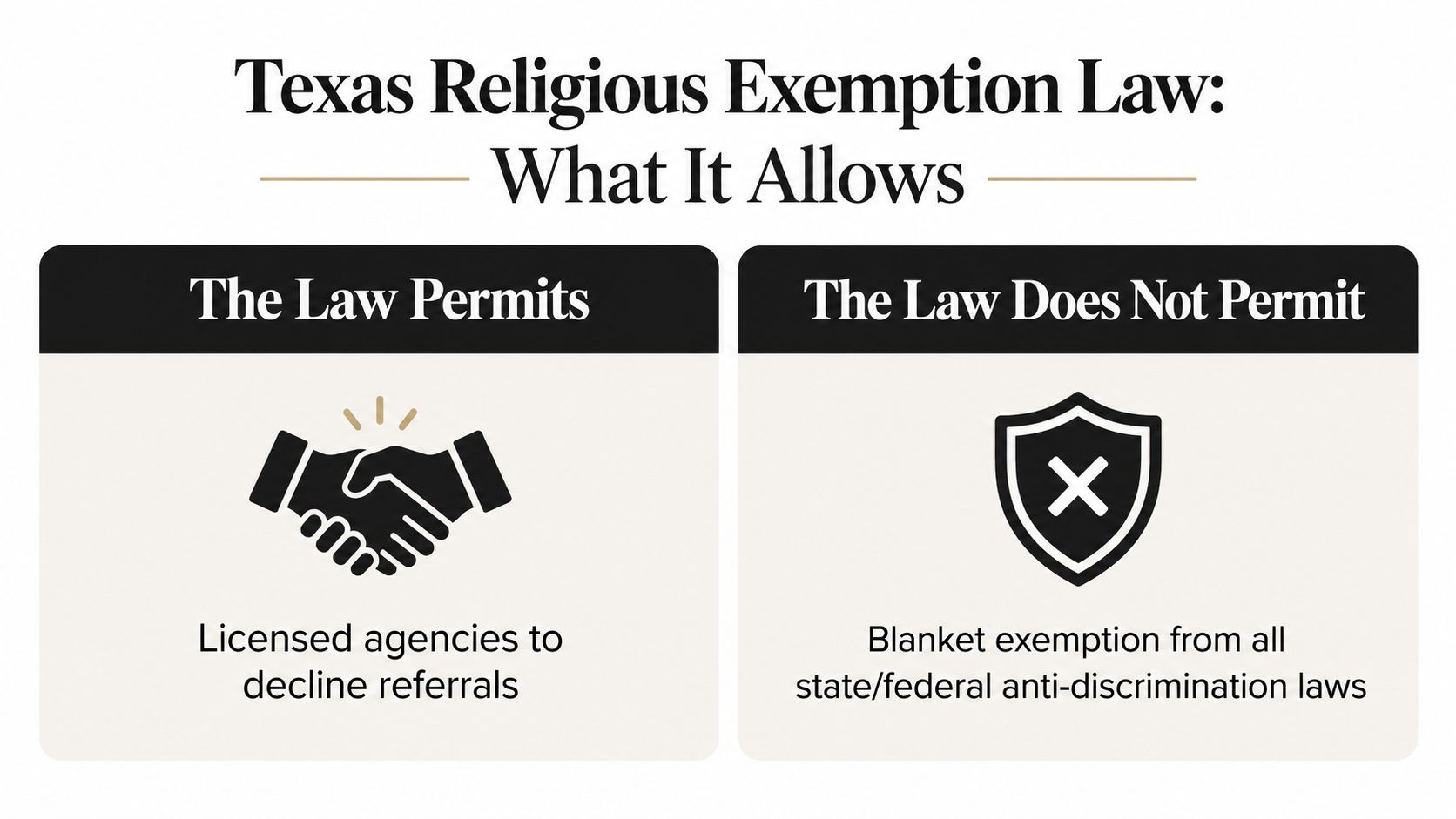
Texas's religious exemption framework protects a child welfare provider, not a universal right to reject every person for every reason. A licensed provider may decline a service or referral when the request conflicts with its sincerely held religious beliefs. The provider may also continue seeking state licensure and public funding under the statutory framework described above.
The practical distinction matters. An agency can say, “We can't process this referral under our religious policy.” That doesn't mean the agency can disregard licensing duties, child safety standards, recordkeeping requirements, or every state and federal nondiscrimination rule that may apply to the situation.
The rule in plain English
Think of the framework as two separate questions:
- Can this provider participate in this particular service or placement? If the provider says the service conflicts with a sincerely held religious belief, Texas law may protect the provider's refusal.
- Does the refusal end the family's adoption opportunity? It shouldn't. Texas materials describe the availability of secondary providers when one provider declines a service.
That structure fits within the broader adoption process. Texas Family Code Chapter 162 governs core adoption matters, including the legal effect of finalization. Chapters 163 through 166 address related adoption and family-law procedures, including termination-related matters, adoption assistance and other statutory protections. A religious exemption doesn't replace the court's authority or remove the need for required investigations, consents, notices, pleadings, and final orders.
Families should also understand the federal backdrop. In Fulton v. City of Philadelphia, the United States Supreme Court issued a narrow ruling involving a faith-based foster care provider and a city contract. The decision left important questions unresolved rather than creating a broad permission for every taxpayer-funded agency to discriminate. A Texas Law Review discussion of Fulton and religious adoption agencies describes why the decision continues to create uncertainty around religious exemptions and nondiscrimination requirements.
For a plain-language overview of how adoption law fits together, families can review this Texas adoption and the Family Code essential guide for parents. Families considering the most common Texas adoption route may also read about Stepparent Adoption in Texas, which involves its own consent, termination, residency, and finalization requirements.
Who Religious Exemptions Protect and Who They Affect
Three groups are involved in most religious exemption disputes: the faith-based provider and its staff, the prospective adoptive parents, and the children waiting for a permanent home.
The exemption primarily protects the provider's religious exercise. It may affect LGBTQ+ individuals and couples, unmarried partners who live together, families with different religious beliefs, single parents, and people who have previously divorced if an agency's written religious standards address those circumstances. The impact is often greatest for an unmarried or same-sex applicant because the provider may define marriage or family structure through its religious policy.
A married different-sex couple may be less likely to encounter that particular barrier, though every agency has its own rules and screening practices. The family's experience can also vary depending on whether the agency is handling a private adoption, a foster-care certification, a home study, or a specific placement referral.
| Applicant Category | Likely Refused? | Legal Basis in Texas |
|---|---|---|
| Same-sex individual or couple | May face refusal from a provider with a conflicting religious policy | A provider may invoke sincerely held religious beliefs, subject to applicable law |
| Unmarried cohabiting partners | May face refusal under a faith-based household policy | The provider may decline a conflicting service or referral |
| Single parent | Depends on the agency's stated religious standards | Texas does not impose a specific religious requirement on applicants |
| Different-faith household | May face screening concerns from some faith-based providers | The agency's religious policy may affect participation |
| Previously divorced applicant | Depends on the provider's policy and the service requested | The provider may rely on its stated religious convictions |
| Applicant of a particular race | A religious exemption isn't a blanket defense to race discrimination | Federal civil-rights protections may restrict race-based refusal |
The child's interests must remain central. DFPS says workers evaluate whether applicants will respect a child's religion and protect the child's health, rather than requiring applicants to belong to a specific faith. That means a family's religious identity and a child's religious identity can't be treated as an afterthought when workers assess the placement.
For LGBTQ+ families, the refusal may also carry emotional weight beyond the immediate delay. A family that has already disclosed intimate information during a home study may feel exposed or judged. Families seeking a more inclusive starting point can review LGBT-friendly adoption agencies and related considerations, while still independently confirming each provider's current policies.
The State Promise of an Alternative Provider
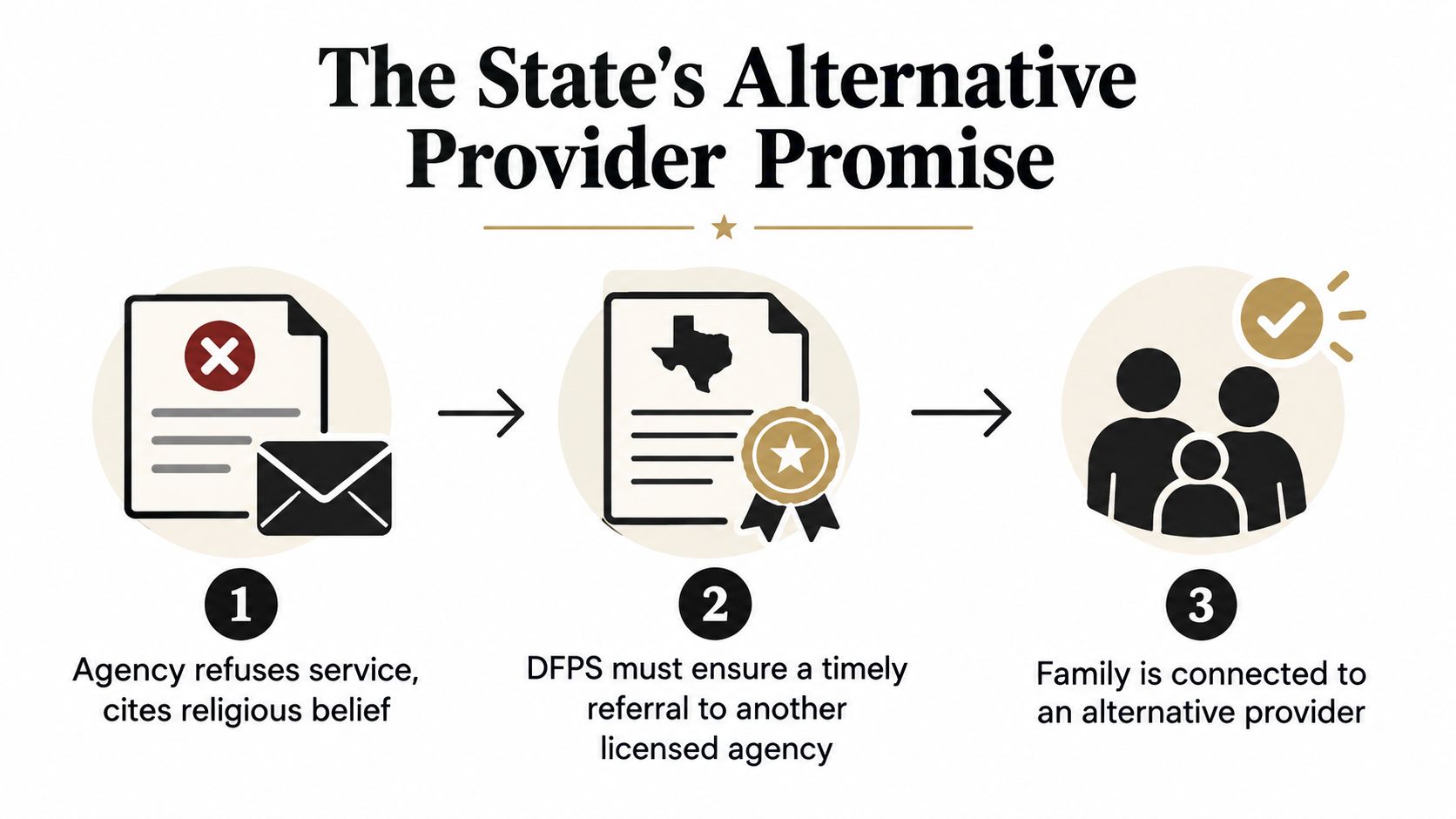
The alternative-provider rule is the operational center of this issue. A refusal may be legally protected for the original provider, but the family still needs a licensed professional to complete the work, protect confidential information, and keep the adoption moving.
The Texas framework described in child welfare materials anticipates that a secondary provider should be available if the first provider declines a service. Texas's child welfare resource on religious rights in out-of-home care explains the alternative-provider concept and the practical concern families face when a referral is refused.
What a workable referral should accomplish
A meaningful referral should do more than hand a family a phone number. The receiving provider should know what service is needed, what stage the family has reached, and what records can be transferred lawfully. The family should understand whether it must repeat a home study, submit updated documents, or sign new releases.
Texas reporting has identified a serious weakness in this process. Texas requires alternative providers, but reporting has noted that the state doesn't have a specific process ensuring that the alternative placement occurs. The Texas Tribune has reported on this gap in implementation.
The problem becomes sharper outside major metropolitan areas. A family in Houston, Dallas, Austin, or San Antonio may have more provider choices than a family in a rural county. Even where another agency exists, its intake schedule, service area, religious policy, and willingness to accept a transferred file may differ.
What families should ask for
Ask the referring organization to identify the alternative provider, explain the handoff, and state what happens to documents already submitted. Ask whether the original refusal affects your position in a placement process, or whether you were only denied agency services before a child was identified.
A replacement provider should be a real handoff, not a dead end disguised as a referral.
Keep written records of every request. If the alternative provider doesn't respond, contact the referring entity again and ask who has responsibility for resolving the delay. The point isn't to force a faith-based agency to violate its convictions. The point is to make sure the family and child don't carry the administrative cost of the refusal.
What to Do If a Texas Adoption Agency Refuses You
A refusal can leave you speechless in the moment. You don't need to argue at the front desk, but you should leave with enough information to protect your rights and preserve your options.
Start before you leave
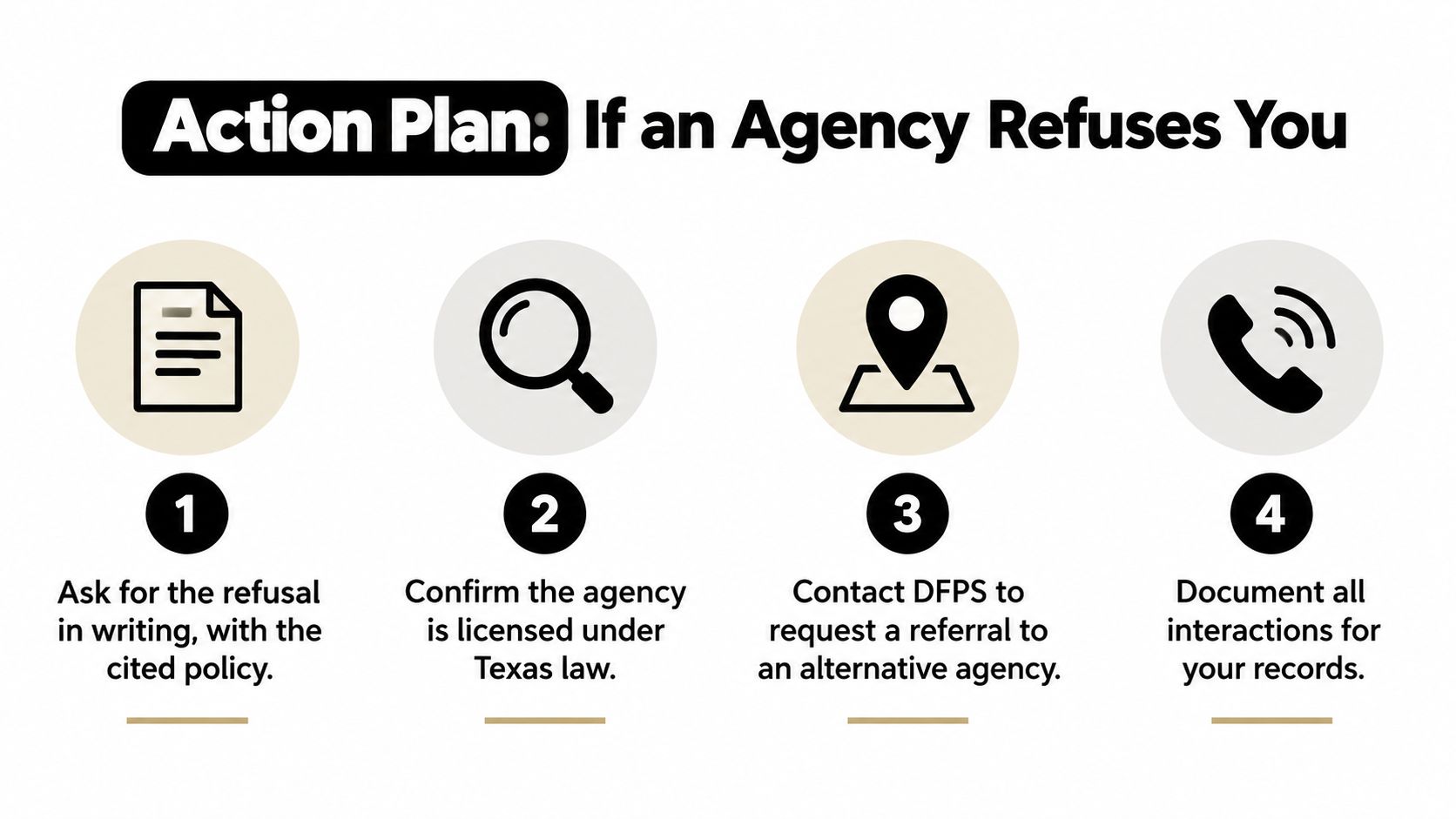
Ask the staff member to provide the refusal in writing. Request the specific policy or legal provision cited, and ask whether the agency is refusing a general application, a home study, a foster certification, or a referral involving a specific child.
Those details change the legal and practical analysis. A hypothetical rejection during intake isn't the same as refusing to participate in an identified placement. Ask whether the agency has a grievance procedure and who supervises the decision.
Preserve the record
Write down the date, the names and titles of the people involved, and the exact words used as soon as you can. Save emails, application confirmations, text messages, receipts, forms, home-study materials, and any notice that identifies the reason for the decision.
Avoid posting private facts about the child or the agency on social media. Adoption records often contain sensitive medical, family, and identifying information. A contemporaneous private record is more useful than a public argument that could expose confidential details.
Escalate in a measured order
Use this sequence:
- Ask the agency director for review. Request a written explanation and the name of the alternative provider responsible for your next referral.
- Confirm licensing. Ask whether the entity is licensed under Texas law and identify the relevant licensing authority.
- Contact DFPS. Explain that you were refused, provide the documentation you have, and request an alternative licensed provider.
- Consider a licensing complaint. If the agency failed to follow licensing requirements or mishandled records, ask about a complaint through the appropriate Health and Human Services channel.
- Discuss civil-rights concerns with counsel. If the facts suggest discrimination outside the religious exemption, an attorney can help evaluate whether a complaint to the Texas Attorney General, a federal agency, or another body makes sense.
The Texas guidance on adopting without an agency can also help you understand whether a private or identified adoption path may be available in your circumstances.
Don't sign a release or withdraw an application before understanding what information will transfer to another provider. If a child has already been matched, contact an adoption attorney promptly because delays can affect notices, consents, court filings, and the child's stability.
Practical Alternatives for Texas Families Building Through Adoption
A refusal narrows one route. It doesn't necessarily close the adoption process. Your next choice should reflect the child's needs, the family's preferred level of openness, the available support, and the legal safeguards you need.
Private or identified adoption
A Texas adoption attorney may help coordinate an independent or identified adoption, prepare pleadings, address birth-parent rights, and work with a qualified professional on the home study. This route can give families more control over provider selection, but it also requires careful handling of advertising, expenses, consents, counseling, confidentiality, and court requirements.
A different agency
Switching agencies may be the simplest solution when the first provider refuses before a placement occurs. Before submitting another application, ask direct questions:
- Household standards: Does the agency accept same-sex couples, unmarried couples, single parents, and families from different faith traditions?
- Referral practice: Does the agency use a religious exemption policy, and if so, what services may be declined?
- File transfer: Will completed home-study materials and clearances be accepted from another provider?
- Decision authority: Who makes placement decisions, and how does the agency explain a denial?
- Complaint process: How can a family challenge an administrative mistake?
Foster care and foster-to-adopt
Families interested in children already in state custody can explore the DFPS pathway. The process generally involves training, screening, a home study, and licensing or approval steps, followed by placement decisions focused on the child's safety and permanency needs. Some children may be eligible for adoption assistance or other support, but families should ask DFPS or counsel about the specific program and the child's circumstances rather than assume assistance applies.
Relatives may also consider kinship adoption or guardianship. Adoption creates a permanent legal parent-child relationship, while guardianship may serve a different family goal and preserve different legal connections. A relative caregiver should compare both options before making a decision.
Interstate or international adoption
Interstate placements require compliance with the laws of more than one state. International adoption adds federal immigration rules and the law of another country. These paths can work, but they demand specialized advice and careful planning.
| Path | Typical Cost | Typical Timeline | Eligibility | Legal Safeguard Level |
|---|---|---|---|---|
| Private or identified adoption | Varies by attorney, professional, and case needs | Varies with matching, consents, and court requirements | Depends on the child, birth parents, and legal facts | Strong when counsel manages consent and court compliance |
| Agency switch | Varies by provider and services already completed | May preserve some progress, but depends on file acceptance | Subject to the new agency's standards | Depends on licensing and agency oversight |
| DFPS foster-to-adopt | Program-specific and case-specific | Depends on training, approval, placement, and permanency decisions | Subject to DFPS requirements and the child's needs | Strong state oversight, with case-specific assistance questions |
| Kinship adoption or guardianship | Varies with legal and court needs | Depends on parent rights, notices, and court review | Based on family relationship and child's best interests | Court-supervised, with different effects for adoption and guardianship |
| Interstate or international adoption | Varies substantially by case and jurisdiction | Depends on multiple legal systems | Subject to Texas and outside-jurisdiction requirements | Requires specialized compliance across jurisdictions |
Don't choose solely based on speed. A slower path with reliable counseling, complete records, and a legally sound final decree may better protect the child and the family.
How the Law Office of Bryan Fagan Walks With You
A family facing a religious refusal needs answers tied to its actual documents and timeline. The Law Office of Bryan Fagan, PLLC can begin with a free initial consultation to review what happened, identify whether the agency's refusal appears protected, and determine whether the immediate need is an alternative referral, a complaint, an agency change, or a different adoption route.
Turning statutes into a working plan
Texas adoption law uses terms that can sound abstract until they affect your family. Under Family Code Chapter 162, finalization establishes the legal parent-child relationship for all purposes. The adoptive parents take on permanent parental rights and duties, and the child becomes their child under Texas law.
Section 162.017 also provides that the adopted child may inherit from and through the adoptive parents as though the child were their biological child. The statute preserves certain grandparent access rights, which can matter in extended-family and blended-family situations. These rules explain why finalization is more than a custody change. It creates lasting legal belonging.
An attorney can help organize the steps that lead to that order:
- Initial review: Examine the refusal letter, agency policy, application, home-study status, and any placement information.
- Referral strategy: Communicate with DFPS, the agency director, or another licensed provider about a workable handoff.
- Family-specific planning: Address stepparent, relative, foster, domestic, LGBTQIA+, single-parent, or adult adoption issues without forcing every family into the same process.
- Court preparation: Prepare petitions, required notices, consents, termination-related filings, and evidence for the final hearing.
- Finalization: Confirm that the court has what it needs to enter an enforceable adoption order.
Stepparent cases show why careful planning matters. TexasLawHelp explains that the other legal parent's rights usually must be terminated, the spouse-parent must join as a petitioner, a child 12 or older must consent in writing or in court, and the child must live with the petitioner for at least six months before finalization. TexasLawHelp's stepparent adoption guidance describes these requirements.
Support without judgment
LGBTQIA+ prospective parents, unmarried couples, single parents, birth parents, and relatives may worry that disclosure will lead to judgment. Legal counsel should do the opposite. The attorney's role is to understand the family structure, protect confidentiality, identify the child's best interests, and explain realistic choices.
If an agency won't provide a meaningful alternative, counsel can help prepare a written escalation, evaluate licensing or civil-rights complaint options, and connect the family with appropriate advocacy resources when needed. The immediate objective remains practical: preserve the record, protect the child's stability, and keep the adoption moving through a lawful provider.
The Law Office of Bryan Fagan, PLLC offers Texas families a free consultation to review a religious exemption refusal, alternative-provider problem, or adoption filing. Visit Law Office of Bryan Fagan, PLLC to request guidance on your next step and discuss a path that protects your family and the child at the center of the case.

