
657 surrogacy births in 2025 changed the Texas conversation, but they didn't erase the need for adoption. In families with the wrong surrogacy facts, the baby still comes home through adoption after birth, even when the pregnancy was carefully planned.
A Texas couple can do everything right, sign the contracts, complete the medical screening, and still hear a lawyer say, “You need an adoption too.” That surprise is exactly why surrogacy vs adoption in Texas when you need both matters. The core issue is not which path sounds better on paper, it's which legal tool fits your family's facts, and in what order.
| Legal feature | Gestational surrogacy | Adoption |
|---|---|---|
| When parental rights attach | Before birth, if the court validates the agreement | After birth, through a legal transfer of rights |
| Genetic connection | Usually preserves a genetic link for the intended family | No genetic continuity is created by the process itself |
| Legal structure | Texas Family Code Chapter 160, Subchapter H | Texas Family Code Chapters 162 through 166 |
| Parentage goal | Pre-birth parentage order may be available | Finalizes permanency for an already-born child |
| Court involvement | Validation of the gestational agreement | Best-interest review, home study, and final decree |
When Both Paths Show Up in the Same Family
A couple comes into the office relieved after a smooth pregnancy journey. They used a gestational carrier, everyone stayed in communication, and the birth went well. Then the paperwork gets reviewed, and the uncomfortable truth lands, their specific setup doesn't finish cleanly with surrogacy alone, so a post-birth adoption filing is still needed.
That shock is real. It feels unfair because the family followed the plan, but Texas law doesn't reward effort alone, it looks at which legal pathway matches the facts.
The emotional whiplash is usually the hardest part
Families expect a clean line from pregnancy to parentage. Instead, they discover that Texas treats gestational surrogacy and adoption as different legal machines, and those machines don't always do the same job. A validated surrogacy agreement can secure parentage before birth, but adoption still matters when the family configuration falls outside that lane.
The takeaway is simple. The question isn't, “Which one wins?” The question is, “Which one controls this child's legal status at this stage?”
Practical rule: if the intended parentage isn't fully locked in before birth, don't assume the hospital record will fix it later.
Texas families also run into this issue when they compare paths for a stepparent, relative, or second parent who needs legal recognition after the baby is already here. In those cases, the right answer often includes both a surrogacy case and a later adoption case, each doing a different legal job.
For readers who want a plain-English overview of Texas adoption rules, this Texas adoption laws guide is a good companion resource.
How Texas Law Treats Each Path
Texas draws a hard line between Chapter 160 surrogacy and Chapters 162 through 166 adoption. That line matters because it decides whether parentage can be set before birth or only after birth, and whether the court is validating a pregnancy agreement or transferring rights from an existing parent to a new one.
Gestational surrogacy is a pre-birth path with strict limits
Under Texas Family Code §§ 160.751 to 160.763, a gestational surrogacy agreement can be validated by a Texas court, and that validation can support a pre-birth parentage order. ASRM's Texas summary notes that Texas also requires medical necessity for the intended mother's use of surrogacy, which narrows the path more than many families expect.
That means Texas is not treating every pregnancy arrangement the same way. It is specifically protecting a structured gestational arrangement where the carrier has no genetic relation to the child.
Adoption is a post-birth permanency process
Adoption under Texas Family Code Chapters 162 through 166 works differently. It transfers parental rights after the child is born, and it exists to create legal permanency for a child who is already here. Texas adoption law requires termination of the birth parent's rights before finalization, and TexasLawHelp explains that cases usually involve reports and studies, including interviews, home evaluations, and sometimes health, social, educational, and genetic records, to show the placement serves the child's best interests.
That best-interests focus is the heart of adoption. It's not about a contract between adults. It's about whether the child's permanent home is legally secure.
For families comparing common paths, Stepparent Adoption in Texas is the most common Texas adoption and how it works.
| Legal Feature | Gestational Surrogacy | Adoption |
|---|---|---|
| Governing law | Texas Family Code §§ 160.751 to 160.763 | Texas Family Code Chapters 162 to 166 |
| Main purpose | Establish parentage before birth | Transfer parental rights after birth |
| Court role | Validate the agreement, then support parentage | Review best interests and finalize permanency |
| Family fit | Planned pregnancy with defined legal structure | Already-born child needing a permanent legal home |
Comparing the Two Paths on the Issues That Matter
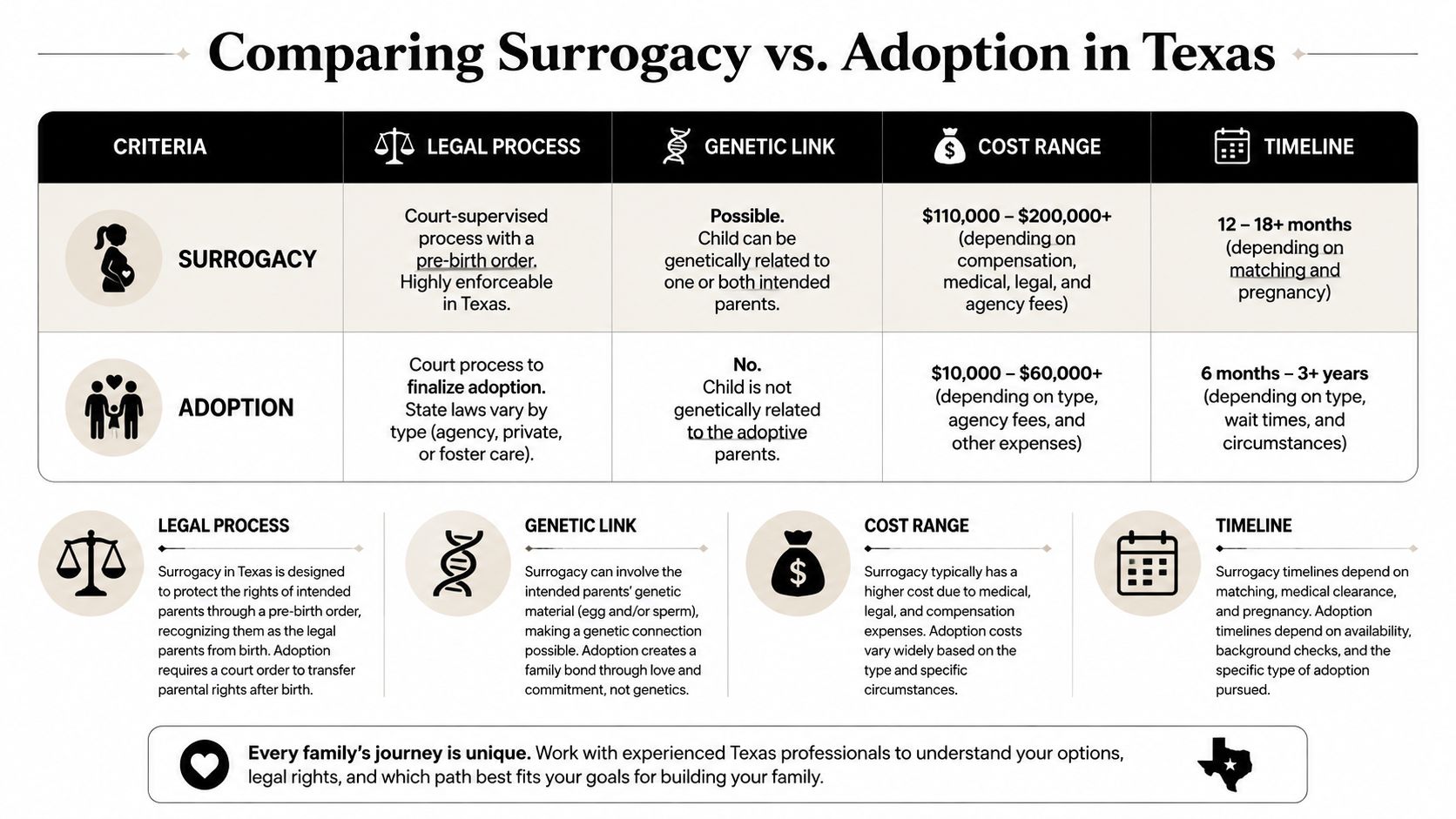
What changes first is legal certainty
With validated gestational surrogacy, the family is aiming for parentage certainty before delivery. With adoption, the legal change happens after birth, so the family is waiting for a court process to finish before the new parentage is fully secure. That timing difference affects everything from the hospital plan to how calm the adults feel on delivery day.
Genetic link matters more than people admit
Texas gestational surrogacy is built around genetic continuity for the intended family. Adoption is a different kind of love and a different kind of permanency, but it does not create a biological link. Families who care about a genetic connection usually feel the difference immediately.
The birth parent's role is not the same in each path
In a gestational arrangement, the carrier is not intended to be the genetic mother, so the legal design is different from a birth-parent surrender. In adoption, the birth parent's rights have to be terminated before the court can finalize anything. That's why traditional surrogacy and adoption start looking alike in practice.
Eligibility cuts both ways
Texas law makes gestational surrogacy narrower than many people think. It's not just “use a surrogate and move on.” The agreement must fit the statute, the court has to validate it, and the family has to fit the legal structure. Adoption is broader in who may pursue it, but it is also more dependent on post-birth court approval and best-interests findings.
Whose rights attach, when they attach, and whether the child already exists legally as someone else's child. That's the real dividing line in Texas.
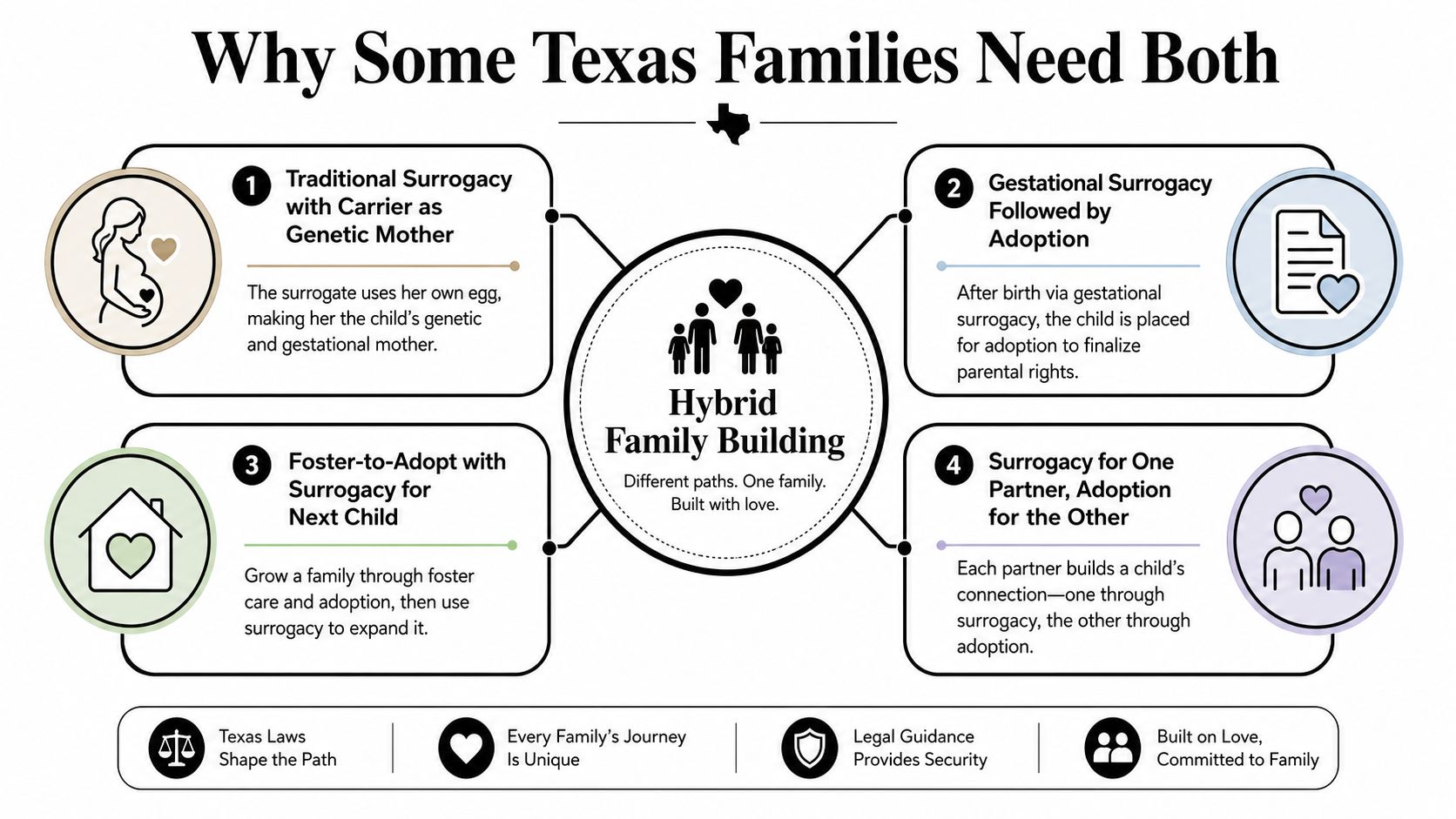
Why Some Texas Families Need Both
The most common hybrid situation is traditional surrogacy. In that setup, the surrogate is the genetic mother, so Texas treats the case much more like adoption because the surrogate has to relinquish parental rights after birth. That's not a technicality, it's the whole legal pivot.
Traditional surrogacy often turns into an adoption case
If the carrier is genetically related to the child, you are no longer in the clean gestational-surrogacy lane. Texas law distinguishes that arrangement sharply, and the practical result is that the family may need a post-birth legal proceeding to complete parentage.
Unmarried intended parents can trigger a second filing
Some families assume the words “intended mother” and “intended father” cover every modern family structure. They don't. When the parentage order or gestational agreement doesn't perfectly match the adults in the home, a separate adoption proceeding may be the cleaner way to secure full legal status for the non-biological parent.
Donor gametes and embryo issues can push the case out of the original lane
A family may begin with a surrogacy plan and still hit a legal mismatch if the donor or embryo arrangement doesn't line up with the validated agreement. When that happens, the court may need a second legal step to make the parentage record match the child's real family.
A successful surrogacy can still be followed by adoption
This is the part many guides skip. Some families use a court-validated surrogacy first, then later need adoption for a spouse or partner who wasn't fully covered by the original order. That can happen in second-parent, stepparent, and other post-birth correction scenarios. For families in that lane, the legal path often overlaps with broader adoption work, including help from an adoption attorney who handles parentage and permanency issues.
The Step-by-Step Path When You Need Both
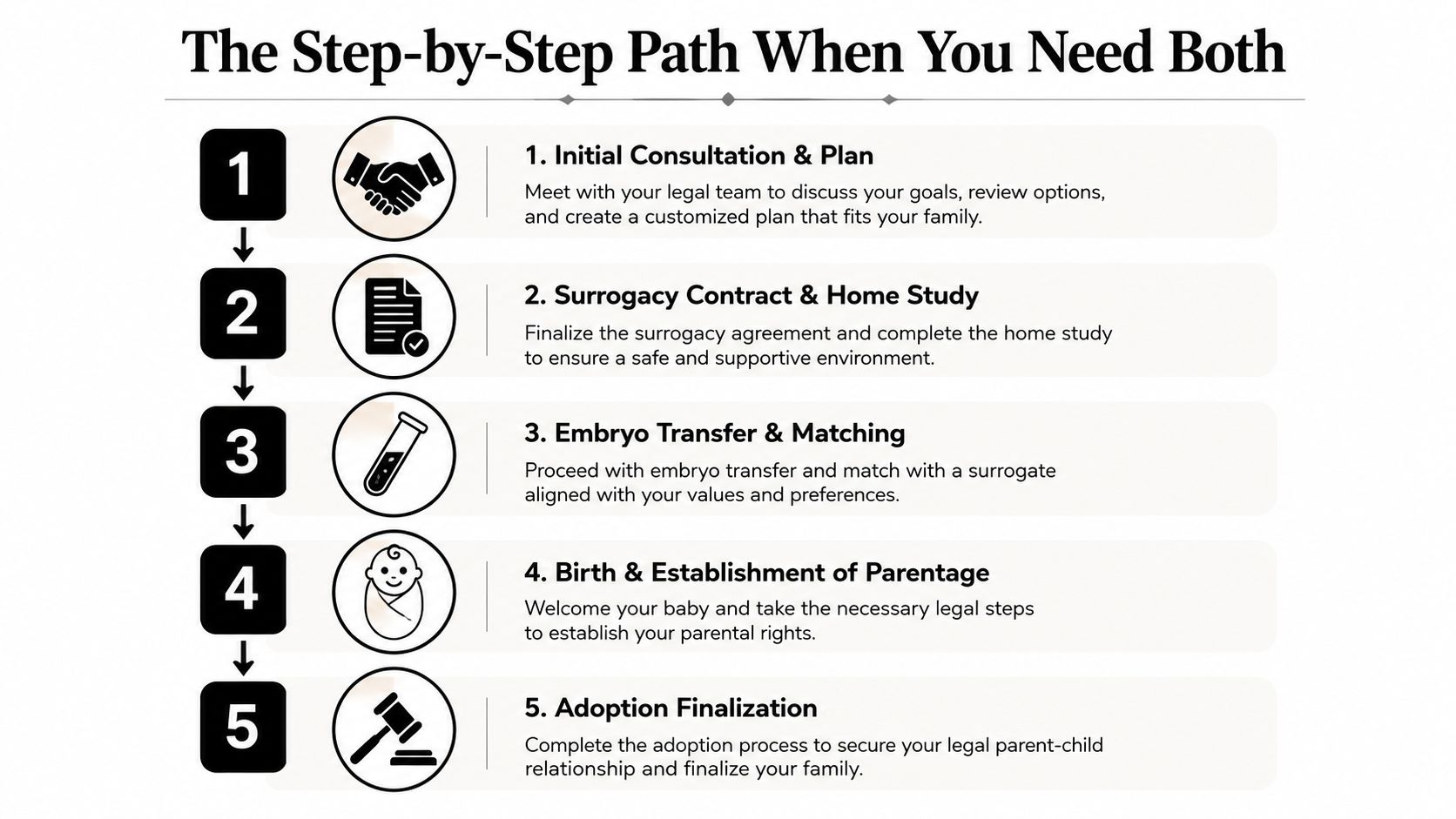
First comes the legal plan, not the embryo transfer
Texas does not reward improvisation here. The written gestational agreement must be signed at least 14 days before embryo transfer, and either the intended parents or the gestational carrier must have lived in Texas for at least 90 days before the court filing. Those timing rules matter because they decide whether the court can validate the agreement at all. Texas adoption process step by step
Then comes validation and parentage work
If the agreement fits Texas Family Code Chapter 160, the court can validate it and support a pre-birth parentage order. That order is the protection families are really after, because it lowers the chance that parentage has to be sorted out in a rushed post-birth fight.
After birth, paperwork still matters
Even when the surrogacy part works, families may still need a post-birth affidavit or a separate adoption petition if the original order doesn't fully cover every intended parent. The hospital does not create legal certainty by itself. The court record does.
A practical sequence looks like this
- Initial consultation and case review. The family identifies whether it needs a surrogacy-only plan or a surrogacy-plus-adoption plan.
- Contract drafting and screening. The legal agreement has to match the family structure before medical movement starts.
- Court validation. The judge reviews the gestational agreement and the residency timing.
- Birth and parentage confirmation. The family secures the child's legal status at or after delivery, depending on the case.
- Adoption finalization if needed. The remaining adult who needs parental rights is added through the proper Texas adoption filing.
A careful sequence protects everyone. It doesn't punish families, it keeps the child's legal identity clean from the start.
Costs, Timelines, and What Legal Certainty Is Really Worth
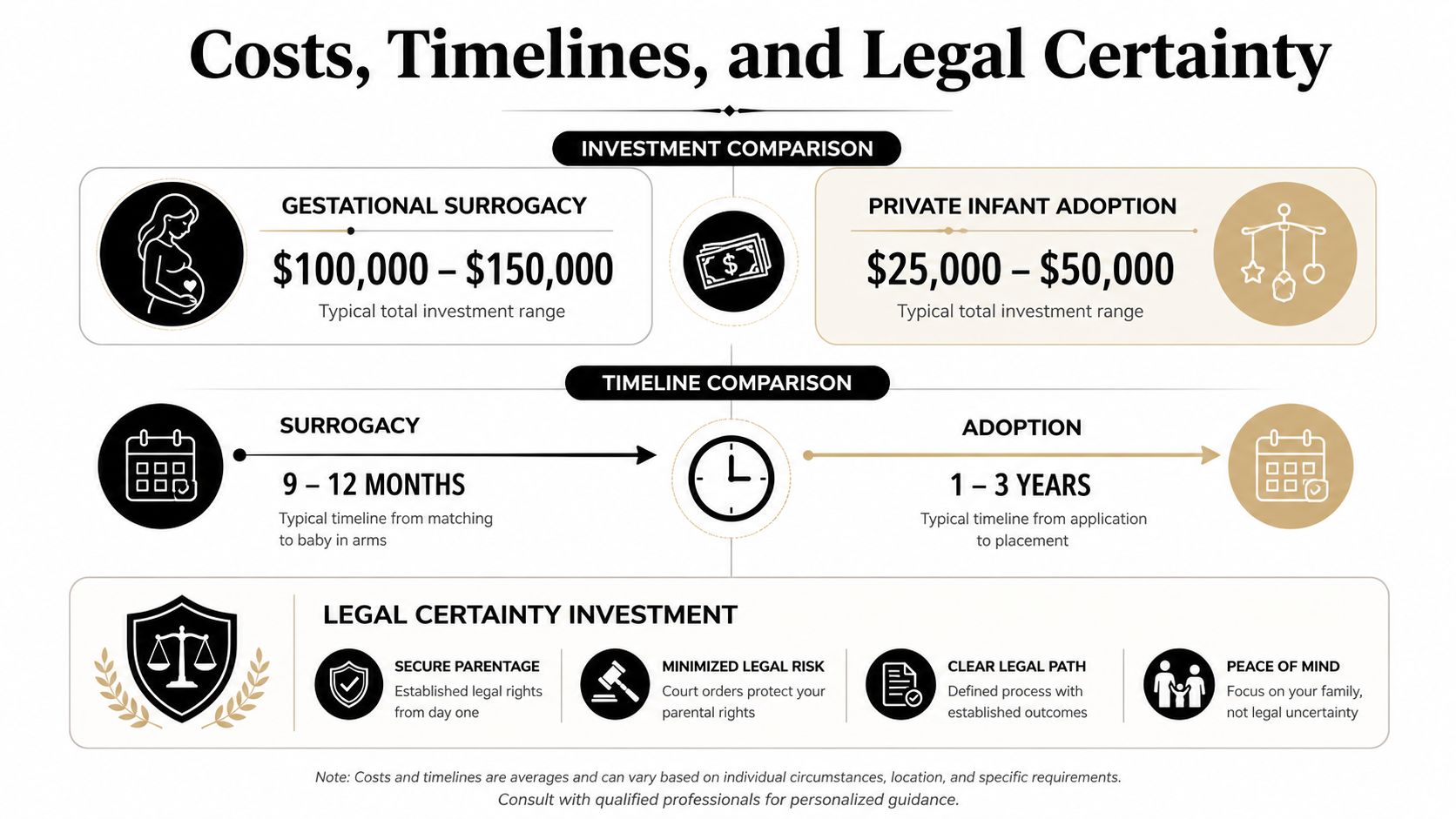
Texas families usually ask the wrong first question. They ask which path costs less. The better question is which path gives the legal certainty their family needs.
Gestational surrogacy is often described in the $120,000 to over $200,000 range, while domestic infant adoption is often estimated at $20,000 to $50,000. Those numbers matter, but they do not tell the whole story for a Texas family deciding whether one path is enough or whether both are needed. How much it costs to adopt a child in Texas
Headline price is not the whole bill
Surrogacy usually costs more because the legal plan is built to establish earlier legal parentage through a validated agreement and, when available, a pre-birth order. That is real value for parents who want their names settled before the baby leaves the hospital, not weeks later in a separate proceeding. Adoption often looks less expensive at the outset, but the tradeoff is that permanency is usually confirmed through a post-birth court process.
Texas also uses adoption on a large scale. In FY 2019, more than 20,000 children exited Texas foster care and 6,107 were adopted, including 3,095 relative adoptions; 18,615 children entered foster care that year, so exits exceeded entries by more than 1,700 children (Texas DFPS press release). A separate Texas adoption analysis reported 7,168 adoptions in 2023, with 58.33% from foster care, 39.96% private domestic, and 123 intercountry adoptions. That pattern matters because it shows how often Texas families are using adoption to finish legal parentage after a child is already in their care.
The smarter question is value of certainty
If your family needs a genetic connection and legal control during pregnancy, surrogacy is usually the better investment. If your family needs permanency for a child already born, adoption is the cleaner fit. If you need both, trying to force one path to do the work of the other usually costs more in delay, paperwork, and stress than doing the legal plan correctly from the start.
Choosing the Right Path for Your Texas Family
Families who need a genetic connection and pre-birth legal control usually fit best with gestational surrogacy under a validated Texas agreement. Families who need permanent legal status for an already-born child, including stepparents, relatives, and many LGBTQ+ couples, are usually better served by adoption.
When the family structure is not standard, don't guess. Some cases need both paths, and that's not a failure, it's just the law matching the facts. Texas courts care about best interests of the child and family unity, and that same theme runs through adoption and court-validated surrogacy alike.
A Texas couple with a traditional surrogacy, an unmarried intended parent who needs full recognition, or a spouse who still needs a later adoption filing should get a lawyer involved early. The right legal plan can prevent a painful second round in court. The wrong one can leave a parent standing in the nursery with no clear legal status.
If you're sorting through stepparent adoption, relative adoption, LGBTQ+ adoption, or a hybrid surrogacy case, the Law Office of Bryan Fagan, PLLC can walk you through the papers, the court process, and the order of filings with plain-English guidance.
The Law Office of Bryan Fagan, PLLC helps Texas families sort out adoption, surrogacy parentage, stepparent adoption, and other family-building cases with careful legal guidance. If your situation may require both surrogacy and adoption, visit Law Office of Bryan Fagan, PLLC to schedule a free consultation and get a Texas-specific plan that fits your family.
