
You've already found the match, signed the paperwork, and started picturing the nursery. Then someone mentions a grandparent, a tribal roll, or a family story that has never been fully checked, and the whole adoption suddenly feels different. In Texas, that moment can shift a private or CPS adoption into a federal-law issue, and families who move too fast can miss the screening, notice, and placement steps that protect the child and the case.
That's why adopting a child with Native American heritage in Texas needs more than hope and good intentions. It needs careful questions, early documentation, and a clear understanding of when the Indian Child Welfare Act, or ICWA, applies. A private intake system like Recepta.ai legal intake can help firms gather the first family details cleanly, but the legal decision still depends on the child's status, the tribe's response, and the court record.
Texas families also need to understand how adoption laws under Texas Family Code Chapters 162 through 166 interact with ICWA. A home study, consent forms, and final hearing still matter, but they don't stand alone when tribal notice and placement preferences are in play. If you're a hopeful parent, a birth parent, or a relative stepping in, the safest path is to learn the rules before the match gets emotionally deep.
When a Texas Adoption Suddenly Involves Native American Heritage
A Houston couple is weeks from finalizing a private infant adoption. The home study is approved, the nursery is ready, and everyone is talking about the final court date. Then the birth father's family mentions Cherokee lineage, and the whole conversation changes from ordinary adoption planning to a question of federal law, tribal verification, and court notice.
That's the moment many Texas families never see coming. It feels personal, because it is personal, but it also becomes procedural very fast. Texas finalized 5,168 adoptions in 2020, 4,546 in 2021, and 4,361 in 2022, while the number of children waiting for adoption fell from 12,290 in 2020 to 6,124 in 2024 according to Texas Child Welfare Outcomes data, and that scale is part of why careful screening matters in this state Texas Child Welfare Outcomes data for Texas.
Why this matters in Texas
ICWA was enacted because Native children were being removed from their homes at rates estimated at 25% to 35%, and about 85% of those children were placed outside their families and communities even when relatives or Tribal members were available to care for them NICWA overview of ICWA. That history is not background noise. It is the reason Texas courts, agencies, and adoptive families must slow down and ask the right questions early.
Practical rule: If Native heritage is mentioned, don't treat it like a side note. Treat it like a legal trigger until the child's status is verified.
A private adoption can be affected just as much as a foster care case. The safest Texas approach is to identify whether the child is legally an Indian child, give notice if required, and document every step before finalization. The process sounds technical, but the goal stays simple, to protect family unity and make sure the child's permanency order is lawful.
From here, the path gets more specific, identifying an Indian child, sending the right notice, following the placement preferences, proving what the court needs, and finalizing with confidence.
What Makes a Child an Indian Child Under Federal Law
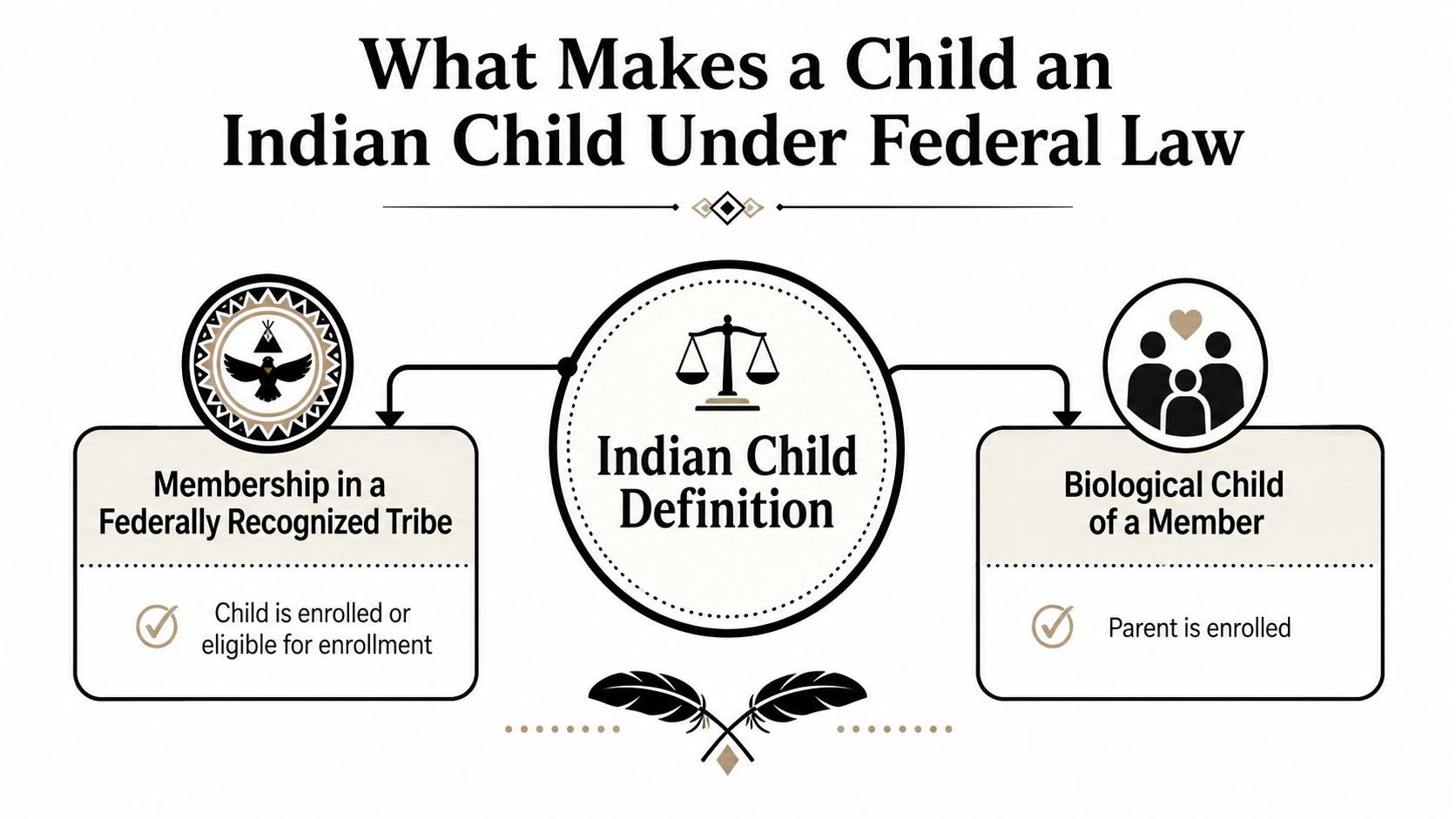
A child can have Native American heritage and still fall outside ICWA. Federal law uses a narrower test. For adoption purposes in Texas, a child is an Indian child only if the child is under 18 and either a member of a federally recognized tribe or eligible for membership and the biological child of a tribal member Texas DFPS ICWA guidelines.
That distinction matters because family history alone does not decide the case. A story about an ancestor, a family surname, or a general statement like “we have Native blood” may raise a question, but it does not answer the legal one. The court and the parties still need proof tied to tribal membership or eligibility under federal law.
A Texas adoption file should treat any hint of Native American heritage as a trigger for early screening. Texas courts are expected to ask at the start of the proceeding whether any party knows of Native American heritage Texas Children's Commission benchbook draft. That first question matters because it tells everyone whether the case follows ordinary state-law adoption steps or whether ICWA procedures may also apply to foster care placement, termination of parental rights, pre-adoptive placement, and adoptive placement.
Families often wonder what proof actually matters. The best place to start is the child's identifying information, the names of parents and grandparents, any tribe the family has mentioned, and any prior enrollment or eligibility records. A tribe may need enough detail to compare the child's information with its own records, so the goal is to gather facts clearly and keep them in one place before memories get fuzzy or relatives give different versions. That is also the point at which a team can onboard a family law paralegal with HireParalegals to help organize records, track names, and keep notice materials in order.
A family law office may also use Who Can Adopt in Texas? Eligibility Requirements to confirm the basic adoptive-parent rules while the ICWA question is being sorted out. The two inquiries are related, but they are not the same. One asks whether the adults may adopt under Texas law. The other asks whether the child's status brings federal protections into the case.
The safest habit is to verify early, document carefully, and wait for the tribe's response before treating the match as ready for final adoption steps. If the child is later found to be an Indian child, the case may need additional notice, different timing, and closer court review.
Tribal Notice and Jurisdiction in Texas Courts
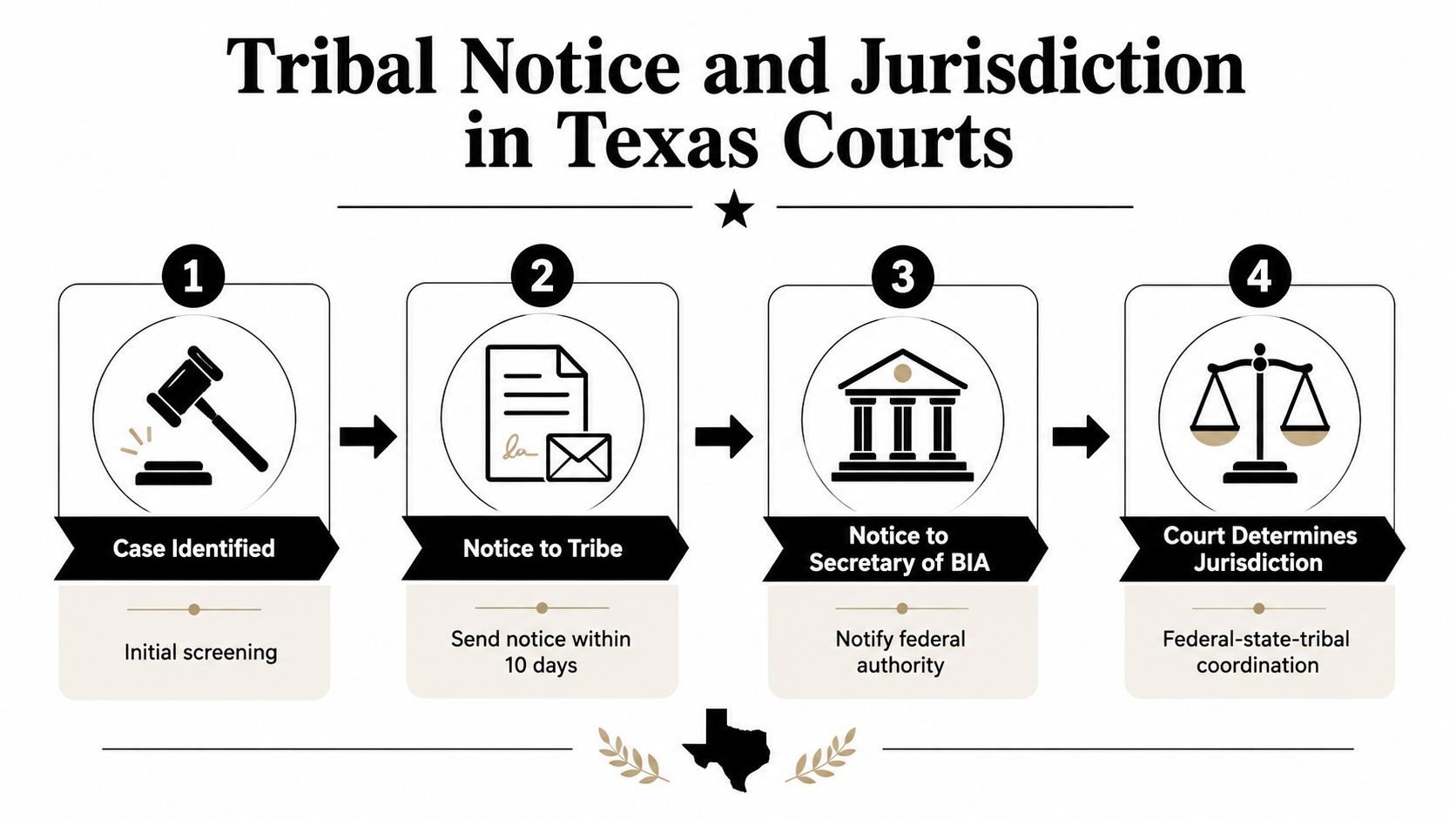
Once ICWA may apply, notice becomes the engine of the case. ICWA applies whenever the court knows or has reason to know an Indian child is involved, and Texas courts are expected to ask at the start of the proceeding whether the child has Native American heritage Texas Children's Commission benchbook draft. That early question matters because it tells the court whether the case stays on an ordinary adoption track or shifts into federal, state, and tribal coordination.
Notice is not a formality. It is how the tribe gets a real chance to respond, verify membership or eligibility, and decide whether it wants to intervene or assert jurisdiction. Texas guidance recognizes that this issue comes up in foster care placement, termination of parental rights, pre-adoptive placement, and adoptive placement, which means the clock can matter long before finalization.
Why late notice causes problems
If notice goes to the wrong tribe, leaves out key family details, or reaches the tribe too late, the case can stall. A judge may have to delay final orders, reopen earlier steps, or require new notice and new findings. That is especially painful in a case where everyone has already bonded and believed the path was clear.
A careful Texas adoption lawyer should think through the notice packet as part of permanency planning, not as an afterthought. The packet needs enough information for the tribe to make a meaningful review, and the record should show when notice was sent and what responses came back. If a tribe intervenes, the case can shift again, because jurisdiction and placement issues can change depending on the child's status and the tribe's position.
Practical rule: A judge can't respect tribal sovereignty if the notice never gave the tribe a real chance to act.
For families working through Texas adoption and Chapter 162 through 166 issues, the family-code process still matters, but it sits beside ICWA rather than above it. A helpful starting point is Texas Adoption and the Family Code Essential Guide for Parents, because the ordinary adoption steps still have to be done correctly even when federal protections are added on top.
Relative and kinship placements can also become part of the discussion here. If a family member is adopting a related child, that fact may affect both the practical placement discussion and the emotional dynamics, but it still doesn't replace notice or verification. If Native heritage is in the picture, the court and the agency need to know early, so the tribe can participate before the file is too far down the road.
ICWA Placement Preferences and Good Cause to Deviate
ICWA changes more than notice. It changes who has priority to adopt, and that can reshape a Texas case quickly once Native ancestry is verified. The federal preference order starts with extended family, then other members of the child's tribe, then other Indian families Texas Children's Commission benchbook on placement preferences.
That order can feel upsetting to a non-Indian foster or pre-adoptive family that has already cared for the child. It can also bring relief to a relative who wants the child to stay connected to family and tribe. Texas courts have to sort through those realities on the record, not by assumption or hallway conversation. If a judge departs from the preference order, Texas bench guidance says the court needs good cause backed by clear and convincing evidence in the record or in writing.
A Texas adoption file can go sideways when a child is first treated as not covered by ICWA, then a tribal connection surfaces later. By then, a family may already have bonded, the placement may already feel settled, and everyone may be reacting to a case that should have been screened earlier. That is why early verification matters so much in Texas, because a late-discovered tribal tie can change who must be notified, who gets to weigh in, and which placement options the court must consider.
A Texas example
A child is placed with a foster family in North Texas. Months later, after tribal verification, an aunt steps forward. The foster family may have built a strong bond, and the aunt may have a strong kinship claim as well. ICWA does not let the court pick the placement that feels easiest. The court must apply the preference order and decide whether the record supports a departure.
That is why families and lawyers need to prepare early. If a family is asking the court to keep a non-preferred placement, the file should explain why that placement serves the child and why the preferred option is unavailable or not workable. If a family is defending a preferred kinship placement, the record should show the relationship, the commitment to the child, and the tribe's role in the analysis.
What good cause looks like in practice
Good cause is not a general feeling that one home is more comfortable than another. It has to rest on evidence the court can review. A stronger record makes it less likely that the adoption will be delayed, reopened, or challenged later.
Courts do not want a summary of preferences, they want a documented reason for the placement choice.
For a relative and kinship adoption in Texas, that point matters a great deal. A kinship caregiver may already be a strong placement candidate under Texas family law and still have to fit within the federal preference structure. The two systems can work together, but only if the facts are gathered carefully and the court has a clean record to rely on.
Active Efforts and the Standard of Proof
An involuntary ICWA case asks the court to do more than weigh competing stories. The party seeking to maintain the challenged placement must prove by clear and convincing evidence, with testimony from at least one qualified expert witness, that continued custody by the parent or Indian custodian is likely to cause serious emotional or physical damage to the child.
That standard changes how a Texas case should be built. The proof cannot be generic, and the expert cannot be just any professional who happens to know child welfare. The court needs a witness who can speak from real knowledge about the child's circumstances and the ICWA setting. Depending on the facts, that may be a tribal elder, a social worker with ICWA training, or a mental health professional familiar with Indian child welfare.
A useful way to prepare is to treat the file like a timeline. If a judge later asks what was done, the record should answer clearly, step by step, without forcing anyone to guess.
What families and attorneys should document
The record should show more than disagreement or frustration. It should show the specific steps taken to support the family, the child, and any reunification efforts. That is the heart of the active efforts requirement, because courts want to see documented, good-faith work to keep the Indian family together before a drastic remedy is ordered.
For Texas families, that means gathering evidence early, while the facts are still fresh and the notices are still traceable. A lawyer handling an ICWA matter should think about what a judge will need to see later, not just what sounds persuasive in the moment.
- Family support steps: Keep track of services, referrals, transportation help, and communication with the family. If a service was offered but not used, note why and whether a different support was tried.
- Tribal involvement: Record who was notified, when notice was sent, how it was delivered, and how the tribe responded. If the child's heritage was learned late, preserve that timeline too.
- Expert preparation: Line up a qualified expert early enough to review the history, not just the day before hearing. The expert should be able to connect the facts to the federal standard, not just repeat what others have already said.
- Court record: Make sure the file shows what the judge relied on, because later review often turns on the paper trail. Clear minutes, affidavits, notices, and hearing notes can matter as much as testimony.
Families often get tripped up by early misclassification. A child may first appear to be outside ICWA, then a late-discovered tribal connection changes the case posture, and the missing notices or incomplete records become the problem. That is why the safest approach is to document before the match feels settled, especially when the child may have a Native family line that has not yet been fully confirmed.
A voluntary adoption does not use the same proof structure, but the paperwork still has to be clean. For consent forms and court filings, families often review Texas consent to adoption forms and filing guidance alongside their ICWA plan so the voluntary side of the case matches the federal side.
Consent, Voluntary Relinquishment, and the Role of DFPS
A Texas adoption can change shape quickly once Native heritage enters the picture. A parent may sign a voluntary consent, a court may hear an involuntary termination case, or DFPS may be managing a CPS matter that is moving toward permanency. Each path follows its own rules, but if the child is an Indian child, ICWA still controls the parts of the case that federal law reaches.
Voluntary adoption paperwork has its own timing and courtroom requirements. Consent must be in writing, before a judge, fully explained, and signed only after the child is more than 10 days old. That timeline matters because adoption paperwork works like a lock on a door, if one piece is rushed, the whole file can become harder to trust later, especially when tribal status has not yet been checked.
Texas's broader permanency numbers show why families need to slow down and document each step. Texas finalized 5,168 adoptions in 2020, 4,546 in 2021, and 4,361 in 2022, while children waiting for adoption declined from 12,290 in 2020 to 6,124 in 2024 and AI/AN children accounted for 0.2% of the relevant child-welfare race/ethnicity category in each year from 2020 through 2024 Texas Child Welfare Outcomes data for Texas. Those numbers do not change the legal test, but they do show how much care Texas courts and agencies have to give to every file that includes Native heritage.
A voluntary case can still go off track if the parties rush the consent before tribal verification is complete.
DFPS cases add another layer because the agency, the child's attorney, the family's lawyer, and the tribe may all need to work from the same set of facts. If the case starts with a mistaken assumption about heritage, the agency plan, placement choices, and final paperwork can all need to be reworked later. Families often review law guidance on adoption consent paperwork before they sign anything, because the consent form has to fit the rest of the record and not sit apart from it.
A clean voluntary file should show who signed, who explained the form, and whether the child's possible tribal connection was checked before final consent. If the adoption is tied to DFPS, the record should also show how the agency handled notice, placement decisions, and any tribal communication that may affect finalization. When Native heritage is confirmed late, the consent may still be valid, but the surrounding record has to be strong enough to show that the family and the court did not guess their way through the process.
Your Texas ICWA Adoption Checklist From First Call to Final Order
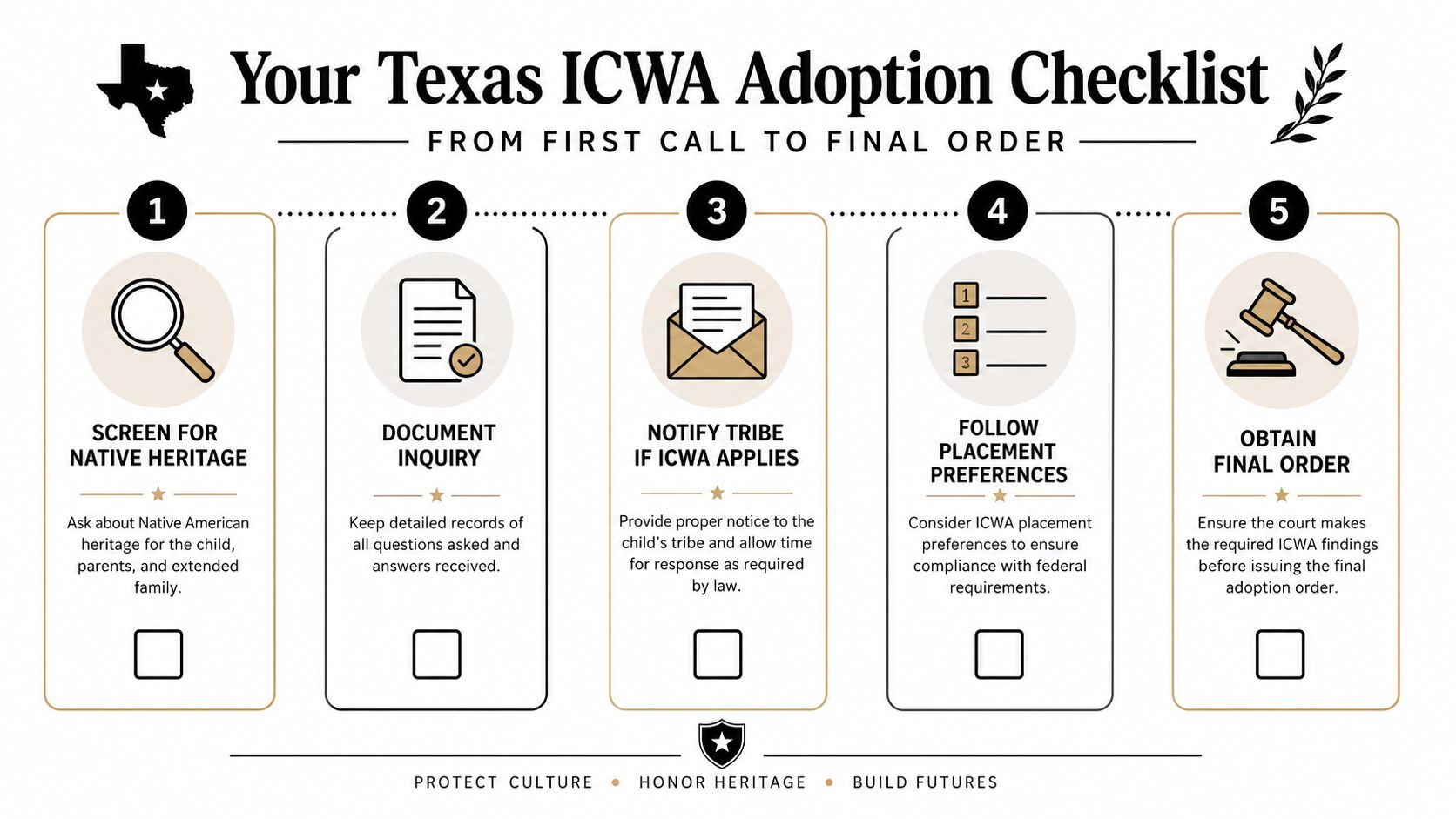
The safest ICWA case starts before anyone falls in love with the wrong assumptions. First, ask about Native heritage at the very beginning and write down the answer, even if it seems uncertain. Second, bring in a Texas family law attorney who knows ICWA before the match agreement is signed, because the legal route can change fast once tribal verification starts.
Third, make sure the home study reflects ICWA-aware planning. Fourth, if ICWA might apply, send proper tribal notice with enough lead time and enough family information for the tribe to respond. Fifth, gather verification letters from any potentially affiliated tribe so the court record shows the child's status was checked, not guessed.
What belongs in the file
A clean file usually contains the family inquiry, any tribal response, the notice package, and the placement reasoning. If the case is voluntary, the consent documents also need to meet the timing and court-explanation rules. If the case is involuntary, the record needs the expert testimony and the active-efforts proof the judge will rely on later.
Practical rule: If the final order can't show notice, status, placement analysis, and consent or proof, the case is not finished yet.
Families also need to be ready for timing surprises. A tribe may respond after the home study, after a match, or even close to finalization. When that happens, the right move is not panic, it's pause, verify, and adjust the plan so the child's permanency is still legally sound.
For families who need help finding old case materials or adoption records, how to find adoption records in Texas can be a useful starting point when the heritage question surfaces late. Missing paperwork is common in older or informal family histories, and records often fill in the details that memory leaves out.
The deeper reason this checklist matters is simple. ICWA grew out of a real crisis, when 25% to 35% of Native American and Alaska Native children were being removed from their homes and about 85% were placed outside their families and communities even when relatives or Tribal members were available NICWA overview of ICWA. Texas families do best when they treat that history with respect, then build a file strong enough to support a child's permanent home.
A late-discovered tribal connection does not mean your adoption is doomed. It means the case needs careful correction, honest documentation, and a court record that respects both the child's best interests and tribal sovereignty. If you are navigating adopting a child with Native American heritage in Texas, the safest move is to slow down, verify status, and prepare every notice and consent the right way before finalization.
When a family learns about possible Native ancestry late in the process, the hard part is usually not emotion, it's timing. The biggest risks are early misclassification, late or informal notice, and assuming a match can move forward without tribal verification. The fix is to correct the record quickly, stay in communication with the agency or court, and make sure every legal step lines up with ICWA and Texas adoption law.
If you're dealing with a Texas adoption that may involve tribal membership, eligibility, or late-discovered heritage, the Law Office of Bryan Fagan, PLLC can help you understand the process, organize the record, and move forward with a plan built around your child's best interests. Schedule a free consultation so you can get clear guidance before the next filing, hearing, or consent deadline puts your family at risk.
