
Yes, Texas generally requires a home study for an adoption, but whether you need a brand-new one or just an update depends on the type of adoption and how recent your last study is. If you're holding a sleeping toddler and wondering whether you have to start the paperwork all over again, you're not alone, and the answer is usually more flexible than people expect.

Welcome Texas Parents Thinking About a Second Adoption
A second adoption can feel emotionally bigger than the first. You already know the paperwork, the waiting, the questions, and the hope that comes with building a family, so the idea of doing it all again can hit hard. The good news is that Texas does not treat every second adoption like a brand-new family from scratch.
The question is not just “Do you need a new home study to adopt a second child in Texas?” It's also, what kind of adoption are you pursuing? A private domestic placement, a foster-to-adopt case, a stepparent adoption, a kinship adoption, and an international adoption can all trigger different rules.
Texas law still expects a home study before adoption approval in the general adoption process, and child welfare guidance says the evaluator must look at all applicants, household members, and children in the home. That means the state is checking whether your home still supports a child safely and well, not punishing you for already being a parent. The process is really about current readiness, which is why a later adoption often turns on whether your previous study is still current.
Practical rule: A second adoption usually calls for a fresh look at the family, but not always a completely new start.
For many families, the key issue is timing. For others, it is whether a judge can waive a study, whether a prior study is still valid, or whether an update will cover the changes since the first adoption. If you want a clear map, the next sections separate the five common Texas paths so you can find the one that fits your family and stop guessing.
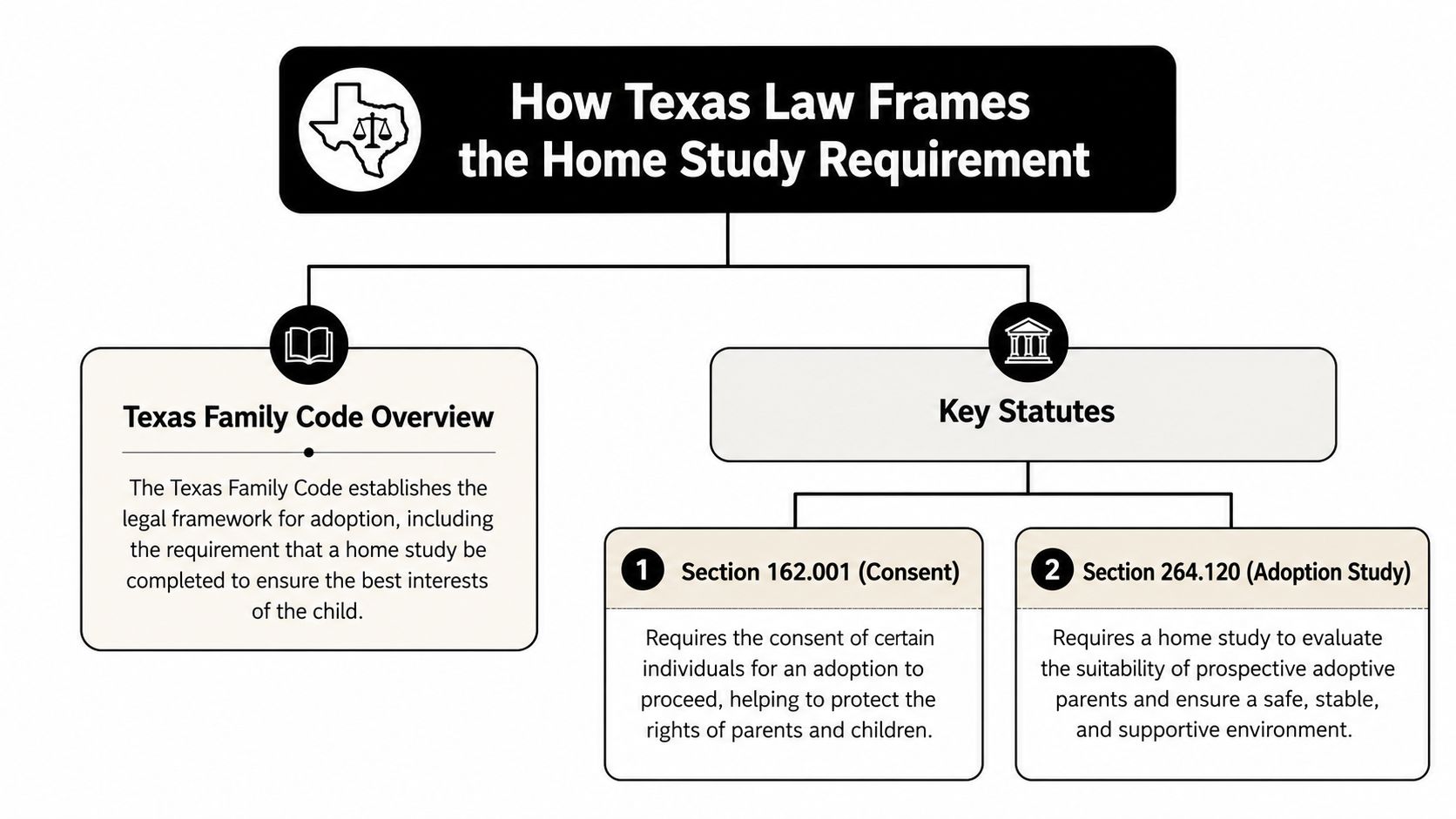
How Texas Law Frames the Home Study Requirement
Texas starts with a simple legal question, does the court have enough information to decide whether the adoption serves the best interests of the child? Under Texas Family Code Chapter 264, the department must complete a home study before approval for adoption. Child welfare guidance explains that the evaluator interviews the adoptive parents, children age 4 or older in the home, and anyone else living there, then completes at least one home visit. The home study also has to cover the household members, not just the adults on the application, because the court is looking at the whole family system. Texas Family Code § 264.207
For families trying to figure out Texas home study requirements for prospective parents, this part of the process works like a current snapshot of the home, not a memory of how things looked during the first adoption. The evaluator is checking safety, space, support, and stability. Texas also expects the study to stay current, so if the child does not begin living with the adoptive parents within 6 months after the evaluation is completed, the evaluation must be updated within 30 days before placement. That rule shows how seriously the state treats what is happening in the home right now. Texas home study requirements for prospective parents
Where House Bill 461 changed the picture
Texas also changed second-parent adoption practice with House Bill 461, which amended Texas Family Code § 107.153. Judges now have discretion to waive the home study requirement in some second-parent adoptions when the child already lives with both parents and the facts make a waiver appropriate. Before that change, families often assumed the home study was required in these cases. Now the answer depends more on the facts of the case. Big changes to second-parent adoption requirements in Texas
That flexibility does not remove the rest of the process. Background checks and a final adoption hearing still remain part of the path. For readers comparing adoption routes, The Texas Adoption Process Step by Step lays out the six core stages from type selection to final decree, which helps place the home study in the larger legal sequence.
The home study tells the court one thing above all else, whether the home still meets the child's needs today.
How the Answer Changes by Adoption Type
The home-study answer changes a lot once you identify the adoption path. A family adopting through a private agency usually faces a different question than a foster parent finalizing a placement, and both are different from a stepparent case where the child already lives in the home. That's why Texas families do better when they sort the case first and the paperwork second. Types of adoption
| Adoption Type | Typical Study Required | Notes |
|---|---|---|
| Domestic private adoption | Usually a new study or a current update | The court and agency still want a current family assessment. |
| Foster-to-adopt | Often an updated service or adoption assessment | The path usually builds on the foster case record. |
| Stepparent adoption | Sometimes waived by the judge | House Bill 461 made the waiver question case-specific. |
| Relative or kinship adoption | Sometimes simplified, sometimes full | The court may tailor the evaluation to the family situation. |
| International adoption | Usually a fresh, country-specific process | U.S. and foreign requirements can both apply. |
For private domestic adoption, families often need a current home study even if they adopted before, because the court is reviewing a new placement and a new child's best interests. In foster-to-adopt situations, the family record already exists in the child welfare system, so the final adoption step may rely on an updated assessment rather than a full repeat of everything.
Stepparent adoption is where House Bill 461 matters most. A judge may waive the home study when the child is already living in the family and the case fits the statute. Relative and kinship adoptions often move more flexibly too, though the court can still ask for a focused evaluation. International adoption is its own lane, because the family may need to satisfy both U.S. and foreign-country requirements, which makes the home-study question more layered than in a local Texas case.
When an Update Is Enough Instead of a Brand-New Study
Texas gives families a real path to avoid repeating everything from scratch when the prior study is still current. One Texas adoption resource says a home study is valid for one year from completion, and if the family is not placed with a child within that time, the study needs an update. It also says if the child doesn't begin living with the adoptive parents within 6 months after the evaluation, the evaluation must be updated within 30 days before placement. Texas adoption home study
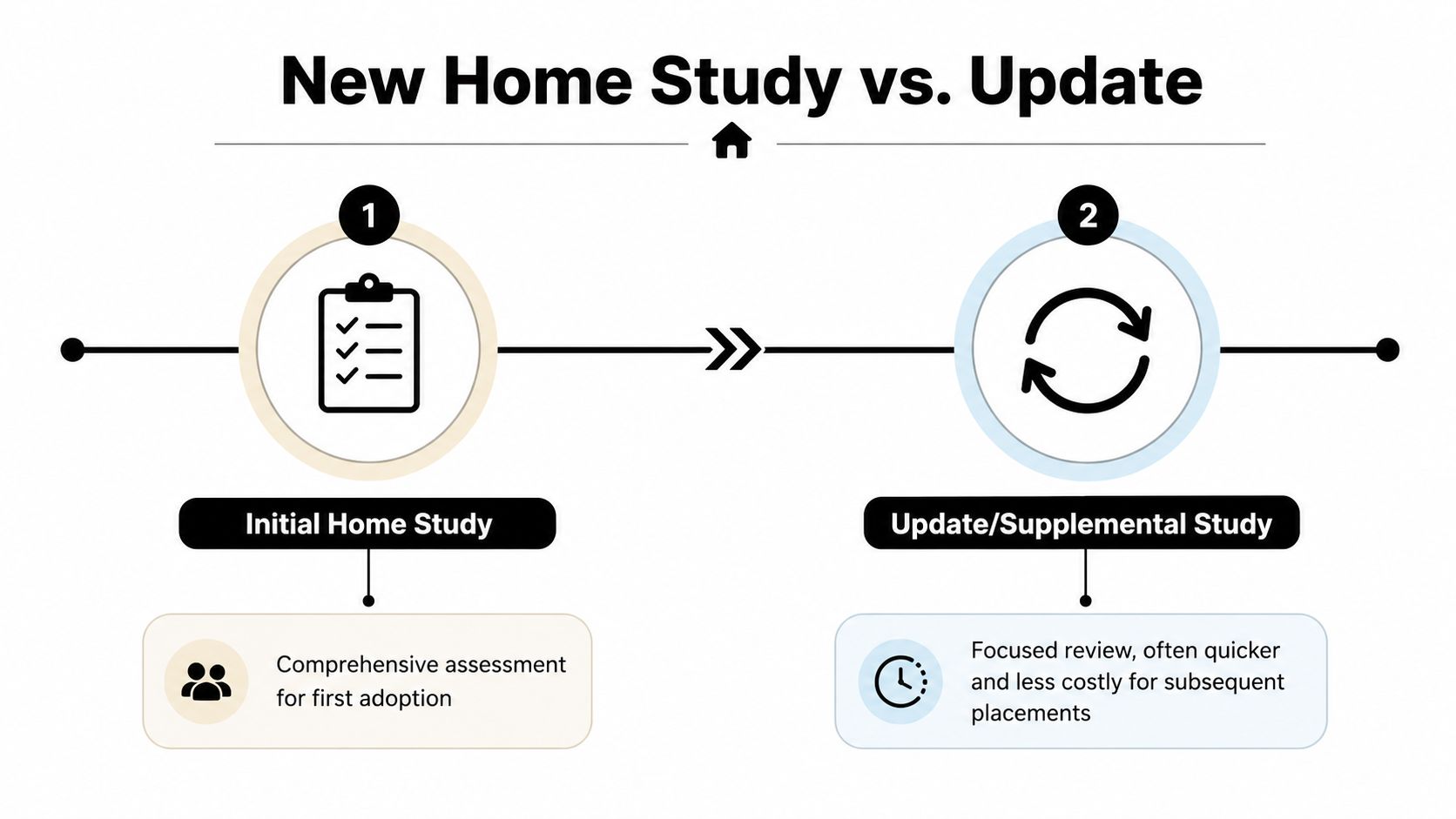
That update is usually narrower than the original study. It focuses on what changed, like household membership, health, income, references, or background-check status. In plain English, the court is asking, “Is this still the same safe home we reviewed before?” If the answer is yes, an update may be enough.
A quick way to think about it
- New study: Used when the prior study is expired, the adoption path demands a fresh assessment, or major changes make the old report unreliable.
- Update or supplemental study: Used when the original study is still recent and the family just needs current information added in.
If you're moving from one adoption to another and your last study is still within the valid window, the attorney or agency may only need updated documents and a new visit. If a lot has changed, such as a move, a new child in the home, or a long delay since the last placement, the court may want a fuller refresh. That is often where families save time by checking the date first instead of assuming the whole process has to restart.
A Texas Family's Second Adoption Story
The Martinez family already knew how adoption paperwork could fill a kitchen table. They adopted their first child through a private agency two years ago, and when they started thinking about adopting a second child, they weren't sure whether they'd have to repeat the whole home-study process. Their first call was to an adoption attorney, because they wanted a straight answer before they spent money chasing the wrong paperwork.
Their situation changed when they decided the second adoption would happen through the Texas foster care system instead of a private agency. That mattered. The family did not need to rebuild the entire file the way they had the first time, but they did have to update the information that had changed since their first adoption. The caseworker still needed current background checks, recent records, and a fresh look at the home.
They felt the emotional pull of both relief and fatigue. Relief, because they weren't starting over. Fatigue, because even a smaller set of forms can feel heavy when you've already lived through one adoption journey. They also had to wait on background-check renewals and coordinate schedules with the caseworker, which is often the part families remember most clearly.
A useful example of how family-law marketing can explain complicated services can be seen in this family law firm SEO success story. Different subject, same lesson, people respond when the process is explained in plain English.
The Martinez family's biggest takeaway was simple. A second adoption can be emotionally familiar and legally different at the same time. They did not have to start from zero, but they also could not assume the first study automatically carried them all the way through the second case.
Documents and Background Checks You Should Gather
Texas home studies move faster when families prepare the paperwork early. The evaluator is trying to confirm identity, stability, health, and support, so the best file is the one that already answers the obvious questions. A neat folder on the counter can save a lot of back-and-forth later. Essential required documents for Texas adoption home study
Common items families are often asked for
- Proof of income: Pay stubs, tax records, or other financial records that show how the household is supported.
- Medical statements: Health information that helps the evaluator understand the adults' ability to parent.
- Marriage and birth certificates: Basic identity documents that support the file.
- Reference letters from nonrelatives: People outside the household who can speak to your character and parenting.
- Proof of residence: A lease, mortgage record, or similar document showing where the child will live.
Texas adoption guidance also says household members age 14 and older generally need background checks, including fingerprinting and abuse or neglect registry review. The evaluator also interviews each adoptive parent, each child age 4 or older in the home, and any other person living there, plus conducts at least one home visit. Texas home study requirements for prospective parents
Practical rule: If you know a background check or reference has aged out, replace it before the home study appointment.
The goal isn't to make families jump through hoops. It's to make sure the court gets a current picture of the home the child is joining. For a second adoption, that picture often starts with documents you already have, then adds the updates that show what's changed since the first child came home.
Common Pitfalls and How to Avoid Them
The biggest mistake families make is assuming the answer is the same for every adoption. A waiver in a stepparent case does not automatically help a private adoption, and an old study that worked once may not still be valid. That's where careful timing matters more than optimism.
Common missteps and better moves
- Letting the study expire: Don't assume the old file still works. Check the completion date and ask whether an update is enough.
- Missing the 30-day window: If placement is delayed after the evaluation, calendar the update requirement early so the family isn't scrambling at the end.
- Assuming a waiver applies automatically: A judge has discretion in some second-parent cases, but that does not mean every case gets the waiver.
- Forgetting older household members: Texas looks at the full household, including children age 4 or older for interviews and household members age 14 and older for background checks.
- Trying to push through without legal review: Adoption paperwork feels manageable until one document blocks the final hearing.
A lot of stress comes from comparing the second adoption to the first one. The process may be shorter, or it may just be different. Either way, a careful review of the old home study, the new placement, and any household changes usually prevents bigger delays later.
If you're feeling worn down, that reaction makes sense. Adoption asks a lot of families, and the paperwork can feel especially heavy when your heart is already full.
Your Next Step Toward Growing Your Texas Family
The shortest honest answer is this. Texas generally requires a home study for adoption, but a second adoption may only need an update, a waiver, or a new study depending on the path and the timing. The one-year validity rule matters, the 30-day update rule matters, and House Bill 461 gave judges more flexibility in some second-parent cases.
If you want one clean next step, gather the date of your last home study, identify the type of adoption you're pursuing, and ask an attorney to compare those facts against the current Texas process. Families often do the same thing with long-term planning in other areas of life too, including a guide to life insurance for families that helps them think ahead while they're building stability at home.
A calm review now can save time, money, and stress later. It also keeps the focus where it belongs, on the child's best interests and the family unity you're trying to build.
Law Office of Bryan Fagan, PLLC helps Texas families sort through adoption questions like home studies, updates, waivers, and final hearings with clear legal guidance. If you're asking whether you need a new home study to adopt a second child in Texas, visit Law Office of Bryan Fagan, PLLC to schedule a free consultation and get a plan designed for your family.
