
Texas does not offer a separate state adoption tax credit. For 2026, Texas families who qualify are usually looking at the federal adoption tax credit of up to $17,670 per eligible child, with eligibility tied to modified adjusted gross income, filing status, and the type of adoption.
That answer usually brings relief, because it clears up one of the biggest points of confusion. A Houston couple finishing a private infant adoption, a San Antonio relative caring for a niece, and a Dallas stepparent all tend to ask the same question in different ways, and the short version is the same, the Texas piece is not a separate credit, it's the federal one on IRS Form 8839. For families trying to plan around adoption costs, that distinction matters just as much as the paperwork.
What Texas Families Should Know About the 2026 Adoption Tax Credit
A lot of Texas parents search for the Texas adoption tax credit who qualifies 2026 and assume the state must have its own special rule. The important correction is simple, Texas does not offer a separate state adoption tax credit, so the benefit most families are talking about is the federal Adoption Credit. For 2026, that credit is projected at $17,670 per eligible child. It is claimed on federal tax forms, not through a Texas-specific adoption credit system, and Texas residency by itself does not create a separate benefit. See the broader family support resources on adoption grants in Texas.
A young couple in Houston might be finalizing a private infant adoption and wondering whether they missed a Texas form. A grandmother in San Antonio might be adopting a grandchild through kinship placement and asking the same thing after hearing neighbors mention “the adoption tax credit.” A Dallas stepparent might be trying to figure out whether the IRS treats that adoption the same way as a foster care case. The answer is that these families may all look to the federal credit, but the rules change based on income, filing status, and adoption type.
Practical rule: start by checking whether your adoption fits the federal rules, because Texas doesn't add a separate credit on top.
The rest of the process gets much easier once that point is clear. Texas Family Code adoption procedures, especially Chapters 162 through 166, still matter because they control the legal path to finalization, consent, and termination of parental rights. The tax credit doesn't replace those steps, it helps qualifying families offset part of the cost after the adoption process is underway or complete.
How the Federal Adoption Credit Works in 2026
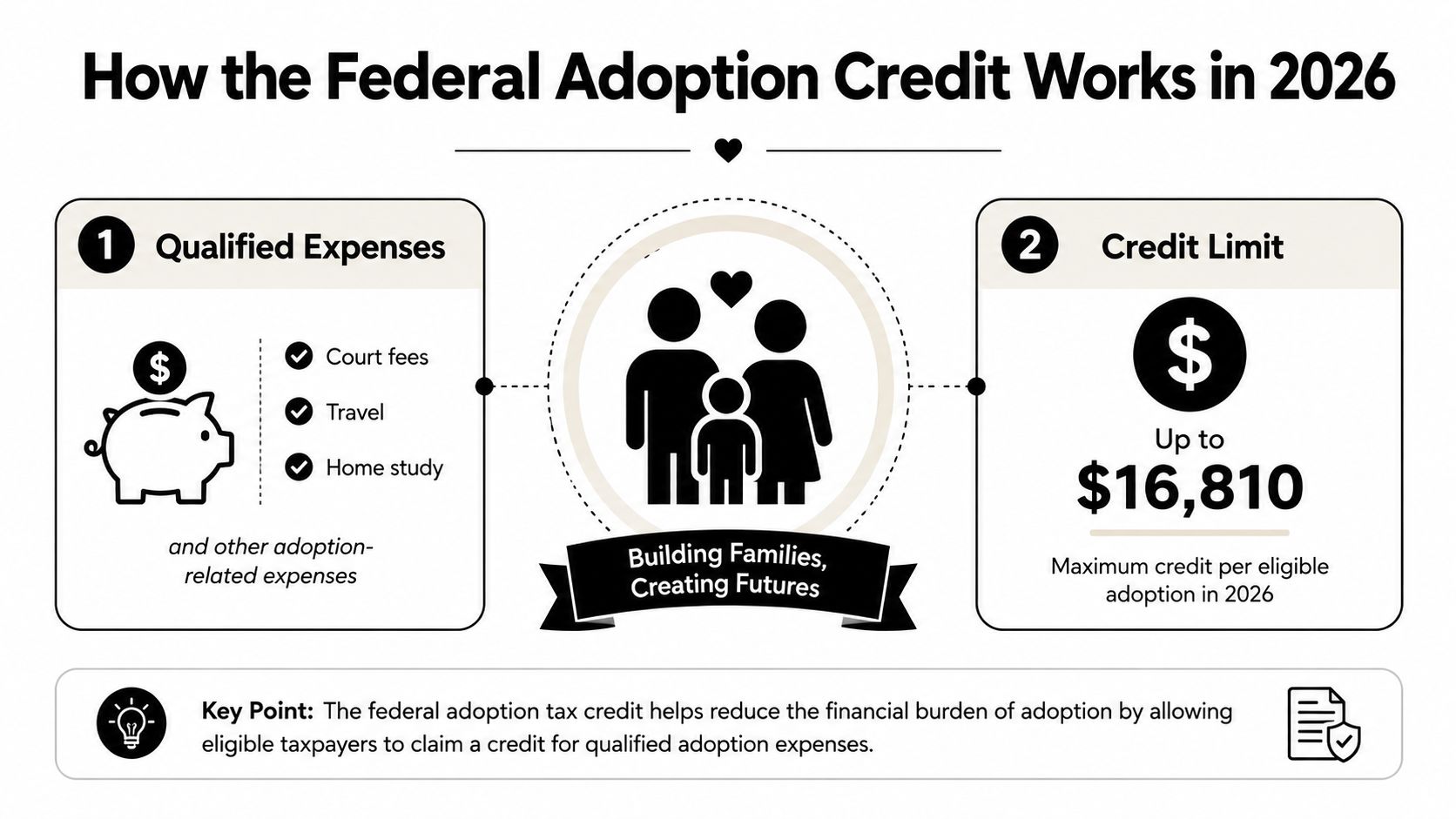
The federal credit is built to help with qualified adoption expenses, which generally include things like agency fees, attorney fees, court costs, and travel that is directly tied to the adoption. The IRS also uses Form 8839 to track the credit, and the adoption credit is tied to the taxpayer's return, not to a separate Texas filing. For Texas families, that usually means keeping a clean folder with receipts, court papers, and any employer-related adoption assistance records.
Some expenses don't qualify. Surrogacy-related expenses are outside the credit, and so are expenses paid by an employer or by an adoption assistance program when those payments are already covered elsewhere. The IRS also treats an adoption of a spouse's child differently, which matters in stepparent cases. For families navigating the legal process, Termination of Parental Rights Before Adoption is the necessary first step in most adoptions, because the child can't usually be adopted until the legal ties to the other parent have been addressed.
Why special needs cases can matter so much
For a child with special needs, the tax result can be very different. The IRS can treat the family as though it incurred the full $17,670 of qualified expenses even when the family's actual out-of-pocket costs were lower. That can be especially important in CPS-related adoptions, where the legal and emotional work is often heavy even when the direct costs are smaller.
Keep every receipt, decree, and support letter together. Families often lose the credit on paperwork, not on eligibility.
One more practical point. The 2026 projection includes a refundable portion, so some families can benefit even if their tax liability is not large enough to absorb the whole credit at once. That makes the filing details matter just as much as the adoption itself.
The Core Eligibility Rules Every Texan Must Pass
The federal credit is not automatic. Texas families have to clear three filters, income, filing status, and adoption type, before the IRS will allow the credit. For tax year 2026, the credit is available only if your MAGI is below $265,080, it phases out from $265,081 to $305,079, and it disappears at $305,080 or above. The IRS calculates this at the taxpayer level, which means one household member's income can affect the whole return if the couple files together. The credit is claimed on Form 8839, and married taxpayers generally must file jointly to claim it.
| Filter | 2026 Rule | What It Means for Texas Families |
|---|---|---|
| MAGI | Below $265,080 for full eligibility, then phaseout to $305,079 | Higher-income households may lose part of the credit or all of it |
| Filing status | Married taxpayers generally file jointly | Filing choice can affect whether the credit is available |
| Adoption type | The child can't be a spouse's child | Stepparent adoptions usually don't qualify |
A simple example helps. A family with $250,000 in MAGI is below the phaseout range, so they may claim the full credit if the adoption itself qualifies. A family with $300,000 in MAGI is in the phaseout range, so they may still get part of the benefit, but not the full amount. Once a family reaches $305,080 or more, the credit is gone for that year.
The citizenship and residency rules can also matter, especially in international cases. The child and the taxpayer must fit the federal adoption framework, and the IRS doesn't treat every family structure the same way. That's why a Texas family can do everything right in the court process and still need careful tax planning before filing.
Which Adoption Types Qualify in Texas

Texas families often assume the credit turns on how much love and work went into the adoption. The IRS looks more narrowly than that. Private domestic infant adoption usually fits the credit rules, foster care and CPS adoption can fit as well, kinship adoption can qualify, and international adoption can qualify once the federal requirements for the child are met. For a closer look at the legal family types, the page on types of adoption is a helpful companion.
Stepparent adoption is the most common point of confusion. The federal credit does not apply when the child is the spouse's child, so a stepmom or stepdad usually won't claim this credit for that adoption. Adult adoption also does not qualify. That can feel disappointing, especially when the family has gone through a long court process, but the tax rules are written around the child relationship, not the emotional length of the journey.
Special needs and foster cases deserve a closer look
For some Texas CPS adoptions, the special needs rule can make a major difference. When a child is treated as having special needs under the IRS framework, the family may be able to claim the full credit amount even if the out-of-pocket expenses were lower. That matters in foster and permanency cases, where the biggest costs are often not the largest invoices.
A few practical yes-or-no examples
- Private infant adoption: usually qualifies if the rest of the federal rules are met.
- Kinship adoption by a relative: can qualify, which is important for grandparents, aunts, uncles, and other caregivers.
- Stepparent adoption: usually does not qualify because the child is the spouse's child.
- Adult adoption: does not qualify.
- International adoption: can qualify, but the timing and citizenship or residency rules matter.
A family can also be perfectly eligible and still miss the benefit if they assume every adoption works the same way. That's why the category of adoption matters just as much as the court order.
The legal process matters too. In Texas, Chapters 162 through 166 of the Family Code govern the road to finalization, including consent and termination issues, and those steps often determine whether an adoption can move forward at all. Adoption is both a family decision and a legal sequence, and the tax credit follows that sequence.
What 2026 Means for Adoptions That Span Tax Years
The hardest timing question is usually this, which year counts? The IRS ties the credit to the year you paid the qualifying expenses, and some families can also claim it after finalization depending on the adoption type and timing. That means a family that paid most agency fees in 2025 but finalized in 2026 may need to look at both tax years. A family that finalized in 2025 but still paid qualifying expenses later may have a separate 2026 issue to review.
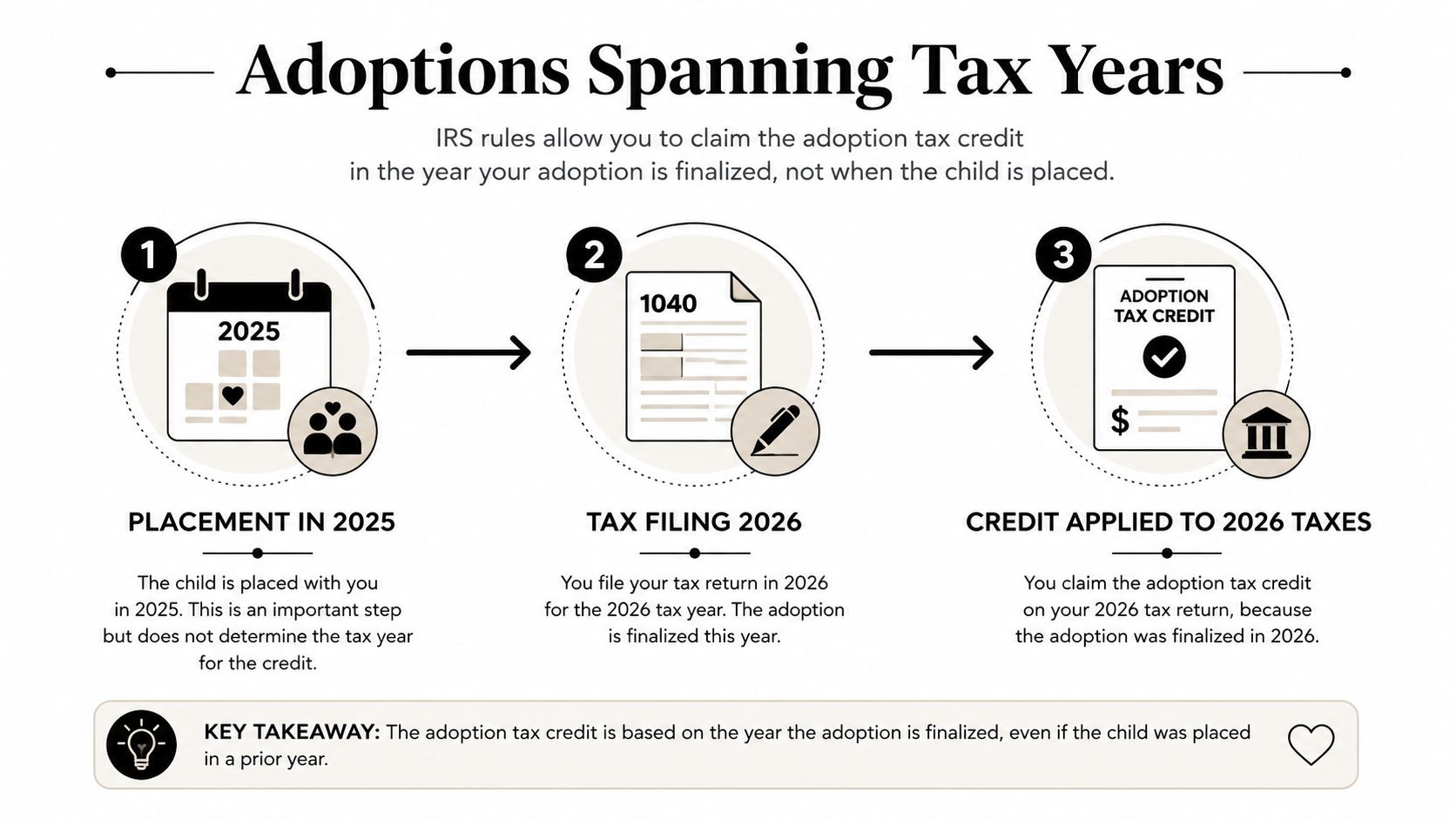
The safest way to think about it is this, the credit follows the tax year of the expense or the allowed filing year connected to the adoption, not just the final decree date. That's why families who adopt across year-end need to keep a timeline of every payment. If a family learns later that they were eligible, an amended return may be part of the solution.
A missed year can mean a missed benefit, especially when expenses and finalization happen in different calendar years.
There's also a carryforward rule. If the family is eligible but cannot use the full credit right away, the unused amount can be carried forward for up to five years. That can make a big difference for families whose tax liability changes after the adoption is complete. The main mistake is assuming the clock starts and ends only with the court date.
Think of a family that finalizes late in the year after paying part of the adoption costs earlier. They may need to sort the return by payment date, not by emotion or by the date everyone came home together. In adoption, those dates are often close, but for tax purposes they aren't always the same.
Documents and Forms Needed to Claim the Credit
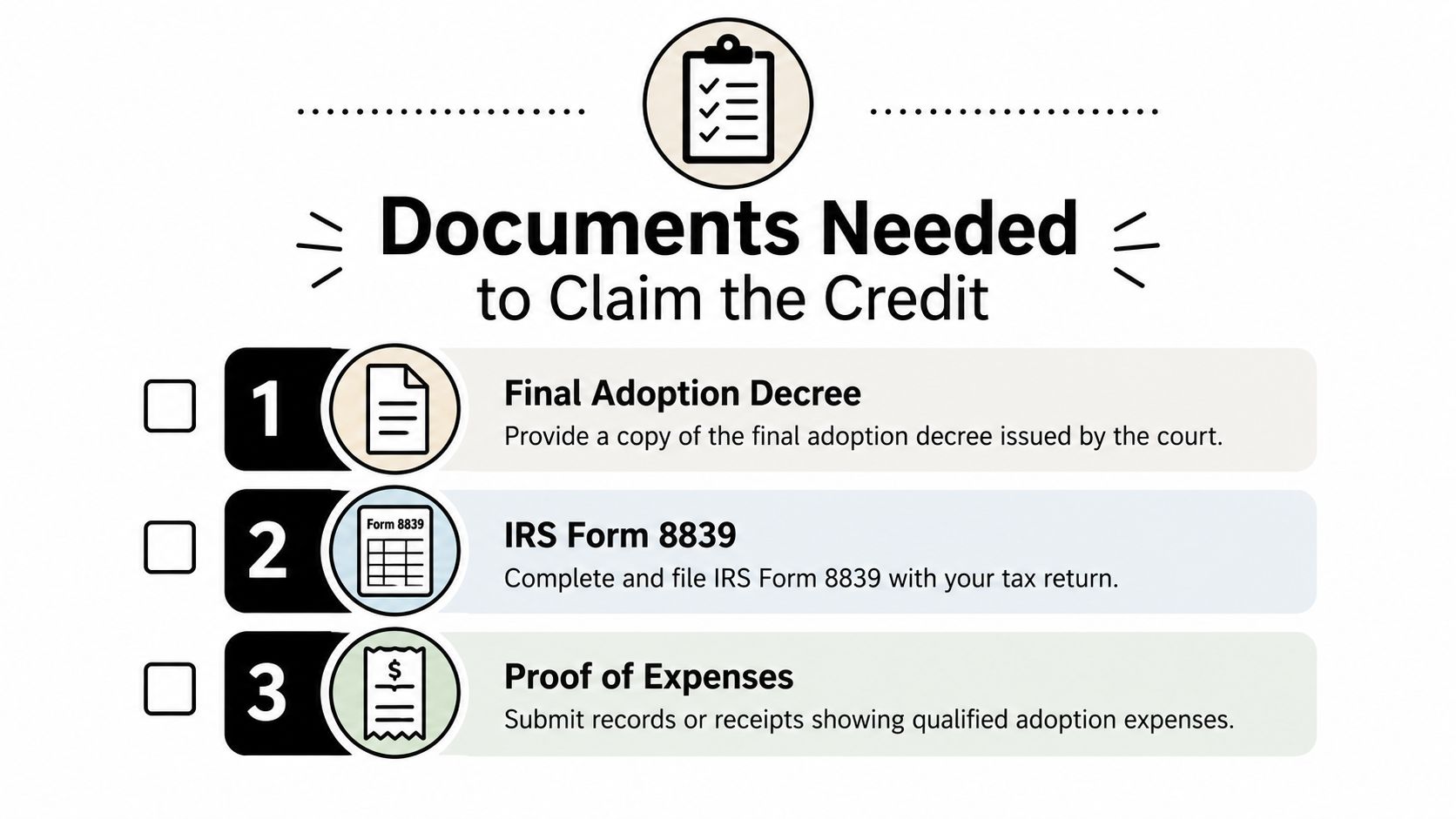
The IRS will want proof, not just a heartfelt explanation. At a minimum, families should gather the final adoption decree, receipts or canceled checks for qualified expenses, and the completed Form 8839. If the employer offered adoption assistance, the W-2 and any related statement matter too, because those payments can change how much of the credit remains available.
For cases that involve special needs or foster adoption, the supporting court order or subsidy paperwork may also be important. Families should keep the child's identifying information, including date of birth and taxpayer identification details, with the tax file. If the return needs a refundable credit calculation, Schedule 8812 may also come into the picture.
A calm filing checklist
- Final decree: keep the signed court order in one folder.
- Expense proof: keep receipts, invoices, and canceled checks together.
- Tax forms: save Form 8839, and any related schedule the return requires.
That same habit helps with other family paperwork too. If your adoption or guardianship team is still collecting documents, it can be useful to automate W-9 collection for vendors and service records so the paper trail stays organized from the start.
Keep the records for at least three years. That gives you room if the IRS asks questions later, and it gives your tax preparer a cleaner file if a return needs to be amended. Families are often exhausted by the time the adoption is final, so a simple document system can save a lot of stress at tax time.
Common Myths and Pitfalls That Cost Texas Families Money
The first myth is the one that starts this whole search, that Texas must have its own credit. It doesn't. If you keep looking for a Texas-only Form 8839 equivalent, you can waste time and miss the federal rules that control the benefit.
The second myth is that a stepparent adoption automatically qualifies because it is still an adoption. The IRS doesn't treat it that way, because the child is the spouse's child, and that rule takes the credit off the table for many stepfamilies. The legal adoption may still be meaningful, but the tax result is different.
The third myth is that the credit always functions like a simple refund. It usually doesn't. The federal adoption credit can reduce tax liability, and under the 2026 rules there is also a refundable portion, but families still need to plan carefully if they owe little or no federal tax.
The most expensive mistakes
- Claiming the wrong year: the expense year matters, not just the finalization year.
- Ignoring amended returns: if you learn later that you qualified, the original filing may need to be corrected.
- Losing proof: missing receipts, decrees, or employer records can delay or derail the claim.
- Assuming every adoption type qualifies: stepparent and adult adoptions are common examples of nonqualifying cases.
If you're helping a child through CPS, a relative placement, or a private infant adoption, the best move is to match the legal path to the tax rule before filing. That keeps the family focused on permanency and the child's best interests instead of a last-minute tax scramble.
Your Next Step With a Texas Adoption Attorney
The key takeaways are straightforward. Texas has no separate state adoption tax credit, the 2026 federal credit is projected at $17,670 per eligible child, and eligibility depends on income, filing status, and adoption type. Those rules can look simple on paper and still feel confusing when you're living the adoption process.
A Texas adoption attorney can help you line up the legal steps and the financial ones at the same time. That matters in private infant adoption, stepparent adoption, kinship adoption, foster care adoption, and CPS-related cases, because each path creates different paperwork and timing issues. If you're deciding who qualifies, the guide on how to choose the right adoption attorney in Texas is a good place to start.
When you're ready, talk through your situation before you file. A careful review can help you protect your family's time, your receipts, and the credit you may be entitled to claim.
The Law Office of Bryan Fagan, PLLC helps Texas families work through adoption with legal guidance that fits the actual tax and court process. If you want help sorting out the federal adoption credit, the timing of your expenses, or the legal steps that come before finalization, visit Law Office of Bryan Fagan, PLLC and schedule a free consultation to talk about your family's next step.
