
Hiring an adoption lawyer in Sugar Land helps Texas families handle parental-rights termination, home studies, and finalization while keeping the child's best interests and the family's unique situation at the center. In 2023, an estimated 7,168 children were adopted in Texas, including 58.33% from foster care, 39.96% through private domestic adoption, and 123 intercountry adoptions (Adoption by the Numbers 2025).
A Sugar Land family may begin with a hopeful conversation at the kitchen table. A stepparent wants to become a legal parent. A grandparent is caring for a grandchild and wants lasting security. A foster parent is ready to make a placement permanent. Then the questions arrive: What happens to the other parent's rights? Who completes the home study? Which court documents are required? How can the family protect the child without turning a joyful decision into a painful conflict?
Texas adoption law answers those questions through a legal process shaped by the child's safety, stability, and best interests. The right attorney won't treat your family as a checklist. They'll help you understand the path ahead, identify the true legal bottleneck, and move toward a permanent parent-child relationship with care.
Why Sugar Land Families Often Choose an Adoption Lawyer Early
A Sugar Land couple may already feel like a family before they ever file an adoption petition. One spouse has raised the child for years, attended school meetings, handled doctor visits, and provided daily care. The child may call the stepparent “Mom” or “Dad.” Yet the legal relationship can still be incomplete if the stepparent hasn't adopted.
That difference between being a trusted caregiver and being a legal parent matters. Texas adoption law creates a parent-child relationship for all purposes under Chapter 162 of the Texas Family Code, rather than approving a child's placement (Texas Family Code Section 162.001). A final decree can establish permanent parental care, custody, and control, as explained by the Texas Children's Commission benchbook.
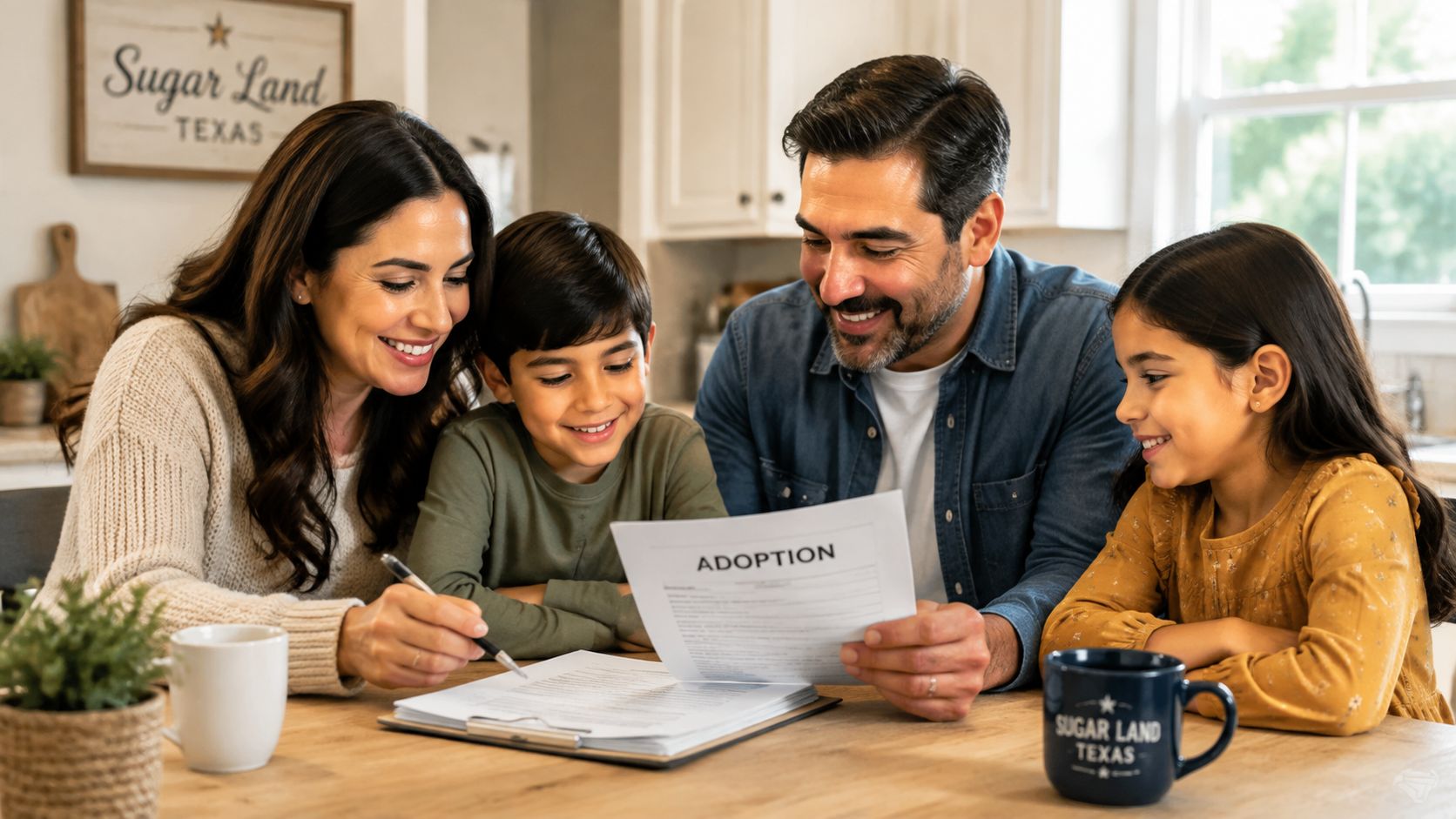
Families often seek legal guidance early because small misunderstandings can become serious obstacles later. A family may assume that an absent biological parent has automatically lost parental rights. Another may believe a signed private agreement completes the adoption. Neither assumption should guide a case without careful legal review.
Legal permanence affects the whole family
Texas adoption has deep historical roots. Historians cite a Texas adoption statute enacted in 1850, followed by the first modern U.S. adoption law in Massachusetts in 1851 (Adoption Law). That shift moved adoption from informal arrangements into a court-supervised process involving judicial approval, consent rules, and inheritance rights.
The same principle guides modern cases. The court must protect the child's future, not just approve the adults' wishes. An experienced adoption lawyer in Texas can help a family address legal rights while respecting the emotional relationships that already exist.
What an Adoption Lawyer in Sugar Land Does
A Sugar Land couple may have completed a home study, welcomed a child into their home, and still face the hardest legal question: has every required parental right been addressed? An adoption lawyer translates Texas law into decisions your family can understand. The lawyer does not replace a social worker, counselor, or adoption agency. Instead, the attorney manages the legal framework, explains your rights and responsibilities, and helps the court receive the information needed for a valid final order. For a step-by-step breakdown of the process, families can review how these duties fit together.
Texas adoption practice commonly involves Texas Family Code Chapters 162 through 166. Chapter 162 addresses adoption procedures and the legal effect of adoption. Other provisions address parent-child rights, consent, relinquishment, and proceedings involving children and families. Your attorney should identify which provisions apply to your circumstances, rather than treating a stepparent adoption, kinship placement, and agency case as identical.
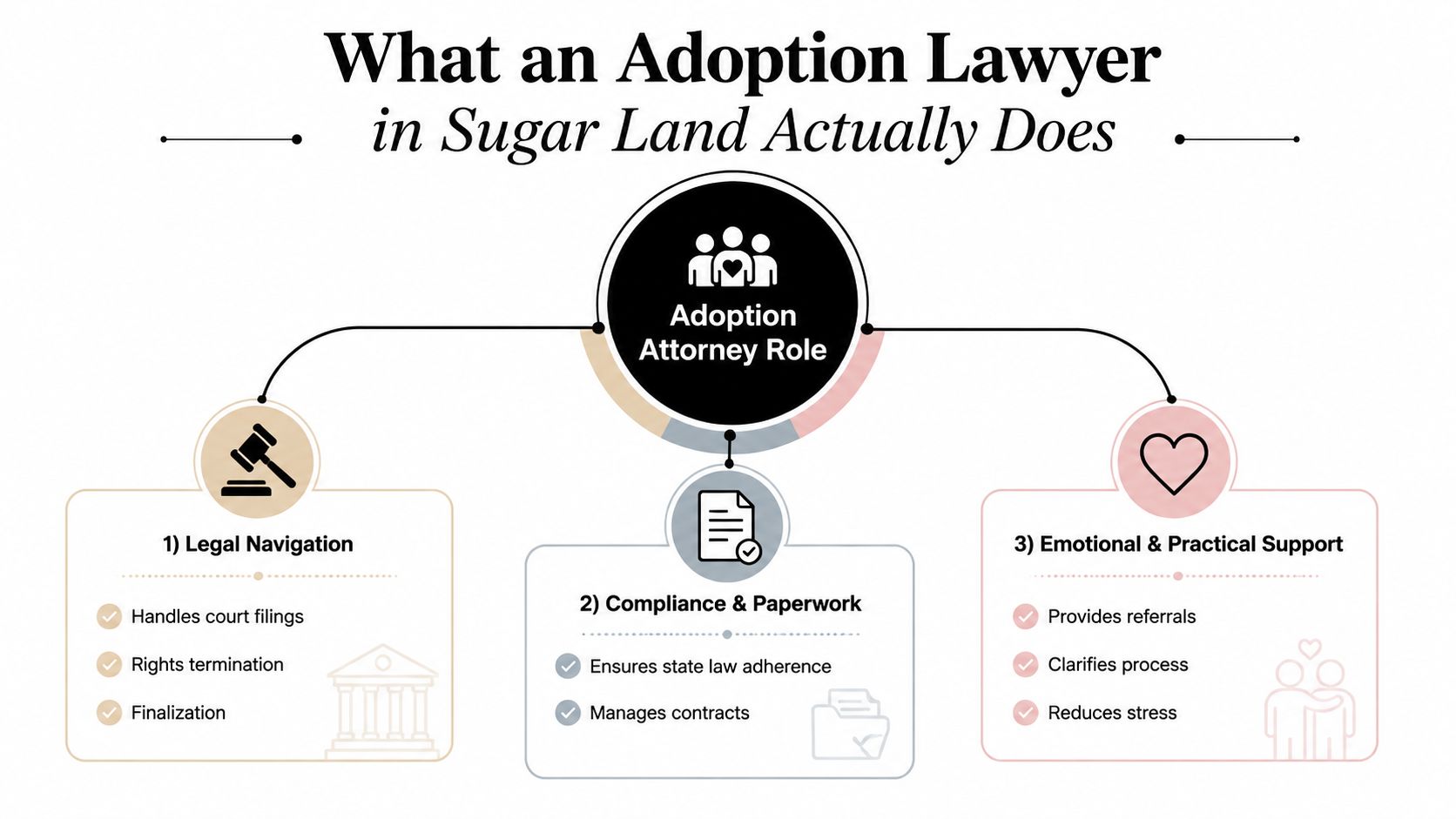
Three parts of the legal role
- Legal navigation: The attorney prepares petitions, addresses parental-rights termination, coordinates required hearings, and seeks the final adoption decree.
- Compliance and paperwork: The lawyer reviews consent documents, checks for missing information, and keeps the filing consistent with Texas requirements, including home-study documentation.
- Practical communication: The attorney explains each stage, identifies decisions requiring your input, and may coordinate with agencies, home-study professionals, or counsel for another party.
The key distinction is between legal consent and parental-rights termination. In a stepparent adoption, the other biological parent's rights generally must be terminated before finalization. A properly prepared affidavit of relinquishment, containing the required language, may allow the court to address termination within the adoption order without a separate termination proceeding. If the parent contests the case, the court must consider statutory grounds and the child's best interests.
Practical rule: Never assume that silence, distance, or informal permission equals legally effective consent.
A consultation should clarify the likely legal path, documents to gather, and issues that could delay finalization. Families seeking an overview of early legal guidance can also read When to Hire a Texas Adoption Attorney.
Common Types of Adoption Available to Texas Families
A Sugar Land family may begin with a child already living at home, a sudden relative placement, or a foster-care relationship that has grown into a permanent bond. The legal route changes with those facts. Texas Family Code Chapters 162–166 provide the framework, but parental-rights termination and home-study compliance often determine whether a case can reach finalization.
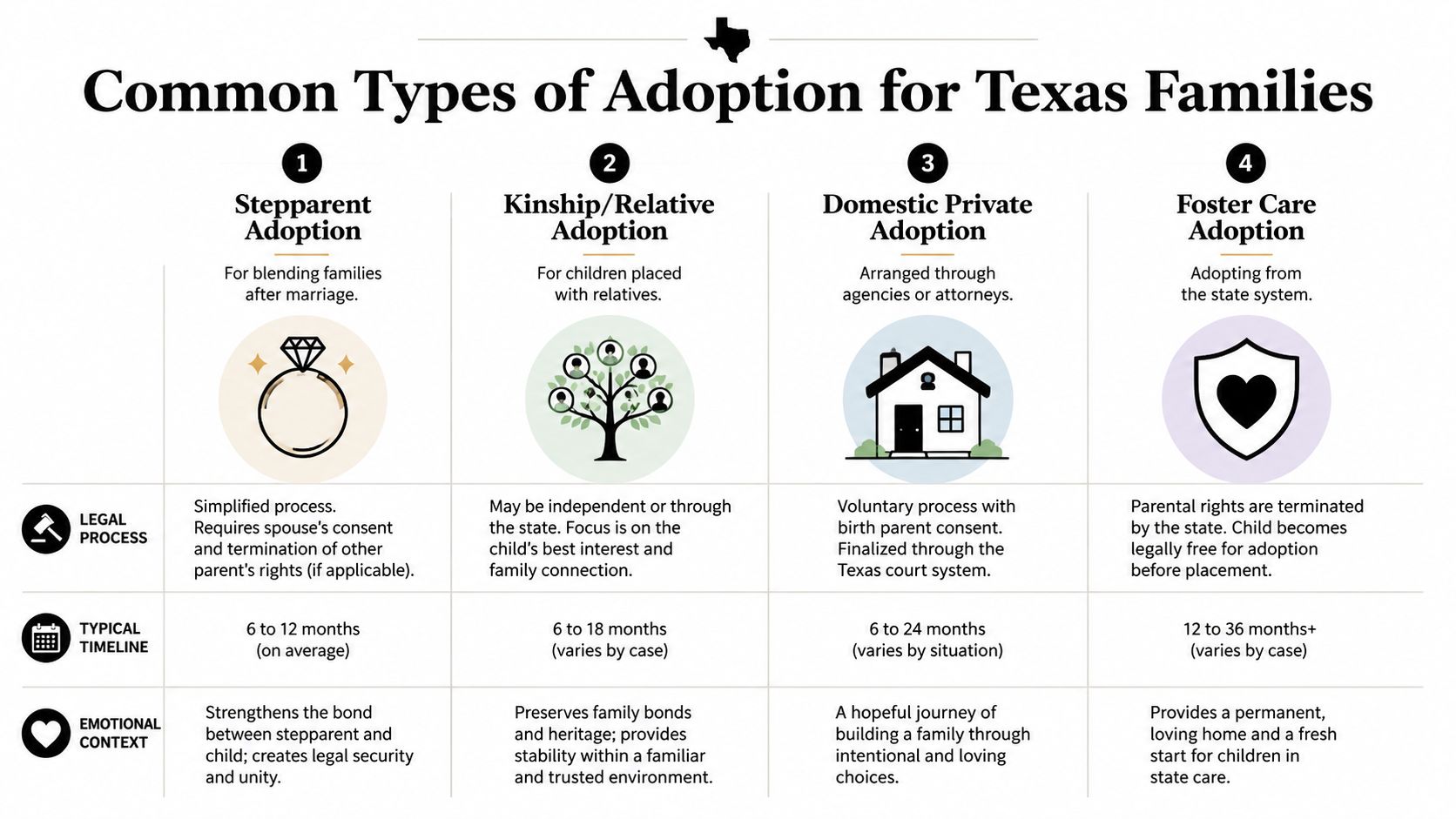
Stepparent adoption
A stepparent can generally file to adopt a child under 18, but the other parent's rights must be terminated before the court finalizes the adoption (Texas stepparent adoption answers). The stepparent's spouse must join as a petitioner, and the child generally must have lived with the petitioner for at least six months. A court may waive that period when the waiver serves the child's best interests.
For example, a spouse who has handled school routines and medical appointments may already function as a parent. Adoption creates the permanent legal relationship, but only after the court addresses the other parent's rights and confirms that required home-study matters are satisfied.
Kinship and relative adoption
A grandparent, aunt, uncle, adult sibling, or another relative may seek adoption after a child enters the extended family's care. Kinship adoption can preserve familiar relationships, culture, and community ties. It still requires attention to consent, termination, home-study requirements, and any CPS or court orders.
A relative placement may also involve a reunification plan. The family must understand whether adoption is currently permitted, what rights remain, and how the proposed permanent arrangement fits the child's best interests.
Private domestic adoption
A private domestic adoption may involve an identified birth parent and prospective adoptive parent, with or without an agency. The attorney helps organize consent, permitted expenses, medical information, placement requirements, and court filings under Texas law.
The practical question is often whether the documents and timing support a valid placement while preserving the birth parent's legally required rights.
Foster-care and CPS adoption
Foster-care adoption occurs within the child-welfare system. Texas recorded an estimated 7,168 adoptions in 2023, with 58.33% involving foster-care adoptions, as reported in Adoption by the Numbers 2025. Foster parents may seek permanency after caring for a child, while relatives may be handling a kinship placement alongside CPS involvement and a reunification plan.
LGBTQ+ parents and single parents can explore adoption and guardianship options. The court focuses on the child's safety and best interests, along with whether the proposed parent can receive permanent rights under the applicable procedure. Adult adoption and adult guardianship are separate options, evaluated according to the adult's needs, capacity, and desired legal relationship.
Step by Step Guide to Working with an Adoption Attorney
The adoption process is easier to understand when each stage has a purpose. The exact sequence can vary, especially when CPS, an agency, a contested parent, or an international component is involved, but most families move through several connected decisions.
Start with a focused consultation
Bring your family story, not just a stack of documents. Tell the attorney who the child lives with, who has provided care, whether another parent is involved, and whether CPS or an agency is part of the case. The attorney can then identify whether your matter is likely to involve voluntary relinquishment, contested termination, a home study issue, or another proceeding.
Prepare for the home study
Texas treats the pre-adoptive home study as a required gate in the process. State guidance says the study examines child safety and available space, and Texas requirements call for the department to complete a home study before an applicant can be approved for adoption (DFPS home study guidance).
A home study may consider household members, safety conditions, motivation, family relationships, and the ability to provide a stable home. Preparation isn't about creating a perfect household. It's about answering truthfully, correcting safety concerns, and showing that the proposed placement supports the child.
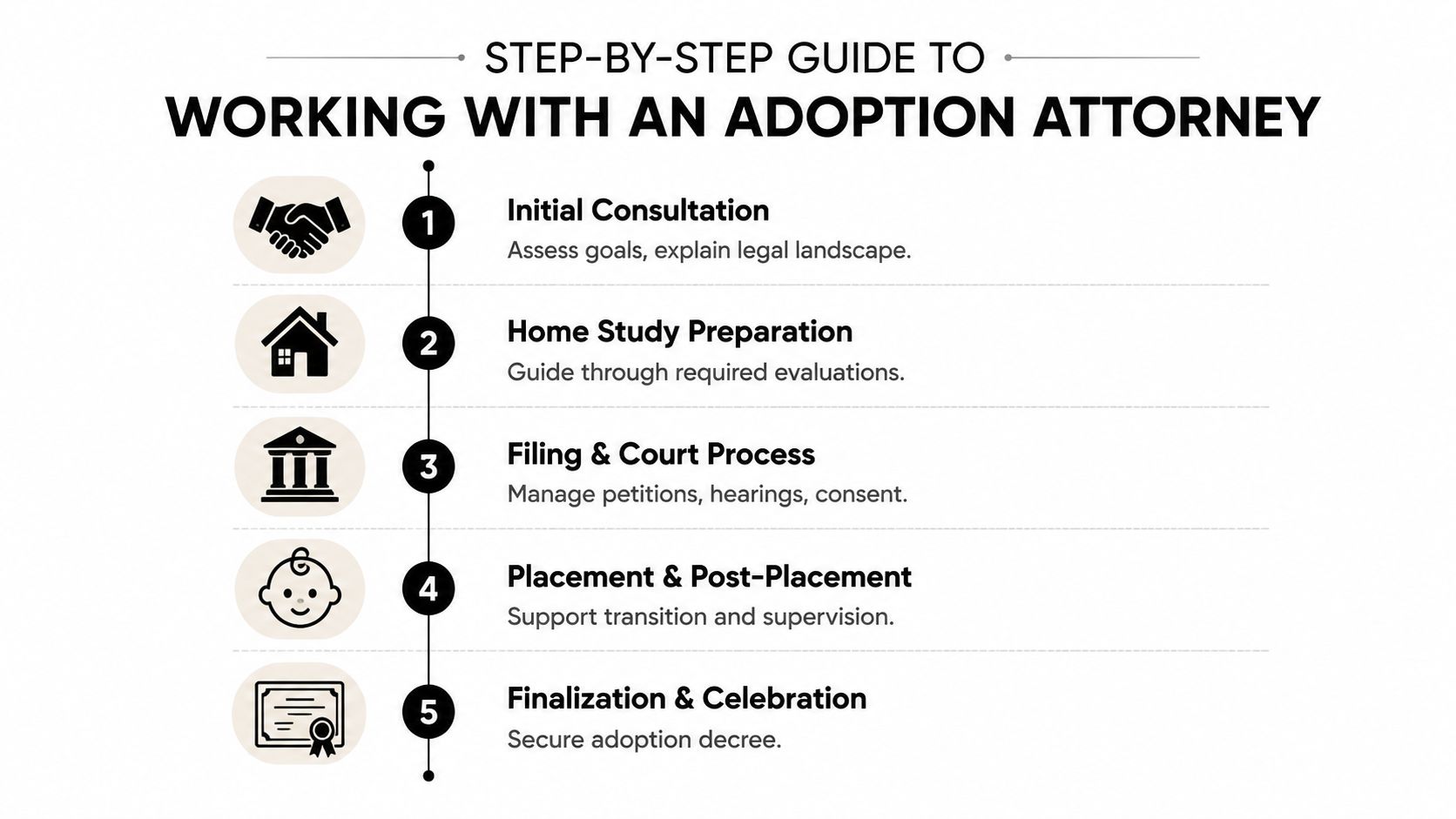
Resolve parental rights
This is often the bottleneck. In a stepparent example, the biological parent may sign a valid relinquishment, making the path more direct. If that parent objects, the adopting party must present evidence supporting a statutory ground for termination and prove that termination serves the child's best interests. A lawyer can help distinguish what must be filed from what must be proved.
Complete placement and court requirements
Depending on the adoption type, the child may already live with the prospective parent or may be placed through an agency or foster-care system. The legal team tracks required reports, notices, consents, hearings, and court deadlines. The goal is to protect a stable transition while ensuring the court has a complete record.
A final hearing gives the judge an opportunity to confirm that legal requirements have been satisfied and that adoption serves the child. Once the court signs the decree, the adoptive parent assumes the permanent legal role created by the order.
Adoption finalization is not merely a celebration. It is the court's formal creation of a permanent parent-child relationship.
What Texas Families Should Know About Adoption Costs and Timelines
A Sugar Land family may begin with a clear goal, such as adopting a stepchild, then discover that the legal work depends on consent, parental-rights termination, and home-study requirements. Costs and timing follow those facts. Texas Family Code Chapters 162 through 166 provide the framework, but each case still needs its own review.
Possible expenses include filing fees, attorney services, a home study, agency or placement services, travel, document preparation, and specialized professional assistance. Foster-care matters may follow a different financial structure from private domestic adoptions. A contested stepparent case can also require more legal work than an uncontested one because the court may need additional pleadings, evidence, and hearings.
Ask for a written description of the attorney's services. It should identify whether the agreement covers the petition, service or notice problems, hearings, termination litigation, finalization, and communication with agencies or other attorneys. If a cost falls outside that agreement, ask who handles it and when it might arise. A clear estimate explains expected categories without promising a fixed total.
Why timelines are difficult to predict
An uncontested adoption may proceed differently from a contested case. The other parent's legal status often controls the pace. A valid relinquishment can simplify the process, while an objection may require proof of a statutory ground for termination and findings that adoption serves the child's best interests.
Home-study compliance creates another checkpoint. Missing records, unresolved safety questions, household changes, or incomplete evaluations can delay approval. Agency schedules, CPS requirements, notice issues, and the court's calendar may affect the remaining steps.
The practical lesson is simple: parental-rights work and home-study preparation should begin early. An attorney can identify which facts must be filed, which must be proved, and which documents the household still needs.
Families seeking a closer explanation of legal fees can review this guide to how much it costs to hire an adoption lawyer in Texas.
How to Prepare for Your First Consultation with a Sugar Land Adoption Lawyer
Your first meeting doesn't require you to have every answer. It helps to bring enough information for the attorney to understand the family structure, the child's current living arrangement, and any legal concerns that could shape the case.
Gather the story and the records
If available, collect the child's birth certificate, existing custody or support orders, prior adoption or guardianship documents, agency paperwork, and information about the other biological parent. For CPS or foster-care matters, include notices, placement documents, and contact information for the caseworker or agency representative.
Write down what you want to accomplish. You may want a stepparent to become a legal parent, preserve a child's relationship with relatives, understand an open-adoption arrangement, or compare adoption with guardianship. Your goals help the lawyer explain which legal path may fit.
Ask questions that reveal the strategy
A useful consultation should address:
- Parental rights: What consent or termination issues are likely to arise?
- Home study: Who completes it, what does it evaluate, and what should the household prepare?
- Court process: Which filings and hearings are expected?
- Family relationships: How can adults discuss the case without placing pressure on the child?
- Communication: How will you receive updates, and who will answer procedural questions?
- Costs: Which services are included, and which expenses may be separate?
Be candid about conflict, prior court orders, safety concerns, and the child's wishes. Withholding a difficult fact rarely makes it disappear. Early disclosure lets the attorney plan for it while keeping the child's welfare in view.
You should also notice how the lawyer explains the law. Clear answers, realistic expectations, respectful treatment of birth parents, and patience with emotional questions are meaningful signs that the attorney understands adoption as both a legal proceeding and a family transition.
Choosing the Right Adoption Lawyer in Sugar Land for Your Family
The right adoption lawyer in Sugar Land should bring together Texas legal knowledge, careful case planning, and compassion. Adoption cases involve permanent rights, so an attorney should be comfortable explaining Chapters 162 through 166, consent and relinquishment rules, home-study requirements, court filings, and the final decree in language your family can use.
Local familiarity can help with practical coordination, but the lawyer's most important skill is legal judgment. Ask how the attorney approaches a contested parental-rights case. Ask how they handle a home study that raises concerns. Ask what happens if a birth parent changes position, a child has lived with a relative, or a CPS case includes reunification efforts.
What strong representation looks like
Look for a lawyer who:
- Explains the legal path: You should understand what must happen before finalization and why.
- Separates certainty from possibility: The attorney should identify risks instead of promising an outcome.
- Protects the child's interests: Family unity matters, but it must be built on safety and lawful consent.
- Communicates clearly: You should know what information is needed, what deadlines matter, and what comes next.
- Respects every participant: Birth parents, relatives, foster parents, LGBTQ+ parents, and children deserve dignity throughout the process.
- Discusses fees openly: Written terms should describe the legal services and possible additional expenses.
Be cautious if an attorney dismisses the home study, treats parental-rights termination as routine, gives a guaranteed timeline, or pressures you to make a major decision before you understand the consequences. A smooth case begins with accurate information, not reassurance that skips the hard questions.
A child-centered adoption plan protects permanence without losing sight of the people and relationships affected along the way.
The Law Office of Bryan Fagan, PLLC helps Texas families with stepparent, relative, domestic, international, foster-care, LGBTQIA+, single-parent, and adult adoption matters, as well as guardianship. Its attorneys assist with applications, home studies, CPS-related issues, court proceedings, and finalization, with virtual consultations available statewide.
Schedule a free consultation with the Law Office of Bryan Fagan, PLLC to discuss your Sugar Land adoption, parental-rights, home-study, or guardianship questions. You'll receive guidance specific to your family's circumstances, helping you understand the next legal step while keeping the child's best interests at the center.
