
A late-night call can turn an ordinary Texas evening into a child-welfare emergency. A grandmother in Houston may find herself driving to court the next morning with her grandson's backpack still sitting by the front door, a few clothes in a grocery bag, and no clear idea what the judge will decide.
Then she hears the phrase permanency plan. It sounds like paperwork, but it answers personal questions: Where will this child sleep next month? Who can sign school forms? Who will take him to medical appointments? When will this family stop living in limbo?
What is permanency planning? It's the structured, court-supervised process of securing a child's stable and lasting living situation while protecting family relationships whenever that can be done safely. In Texas, that process may lead to reunification, adoption, a permanent managing conservatorship, or another planned permanent arrangement. The right answer depends on the child's safety, relationships, needs, and best interests.
A Texas Family Meets Permanency Planning for the First Time
The grandmother arrives at the courthouse early, still carrying the stress of the night before. The courtroom has plastic chairs, a humming air conditioner, and a manila case folder that seems far too thin to contain the future of a child she has raised for years. Her grandson's backpack is at home, still waiting by the door.
At the first hearing, the judge discusses the child's temporary placement and the work that must happen next. Someone mentions a permanency plan. The grandmother hears the words but doesn't yet understand what they mean for her family.
A permanency plan isn't just a note in a case file. It's a direction for the child's future. The court and the Texas Department of Family and Protective Services, commonly called DFPS, must work toward a safe, stable outcome rather than allow the child to remain in temporary care without a clear path forward.
Turning a formal phrase into real questions
For a relative caregiver, the plan becomes easier to understand when it's translated into daily life:
- Home: Will the child return to a parent, remain with a relative, or move to an adoptive family?
- Authority: Who can make decisions about school, health care, counseling, and activities?
- Relationships: How will the child maintain safe contact with parents, siblings, grandparents, or other important people?
- Time: What must happen before the court changes the placement or enters a final order?
The planning process begins when a child comes to the attention of the child-welfare system. It's designed to move case decisions forward early, with a permanent goal, services, and timelines rather than an open-ended temporary placement. The federal child-welfare framework describes permanency planning as a way to return children to family stability as quickly as possible, and the Adoption Assistance and Child Welfare Act of 1980 made permanency-planning procedures a formal condition for states receiving federal funds (Office of Justice Programs overview).
A practical translation: The court isn't asking only where the child is today. It's deciding what must happen so the child can have a safe and lasting home.
For the grandmother, that may mean telling the caseworker she wants to be considered for placement, attending hearings, supporting visits, and learning whether adoption or permanent managing conservatorship fits the child's needs. Before choosing among those paths, it helps to understand what “permanent” must provide.
What Permanency Really Means and the Four Legal Outcomes
For a Texas grandmother caring for a child after removal, a safe bedroom may solve tonight's problem. Permanency planning asks a larger question: what arrangement can give the child safety, belonging, and dependable legal care over time?
A stable home has several dimensions. The Ontario Association of Children's Aid Societies framework describes physical permanency, relational permanency, and legal permanency as distinct parts of that picture.
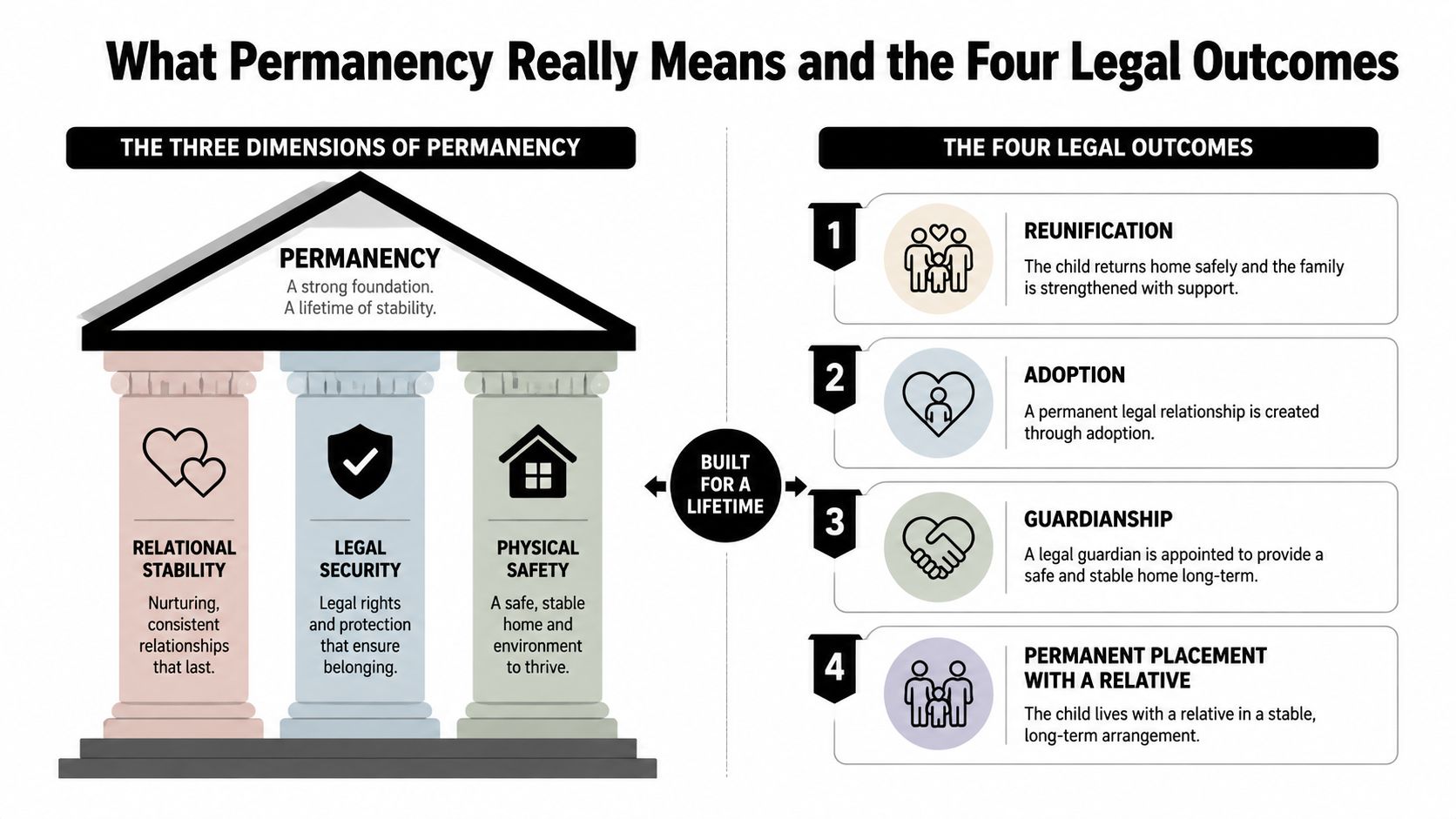
Permanency works like a house supported by three pillars:
- Physical stability is the house itself. The child has a safe, dependable place to live with a caregiver who can meet daily needs.
- Relational stability is the sense of belonging within that house. The child maintains lasting emotional connections with caregivers, siblings, relatives, and other safe adults.
- Legal security is the foundation and deed. A person has clear authority to care for the child, make decisions, and provide continuity.
One pillar does not guarantee the others. A foster placement may be safe while remaining temporary. A relative may offer a strong emotional bond but lack authority to handle school enrollment or medical decisions. A permanency plan is more than a note in a case file. It shapes the child's future by setting a clear direction toward safety and stability.
Four destinations on the same road
Texas families can view the legal outcomes as different destinations:
- Reunification returns the child to a parent when the court finds that return safe. The parent generally completes services and court-ordered requirements while maintaining contact with the child.
- Adoption creates a new legal parent-child relationship after parental rights are addressed. It generally ends the former parent's legal rights and responsibilities, although families may agree to continued contact in appropriate circumstances.
- Permanent managing conservatorship, sometimes called guardianship in everyday conversation, gives a caregiver long-term legal authority without creating adoption's parent-child relationship. It may preserve parental rights and allow visitation or sibling contact when that arrangement serves the child.
- Another planned permanent living arrangement may be considered for an older youth when the other outcomes do not fit. Long-term foster or residential care can provide support, but it retains more of the child-welfare case structure and does not provide adoption's legal finality.
The choice between adoption and permanent managing conservatorship matters greatly to grandparents and other relatives. Adoption offers stronger finality but ends the parent-child legal relationship. Permanent managing conservatorship can preserve family connections and avoid termination of parental rights, while offering less finality because a parent may later seek custody.
Families reviewing adoption can use The Texas Adoption Process Step by Step to follow the six core stages from selecting an adoption type through the final decree. For a closer explanation of why termination of parental rights may be necessary before adoption, review how that legal decision affects the adoption path.
How Permanency Planning Works Inside the Texas System
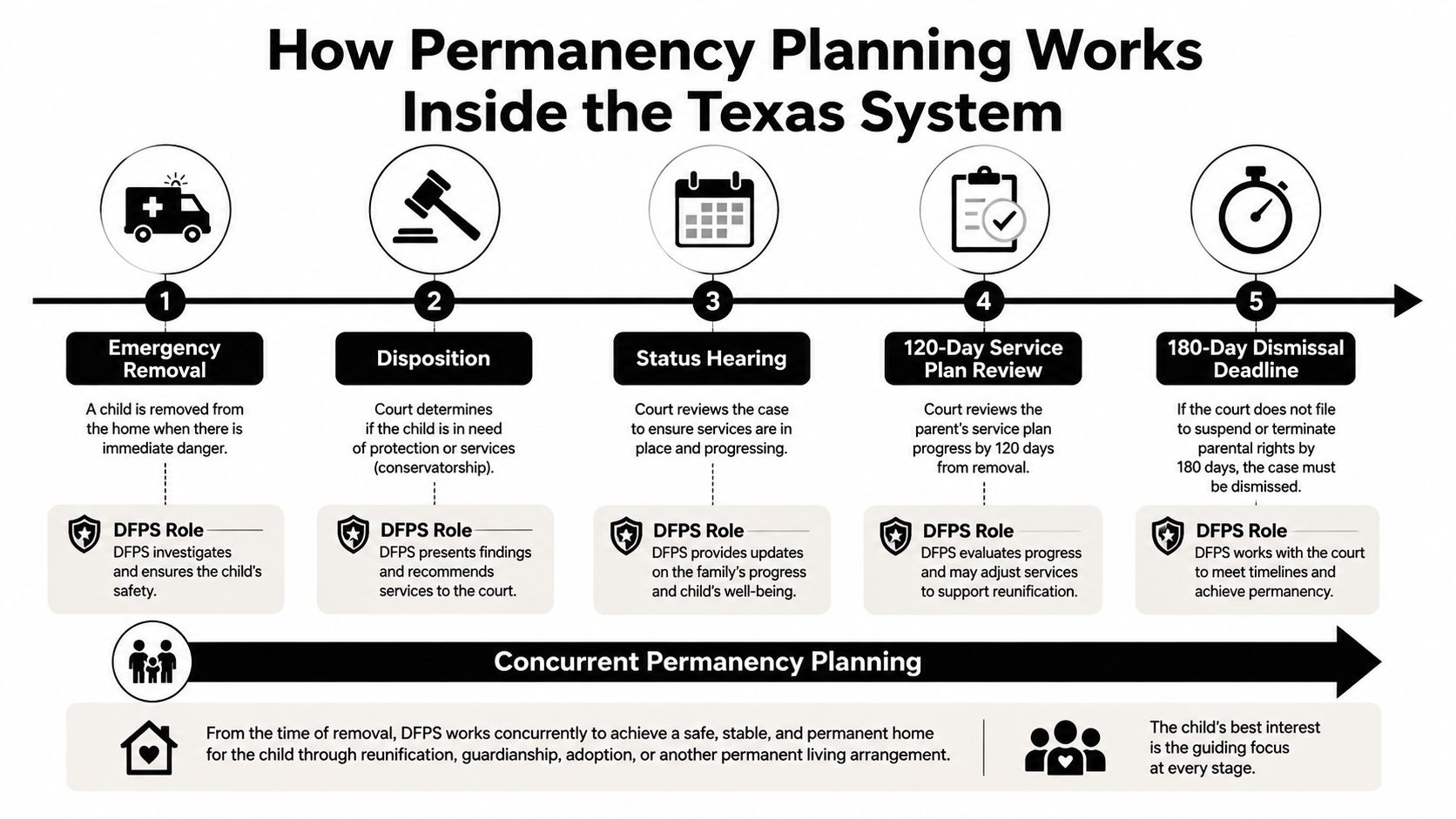
For a Texas relative, the process may begin with an emergency removal and a phone call from DFPS. From that point, the court sets deadlines, DFPS develops services and placement plans, and each hearing helps determine what must happen next. The purpose is to establish a permanent goal, support the family, and prevent a child from remaining in temporary care without a clear direction.
After an emergency removal, the court holds an initial removal hearing within three working days under the Texas process. An adversary hearing must occur no later than the 14th day. These early hearings address whether the child should remain in DFPS custody while the court examines safety concerns and the family's circumstances.
DFPS develops a service plan for the parents and identifies placement and permanency options. The agency works toward reunification while preparing another safe outcome if reunification does not succeed. One part of the case supports the parent's progress. Another protects the child if that plan cannot be completed.
Hearings and written plans
Texas permanency cases use scheduled review points. The first permanency hearing before a final order must occur no later than 180 days after the court appoints DFPS as temporary managing conservator. Later hearings before a final order must occur no later than 120 days after the preceding permanency hearing (Texas DFPS permanency hearing guidance).
Texas law requires the permanency plan to be provided to notice recipients at least 10 days before the first permanency hearing. It must list concurrent goals, including a primary goal and at least one alternate goal (Texas Family Code Section 263.3025).
A DFPS caseworker gathers information about the child's placement, services, visits, medical needs, education, and family relationships. Depending on the court and local program, a CASA volunteer may investigate and advocate for the child's best interests. The judge then enters written orders that set the next requirements for parents, relatives, and caregivers.
Each review asks whether the placement remains safe and whether the permanency goal is progressing. Families considering foster-care adoption can read about how to adopt a child from foster care in Texas to understand the adoption path.
A court order may require services, visitation, evaluations, or other steps. Keep copies, read each order carefully, and ask an attorney to explain unclear language. A missed deadline or misunderstood requirement can affect the child's future.
Choosing the Right Path for Your Family
No single permanency outcome fits every child. A parent may be making meaningful progress toward reunification. A grandmother may be ready to provide a lifelong home but may not want to end her child's parental rights. A foster parent may be prepared to adopt after termination, while the child may need continued sibling or family contact.
| Path | Legal Finality | Caregiver Rights | State Oversight | Best Fit |
|---|---|---|---|---|
| Reunification | The child returns to a parent when safe | The parent resumes legal authority | DFPS and the court monitor progress until the case resolves | A parent who can address the safety concerns |
| Adoption | Creates a new legal parent-child relationship and ends the former parent's rights | Adoptive parents hold parental rights and responsibilities | Court involvement continues through finalization | A child who needs a legally permanent family |
| Permanent managing conservatorship or guardianship | Long-term care without the same finality as adoption | The conservator receives significant decision-making authority | Court orders control the arrangement, and parental rights may remain | Relatives preserving family ties when adoption isn't appropriate |
| Planned permanent living arrangement or long-term care | Less final than adoption or conservatorship | Caregiver provides daily care under the applicable arrangement | State support and case oversight may continue | Older youth whose needs make another plan unsuitable |
The tradeoff relatives often face
Adoption can provide the clearest legal status, but it normally requires addressing the rights of a legal parent. Guardianship can preserve parental ties and avoid termination, but a parent may later petition to regain custody. Long-term foster care can keep needed services available, yet the child may continue living under a system designed around temporary care.
Financial support also depends on the legal path and the child's circumstances. Families should ask DFPS or a qualified attorney about programs such as Adoption Assistance or Permanency Care Assistance rather than assuming that one outcome automatically provides a particular benefit.
For a relative caregiver: The best choice isn't the label that sounds most permanent. It's the arrangement that gives this particular child safety, belonging, legal authority, and an honest plan for family relationships.
The court's findings, the child's needs, and the caregiver's ability to provide consistent care all matter. Personal preference is part of the conversation, but it doesn't replace the best-interests analysis.
How Different Families Experience Permanency in Texas
The legal route becomes clearer when you place it in the family's daily reality. A Houston stepparent, an East Texas grandmother, and a San Antonio foster parent may all care for a child, yet each starts with different rights, responsibilities, and court questions.
A Houston stepparent
A stepparent may have handled homework, doctor visits, and bedtime for years while the other legal parent remains absent. The case may call for termination followed by adoption, or for another parentage strategy based on the facts. In a Texas stepparent adoption, the court may address termination and adoption together when the petitions are joined. The judge must still make separate best-interest findings for each decision. If the child is 12 or older, the child must consent in writing or in court, as explained in this TexasLawHelp explanation of stepparent adoption.
The family's daily routine may already look permanent. The court still has to create the legal relationship that gives the stepparent authority and responsibility.
A rural East Texas grandmother
A grandmother may be raising her grandchildren while working to preserve their relationship with their parents. She might explore a kinship placement and a SAPCR, or suit affecting the parent-child relationship, seeking permanent managing conservatorship. That order can provide authority for school and health decisions without automatically creating an adoptive relationship.
Questions about consent, termination, placement, and family contact often shape the decision. Families can review kinship adoption in Texas while discussing which legal arrangement fits the child's needs.
A San Antonio foster parent
A foster parent may learn that parental rights have been terminated and then face a choice between adoption and permanent managing conservatorship. Adoption can provide greater finality. Conservatorship may preserve some family relationships. The caregiver should consider the child's wishes, sibling connections, medical needs, and long-term support before agreeing to a final order.
An LGBTQIA+ couple in Dallas
An LGBTQIA+ couple may consider joint adoption, second-parent adoption, or parentage orders connected with assisted reproduction. If CPS is involved, the couple must also examine the child's current legal status, placement, and court orders. Those facts determine which path remains available.
The practical questions stay focused: who holds legal rights now, what must change, and which arrangement gives the child a stable family relationship?
A birth parent working toward reunification
A birth parent may attend services, participate in visits, and address the conditions that led to removal. Under concurrent planning, the parent works toward reunification while DFPS evaluates another permanent caregiver. That alternate plan does not decide the outcome by itself, but timely progress and clear communication matter.
If parental rights are terminated, the legal relationship changes significantly. The parent should seek counsel before signing documents or agreeing to an order.
Practical Next Steps and Common Misconceptions
Families can protect themselves and the child by taking practical steps early. A clear record helps everyone understand what happened, what has been completed, and what remains unresolved.
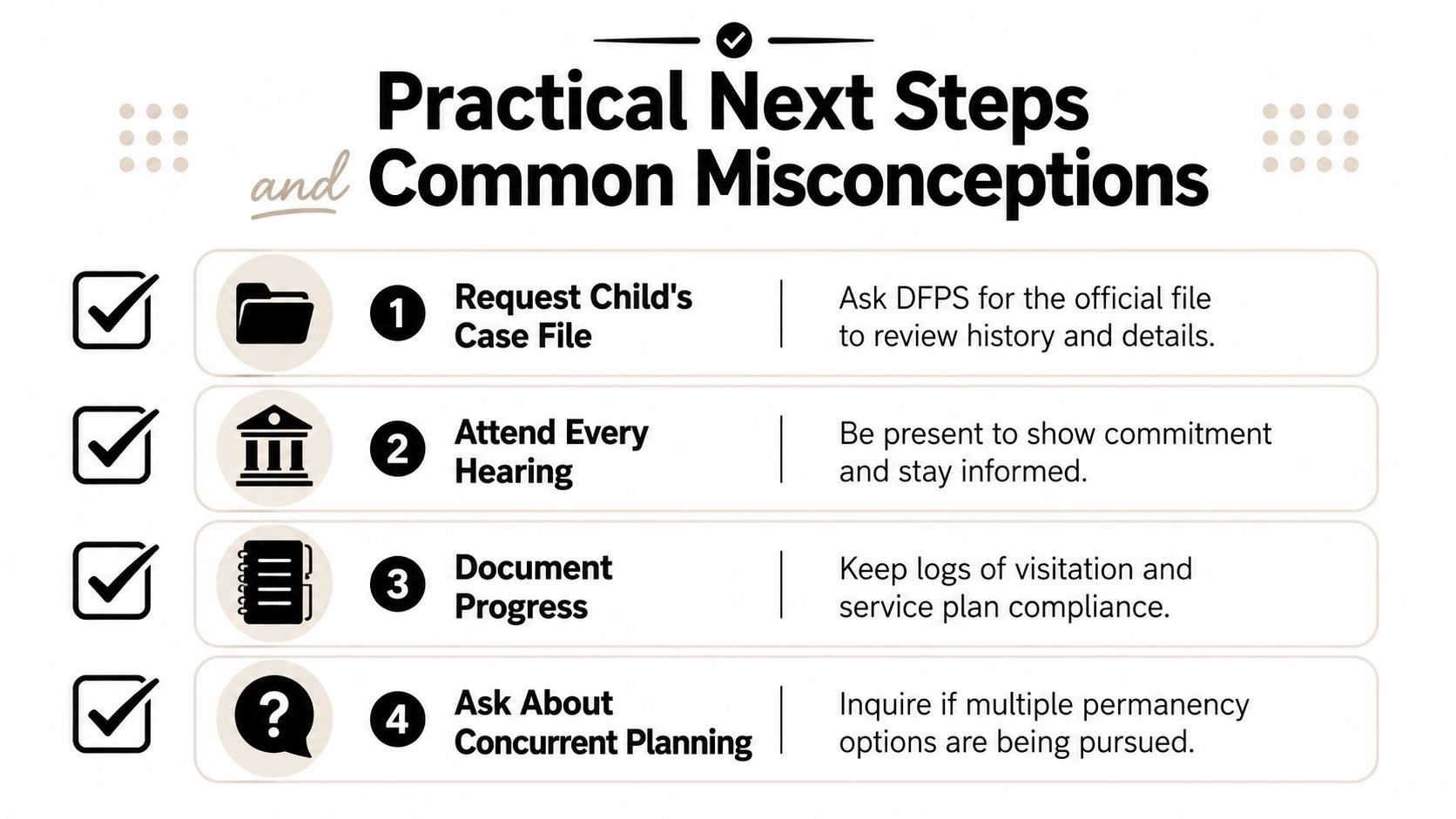
- Request the case file: Ask DFPS how to obtain the official records available to you and review the history carefully.
- Attend every hearing: Your presence shows commitment and keeps you informed about placement and permanency decisions.
- Document progress: Keep a calendar of visits, services, communications, appointments, and concerns about the child.
- Ask about concurrent planning: Find out what primary and alternate goals DFPS is pursuing.
- Review proposed orders: Speak with a Texas family law attorney before signing an order affecting custody, adoption, or parental rights.
- Ask about support: Explore Adoption Assistance or Permanency Care Assistance with DFPS and qualified counsel.
Misconceptions that create delay
Kinship caregivers don't automatically have to file for adoption. A relative placement may lead to reunification, conservatorship, guardianship, or adoption depending on the court's findings and the family's situation.
DFPS also can't create a permanent legal placement by itself. A final legal outcome requires the appropriate court action and order. Termination of parental rights isn't automatic because a child has been in care for a particular period. Likewise, LGBTQIA+ families aren't barred from adopting through CPS, and guardianship isn't identical to adoption for legal authority, school decisions, insurance, or family relationships.
Texas timelines move quickly. Early legal advice can help a parent, relative, or prospective adoptive caregiver make an informed choice before an important hearing or document deadline passes.
Frequently Asked Questions and How We Can Help
What should I bring to my first hearing?
Bring every notice, court order, DFPS document, and message that may help explain the case. Write down questions about visits, services, placement, and the proposed permanency goal. A simple timeline of important events can help your attorney understand what happened and what needs attention.
Arrive prepared to discuss the child's daily care, medical or school needs, family connections, and any safety concerns. Your court order controls your responsibilities, so follow it carefully and ask counsel about anything you do not understand.
How can I request a CASA volunteer?
Ask the child's attorney, caseworker, or the court whether a CASA program serves your county. CASA volunteers are trained community members who gather information and advocate for the child's best interests. Availability depends on the local program, and a volunteer does not replace the child's attorney or your own lawyer.
Do relatives receive preference over non-relatives?
Kinship care is an important option, but being related does not guarantee custody or adoption. The court considers safety, stability, willingness to care for the child, existing relationships, and the child's best interests. A relative who wants placement should tell DFPS promptly and provide information about the home and available support.
How is managing conservatorship different from adoption?
Managing conservatorship gives a caregiver legal authority to care for the child while parental rights may remain. Adoption creates a new legal parent-child relationship and generally ends the former parent's legal rights. The difference affects decision-making, family relationships, and the legal steps required.
Can parental rights be restored after termination?
Termination is a serious legal event that is generally permanent. A parent should speak with an attorney before signing a relinquishment or agreeing to termination because choices may be limited afterward.
The Law Office of Bryan Fagan, PLLC helps Texas parents, relatives, and prospective adoptive families understand their options from the first CPS contact through the final court order. A consultation can clarify which path may fit the child's needs and the family's circumstances.
The Law Office of Bryan Fagan, PLLC offers guidance with Texas adoption, kinship placement, stepparent adoption, CPS-related cases, and guardianship matters, including hearing and final-order preparation. Visit Law Office of Bryan Fagan, PLLC to schedule a free consultation with a Texas family law attorney.
