
You may be an adult adoptee holding an old birth certificate, a birth parent wondering whether your child ever wants contact, or a biological sibling searching for a missing part of your family story. The need for answers can feel hopeful one day and overwhelming the next. In Texas, the adoption reunion registry offers a careful starting point, but it isn't the same as opening sealed adoption records.
Texas balances the desire for family connection with privacy protections created when an adoption was finalized. The registry can help when both sides voluntarily choose contact. If it doesn't produce a match, a separate legal path may involve the court that handled the adoption. Understanding that difference can help you search with realistic expectations and protect everyone's emotional and legal boundaries.
Understanding Your Search for Biological Family
A woman sits with an old photo album. She recognizes her own face in a childhood picture, but the unanswered questions are about the people who came before that photograph. She wants medical history, family traditions, and perhaps a conversation with someone who remembers the circumstances surrounding her adoption.
A birth parent may carry a different kind of uncertainty. Years after placement, that parent may wonder whether reaching out would be welcomed or disruptive. A biological sibling may be searching for a person whose name has never been part of family conversations. Each experience is different, but the wish to understand where you came from is human.

A private search deserves a careful beginning
Texas has operated a state mutual-consent adoption registry since January 1, 1984, when the Central Adoption Registry became effective under Texas law. Its purpose is to help adult adoptees, birth parents, and biological siblings voluntarily locate one another without immediately going through the court system. Texas adoption records guidance can help you understand why a registry search and a records request are separate issues.
The registry doesn't promise that a relative will be found. It also doesn't authorize an unexpected message to someone who hasn't agreed to participate. Instead, it creates a structured way for people on both sides of an adoption to express willingness to be located.
A reunion search should protect your hope without ignoring another person's right to privacy.
Before registering, think about what you hope to learn and what you may be ready to share. You might seek family medical information without wanting immediate contact, or you might hope for a relationship that grows slowly through letters or supervised communication. Writing down those boundaries can make the process feel more manageable.
The child's interests remain important
Even when all participants are adults, adoption affects a larger family system. A reunion can bring joy, grief, anger, relief, or uncertainty. A careful process gives people space to make informed choices instead of forcing an emotional moment before they're prepared.
If your search involves a child who is still under a parent's care, a stepparent adoption, or a CPS history, the registry may not address the legal issue you're facing. Those situations require a separate review of parental rights, court orders, and the child's best interests.
How the Central Adoption Registry Works
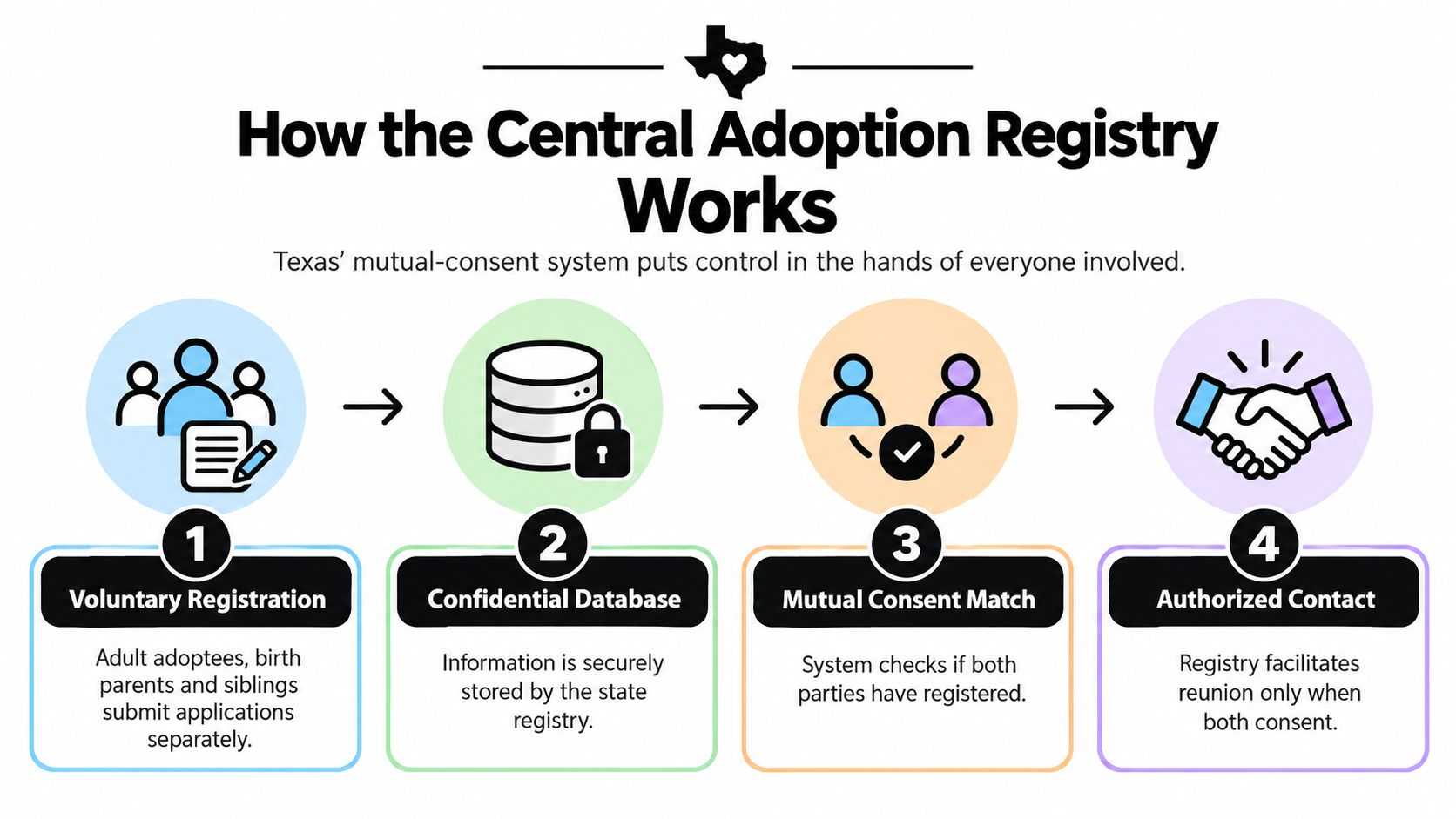
The Texas Central Adoption Registry is the first layer of a reunion search. One registration does not reveal identifying information. Instead, the system waits for a voluntary match, then applies a separate consent and counseling process before information can be disclosed.
Texas Vital Statistics administers the registry. Approved child-placing agencies may also maintain registries, but they must share information with the state system. The result is a statewide network rather than a collection of entirely separate databases. Texas Vital Statistics information about the Central Adoption Registry explains the state's role and eligible participants.
Who may participate
Participation is limited to adults and certain close biological relatives. An adoptee must be at least 18 years old. Eligible participants include:
- Adult adoptees: People adopted in Texas who want qualifying relatives to be able to locate them.
- Birth parents: Parents who may want contact with an adult child placed for adoption.
- Biological siblings: Adult siblings seeking contact with an adopted brother or sister.
Registration is voluntary. A person does not consent because another relative has enrolled. That rule protects confidential adoption information and keeps the registry focused on mutual choice, rather than one-sided disclosure.
For a broader explanation of adoption records in Texas, see adoption records in Texas. A records request and a registry registration address different questions, even when both relate to the same adoption.
What creates a match
Both sides must register independently. For example, an adult adoptee may submit an application hoping to find a birth parent. If that parent does not enroll, the adoptee's registration alone does not create a match or release identifying information.
When both people register, the state can identify the mutual match. Written consent and at least one hour of post-adoption counseling with a qualified social worker or mental health professional are required before identifying information is released. Texas Central Adoption Registry guidance describes this two-stage process.
Counseling gives each person time to consider expectations, emotional reactions, and respectful boundaries for first contact. It is a pause for informed choice, not a penalty.
What the registry doesn't do
The registry supports voluntary location and reunion. It does not automatically open the original adoption file, replace a court petition, or guarantee that a relative will agree to contact.
That distinction matters if the registry produces no match. A person seeking sealed records may need a formal court petition, while someone considering a stepparent adoption faces a different legal issue. Stepparent Adoption in Texas concerns legal parentage and termination of another parent's rights. The registry concerns voluntary contact among qualifying biological relatives.
Steps to Register and Request a Match
You may hold the completed form for a moment, aware that it represents more than routine paperwork. It can be the first formal action toward a biological family connection you have considered for years. Work carefully, use the current materials from Texas Vital Statistics, and keep a copy of everything submitted.
Begin with eligibility and identity
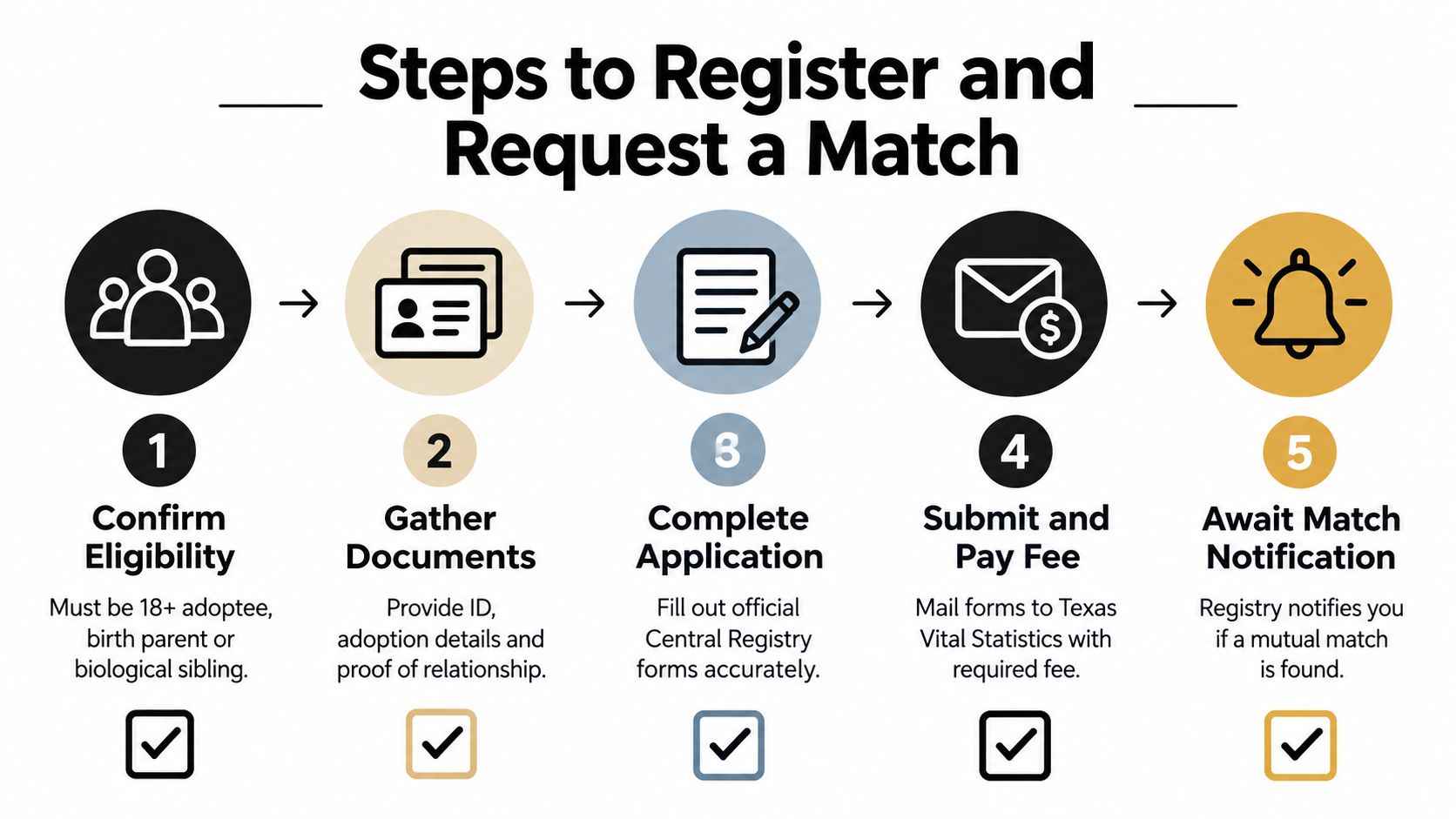
Start by confirming that you meet the registry's adult-participant requirements. The system is intended for adult adoptees, birth parents, and biological siblings who are 18 or older. As noted earlier, the registry is a voluntary matching process, not an automatic release of adoption records.
Gather the information available to you. This may include identification, adoption details, names used before or after adoption, and information showing the biological relationship. If a detail is uncertain, do not guess. An incorrect name, date, or adoption location can make it harder for the state to connect two registrations.
Complete and submit the application
Use the official Central Adoption Registry application and follow its instructions closely. The state's Vital Statistics unit maintains the registry and processes registrations in an effort to match an adoptee with a birth parent or biological sibling. The application may require a fee, so confirm the current amount and payment instructions through the official materials instead of relying on an old form or online discussion.
A preparation list can keep the process manageable:
- Confirm eligibility: Make sure the participant is an eligible adult.
- Collect records: Assemble identification and the adoption or relationship information available to you.
- Review every field: Check spellings, former names, addresses, and contact details.
- Submit through Vital Statistics: Send the application as directed by the state.
- Keep a complete file: Save copies, proof of submission, and related correspondence.
Understand the waiting stage
A registration can remain active for up to 99 years, unless you withdraw it sooner or select a shorter period. Texas access-to-adoption-records guidance explains the duration, notice process, and counseling requirements connected with a match.
If the registry identifies a mutual match, written notice goes to the registrants. Identifying information is not released immediately. Each person must provide written consent and complete the required counseling before disclosure.
A quick response is not guaranteed. Silence may mean the other person does not know about the registry, has concerns about contact, or has chosen not to participate. It does not by itself explain the reason or communicate rejection. You may withdraw your registration in writing if your circumstances or wishes change.
When the Registry Is Not Enough
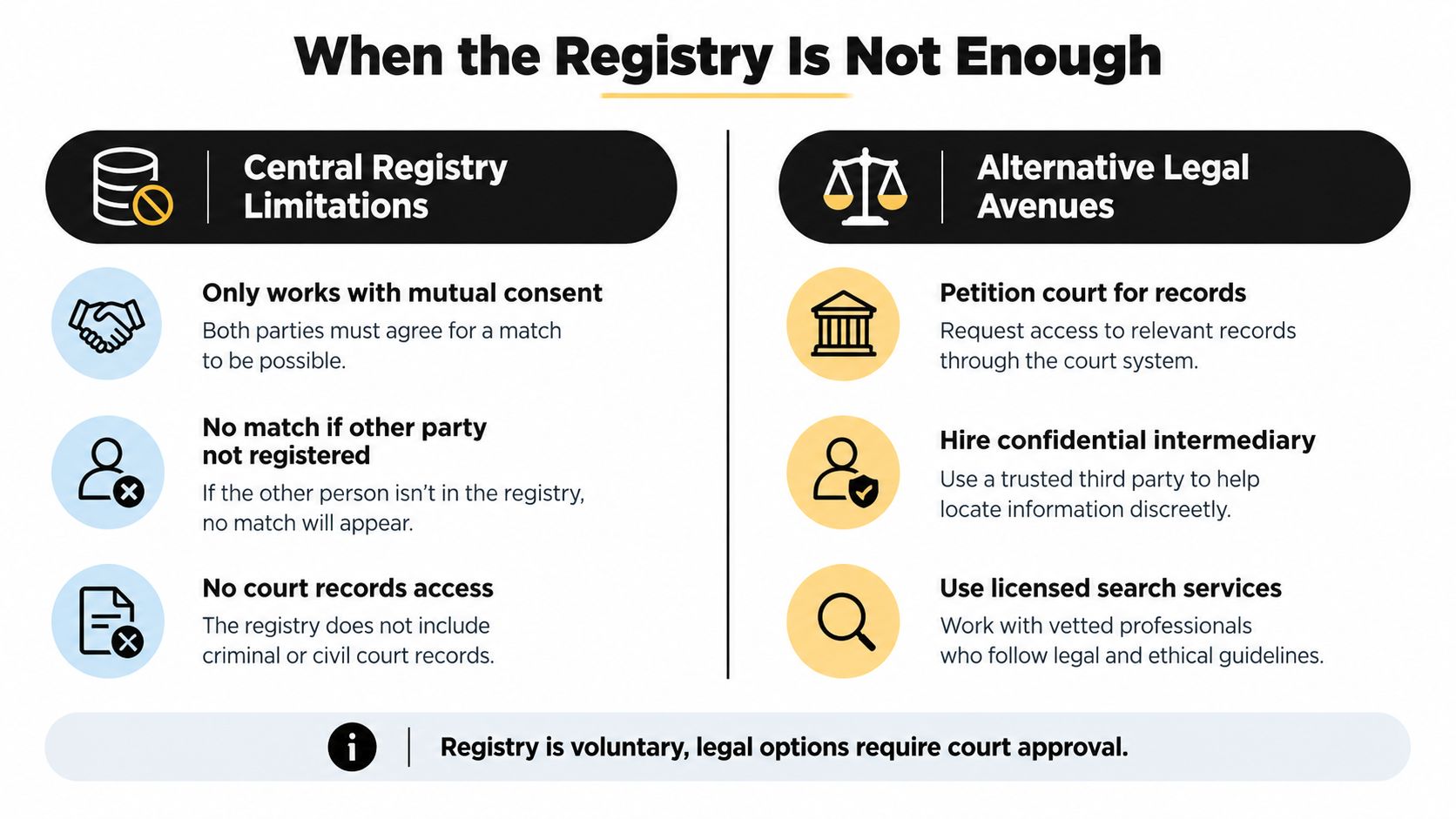
The Central Adoption Registry is useful because it offers a voluntary path that doesn't begin with a court fight. Its limitation is equally important. It can work only when the person you're seeking has also registered and is willing to proceed through the mutual-consent process.
A person may register years after you do, or may never register at all. The absence of a match doesn't prove that the person has rejected you. It only means the registry hasn't reached the mutual-consent point required for disclosure.
Two different legal tools
The registry is a discovery layer. The Texas Family Code requires the Vital Statistics unit to maintain it and process registrations in an effort to match adult adoptees with birth parents or biological siblings. Its purpose is voluntary location and reunion.
A sealed-record request is different. Access to the underlying adoption record generally requires a petition to the court that granted the adoption. Texas Family Code Section 162.403 makes clear that the registry doesn't replace other legal search routes or court access to sealed records.
| Central Adoption Registry | Court-based records request |
|---|---|
| Voluntary enrollment | Formal legal petition |
| Requires participation by both sides | Asks the court to consider access |
| Designed for mutual location and reunion | Addresses access to sealed adoption records |
| Doesn't open the original file | Requires review by the court that granted the adoption |
Knowing when to seek legal help
If you have registered and no match has occurred, an attorney can help you determine whether a court petition is appropriate. The legal analysis may depend on the adoption file, the court involved, the information requested, and the privacy interests of other people named in the record.
That doesn't mean a petition guarantees release. The court must apply the governing legal standards, and sealed records remain protected unless the court authorizes access. A lawyer can help you avoid treating a registry result as a final answer or filing a request in the wrong court.
A registry search is not a dead end when it produces no match. It may be the point where a carefully prepared legal strategy begins.
Exploring Alternative Search Methods
A registry and a court petition aren't the only possible parts of a reunion plan. Some people use more than one resource while protecting privacy at each stage. The right approach depends on the information available, the urgency of the search, and how much direct contact each person can handle.
Approved child-placing agencies may operate their own registries under Texas law. Those agencies must share information with the state registry, so an agency record can form part of the broader statewide network. If you worked with a particular agency, ask what post-adoption information or registry assistance it maintains, and confirm current procedures before sending personal documents.
Private tools require careful judgment
Private reunion registries and DNA testing databases may help people identify possible family connections, but they operate under their own terms. Before using one, review its privacy policy, data-sharing practices, deletion process, and rules for contacting potential relatives. A genetic connection can reveal unexpected information, so consider whether you have emotional support before proceeding.
A private service also doesn't override Texas confidentiality law. Finding a possible relative isn't the same as having permission to obtain sealed court records or contact someone through private details. Use any result as information to evaluate, not as authority to bypass another person's boundaries.
Intermediaries can soften first contact
A qualified social worker, mental health professional, or confidential intermediary may help communicate without immediately exchanging direct identifying information. This can be especially helpful when one person fears rejection, worries about disrupting an existing family, or wants time to decide how much history to discuss.
An intermediary can help with practical questions:
- Message design: What should the first communication say?
- Pacing: Should contact begin with a letter, email, or a structured conversation?
- Boundaries: What information should remain private at the outset?
- Support: Who can help if the response brings grief or anger?
You may also encounter related records issues involving alleged biological fathers. The Texas putative father registry resource addresses a different legal mechanism, so don't assume it works like the Central Adoption Registry.
The most respectful search strategy combines persistence with restraint. A person's decision not to participate should be treated as a boundary, even when the searcher has strong reasons for wanting answers.
Navigating Complex Legal and Family Dynamics
A reunion search can uncover more than names. It may reveal a termination-of-parental-rights case, a stepparent adoption, a CPS history, conflicting birth information, or relatives who have different memories of what happened. Those facts can affect both the legal route and the emotional safety of contact.
Texas adoption procedure is primarily organized under Chapter 162 of the Texas Family Code, while termination of parental rights is governed by Chapter 161. Chapter 162 addresses matters such as residency, home studies, post-placement reports, petition contents, final decrees, and sealing or later opening adoption records. A living legal parent's rights must be terminated before an adoption can be granted, either voluntarily under Section 161.103 or involuntarily under Section 161.001. Texas adoption procedure guidance explains that relationship between termination and adoption.
Termination and adoption are connected, but separate
The Texas Children's Commission bench book states that a court may proceed with adoption only when parental rights have already been terminated or when termination is filed with the adoption case. The court must make separate best-interest findings for termination and adoption, and pre-adoptive and post-placement social studies are required under Texas Family Code rules. The Texas Children's Commission adoption bench book provides that procedural framework.
This matters if your search reaches a file involving CPS or a contested parent. A person may want biological information while another family is relying on a final termination order. An attorney must respect the existing judgment while identifying lawful ways to request information.
Stepparent and relative situations need special care
Texas stepparent adoption requires termination of the other parent's rights. If the child is 12 or older, the child must consent in writing or in court. TexasLawHelp's stepparent adoption explanation describes why the child's voice and the legal status of the other parent are central.
Kinship adoptions can raise similar concerns. A grandparent, aunt, uncle, or sibling may already provide daily care, but caregiving alone doesn't automatically create adoptive parental rights. LGBTQIA+ couples, single parents, foster parents, and families considering guardianship also need advice specific to their legal posture.
The Law Office of Bryan Fagan, PLLC can review adoption and guardianship records, explain the relationship between Chapters 161 and 162, and help a family decide whether registry participation, agency assistance, or a court request fits its goals. Legal guidance is particularly valuable before anyone contacts a relative connected to a sealed or contested matter.
Taking the Next Step Toward Reunion
A reunion search rarely follows a straight line. You may begin with the Central Adoption Registry, wait for a mutual match, receive counseling, and still need legal advice about sealed records. Or you may discover that an agency, intermediary, or carefully chosen private tool belongs in your plan.
Keep the central principles in view:
- Consent matters: A match requires independent participation by both sides.
- Privacy matters: Identifying information has additional safeguards before release.
- The court has a separate role: A registry doesn't open sealed adoption records.
- The child's best interests remain central: Adoption and family decisions should support safety, stability, and family unity.
- Emotional preparation matters: A first contact may bring relief, sadness, anger, or all of these at once.
If a reunion is approaching, practical planning can help you choose a calm setting, establish boundaries, and prepare for different responses. For ideas focused on creating a thoughtful family gathering, these online reunion celebration tips may help you plan a meaningful moment without placing pressure on anyone to perform happiness.
You don't have to decide every legal and emotional question at once. Gather the documents you have, write down what you hope to accomplish, and obtain advice before filing a court request or making direct contact. A compassionate attorney can help turn an uncertain search into a clear, respectful plan.
The Law Office of Bryan Fagan, PLLC helps Texas families evaluate Central Adoption Registry searches, petitions involving sealed adoption records, adoption finalization, stepparent and kinship matters, CPS-related cases, and guardianship options. Visit Law Office of Bryan Fagan, PLLC to schedule a free consultation and discuss the next step in your reunion or adoption journey.
