
A Texas affidavit of relinquishment can be revoked only in narrow ways, within 11 days of signing if no irrevocability period is stated, or up to 60 days if the document expressly says so, and once it's irrevocable, it can usually be set aside only for fraud, duress, or coercion. For families in the middle of an adoption, that timing can feel like a cliff edge, especially when everyone is trying to do the right thing for the child.
A parent may be sitting in a hospital room with a pen in hand, wondering whether they're making a permanent decision too soon. An adoptive parent may be waiting for paperwork to clear, hoping the placement won't unravel. Both worries are real, and Texas law treats them with seriousness because an affidavit of relinquishment is not just another form, it's a document that can shape the child's future and the family's legal future.
The law gives Texas families more structure than is commonly understood. In some cases, the document is irrevocable immediately, in others it stays open for a short period, and in others it can be revoked for a stated period of up to 60 days. If you're searching for an affidavit of relinquishment Texas can it be revoked answer, the specific answer depends on the exact wording, the timing, and whether a judge has already signed a termination order.
A Moment That Changes Everything
A birth parent in a Texas hospital or attorney's office often reaches the hardest part of the day right when the pen touches the page. The affidavit may be sitting in front of them, the room may be quiet, and the question underneath everything is simple, even if the legal answer isn't. Can this be undone later?
That fear can show up in different ways. Sometimes it's a mother who has just given birth and feels overwhelmed, tired, and unsure whether she's ready. Sometimes it's a father trying to understand whether signing means the door closes forever. On the other side, hopeful adoptive parents may be praying the process stays steady because they've already started to imagine a child at home, in the nursery, in family pictures, in ordinary daily life.
Texas law tries to balance those human realities with legal finality. The affidavit of relinquishment is part of a larger adoption path, and the court still has to enter an order to terminate parental rights. That distinction matters because many people think the affidavit itself ends everything. It doesn't. It starts a process that the court must complete.
For families trying to understand Giving Baby Up for Adoption in Texas, the hardest part is often not the paperwork itself. It's the uncertainty around timing, revocation, and whether the judge has already acted. A parent can have a brief window to revoke, a slightly longer window if the paper says so, or no practical revocation option at all once the document becomes irrevocable.
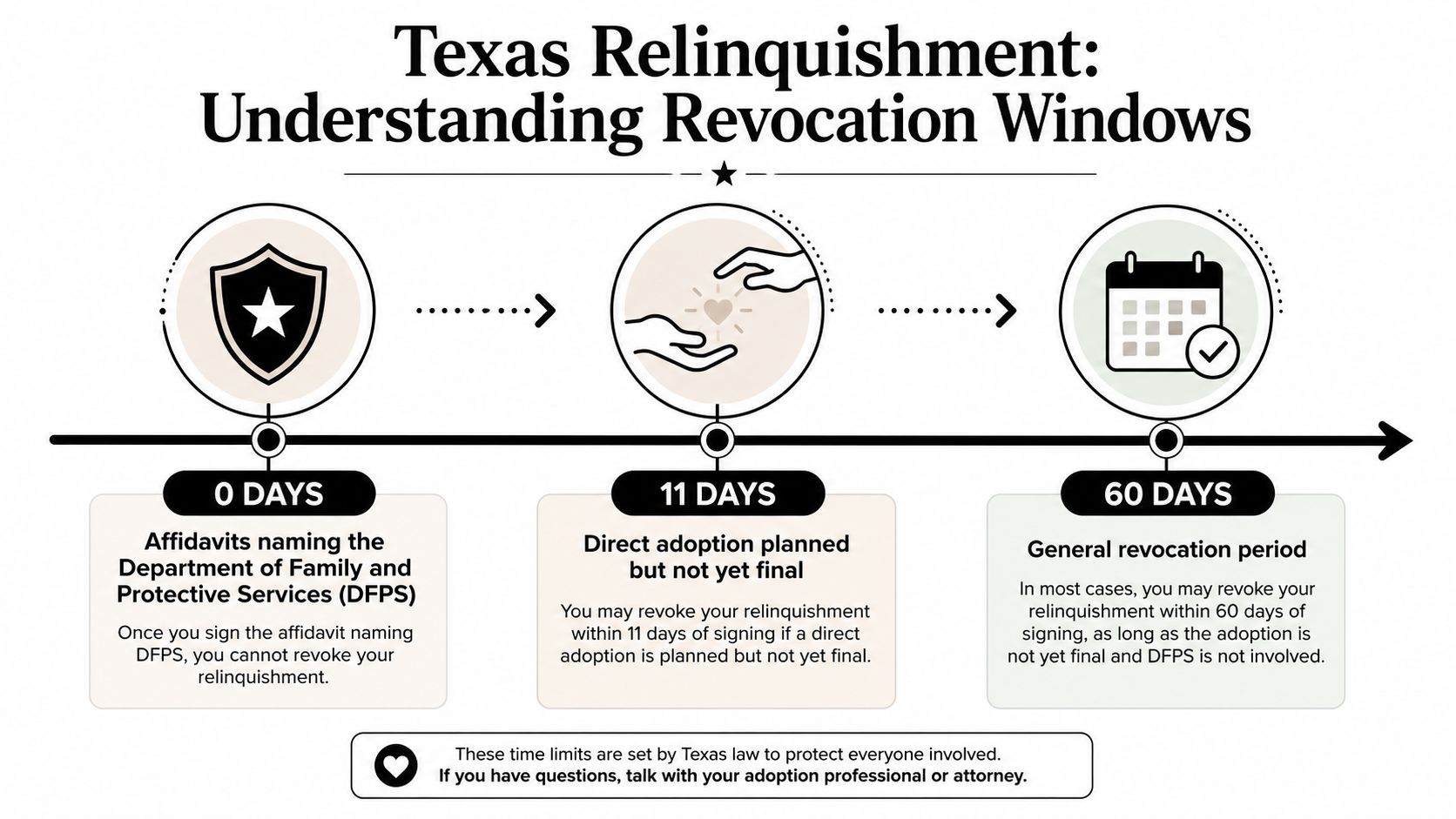
The three Texas revocation windows, 0 days, 11 days, and 60 days, are the key to making sense of the rest of the process.
How Texas Treats Voluntary Relinquishment
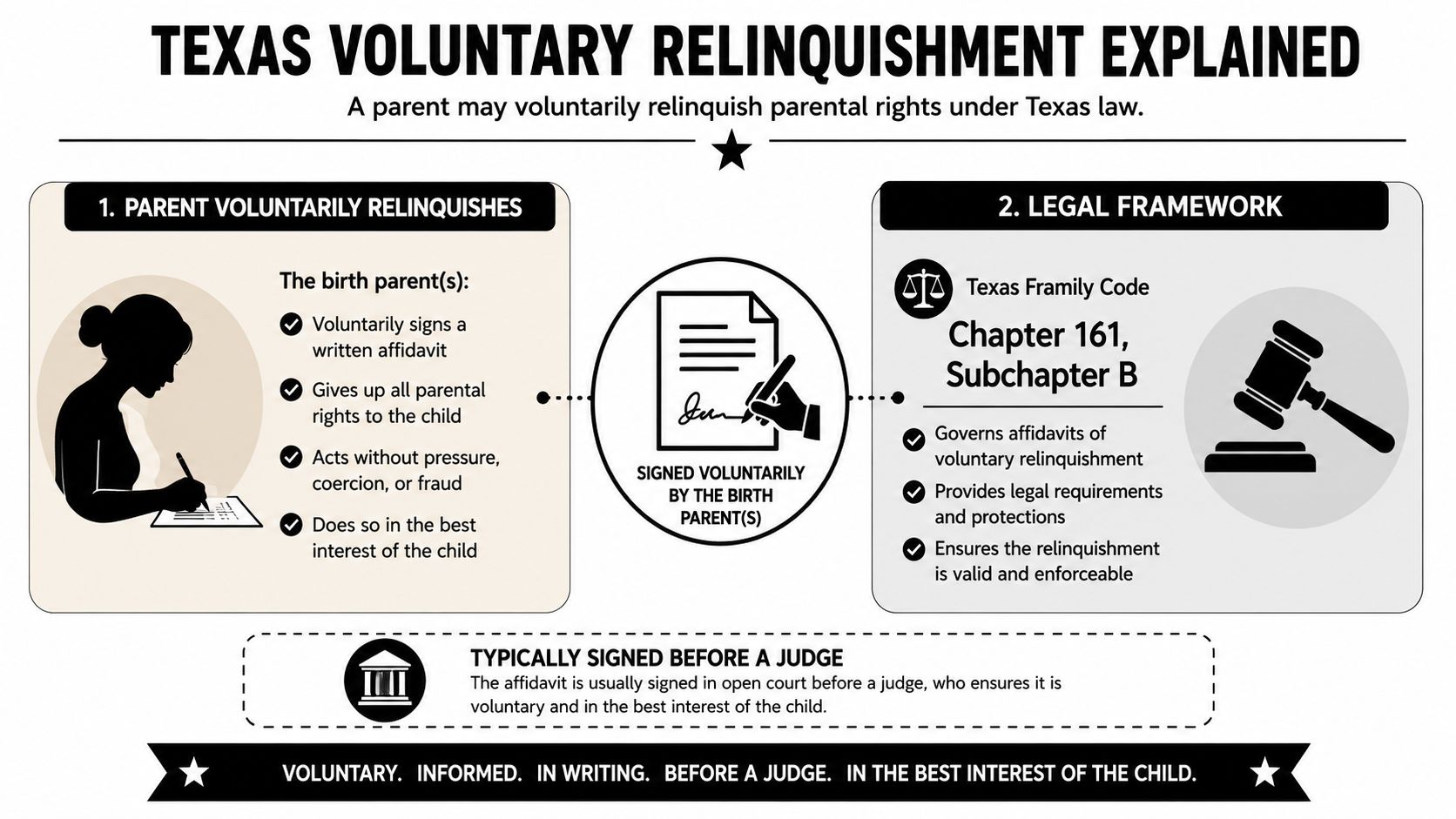
Texas handles voluntary relinquishment under Texas Family Code Chapter 161, Subchapter B, which is the statutory home for these affidavits. In plain English, the affidavit is the birth parent's written statement that they're voluntarily giving up parental rights so adoption or another legal plan can move forward. It's used in cases like stepparent adoption, agency adoption, private adoption, and kinship arrangements, including situations where relatives are helping raise a child. Voluntary Relinquishment of Parental Rights in Texas describes that basic function accurately, a birth parent voluntarily ends their rights for an adoption.
The important part is that the affidavit and the termination order are not the same thing. Think of the affidavit like a signed deed, and the court order like the recorded title. A deed shows intent, but the recording process gives the change legal force in the public record. In the same way, the affidavit is the parent's formal statement, but the judge's order is what terminates parental rights.
Where the three revocation models fit
Texas law recognizes three major revocation paths. One is immediate finality for some agency-managed relinquishments. One is the default short window when no irrevocability period is written into the document. One is an express period of up to 60 days if the affidavit says so.
| Affidavit Type | Revocation Window | Key Trigger |
|---|---|---|
| Agency-managed relinquishment | 0 days | The affidavit names the Department of Family and Protective Services or a licensed child-placing agency as managing conservator |
| Standard affidavit without an irrevocability term | Up to the 11th day after execution | The document does not state a revocation period |
| Express irrevocability period | Up to 60 days | The affidavit expressly says the relinquishment is irrevocable for a stated period not to exceed 60 days |
Practical rule: the paper's exact language controls, not what anyone thought the process would be.
For parents comparing adoption paths, the timeline in How Long Does a Birth Parent Have to Revoke Consent in Texas usually comes down to the affidavit type and whether a court has already taken the next step. That's why careful review before signing matters so much.
The 0, 11, and 60 Day Rules Explained
A frequent and appropriate question is the right one: Which rule applies to my affidavit? Texas law answers that by looking at who is named in the document and whether the affidavit states an irrevocability period. If the answer isn't obvious from the page in front of you, that's a sign the document needs a close legal read.
The 0-day rule
If the affidavit names the Department of Family and Protective Services or a licensed child-placing agency as managing conservator, Texas law treats that relinquishment as irrevocable under Section 161.103(e). There isn't a revocation window to count down. For a parent in that situation, the legal effect is immediate.
The 11-day rule
If the affidavit does not say it's irrevocable for a stated period, Texas law gives a short revocation period. It's revocable until the 11th day after execution, and then it becomes irrevocable on or after that day. That 11-day rule is a statutory rule, not a casual practice that can be stretched because someone changed their mind over the weekend.
The 60-day rule
If the affidavit expressly says the relinquishment is irrevocable for a stated period, that period can't exceed 60 days after execution. Some families assume every affidavit works the same way, but the text controls the timing. A carefully drafted document may leave more room for review, while a standard form may close the door much sooner.
The revocation mechanics matter just as much as the deadline. A revocation has to follow the statute, which means a parent can't just make a phone call or send a text and expect it to work.
A quick call to an attorney or an agency can matter emotionally, but it doesn't replace the formal revocation procedure Texas requires.
For families working through adoption planning, guardianship questions, or CPS-related cases, the broader structure of Texas Family Code Chapters 162 through 166 still matters because the affidavit is only one step in a larger court process. The legal window is short, and the child's need for stability grows as the case moves forward.
How to Properly Revoke Before the Deadline
Texas Family Code § 161.1035 gives a revocation path, but it's formal. A parent who wants to revoke has to do more than say, “I changed my mind.” The law requires a formal written statement, signed in a way that meets the statute, and that's where many people get tripped up.
What the revocation has to include
The revocation must be:
- A formal written statement, not a voicemail, email, or phone call.
- Witnessed by two credible persons.
- Verified before an authorized officer, such as a notary or other authorized official.
- Delivered to the designated recipient named in the affidavit.
- Filed with the clerk of court if a termination suit is pending.
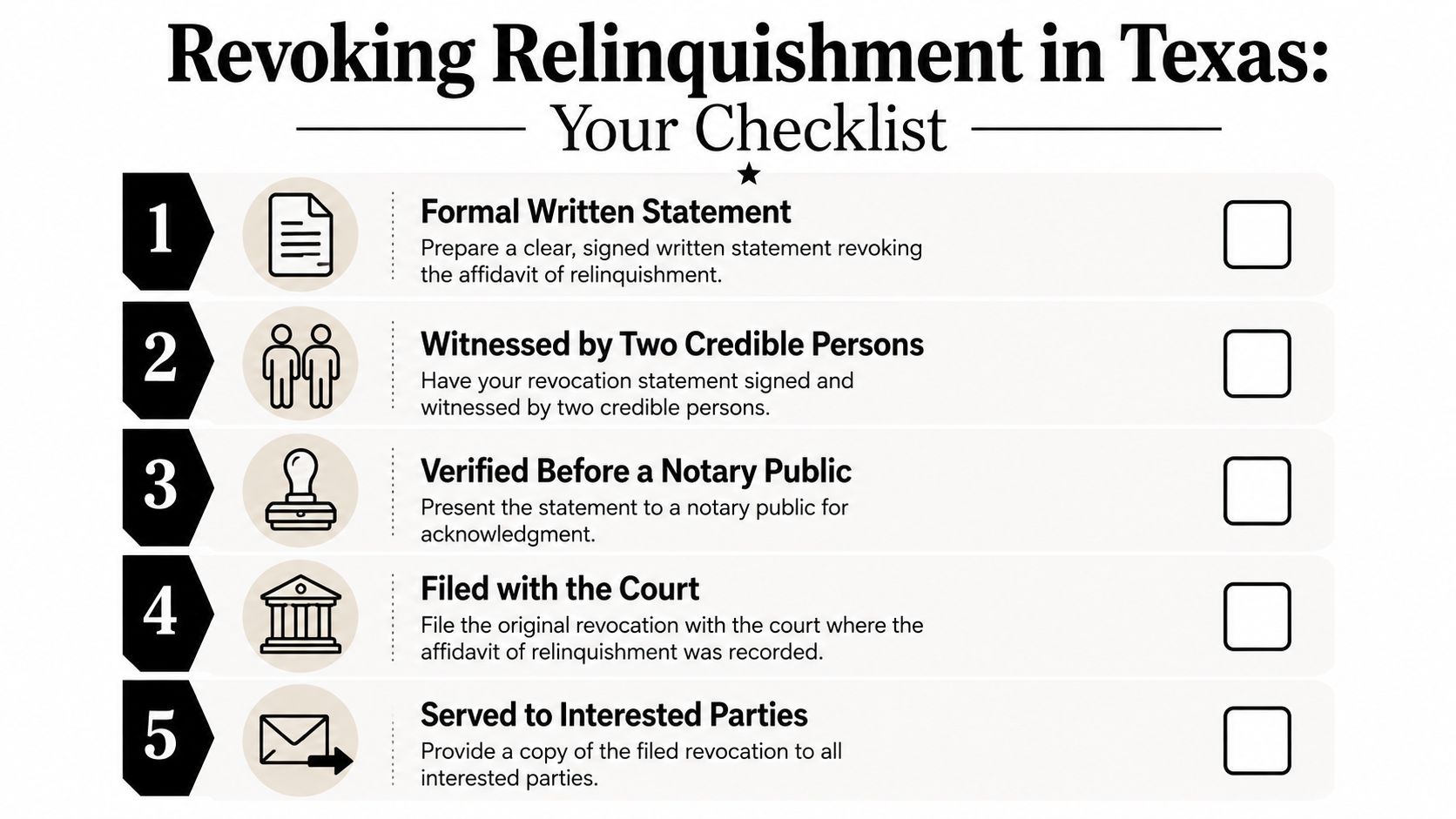
That checklist sounds simple, but it isn't casual paperwork. If a parent misses one of those steps, the revocation may fail even if the deadline hasn't passed yet. Texas law is built around formal notice because adoption cases affect the child, the birth family, and the prospective family at the same time.
Why informal attempts usually don't count
Many parents assume a heartfelt call should be enough. It usually isn't. If the affidavit and the statute require a written revocation with witnesses, verification, delivery, and court filing, then an informal message won't satisfy the legal standard.
The difference between revoking the affidavit and undoing a termination order after the judge signs is huge. Before the order, the focus is on whether the affidavit was revoked properly. After the order, the family is dealing with a much narrower challenge process, which is why timing and paperwork matter so much from the start.
A parent who acts quickly, keeps copies, and follows the statute has a real chance to preserve the issue. A parent who waits for someone else to explain the process may find the deadline has already passed.
After the Judge Signs the Order
The legal situation changes once the termination order is signed. At that point, the affidavit is no longer the only thing that matters, because the court has entered an order that gives the case legal finality. Texas Family Code § 161.211 sharply limits later direct or collateral attacks after the sixth month following the signing of the termination order, except for challenges based on fraud, duress, or coercion in executing the affidavit.
The opportunity to challenge gradually diminishes. Early on, there may still be room to ask a court to look at what happened. As time passes, this opportunity narrows until most challenges are shut out. By the time six months have passed, the courthouse doors are usually locked on most arguments.
What this means in practice
A parent who waits too long usually loses the ordinary chance to attack the order. A parent who moves quickly may still have a narrow legal path, but that path is much smaller than the revocation option that exists before the order. That's the practical reason lawyers emphasize early review of the affidavit, not just the final hearing.
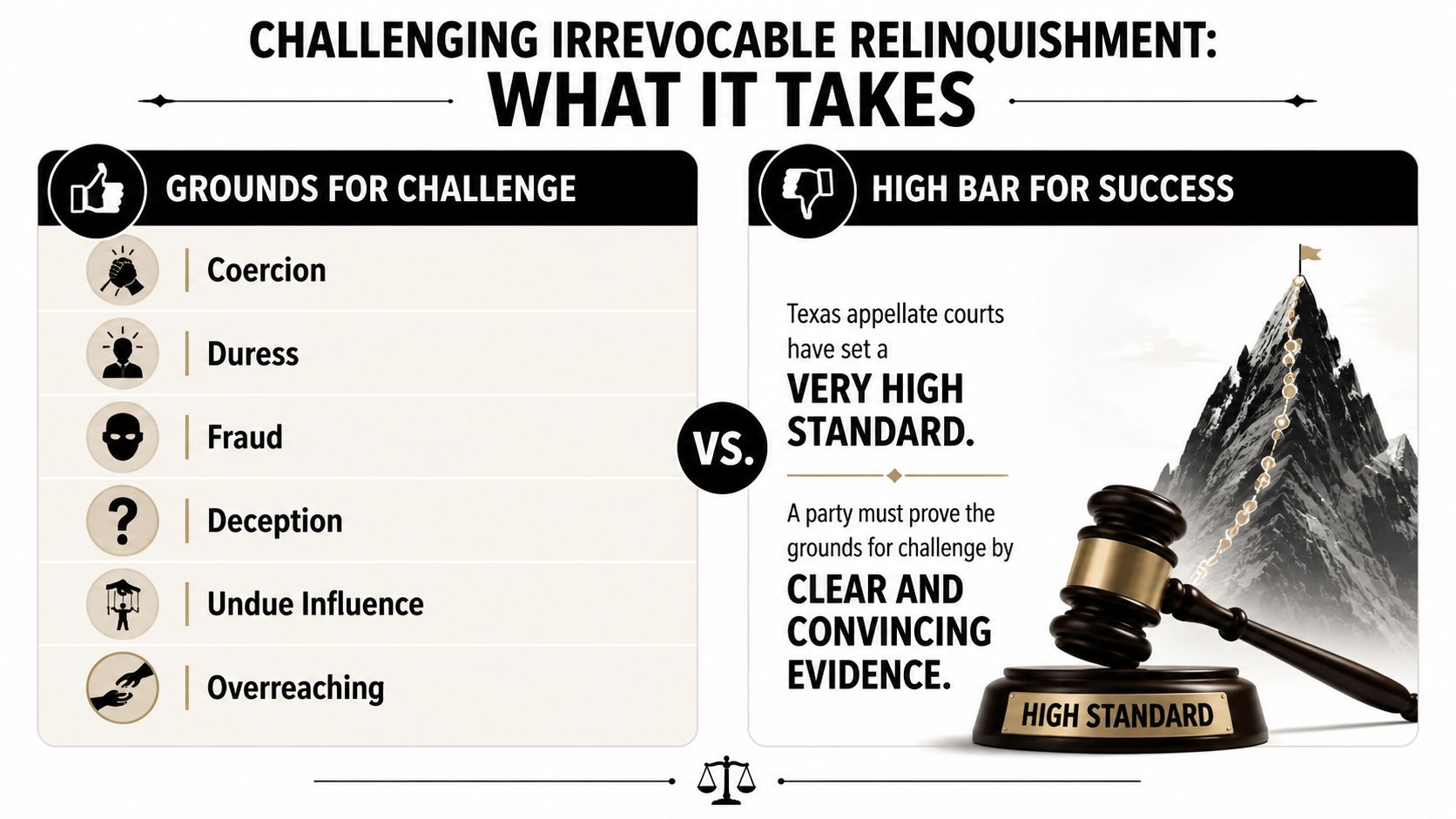
Texas appellate authority also recognizes that setting aside an irrevocable affidavit generally requires proof by a preponderance of the evidence of coercion, duress, fraud, deception, undue influence, or overreaching. That means the person challenging the affidavit has the burden to bring forward enough credible proof to tip the balance.
What Happens After an Adoption Is Final in Texas becomes the next question for many families once the judge signs, because finality changes the entire case posture. After that point, the focus shifts from revocation to whether any narrow legal challenge still exists.
Bottom line: once a termination order is signed, time is no longer just important. It becomes the difference between a possible challenge and a closed file.
Grounds for Setting Aside an Irrevocable Affidavit
A parent who wants to challenge an irrevocable affidavit usually has to show more than regret. Texas courts look for serious problems in how the affidavit was obtained, including coercion, duress, fraud, deception, undue influence, or overreaching. Those are legal words, but in everyday language they all point to pressure or unfair conduct that kept the parent from making a voluntary choice.
A real-world kind of scenario
Consider a parent who signs in a hospital room after a partner pressures them, tells them they'll be homeless if they don't sign, or misleads them about what the document says. Or think about a parent who is exhausted after delivery and is told they have no choice when the statute provides for a limited window and formal procedures. Those facts can matter if a court later has to decide whether the affidavit was genuinely voluntary.
Texas appellate authority uses a preponderance of the evidence standard for these claims. That means the challenger has to show it is more likely than not that the affidavit was tainted by the improper conduct claimed. The law does not treat sadness, second thoughts, or a later change of heart as enough by themselves.
What regret cannot do
Regret is human. It happens in adoption, in stepparent cases, in kinship placements, and in CPS-related decisions. But regret alone doesn't undo a properly executed affidavit once the statutory window has closed and the court order is in place.
The strongest protection is careful review before signing. That's the point where a lawyer can check whether the wording matches the family's intent, whether the timing is correct, and whether the parent fully understands what they're giving up.
A careful affidavit stage can prevent a painful court fight later, which is better for both the child and the adults trying to build a stable plan.
What Birth Parents and Adoptive Parents Should Do Next
Birth parents and adoptive parents need different next steps, even though they're often looking at the same affidavit from opposite sides. The law tries to protect both the parent's informed choice and the child's need for permanence, so the smartest move is to act quickly and document everything clearly.
If you're a birth parent
If you're still within the revocation window, move now. Read the affidavit line by line, check whether it names DFPS or a licensed child-placing agency, and look for any express irrevocability language. If you think you were pressured, misled, or rushed, write down who said what, when they said it, and who was present.
- Act before the deadline: Time can close the door even when emotions are still catching up.
- Keep evidence: Save texts, hospital paperwork, notes, and names of witnesses if you believe pressure or misrepresentation happened.
- Get legal advice quickly: A Texas family law attorney can help you figure out whether revocation is still available and whether the formal steps can be completed in time.
- Do not sign new papers casually: Another signature can create new problems if you haven't reviewed the first affidavit carefully.
If you're an adoptive parent
Keep every signed document, note the dates, and preserve any disclosures or communications about the relinquishment. If the placement depends on the affidavit, your attorney should review whether the document was signed correctly and whether the revocation period has passed. Good-faith reliance matters, but it needs to be paired with real legal protection.
Relative caregivers and stepparents often need separate guidance because family structure can make the process feel more informal than it really is. For those situations, Relative and Kinship Adoption in Texas is a useful example of how Texas law still requires a formal legal path even when the child is already part of the family.
Texas families sometimes also need help choosing the right legal team and support tools. Attorneys who handle adoption and related family-law matters often pair legal guidance with educational resources, and a practical overview of technical SEO for attorneys can help families understand how some firms organize those online resources.
If you need legal help on either side, the Law Office of Bryan Fagan, PLLC works with families on adoption and guardianship matters across Texas, including situations where timing, paperwork, and court deadlines all matter at once.
Compassionate Next Steps for Your Family
The answer to whether an affidavit of relinquishment in Texas can be revoked depends on the timing, the wording of the document, and whether the termination order has already been signed. That answer can feel harsh, but it's meant to protect both the child's stability and the parent's right to make a voluntary decision.
You don't have to sort through that alone. Families in Houston, Dallas, Austin, San Antonio, and nearby communities often need calm, careful guidance when adoption paperwork starts to carry permanent legal weight. The right help can turn confusion into a plan and help you take the next step with more certainty.
Whether you're a birth parent trying to understand your rights or an adoptive parent trying to protect a placement, clear advice matters at the affidavit stage. That's where the statute, the court process, and the family's real-life needs all meet.
The Law Office of Bryan Fagan, PLLC helps Texas families with adoption and guardianship matters, including questions about relinquishment, revocation, and finalization. If you're dealing with an affidavit of relinquishment and need clear guidance on your next step, visit Law Office of Bryan Fagan, PLLC to schedule a free consultation and speak with a team that understands how much is at stake.
