
A Texas kitchen table can hold a lot of worry. One spouse may be a U.S. citizen, the other may be a green-card holder or visa holder, and both may be looking at the same child and asking the same quiet question, can we adopt together without making immigration status the whole story?
That fear is common in Texas adoption when one adoptive parent is a non-citizen, and it deserves a careful answer. The short version is reassuring, Texas law does not impose a blanket citizenship bar in every adoption, but the family still has to handle two separate systems with care, the state court process and the federal immigration process. If you're also navigating cultural differences in marriage and family life, a thoughtful resource like navigating love across cultures can help you name the emotional side of that experience while you work through the legal side.
For many families, the first practical question is where to start. A plain-English overview like The Texas Adoption Process Step by Step can help you see the six core stages from type selection to final decree, so the process feels less mysterious before you ever file a petition. And if you're trying to understand how a mixed-status household fits into that process, the answer usually comes down to documentation, child welfare concerns, and the kind of adoption you're pursuing, not a simple yes-or-no citizenship rule.
A Family Sitting at the Kitchen Table
A couple may sit down after dinner with a stack of papers between them, a home study checklist, and a whole lot of hope. One of them has lived in Texas for years, the other is still sorting out immigration paperwork, and both are thinking about the same child as already part of the family.
That moment can feel tender and intimidating at the same time. The legal question sounds huge, but the family's real concern is often much simpler, will my status stand in the way of giving this child a permanent home?
The part most families worry about first
Texas law does not require every adoptive parent to be a U.S. citizen. The legal path depends more on whether the parent can meet the court's best-interest and eligibility requirements under Texas adoption law, and on what kind of adoption is involved. Federal immigration rules can still matter, especially if the child was born abroad or if the adopting parent is a nonimmigrant visa holder, but that is a separate question from whether Texas can hear the adoption at all. See also the family-law process summary in How to Start the Adoption Process in Texas.
For mixed-status couples, that distinction matters. A domestic adoption in Texas, a foster-care adoption, and an international adoption can each raise different follow-up issues, even when the family is united on the most important point, the child's need for a safe and permanent home.
Practical rule: if the family relationship is real, the legal work should focus on proving stability, fitness, and the child's best interests, not on assuming immigration status automatically ends the case.
Why this feels heavier than it should
Families often carry fear from other parts of the immigration system into adoption, and that fear makes every form feel bigger than it is. But adoption isn't about judging a family's worthiness in the abstract, it's about whether a court can find that the placement serves the child well.
That's why mixed-status families do better when they treat the process as a careful paper trail, not a moral test. The court wants clear facts, a stable home, and the right legal steps taken in the right order. Love matters, and Texas law still asks for the paperwork to match the love.
Who Texas Law Says Can Adopt
A Texas family can start from a simple question at the kitchen table, who is legally allowed to adopt, and what does the court look for. Texas Family Code Chapter 162 centers on who can adopt and whether the adoption serves the best interest of the child. It does not treat U.S. citizenship as a core adoption-eligibility requirement, and that is the point many readers miss. In practice, the court looks at whether the person asking to adopt can lawfully and safely parent the child, complete the required filings, and answer the court's questions about the home.
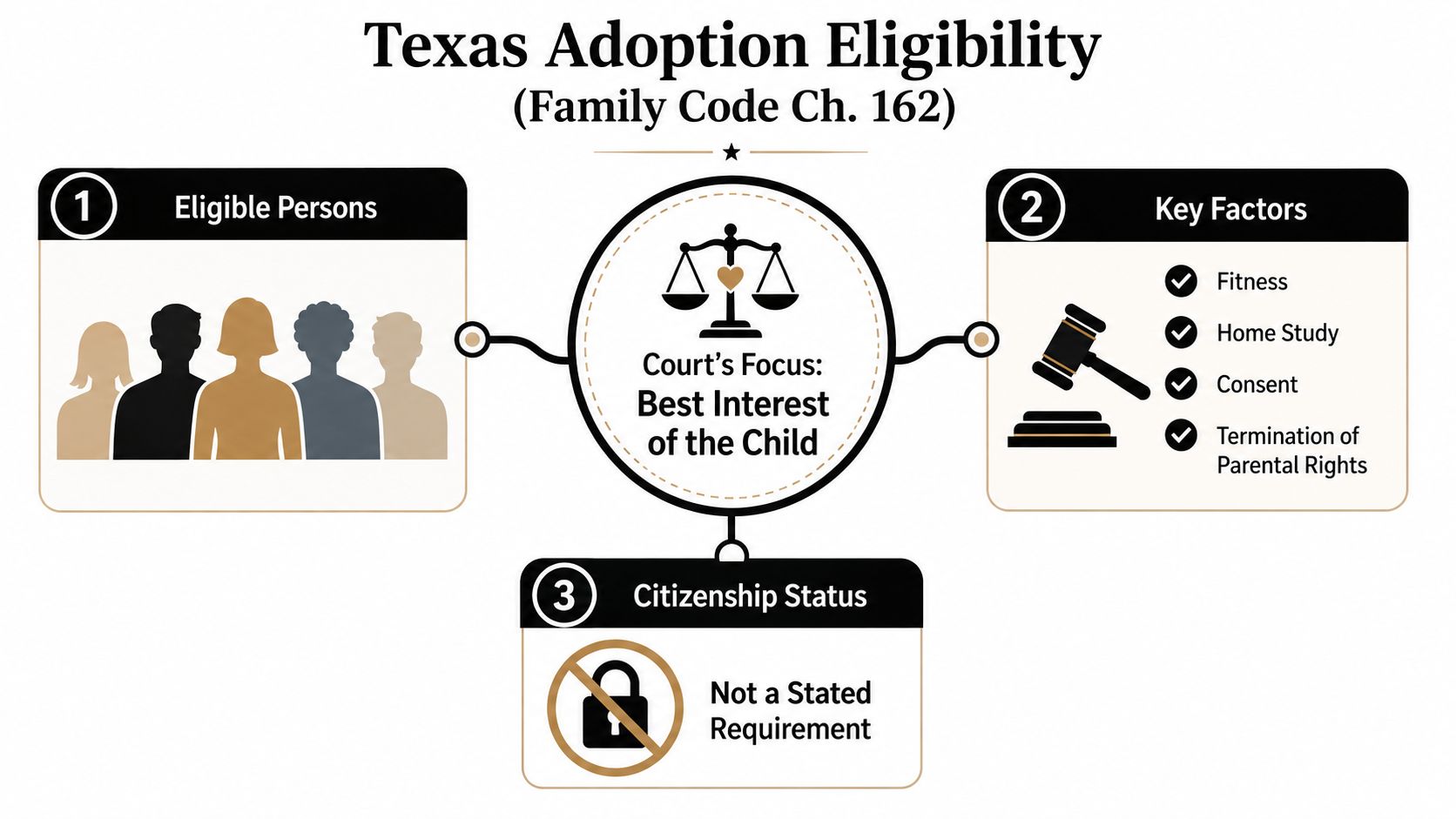
The court's focus is broader than citizenship
Texas courts look at fitness, the home study, consent, and, when needed, the termination of parental rights. Those are the practical issues that move a case forward. A non-citizen parent can still be evaluated on those same points, because the court's job is to protect the child, not to create a blanket exclusion based on immigration status.
Many families feel relief when they hear that. If one spouse is a non-citizen, the adoption does not stop at the courthouse door because of that status alone. The family still has to show that the arrangement makes sense for the child, and the judge still has to be satisfied that the legal requirements are met.
A note on relatives and agency practice
Older reporting on Texas policy noted that undocumented relatives have been allowed to adopt since a 2012 CPS policy shift, so long as there is a pre-existing relationship and a contingency plan if the parent is deported. That does not make every kinship case simple, but it does show that Texas practice has long recognized family unity as a real consideration. The Texas Adoption Step by Step helps frame the adoption path as a series of legal stages, not one single gate that a family either passes or fails.
The law does not ask, “Is this parent a citizen?”
It asks, “Can this parent safely and legally meet the child's needs, and is the adoption in the child's best interest?”
For many families, that difference changes everything. It shifts the question from whether adoption is impossible to what kind of adoption, what paperwork, and what court findings will be needed to get there.
How the Texas Court Process Actually Works
The Texas adoption process is built around proof, not assumptions. Families usually begin by choosing the right professional support, then moving through the home study, petition, service, termination issues, and final hearing in a way that gives the court a complete picture of the child's future home.
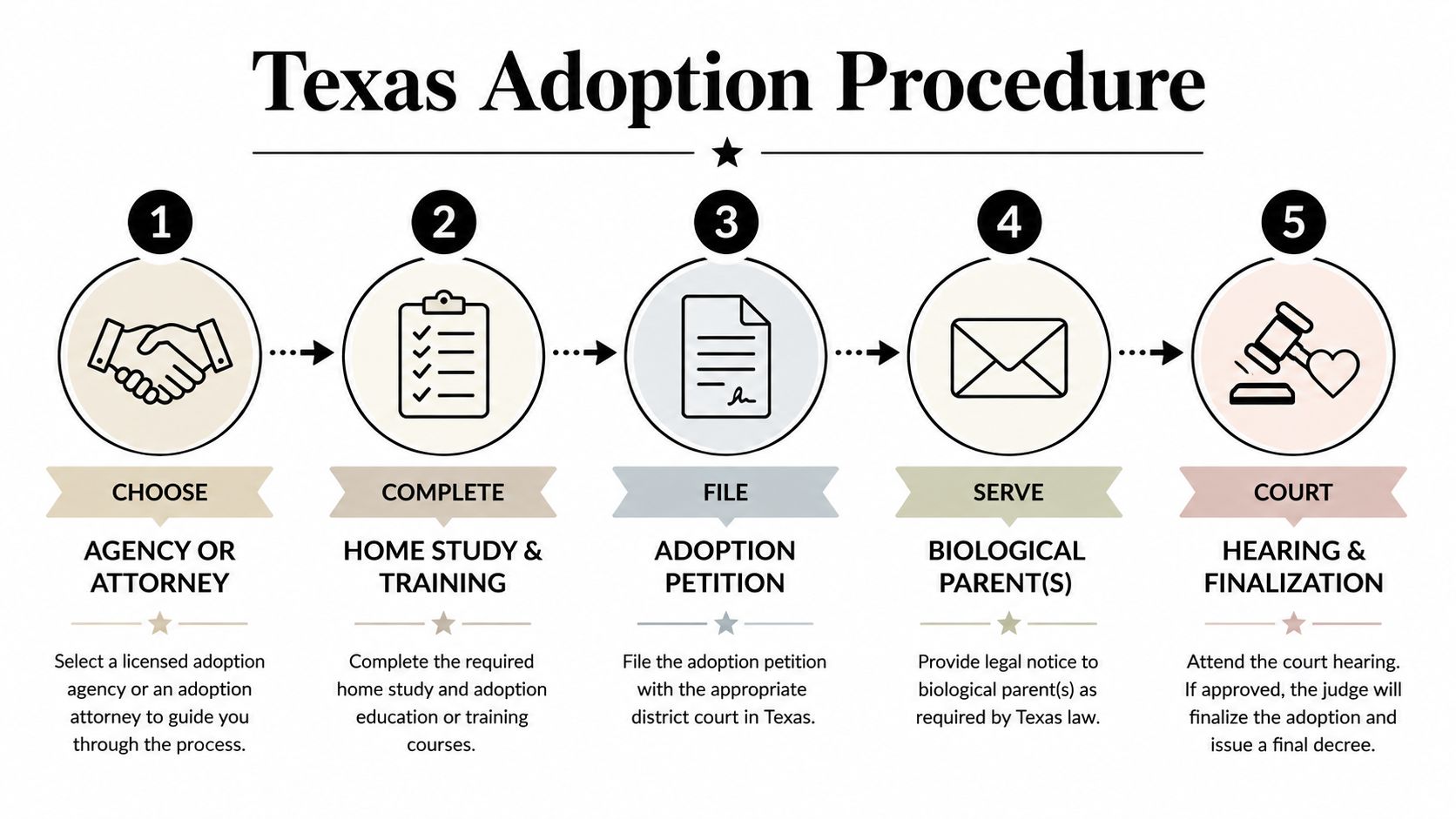
Step one through step five in plain English
Choose the right help. Some families work through an agency, while others hire an attorney directly. The choice often depends on whether the case involves foster care, kinship, stepparent adoption, or a private placement.
Complete the home study and training if required. Texas Law Help explains that adoption cases often involve more than one legal step, including the social study and, in some cases, training. For mixed-status families, this is the stage where immigration records, proof of lawful presence if available, prior custody orders, and identity documents should be organized early so nobody is scrambling later. Texas Law Help's overview of how children are adopted in Texas also explains that adoption usually comes after parental rights are terminated, either voluntarily or involuntarily, and that a child 12 or older generally must consent unless the court waives that requirement because waiver is in the child's best interest. See Texas Law Help's adoption guide.
Practical rule: if a document may help explain who lives in the home or how the child came into the family, gather it now, not after the petition is filed.
File the petition and serve the other parent. If another biological parent has rights, that parent has to be properly notified and, in many cases, those rights must be addressed before the adoption can move forward.
Handle termination or consent issues. Texas procedure is centered on ending the legal relationship that blocks adoption, then replacing it with the new parent-child relationship. A stepparent adoption can move forward without terminating the spouse's rights, so long as the other biological parent's rights are ended.
Attend the final hearing. The judge reviews the record and decides whether the adoption serves the child's best interest. For many families, this is the day when the paperwork finally matches the life they've already been living.
The main thing to remember is that the court wants a clean record. When a parent is non-citizen, that often means more questions about identity, residence, and legal status, but not a different emotional standard. The child's stability still sits at the center.
How a Parent's Immigration Status Affects the Child
The state court and the immigration system do different jobs. Texas can finalize parental rights, but federal law controls whether a child can enter the United States, stay here, or obtain the immigration benefit the family expects after adoption. That is the two-track reality mixed-status families need to understand early.
Domestic adoption and international adoption are not the same
If the adoption is domestic and the child is already in Texas, the child's immigration status may not be the main issue at all. A Texas adoption order can establish parentage in state court, but it does not automatically create a visa, green card, or other federal immigration benefit. For families facing a cross-border case, US Immigration Bonds citizenship guide can help readers think about how federal status questions can affect a child's long-term path, even though adoption itself is handled in another legal system.
That separation matters because a court order and an immigration benefit are not the same document. A Texas judge can say who the child's legal parents are under state law, but federal agencies still decide whether the child can enter, remain, or derive status through the adoption. For some intercountry cases, the State Department's two-year legal-custody and two-year joint-residence rules may matter when a non-citizen parent seeks to bring an adopted child to the United States. A helpful overview of that cross-border issue is Can You Adopt a Child From Another Country While Living in Texas.
The child's path depends on the setting
A child born in the United States is generally already tied to U.S. citizenship or lawful presence through birth and whatever else the child's records show, while a foreign-born child adopted abroad has to satisfy the federal process separately. That's why a family may finish the Texas adoption and still need to do federal paperwork before travel, benefits, or recognition are settled.
The child's future doesn't pause for legal categories, and neither should the planning. Families do better when they ask, from the start, whether this is a domestic adoption, a foster-care case, or an international adoption, because each one changes what the parent's immigration status means in practice.
Bottom line: Texas adoption secures parentage under state law, but it does not automatically solve federal immigration questions for a foreign-born child.
That's the part many families find confusing. The adoption may be emotionally complete the day the judge signs the order, yet the paperwork for immigration or recognition may still need careful follow-through.
Stepparent, Kinship, and CPS Foster Care Pathways
A mixed-status family at the kitchen table often has to sort through a simple question that does not feel simple at all. Which legal path matches the child's real-life caregiving arrangement, while also leaving room for any separate federal immigration issue that may arise later?
The answer usually falls into one of three paths. Each one starts from a different family situation, and each one asks the court a different set of questions about parentage, safety, and permanence.
| Texas Adoption Pathways for Mixed-Status Families | Best For | Typical Timing | Immigration Consideration |
|---|---|---|---|
| Stepparent adoption | A spouse who is already raising the child in the home | Often one of the more direct family-law paths | The non-citizen spouse can still be part of the adoption, but the family should check whether any federal issue exists for the child |
| Kinship adoption | Relatives such as grandparents, aunts, uncles, or siblings | Depends on whether parental rights are already resolved | Texas has allowed undocumented relatives to adopt when the family relationship is already established and there is a contingency plan |
| CPS foster-care adoption | Children whose permanency plan has moved toward adoption after foster care | Varies with the child's case plan and court schedule | The focus is on permanency and best interest, while immigration issues may matter separately if a child is foreign-born |
The stepparent path is often the easiest for families already sharing a home, meals, and daily care. The court is not asking whether the adults live like a family in the ordinary sense, because that part may already be obvious. It is asking whether the legal steps to create the parent-child relationship have been completed correctly.
Kinship adoption matters in Texas because relatives often step in after a parent cannot safely care for a child. A relative does not lose the chance to adopt just because that relative is a non-citizen. For families looking more closely at this route, the kinship adoption guide in Texas explains how the family relationship, court process, and parental-rights issues fit together.
CPS foster-care adoption is a different kind of case, because the child has usually already been through state supervision and the court is focused on finding a permanent home. Texas child-welfare records show that foster-care adoption remains a major part of the state's adoption work, and the broader data portal also records Texas child-welfare outcomes data that families and attorneys can review when they want to understand the state's permanency system. For mixed-status families, that means the adoption question is usually about the child's path to a stable home first, then about whether any separate federal immigration issue must be handled for the child.
The safest way to sort the options is to start with the relationship that already exists. Then compare that relationship to the legal path that fits it best, because the right case type can reduce friction and keep the focus where it belongs, on the child's stability and the family bond already in place.
Common Misconceptions That Derail Families
Families often lose time because they start with the wrong assumption. The law is usually more practical than people expect, but the paperwork can still go sideways if everyone is working from a myth.
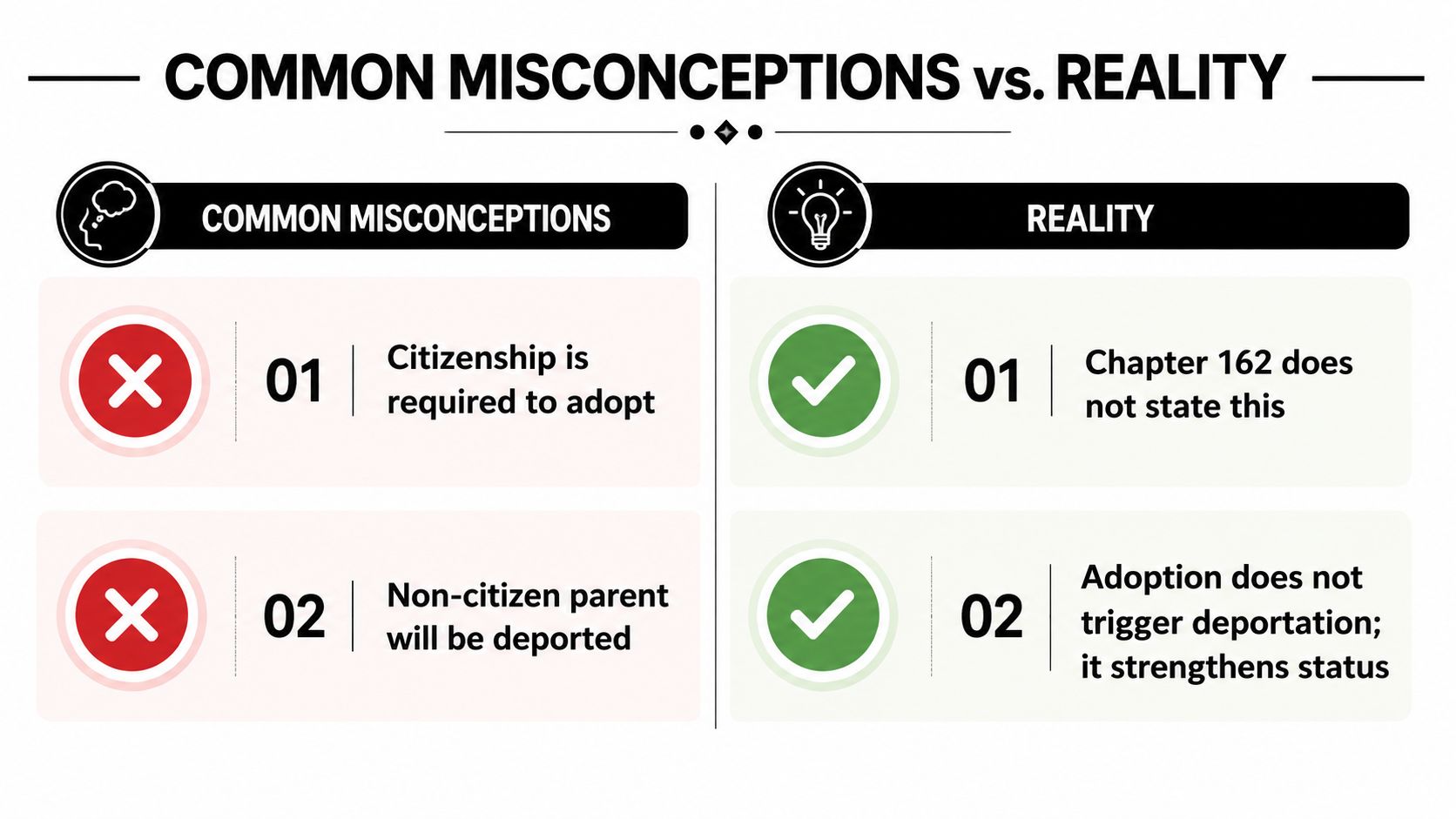
Four myths that cause real delays
Myth 1, citizenship is required to adopt in Texas. Texas Family Code Chapter 162 does not state that U.S. citizenship is a core adoption requirement. The court still has to be satisfied that the adoption is legal and in the child's best interest, but citizenship alone is not the whole test.
Myth 2, a finalized adoption automatically gives the child a green card or visa. That's not how federal immigration works. A Texas order can establish parentage, but a foreign-born child may still need immigration processing.
Myth 3, a foreign adoption order is automatically honored in Texas. Foreign decrees may be registered or recognized through Texas court procedures, but the adoptive parent still has to follow the right process. That recognition step matters when families later need to prove parentage for school, benefits, or custody enforcement.
Myth 4, a non-citizen parent can't appear on the new birth certificate. In many domestic Texas cases, that's not the problem families think it is. The bigger question is whether the adoption itself is legally completed and properly documented.
The safest assumption is simple, state adoption and federal immigration are related, but they are not the same legal event.
The practical takeaway is to stop asking only, “Can we adopt?” and start asking, “What kind of case do we have, and what paperwork does that case need?” Once families make that shift, they usually waste less time and make calmer decisions.
Coordinating Family-Law and Immigration Counsel
Mixed-status families protect themselves best when they treat adoption like a two-lawyer conversation from the start. A Texas family-law attorney can guide the court case, and an immigration attorney can flag child-status issues before they become delays, denials, or travel problems.
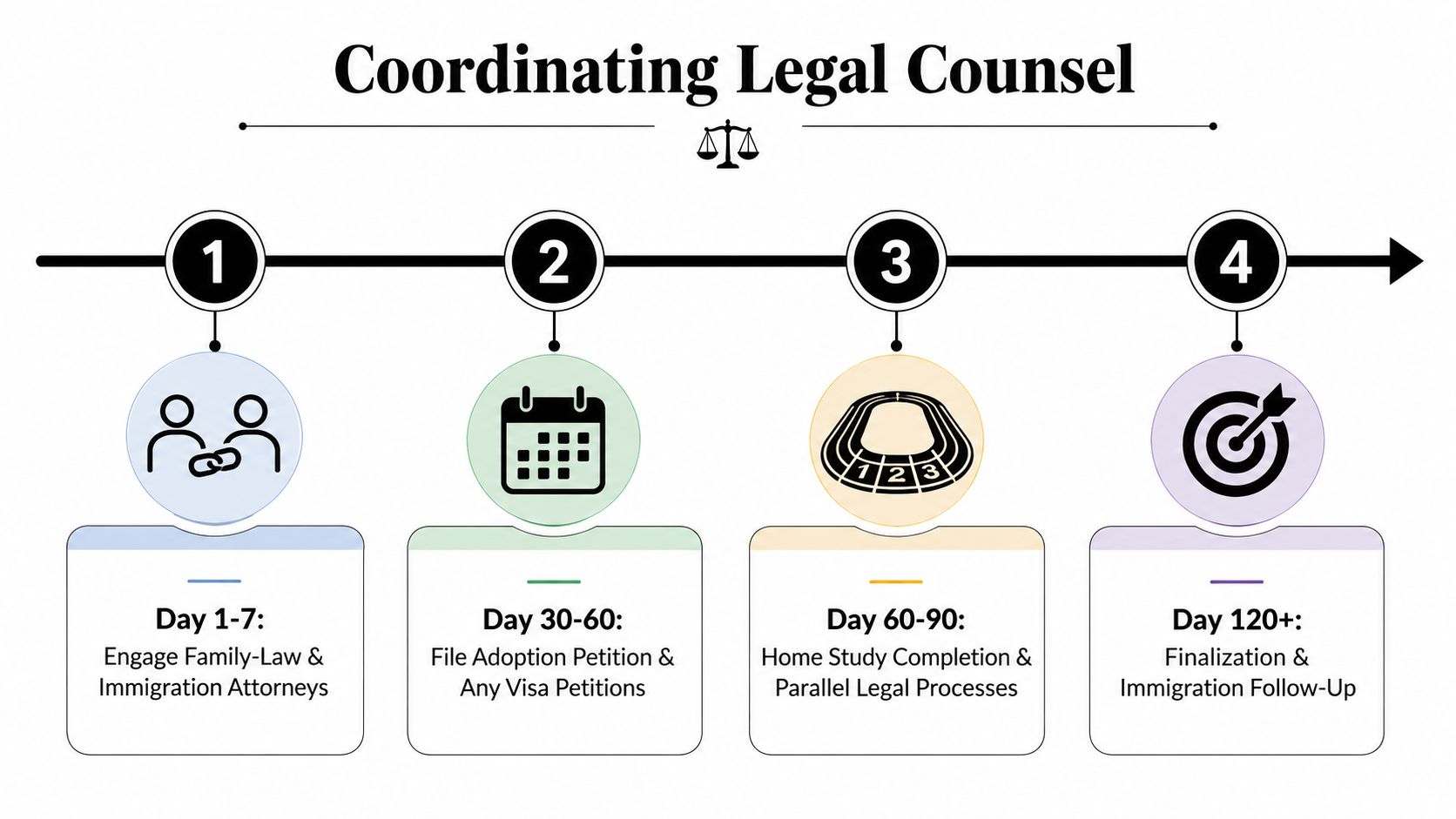
Timing matters more than most families expect
A practical timeline often starts with 60 to 90 days for documentation and home study preparation, then moves into the petition and termination phase over the next several months. Many families should expect 6 to 12 months before finalization, though the exact pace depends on the case and the court schedule. If the child is foreign-born, immigration work may run in parallel, because the state case and the federal case do not wait on one another.
That's where coordination matters. If one lawyer knows the court schedule and another knows the immigration implications, the family is less likely to miss a document, repeat a filing, or learn too late that a status issue affects the child's next step. The Law Office of Bryan Fagan, PLLC handles Texas family-law adoption matters and can work alongside immigration counsel when the case needs that added layer of review.
What to bring before the first meeting
Bring the paperwork that tells the child's story and the adults' status clearly.
- Identity documents: passports, birth certificates, marriage records, and any government-issued identification.
- Immigration records: visa paperwork, residence records, and anything showing lawful presence if applicable.
- Court records: custody orders, termination orders, or prior conservatorship papers.
- Home information: proof of where the child lives and who's in the household.
- Relationship history: school records, medical records, or family evidence showing the bond already exists.
- Questions in writing: ask what state court needs now and what federal agency may need later.
When families walk in prepared, the consultation feels less like crisis management and more like planning a child's future. That shift helps everyone, especially parents who are already carrying enough anxiety without guessing which form matters most.
Your Next Step Toward Building Your Family
A mixed-status adoption can feel like two hard things at once, legal and emotional. The good news is that families do complete these cases, and they do it by taking the process one step at a time, with the child's stability at the center.
A loving family is not built by paperwork alone, but paperwork can protect the family you've already built.
If you're holding back because you're unsure whether your immigration status will complicate adoption, that's the right time to ask for guidance, not the time to guess. A calm review of your facts can turn a scary question into a workable plan, and that plan can protect the child you're trying to care for.
The Law Office of Bryan Fagan, PLLC helps Texas families with adoption and guardianship matters, including mixed-status cases that raise both family-law and immigration questions. If you're ready to move forward, visit Law Office of Bryan Fagan, PLLC to schedule a free consultation and get clear guidance for your next step.
