
You've spent years putting an old CPS case behind you. Now, a relative needs a permanent home, your spouse wants to adopt your child, or you're ready to pursue adoption from foster care. Then the application asks about prior CPS involvement, and the question feels like a door closing before you've had the chance to explain.
Can you adopt in Texas with a prior CPS history? Often, yes. Texas doesn't impose a blanket ban on adoption applicants who have had prior CPS contact. Instead, the state uses a risk-based process that looks at the full picture, including the home study, criminal history, child-abuse and neglect registry information, the outcome of the earlier case, and your present ability to provide a safe, stable home.
When an Old CPS Case Meets a New Adoption Dream
Maria is a grandmother who wants to adopt her grandson. Years ago, CPS investigated her home after a family crisis. The case closed, services were completed, and Maria has had stable housing, steady work, and no further involvement with CPS. Still, when she reaches the adoption application, she pauses at the question about previous investigations.
She worries that checking "yes" will end the process. Leaving it blank feels dishonest. Neither reaction helps her tell the story that an adoption evaluator needs to understand.

Texas agencies don't evaluate a prior CPS report in isolation. They ask what happened, how the case ended, whether the concerns were addressed, and whether your current home and parenting capacity support the child's best interests. A closed case with completed services may raise questions, but it isn't automatically the same as an adverse registry finding or a current safety concern.
That distinction matters for parents, stepparents, grandparents, siblings, and other relatives. A prior report can be part of your file without defining your entire family. The more useful question is not, “Will CPS history automatically disqualify me?” It's, “What does the record show, and what can I document about my life today?”
Families often benefit from learning what happens if CPS is involved in an adoption case before submitting paperwork. Honest disclosure, organized records, and early legal advice can prevent an old case from becoming a last-minute surprise.
How Texas Screens Adoption Applicants
A Texas adoption file works like a set of connected safety checks. Each part asks a different question, and an old CPS history may appear in several places. The goal is to understand how the earlier concern fits with your household today.
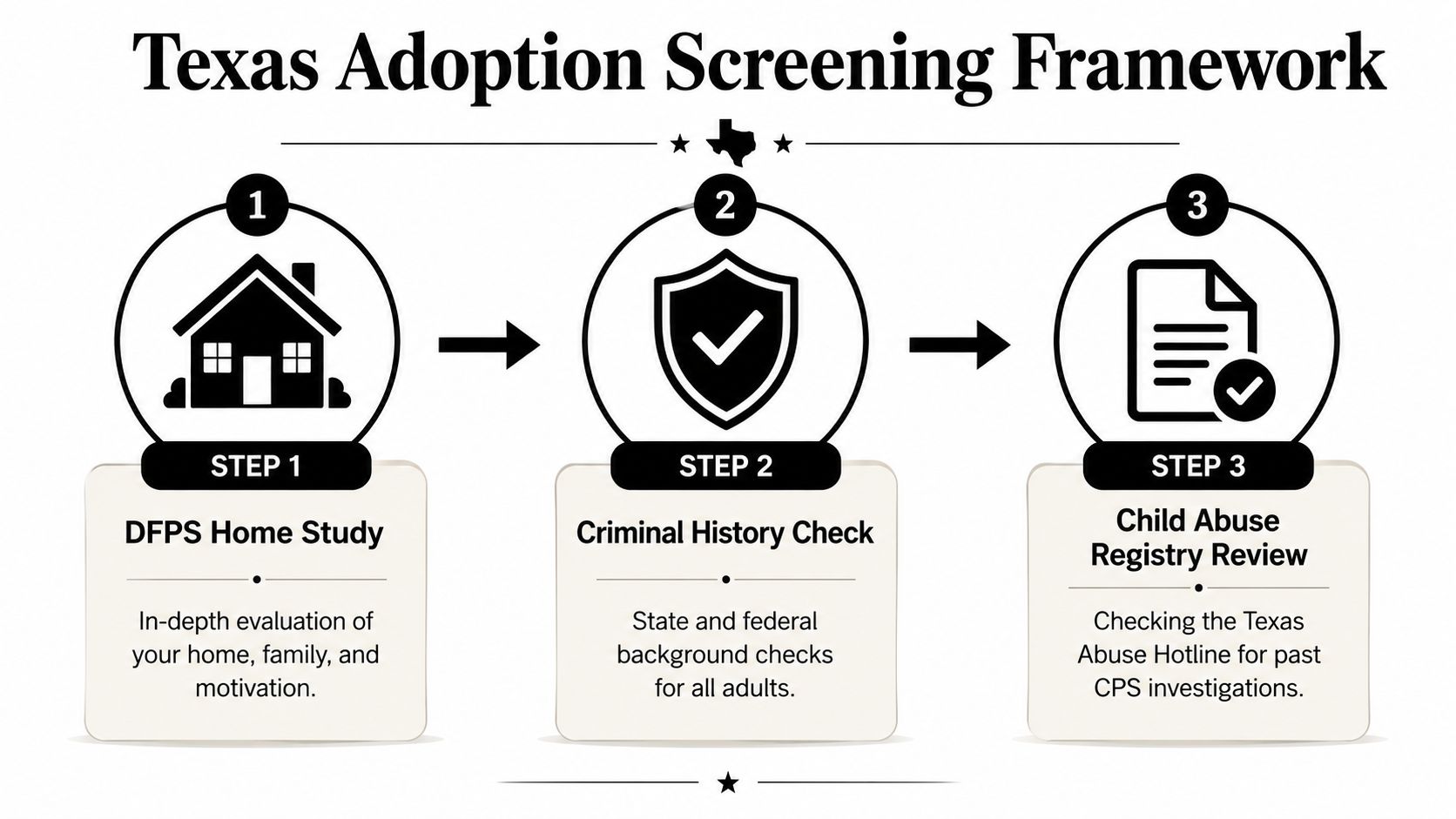
The home study
The home study gives the agency or professional a structured view of your family before adoption approval is recommended. It covers the home, household relationships, finances, health, parenting experience, motivation, and ability to meet a child's needs. The evaluator may also ask for the CPS record, service-completion documents, and your explanation of what changed.
DFPS guidance describes a review of past and present functioning, including any history of abuse or neglect. It also addresses an applicant's understanding of discipline and sensitivity to children who have experienced abuse or neglect. In practice, the evaluator is assessing judgment, stability, honesty, and a workable parenting plan, not searching for a flawless personal history.
Families can review the practical requirements in this guide to adoption home study requirements in Texas. Preparing records before the interview can make the discussion clearer and reduce avoidable delays.
Criminal history screening
Applicants must provide current criminal-history information. The court may use information obtained by DFPS or a licensed agency only if it was obtained within the required period before the adoption order. For adoptive parents, the criminal-history check must be current within 12 months of filing the adoption petition.
The review can include another state. If an applicant or another adult in the household lived outside Texas during the preceding five years, the relevant out-of-state history must be checked. A family that moved to Texas after an earlier CPS case elsewhere may therefore need records from that state before the agency can finish its review.
Abuse and neglect registry review
DFPS and adoption agencies also examine CPS-related databases and child-abuse or neglect registry information. A prior contact carries more weight when the investigation resulted in a registry disposition such as “reason to believe.” The home study then becomes the place to connect that record with present-day safety, accountability, and family functioning.
The Stepparent Adoption in Texas process has its own consent and court requirements, although screening concerns still matter.
Practical rule: Treat an old CPS case like a chapter in the file, not the entire story. Gather the record, explain the outcome, and show what your household can safely provide today.
Which CPS Findings Actually Matter to an Adoption
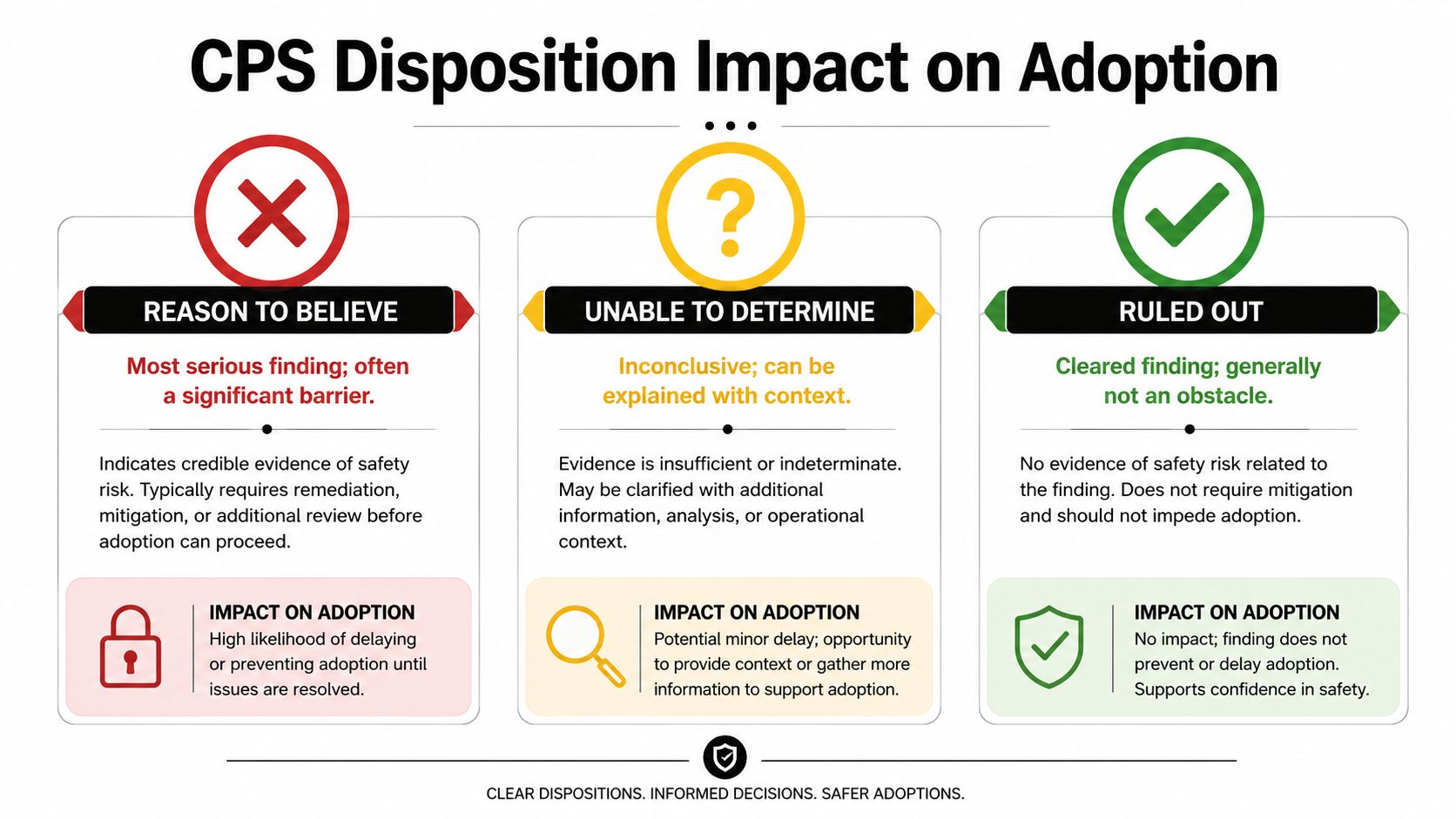
The words used to describe a CPS outcome can feel confusing. Families sometimes say a case was “unsubstantiated,” “closed,” or “cleared,” but the legal and agency record may use a more specific disposition. That exact wording can affect how a home study professional evaluates the application.
Reason to believe
A “reason to believe” disposition is generally the most serious concern for an adoption applicant. It means the CPS investigation reached the threshold that can place an individual in the central registry. Because registry information is part of the background-check review for adoptive placements, an agency may need detailed records before deciding whether the applicant can safely proceed.
This doesn't mean every applicant with such a history receives the same result. The evaluator may consider the age of the case, the conduct involved, whether the applicant was the person responsible, whether services were completed, and whether later conduct shows lasting safety and stability. But a registry finding usually requires more than a brief verbal explanation.
Unable to determine
An “unable to determine” result is inconclusive. It isn't the same as a finding that abuse or neglect occurred, but it also may not erase the agency's questions. The home study writer may ask what was happening in the household, what records say about the investigation, and what has changed since then.
Context matters here. A family can explain the circumstances without minimizing the child's experience or attacking the investigation. A thoughtful account, supported by closure records and service documentation, gives the evaluator something concrete to assess.
Ruled out
A “ruled out” finding generally presents less concern because the investigation didn't establish the reported allegation. Even then, the applicant should disclose the history accurately if the application asks about CPS involvement. Omitting a report can create a trust problem that becomes more serious than the original contact.
The home study recommendation reflects this analysis. An evaluator may recommend approval, request additional safeguards or documentation, or identify a serious barrier. The result depends on the record and the present circumstances, not merely on the existence of a past report.
For a broader discussion of potential barriers, review what can disqualify you from adopting a child in Texas. The important point is that a disposition is evidence to understand, not a label that replaces individualized review.
Different Adoption Paths Different Outcomes
The same CPS history can carry different practical weight depending on the adoption path. A stepparent adoption, for example, usually involves a child already living within an established family relationship. A private agency adoption may involve an applicant seeking placement with a child who has no prior connection to the household. Those contexts can lead the evaluator to ask different questions.
| Adoption Path | CPS History Sensitivity | Typical Documentation Focus |
|---|---|---|
| Private agency adoption | The agency may examine the history closely before matching a child with the family. | Disposition records, rehabilitation evidence, references, and the applicant's parenting plan |
| Stepparent adoption | The evaluator considers the existing relationship, household safety, and the child's best interests. | Household functioning, relationship with the child, consent or termination issues, and current stability |
| Foster care adoption | The agency reviews safety history while also considering the applicant's experience caring for children affected by trauma. | Foster-care records, training, placement history, services, and permanency planning |
| Kinship adoption | The existing family relationship and the child's need for continuity may provide important context. | Family connection, caregiving history, CPS records, safety plan, and the child's adjustment |
Private and agency adoptions
A private agency may focus heavily on whether the applicant can safely parent a child who doesn't already know them. The agency may request complete CPS records, explanations of past concerns, and references from people who have observed the applicant's conduct over time.
Stepparent cases
A stepparent may have a stronger day-to-day relationship with the child, but that doesn't remove screening or court requirements. The court still focuses on the child's best interests, the legal parent-child relationship, and whether required consent or termination issues have been resolved.
Foster care and reunification
Foster-to-adopt cases often involve a documented history of caregiving, training, and collaboration with the child-welfare system. A prior CPS history still matters, but the evaluator may also be able to observe the applicant's parenting directly and assess how the family supports the child's relationships and permanency needs. Families should also understand that reunification remains a central child-welfare goal when it can happen safely.
Kinship adoption
Kinship caregivers frequently have an existing bond with the child and knowledge of the family's circumstances. That connection can help explain why adoption or guardianship serves the child's best interests, but relatives still need a candid review of their own history and home.
Texas Family Code Chapter 162 also governs important consent mechanics. The managing conservator usually must consent unless that person is the petitioner. A child who is 12 or older must generally consent in writing or in court, unless the judge waives that requirement as being in the child's best interest. When termination and adoption are joined in one petition, the court can terminate the parent-child relationship at the same time it grants the adoption under Texas Family Code Chapters 162 through 166.
Steps to Strengthen Your Adoption File After CPS History
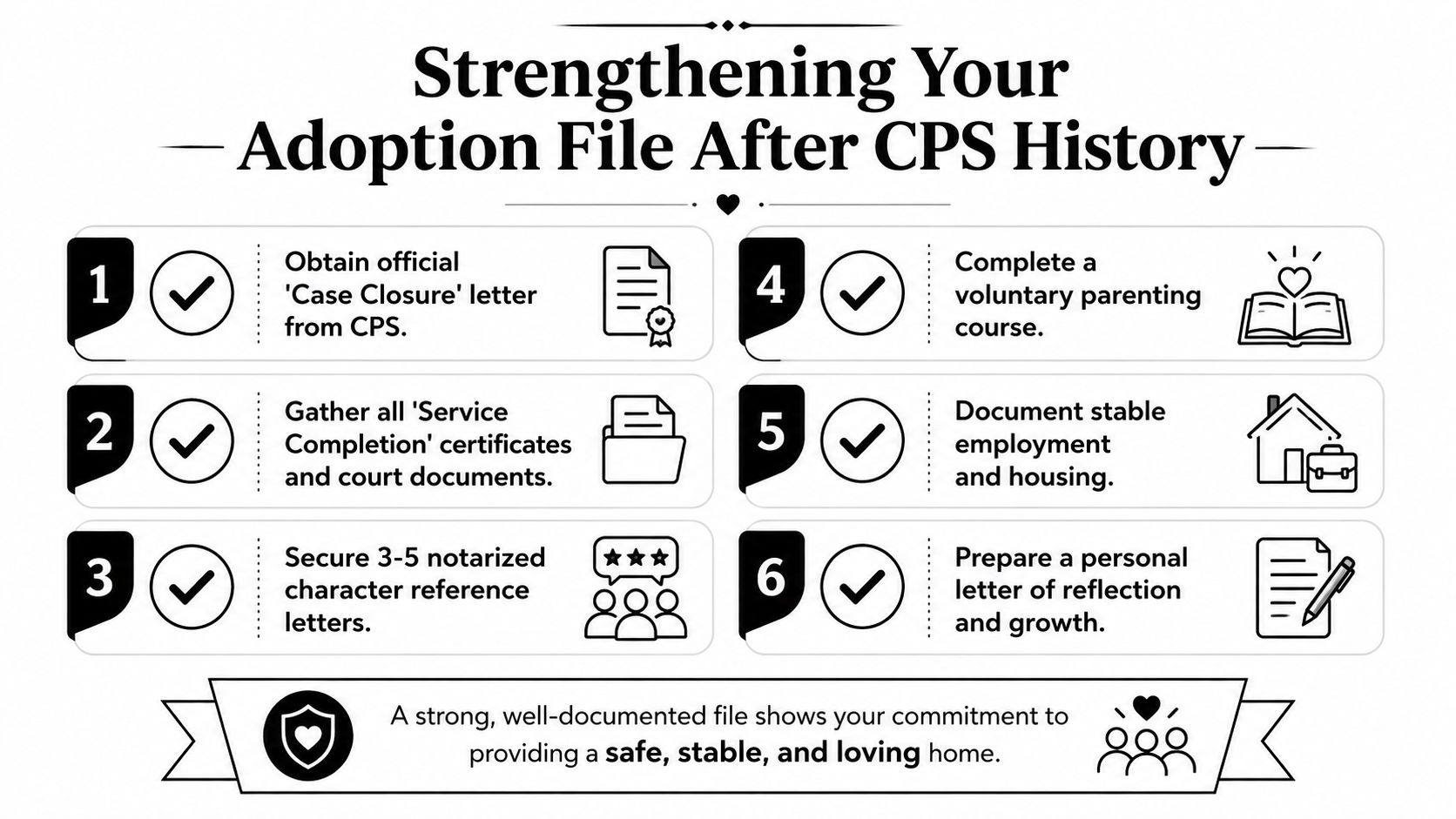
You can begin preparing before the first agency meeting. The goal isn't to hide the old case or argue that it never mattered. The goal is to give the evaluator reliable proof of what happened, what changed, and why your home is safe today.
Build the record first
Request the official closure information from the CPS case and collect service-completion records, court orders, evaluations, and other documents showing how the matter ended. If the records are incomplete, write down the agency names, caseworker information, court involved, and approximate dates so an attorney or agency can help identify what is missing.
Next, gather evidence of present stability. This may include housing records, employment information, medical documentation when relevant, and a description of who lives in the home. The evaluator needs a current picture, not just a promise that things are better.
Show growth without minimizing harm
A personal statement can help explain the earlier circumstances. Describe the stressors that existed, the decisions you made, the services you completed, and the habits you use now to protect children. Avoid blaming the child, the reporting person, or CPS for every problem. Accountability often gives the evaluator more confidence than a defensive narrative.
Character references should come from people who know you well enough to discuss parenting, reliability, conflict management, and family relationships. A short letter saying you're “a good person” is less useful than a specific account of how you respond when a child is upset or when a household problem needs attention.
Prepare a simple file checklist
- Closure records: Obtain the case outcome and any official documentation showing the matter's status.
- Service proof: Include completion certificates, counseling records when appropriate, and relevant court documents.
- References: Ask trusted adults for detailed, honest letters about your current character and caregiving.
- Parenting preparation: Consider a voluntary parenting or trauma-informed course that fits the child's likely needs.
- Stability evidence: Organize housing, employment, household, and support-network information.
- Personal reflection: Write a clear account of responsibility, change, and your plan for safe parenting.
The home study writer may still ask difficult questions. Answer directly, correct misunderstandings promptly, and disclose uncertainty rather than guessing. For legal questions about records, consent, or the best adoption route, the Law Office of Bryan Fagan, PLLC can help families organize the issue before it delays the home study.
A Family Working Through the Process
James and Elena are grandparents caring for their granddaughter after the child's parents lost their parental rights. The grandparents had prior CPS contact from a difficult period in their own family history. Their old case wasn't ignored, but they approached it with records instead of fear.
Their first obstacle was access to the child's redacted CPS records. Texas legislators noted in 2026 that families may wait more than six months for those records before an adoption can proceed, and proposed a 90-day production deadline in Senate Bill analysis materials published by the Texas Legislature. For a kinship family, that delay can feel especially painful because the child may already be living with the relatives while the legal file remains incomplete.
While waiting, James and Elena prepared their home-study materials. They collected proof that their earlier CPS case had closed, documented completed services, gathered references, and discussed how they would support the child's relationship with safe relatives. During the home visit, they answered questions about discipline, supervision, transportation, school, and the child's emotional needs.
Their granddaughter was 12 or older, so the court needed her written or in-court consent unless the judge determined that a waiver served her best interests. The child's voice was not treated as a formality. The court needed to understand whether she felt safe, informed, and supported.
The grandparents also learned that consent isn't always final before the hearing. Under Texas Family Code Section 162.011, a required consent may be revoked at any time before the court renders the adoption order, as explained in the Texas consent-revocation statute. Their attorney monitored the consent status and prepared the final paperwork so the judge could address the adoption and any joined termination issues together.
The process was slower than the family hoped, but each delay had a practical response. They requested records, kept documents organized, stayed focused on the child's stability, and asked questions before signing anything.
Common Questions Families Ask After a CPS Case
Will a sealed or expunged CPS record still appear?
May still appear. A sealed or expunged record can remain visible in CPS-related registries and agency screening systems. Ask which databases the agency reviews, and get legal advice before treating the history as irrelevant.
How is out-of-state CPS history handled?
If you or another household adult lived outside Texas during the preceding five years, the screening process may require an out-of-state check. Gather that state's case information early, including the final disposition and service records, so the agency can evaluate the history accurately.
What if a biological parent contests the adoption?
The answer turns on parental rights, notice, consent, and the case facts. A private agreement or verbal promise does not settle those legal requirements. Have an attorney review the parent's status and Chapter 162 before filing or appearing at the final hearing.
When should you stop handling the paperwork alone?
Seek legal help if the agency cannot explain a registry result, records are missing, consent is disputed, a parent has reappeared, or the home-study recommendation contains conditions you do not understand. Early advice can help you respond with the right documents and avoid a preventable filing problem. A prior CPS case can create extra questions, but clear records and prompt answers give the agency a better basis to assess your household today.
A Gentle Next Step Toward Your Family
A prior CPS history is one part of your family's story. It may require additional records, honest conversations, and proof of rehabilitation, but Texas adoption screening is designed to evaluate present safety and the child's best interests rather than impose a blanket punishment for every past report.
Whether you're considering foster care and CPS adoption in Texas, a kinship adoption, a stepparent case, or guardianship, start by identifying the exact disposition and the legal path available to your family. A careful review can clarify what the agency needs and what the court will require.
The Law Office of Bryan Fagan, PLLC helps Texas families address CPS-related adoption concerns, prepare for home studies, resolve consent and termination issues, and move cases toward finalization with child-focused legal guidance. Visit Law Office of Bryan Fagan, PLLC to schedule a free consultation and discuss your prior CPS history with a Texas adoption attorney.
