
A child may be sleeping in the same home, attending the same school, and being loved as a son or daughter, while the adoption that was meant to make the relationship permanent remains unfinished. Then an illness, a death, or a benefits application forces a painful question: What legal protections does the child have if the Texas adoption was never finalized?
The answer turns on one document, the court's final decree of adoption. Before that order, some assistance may already be available, but inheritance rights and certain benefits can remain incomplete. This guide explains the difference in plain English, including what happens under Texas intestacy law, when equitable adoption may help, and what families can do now to protect a child's future.
A Family's Questions When an Adoption Stalls
Maria has raised her nephew since he was young. He calls her home his home, and she has handled school meetings, doctor visits, and the ordinary responsibilities of parenting. The family started an adoption case, but paperwork stalled after a difficult change in the child's circumstances. Years later, Maria worries about questions she once thought had already been answered.
Would the child be able to inherit if Maria died unexpectedly? Could someone else make medical decisions during an emergency? Would the child receive the same benefits as a biological child? These concerns aren't signs that Maria loves the child any less. They show that she understands love and legal protection aren't always the same thing.
Texas law gives a finalized adopted child a strong inheritance position. Under Texas Family Code § 162.017, an adopted child may inherit from and through the adoptive parents as though the child were their biological child, but that status depends on a final adoption order. A child living in an adoptive placement doesn't automatically receive that same intestate status before the judge signs the decree.
Practical rule: A child's daily life may look permanent before the law treats the adoption as permanent.
This issue affects more than relatives. A stepparent may have raised a child for years but still lack the inheritance relationship that a completed stepparent adoption creates. A birth parent may have consented to an adoption and still need to understand what remains legally unsettled until finalization. Families also face different choices involving guardianship, conservatorship, open adoption, closed adoption, CPS permanency, or reunification.
If your case has stalled, reviewing Texas adoption disruption before finalization can help you identify questions to raise promptly. The goal isn't to create fear. It's to give you a clear path toward protecting the child's best interests and preserving family unity.
What Texas Law Means by an Unfinalized Adoption
Think of the final decree as a key. Placement, a home study, consent documents, and temporary orders may open important doors, but the final decree establishes the legal relationship that Texas law attaches to adoption.
Texas Family Code Chapter 162 is the core adoption chapter, and the legal effect of adoption depends on whether the child has been adopted under that chapter's procedures, as shown in the official Texas Family Code compilation. The process can include several major steps:
- The family begins the case. Depending on the situation, that may involve an application, pleadings, consent or termination issues, and required notices.
- The home is evaluated. A home study generally examines the proposed home and the people who will care for the child. For a plain-language overview of what the study evaluates and when it can be waived, see The Texas Adoption Home Study Explained.
- Prior parental rights are addressed. A court must handle the legal relationship with the child's existing parents according to the facts and applicable procedures.
- The child is placed. Placement allows the child to live with the prospective adoptive family, but placement alone isn't the same as final adoption.
- The court holds a final hearing. If the legal requirements are satisfied, the judge enters the final decree.
The timing may stretch from a few months to many years, depending on the adoption type, contested issues, required investigations, the child's age, and court scheduling. A completed home study or interim order doesn't, by itself, change the child's inheritance status.
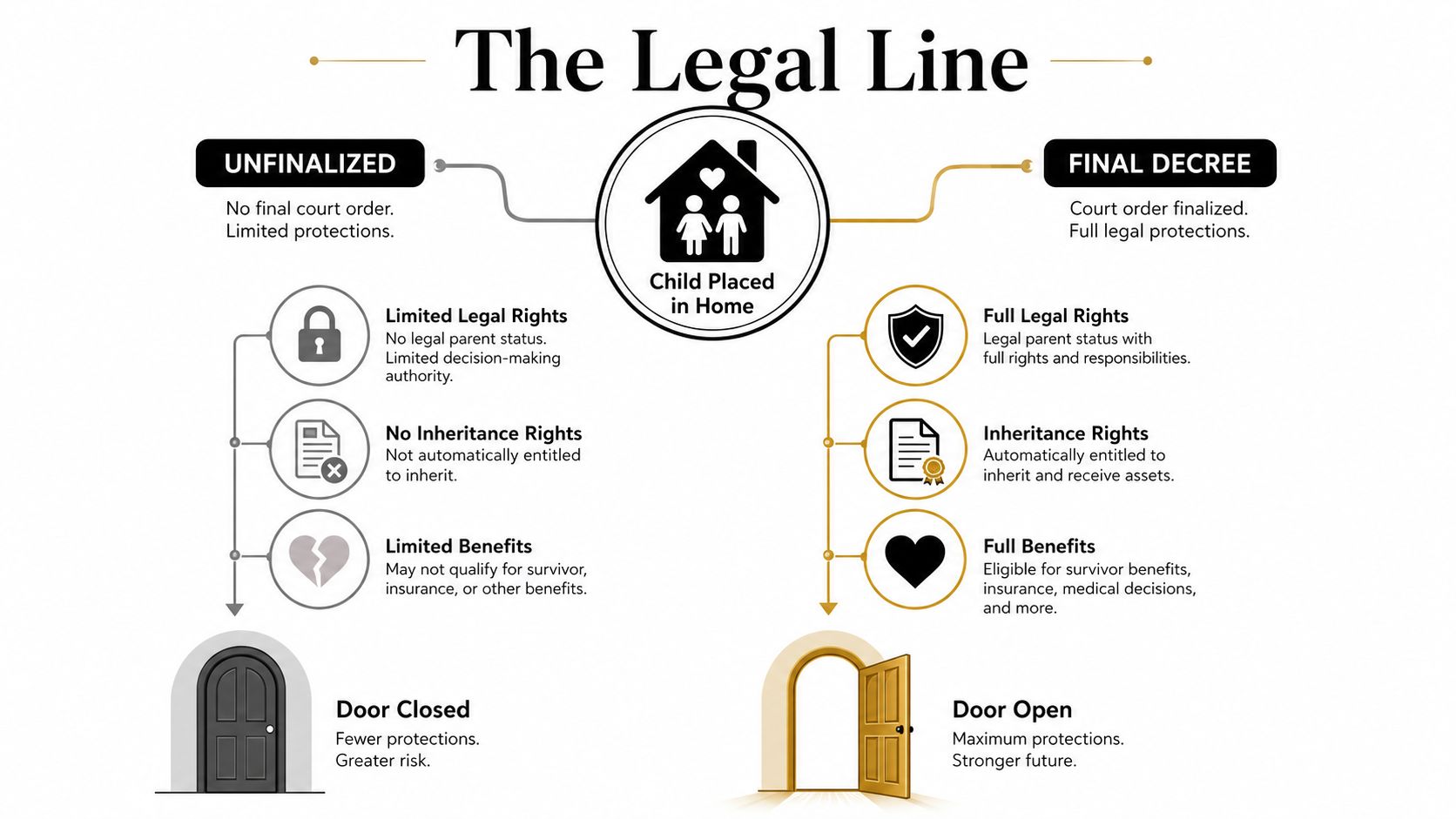
Until finalization, the child may remain connected to the birth family for certain official purposes. That doesn't erase the child's relationship with the prospective adoptive family, but it does mean agencies, benefit programs, and probate courts may ask for documents that show exactly where the case stands.
The most important question is simple: Has a Texas judge signed the final decree of adoption? If the answer is no, families should treat inheritance and benefit planning as an immediate legal task, not something to postpone until a crisis.
Inheritance Without a Final Adoption Order
The default inheritance system matters most when someone dies without a will. In that situation, Texas intestacy law identifies heirs through statutory family relationships. A child in an unfinalized adoption generally isn't placed in the same default child category as a child whose adoption is complete.
Texas Estates Code § 201.054 provides that, for intestate inheritance, an adopted child is treated as the child of the adoptive parent or parents. The child and the child's descendants may inherit from and through the adoptive parents and their relatives as though the child were naturally related. You can review the statutory language in Texas Estates Code Section 201.054.
That rule creates a sharp contrast. A stepchild who hasn't been adopted generally isn't an automatic heir of the stepparent. A relative's child living in a kinship placement doesn't automatically become the relative's intestate heir. Without another legal document or doctrine, the child may be outside the default inheritance channel.
| Adoption Status | Default Intestacy Result | Other Ways to Inherit |
|---|---|---|
| Final adoption order entered | The child is treated as the adoptive parent's child for intestate inheritance | The child may also inherit under a will, trust, or beneficiary designation |
| Adoption placed but not finalized | The child generally doesn't receive the same automatic adopted-child status | A will, trust, named beneficiary, or possible equitable-adoption claim may help |
| No adoption and no separate protection | No automatic adoptive-parent inheritance relationship exists | The family may need estate planning or a probate remedy |
A will or trust can name a child even when the adoption isn't complete. Life insurance, retirement accounts, and payable-on-death arrangements may also provide a separate path, but each designation should be reviewed carefully because beneficiary forms operate outside the ordinary will process.
Probate questions can become complicated when the family has blended relationships, minor children, or disputed heirship. Families may find it useful to review probate services from Lein Law Offices while coordinating with a Texas adoption attorney about the child's status.
Adult adoption has its own important consequence. Under Texas Family Code § 162.507, a finalized adult adoption makes the adopted adult the son or daughter of the adoptive parents for all purposes and allows inheritance from and through those adoptive parents as though biologically related. It also changes the adult's inheritance relationship with the biological family. That makes timing especially important, as explained in whether an adopted adult can inherit from biological and adoptive parents in Texas.
Equitable Adoption as a Safety Net
Equitable adoption, sometimes called adoption by estoppel, is a narrow probate doctrine. It may help a child who was never formally adopted, but it isn't a substitute for completing an adoption while the would-be adoptive parent is alive.
The doctrine is generally considered after the person who promised to adopt has died. A court may examine whether there was a clear agreement or representation to adopt, whether the child relied on that promise, and whether the promise remained incomplete because the adult died before formal adoption.
Consider a grandparent who raises a grandchild as their own. The grandparent tells family members that the child will be adopted, provides financial support, and begins gathering documents. The grandparent dies before the case reaches a final hearing. The child may ask a probate court to recognize the promise, but the result will depend on the evidence and the court's analysis.
What a court may examine
- A clear promise: Was there a definite agreement or representation that adoption would occur?
- Reliance: Did the child rely on that promise in a meaningful way?
- Conduct consistent with adoption: Did the adult raise and support the child as their own?
- Failure before death: Did the promised adoption remain unfinished when the adult died?
- Proof: Are there records, communications, witnesses, or other evidence supporting the claim?
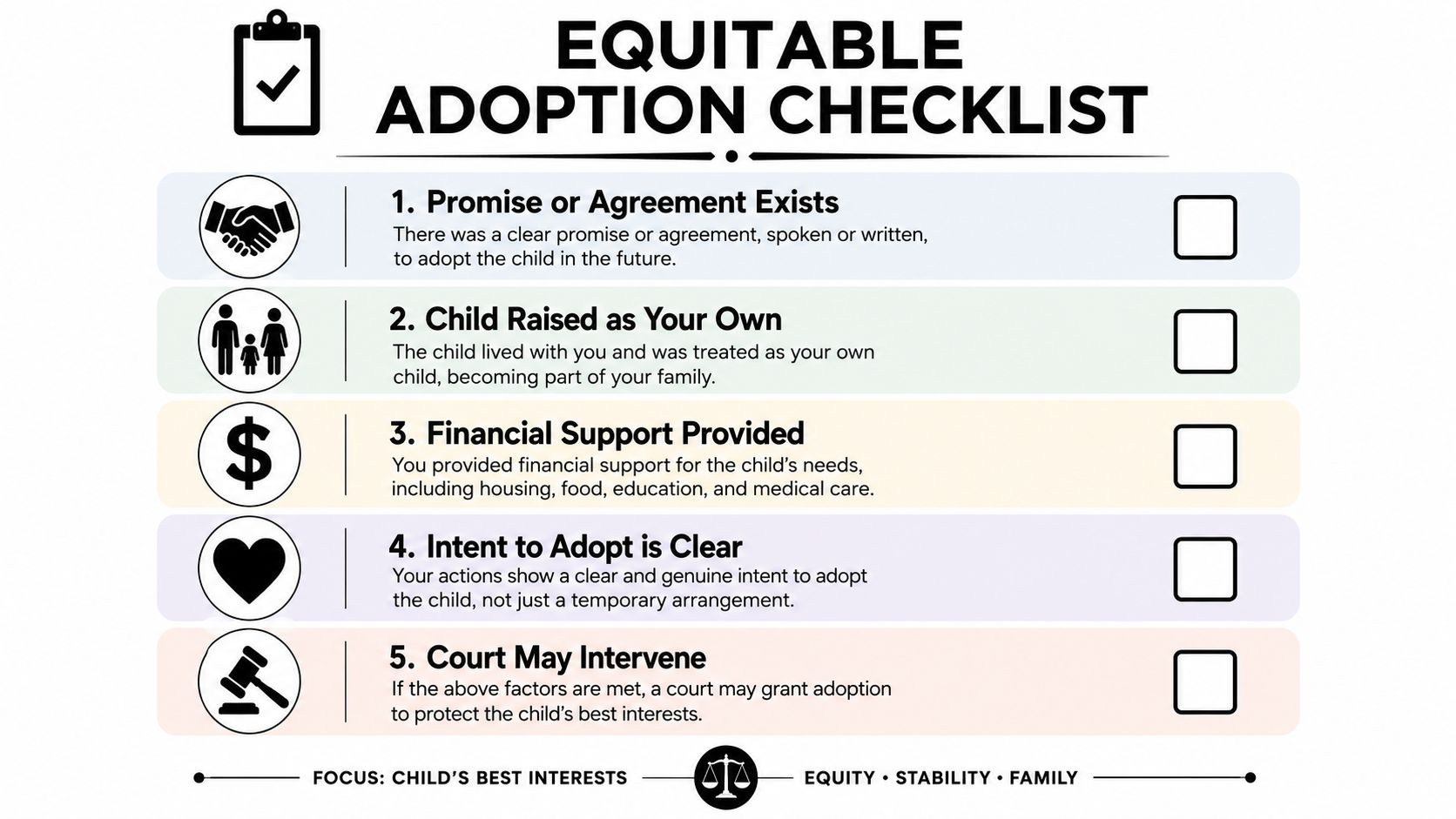
Equitable adoption is limited. It generally concerns the estate of the person who made the promise, rather than creating a complete parent-child relationship for every legal purpose. It doesn't automatically create custody rights, change a birth record, provide a name change, or establish inheritance from the deceased person's relatives.
That limitation matters for families who are still able to act. If the prospective adoptive parent is living, formalizing the adoption remains the more reliable route. If finalization fails, gather every document that may show intent, reliance, caregiving, and financial support, then obtain advice before assuming the child has no possible claim.
Public Benefits and Federal Protections That Hinge on Finalization
Benefits don't all follow the same timeline. Some Texas adoption assistance and Medicaid support may begin before the final decree, while other protections require the court-entered order.
Texas adoption-assistance materials explain that adoption assistance payments and benefits may begin in the first month after the month of placement. Medicaid and monthly benefits may also begin before finalization. But a $150 monthly subsidy for health-benefit premiums is tied to a court-entered final order under Texas Family Code § 162.304, as described in the Texas adoption assistance materials.
That distinction can be easier to understand in a side-by-side comparison:
- Before finalization: Adoption assistance may already be available, and Medicaid may begin. The family should confirm eligibility and effective dates with the responsible agency.
- After finalization: The court's order can trigger protections that depend on completed adoption status, including the premium subsidy described above.
- In foster-care cases: DFPS remains the representative payee for a child's Social Security or SSI benefits until the adoption is consummated. DFPS then contacts the Social Security Administration to end that arrangement.
- For federal programs: The child's legal status may affect Social Security, SSI, veterans' benefits, TRICARE, or employer-sponsored insurance. Each program has its own enrollment rules and proof requirements.
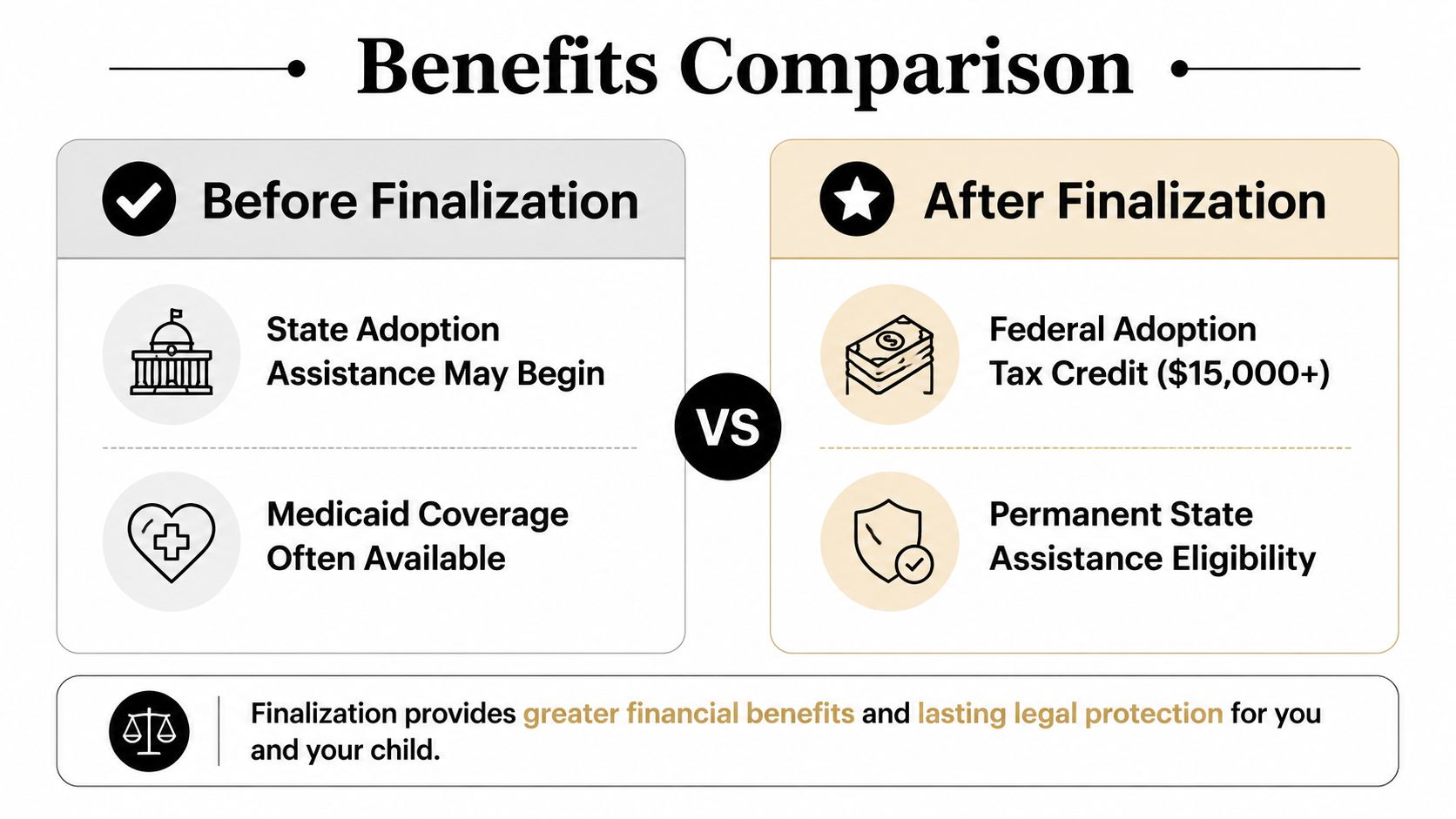
Federal Social Security rules recognize an equitably adopted child only in narrow circumstances. The equitable adoption must exist before the wage earner's entitlement date for retirement or disability benefits, making timing a technical cutoff that families shouldn't guess about. The Texas adoption subsidy and federal adoption assistance comparison can help families organize the questions they need to ask.
Keep copies of the placement documents, assistance agreement, court filings, and any benefit correspondence. When a case stalls, ask each agency which event controls eligibility. A child being physically present in the home doesn't automatically mean every benefit system recognizes the same legal relationship.
Three Texas Family Stories That Look Similar but End Differently
A stepparent, a kinship caregiver, and a birth parent may all describe an adoption as “almost finished.” Their legal positions can still be very different.
The stepparent who cannot locate a biological parent
A stepparent has raised a child for a decade and wants the child to inherit as a legal child. The adoption petition begins, but the other biological parent cannot be located. Until the court resolves notice and parental-rights requirements and enters the decree, the stepparent shouldn't assume the child has the same intestate inheritance status as a finalized adoptee.
The family may need to address service efforts, consent, termination questions, and temporary authority while protecting the child's daily stability. A will or trust can provide an interim estate-planning safeguard, but it doesn't replace the parent-child relationship created by final adoption.
The grandmother choosing between permanency paths
A grandmother becomes a kinship caregiver after CPS involvement. She loves the child and is considering adoption, but permanent managing conservatorship may also be part of the discussion. Those options don't carry identical effects.
Adoption is designed to create a permanent legal parent-child relationship after the court enters the decree. Conservatorship may provide authority and stability without producing the same automatic adoptive inheritance relationship. The grandmother's decision should focus on the child's best interests, the family's long-term capacity, and the legal rights that may remain with birth parents.
The birth mother who placed a child with relatives
A birth mother places her child with relatives and wants to understand what she has already consented to and what remains before finalization. Consent, placement, and final adoption are separate legal events. The exact documents and court orders matter, especially in an open adoption where communication may continue.
Until the decree is entered, the case may still involve unresolved parental-rights issues and benefit questions. The family should avoid informal assumptions and review the record with counsel so everyone understands the child's safety, permanency, and legal identity.
How to Protect a Child Before, During, or After an Unfinalized Adoption
Families can take protective steps while an adoption case is pending. The right starting point depends on whether the immediate concern is caregiving authority, inheritance, benefits, or getting the adoption back on track.
Start with immediate authority
Ask whether the adults caring for the child have written authority for school, medical, and routine caregiving decisions. Depending on the circumstances, a caregiver authorization, power of attorney, emergency guardianship request, or other court filing may help fill a temporary gap. These tools don't create an adoption, but they can reduce confusion during everyday decisions.
Secure the estate plan
A Texas estate-planning attorney can help the prospective adoptive parent name the child in a will, create a testamentary trust, and coordinate beneficiary designations. Life insurance, retirement accounts, payable-on-death accounts, and transfer-on-death arrangements should be reviewed together so the documents don't conflict.
A trust can be especially useful when the child is young or when direct control of inherited property would create practical problems. The plan should identify the child clearly and account for what happens if the adoption is finalized later.
Preserve the adoption record
Keep the home study, placement papers, consents, agency communications, court notices, benefit records, and evidence of caregiving in one secure file. If the case stalls, those records may help counsel identify the missing step, seek a new order, or evaluate an equitable-adoption issue.
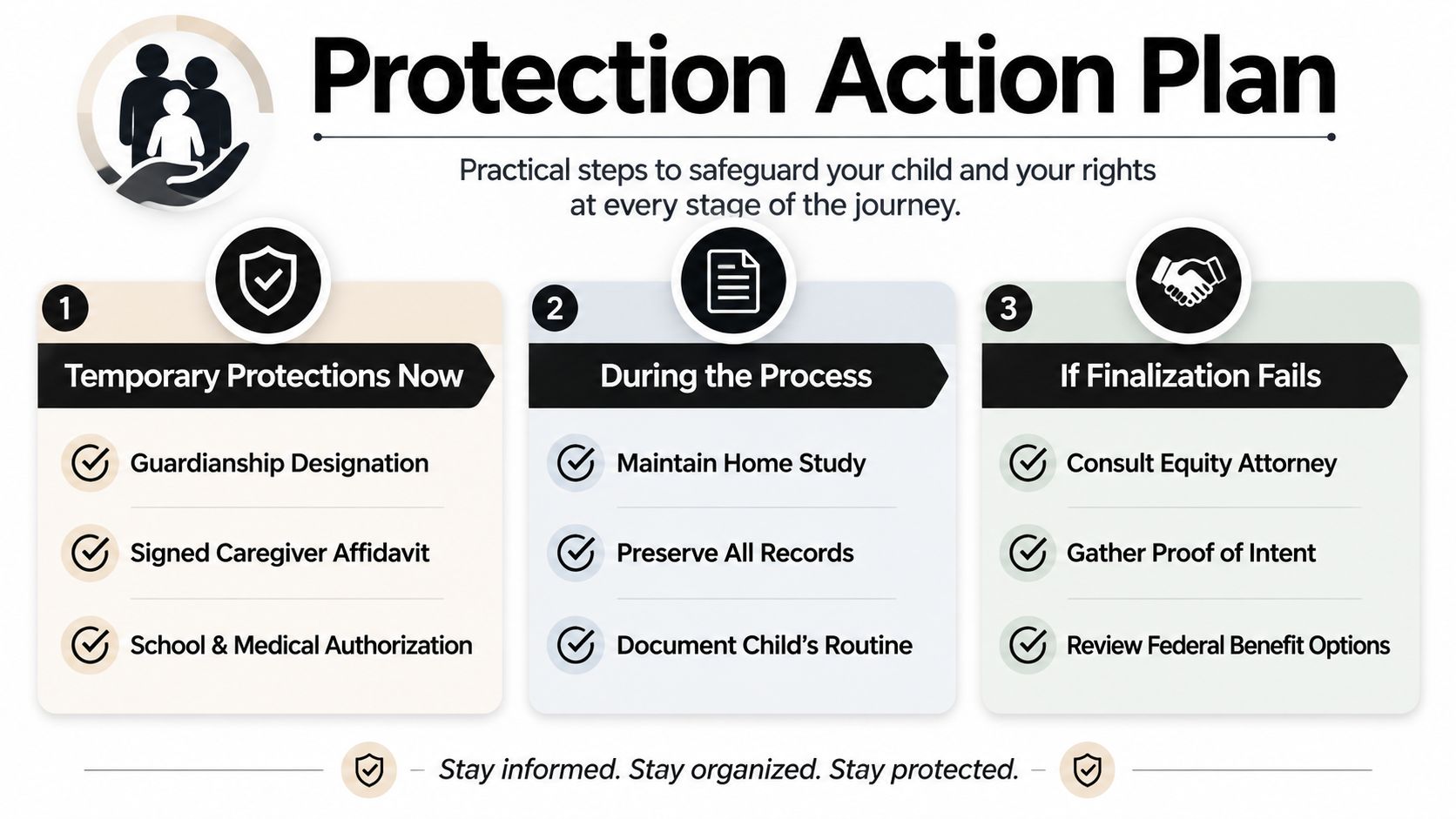
If finalization can still move forward, ask an attorney to review the case status and pursue the appropriate adoption path, including stepparent, relative, CPS, domestic, LGBTQIA+, or adult adoption. If the child is an adult, Texas Family Code § 162.507 may provide a direct route to establish the parent-child relationship and inheritance rights described earlier.
For federal benefits, timing can be decisive. The Social Security Administration's guidance on equitable adoption explains that recognition may depend on whether equitable adoption existed before the wage earner's entitlement date. Don't wait until a benefits claim is denied to gather the evidence.
Frequently Asked Questions and Gentle Next Steps
What happens if the prospective adoptive parent dies first?
The child may not receive the automatic intestate inheritance status of a finalized adopted child. A will, trust, beneficiary designation, or a possible equitable-adoption claim may provide protection, but the outcome depends on the documents and facts.
Can an older child be adopted as an adult?
Often, adult adoption can address a relationship that was never finalized during childhood. Under Texas Family Code § 162.507, the adopted adult becomes the adoptive parents' son or daughter for all purposes and may inherit from and through them as though biologically related. Adult adoption also changes inheritance rights involving the biological family, so the consequences should be reviewed before filing.
Can a finalized adoption be undone?
A finalized adoption isn't something a family can casually reverse. The legal effect is permanent in a way that an unfinalized placement is not, and any challenge or request for relief depends on specific facts and legal grounds.
The most helpful next step is to collect the court papers, placement records, benefit letters, and estate documents. Then ask a Texas family law attorney to identify whether the case should be finalized, protected through estate planning, addressed through guardianship, or evaluated for a limited probate remedy.
The Law Office of Bryan Fagan, PLLC helps Texas families review stalled adoptions, pursue stepparent and kinship adoptions, and understand inheritance and benefits before finalization. Visit Law Office of Bryan Fagan, PLLC to schedule a free consultation, including a virtual appointment for families anywhere in Texas.
