
You may be preparing to adopt a niece, nephew, grandchild, or child placed with your family through CPS. The home study may be underway, relatives may be hopeful, and everyone may be asking when the Texas court can finalize the adoption. Then someone asks about Native American ancestry, tribal membership, or a reservation connection. Suddenly, the question isn't only whether the adoption is in the child's best interests. It becomes, which court has authority to decide it?
That question can feel unsettling, especially when a child needs stability and the adults around the child are trying to make careful decisions. In Texas, an adoption involving an eligible Indian child can involve tribal sovereignty, Texas adoption law, and the federal Indian Child Welfare Act, commonly called ICWA. Understanding how those systems fit together can help families protect the child's relationships, culture, and legal permanence without unnecessary confusion.
When Three Courts Could Hear Your Texas Adoption
Suppose a Texas aunt steps forward to adopt her niece after the child's parents can no longer provide care. The child is connected to a federally recognized tribe, but she currently lives with the aunt away from the reservation. The aunt contacts a Texas adoption attorney and expects the case to follow the ordinary state process. She begins gathering documents, preparing for a home study, and learning about a final adoption hearing.
During the first legal interview, the attorney asks about the child's biological parents, tribal membership, ancestry, and current residence. Those questions aren't routine curiosity. They may determine whether the case belongs in tribal court, Texas state court, or both courts under a federal framework.
Federal ICWA provides the guardrails. Tribal law reflects the tribe's sovereign authority over its children and families. Texas law supplies the ordinary adoption process, including petitions, investigations, hearings, consents, and final decrees under the Texas Family Code. These systems don't operate as three unrelated choices. They interact based on facts such as the child's tribal status, residence, domicile, and whether a tribal court already has authority over the child.

Why the first questions matter
A private adoption, stepparent adoption, kinship adoption, and CPS adoption can all require different documents and court steps. Texas courts generally supervise the adoption process, and families may need a home study, required notices, valid parental consent or termination orders, and a final hearing. But those state steps can't override ICWA when the child qualifies for its protections.
Practical rule: Before filing an adoption petition, identify possible tribal connections and jurisdictional facts. A late discovery can affect notice, placement, transfer, and even the validity of earlier proceedings.
The emotional stakes are high. A relative may fear losing the opportunity to provide a permanent home. A birth parent may worry that tribal involvement will make the process harder. A hopeful adoptive parent may believe that following ICWA threatens the placement. In reality, the legal goal is to protect the child while preserving family unity and tribal relationships whenever possible.
The rest of the process depends on one central distinction. Exclusive tribal jurisdiction means the tribal court has authority to hear the custody proceeding first and state court generally can't take over. Concurrent jurisdiction means Texas and tribal courts may both have authority, but transfer to tribal court may still be required unless a recognized exception applies.
The Jurisdictional Framework Texas Families Need to Understand
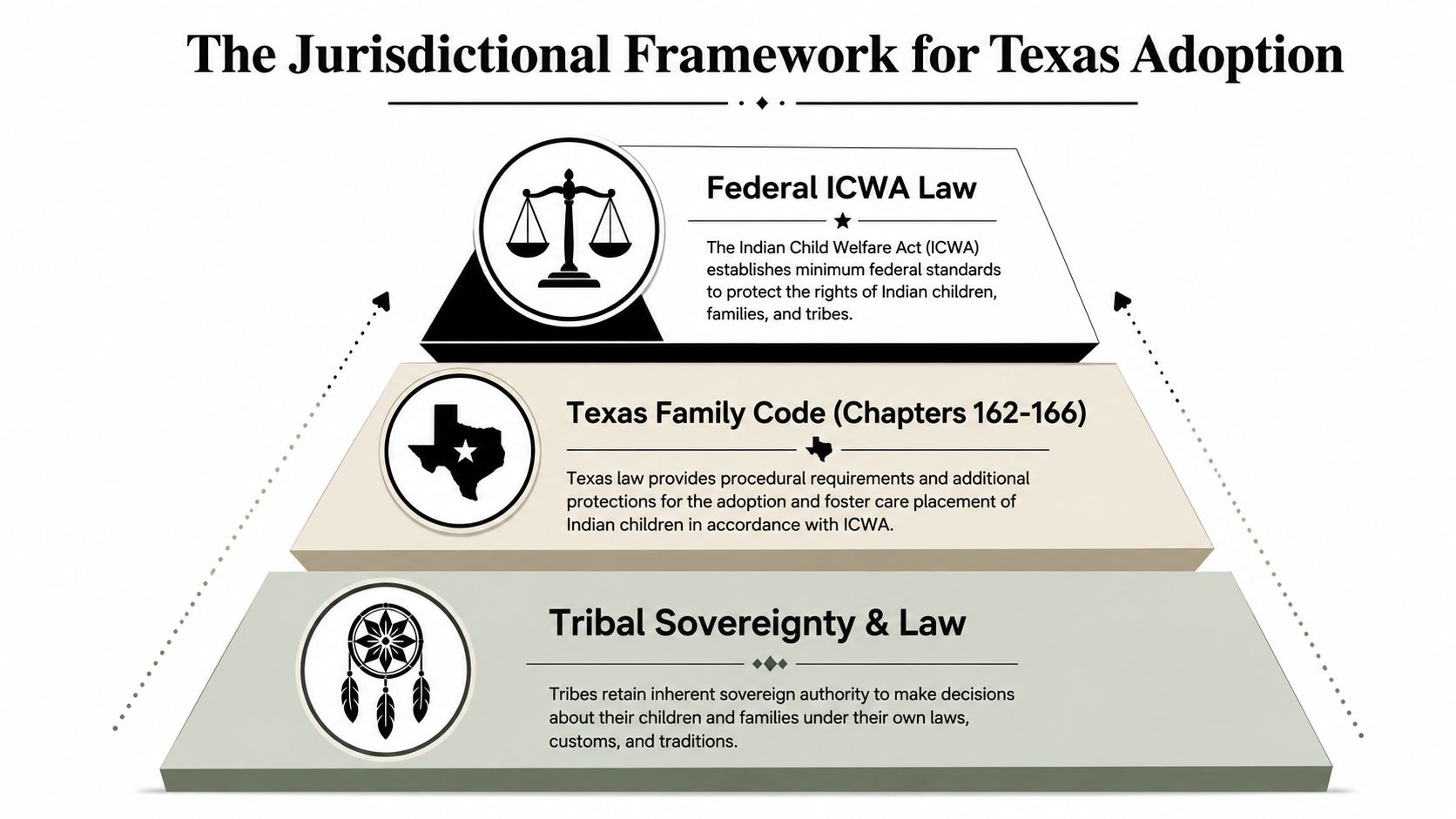
Think of the legal system as a building with three connected levels. Tribal sovereignty forms the foundation, Texas adoption law operates within the state-law level, and federal ICWA supplies the rules that prevent either system from ignoring the other's authority.
The federal framework began in 1978, when Congress enacted ICWA to address the removal of Native children from their families and establish federal minimum standards for foster-care and adoption placements. Texas adoption law remains important. The Texas Family Code organizes adoption procedures primarily in Chapters 162 through 166, covering matters such as adoption petitions, investigations, hearings, parent-child relationships, and related family-law procedures. Those chapters guide the case unless federal law requires a different result.
How the layers work together
Start with the child, not the courthouse. Ask whether the child is an Indian child under ICWA. Then identify where the child resides or is domiciled, whether the child is a ward of tribal court, and whether the case is taking place on or off a reservation.
If the child is domiciled or resides on a reservation, or is a ward of tribal court, the tribal court generally has exclusive jurisdiction over the adoption or other child-custody proceeding. If the child is off-reservation, Texas and tribal courts generally have concurrent jurisdiction, but ICWA can create a presumption favoring transfer to tribal court.
Texas Family Code Section 152.104 reinforces this federal relationship. It provides that a custody proceeding involving an Indian child isn't subject to Texas's usual uniform jurisdiction rules to the extent ICWA governs the proceeding. It also requires Texas to treat a tribe as a U.S. state for jurisdictional purposes. That means an ordinary Texas venue rule may identify where a petition could be filed, but it can't defeat ICWA's notice, transfer, or recognition requirements.
The Texas Adoption Process Step by Step describes the six core stages of a Texas adoption from type selection to final decree. Those stages remain useful as a roadmap, but an ICWA case adds a federal and tribal review at the beginning and throughout the proceeding.
For a broader explanation of how Texas adoption statutes fit together, families can review this Texas Adoption and the Family Code guide.
The state court isn't deciding which system is “better.” It must determine which sovereign has legal authority, whether the case must move, and which rules control while the case remains in Texas.
What Makes a Child an Indian Child Under ICWA
ICWA doesn't apply just because a child has Native ancestry or appears to belong to a particular racial group. The legal inquiry focuses on the child's relationship with a federally recognized tribe.
A child generally qualifies as an Indian child when the child is a member of a federally recognized tribe. The child may also qualify when the child is eligible for membership and is the biological child of a tribal member. The tribe, not a Texas adoption court, determines its own membership and eligibility under tribal law.
Texas child-welfare guidance identifies three federally recognized tribes within Texas borders that are specifically covered in state guidance:
- Kickapoo Traditional Tribe of Texas, near Eagle Pass.
- Alabama-Coushatta Tribe, near Livingston.
- Tigua Tribe, near El Paso.
ICWA also applies to children connected to federally recognized tribes located outside Texas when the child is involved in a Texas case. A child doesn't need to be connected to a Texas-based tribe for the federal protections to matter.
The “reason to know” standard
At the start of an adoption or custody case, the court and the parties should ask about tribal affiliation. If the court has a reason to know that an Indian child may be involved, the proceeding must follow ICWA's notice, placement, and transfer rules while the child's status is investigated.
That doesn't mean a parent must arrive with a tribal enrollment card before anyone asks further questions. A biological parent's statement about tribal membership, a family record, or other reliable information may require counsel and the court to contact the potentially affiliated tribe. Families should answer ancestry questions carefully and provide names, birth information, family records, and known tribal contacts when available.
The legal status question comes before the jurisdiction question. The following simplified comparison shows how different facts can produce different results.
| Scenario | Where the Child Lives | Which Court Has Authority |
|---|---|---|
| Reservation-based case | The child resides or is domiciled on a reservation | Tribal court generally has exclusive jurisdiction |
| Tribal ward case | The child is a ward of a tribal court | Tribal court generally has exclusive jurisdiction |
| Off-reservation case | The child lives away from the reservation | Texas and tribal courts generally have concurrent jurisdiction, with possible transfer to tribal court |
Families dealing with possible Native heritage can review this guide to adopting a child with Native American heritage in Texas. The earlier the inquiry begins, the less likely the family will face avoidable delay or a challenge to an order entered without proper tribal notice.
How Notice and Transfer Rules Work in Practice
When ICWA may apply, the attorney's first task isn't to rush toward finalization. It is to create a reliable record showing that the child, parents, tribe, and courts received the process the law requires.
The practical sequence
First, confirm the possible Indian-child connection. Counsel asks the parents, relatives, CPS, or placement agency about tribal membership and eligibility. If the available information gives the court a reason to know that ICWA may apply, the court treats the issue seriously instead of waiting until the final hearing.
Second, send formal notice. Notice generally goes to the potentially affiliated tribe and the Bureau of Indian Affairs when required. The notice should contain enough family information for the tribe to investigate membership or eligibility. A casual phone call to a tribal office isn't a substitute for legally sufficient notice.
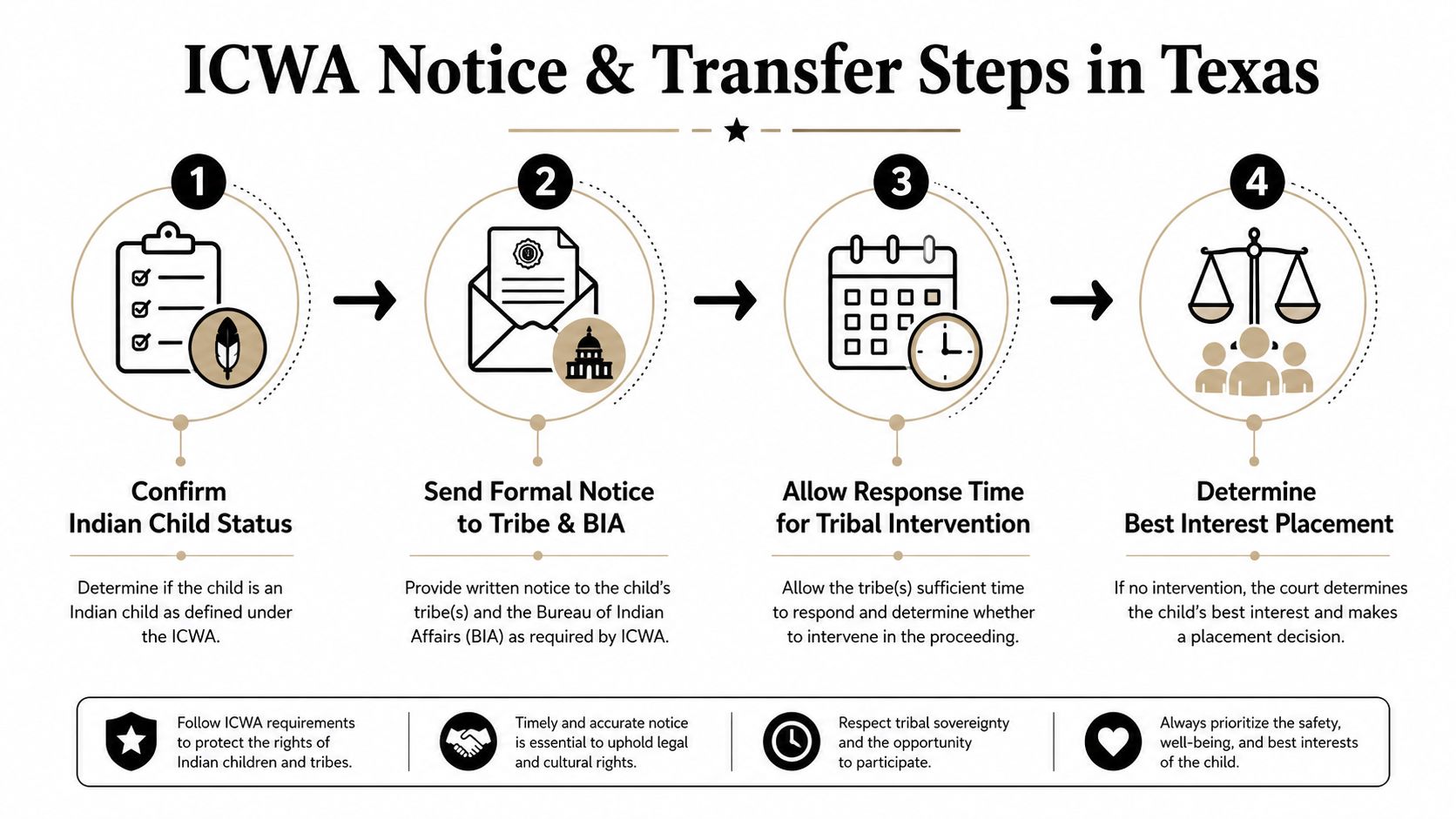
Third, allow the tribe to respond and participate. A tribe may confirm that the child is an Indian child, intervene in the Texas case, request transfer, or decline to exercise jurisdiction. Texas must comply with ICWA whether or not the tribe intervenes. Tribal nonparticipation doesn't automatically erase the federal rules.
Fourth, determine whether transfer is required. In an off-reservation case, state and tribal courts may share concurrent jurisdiction. Even so, a transfer request generally creates a presumption favoring tribal court, and the Texas court may need to transfer the case unless a parent objects, the tribal court declines, or the court finds good cause not to transfer.
The key question isn't only whether ICWA applies. Ask which court should hear the case, whether transfer is mandatory, and what evidence supports keeping the case in Texas.
Emergency action has a narrow purpose
Texas authorities may act when an Indian child is temporarily off-reservation and an emergency exists. The state may intervene only to prevent imminent physical damage or harm. Emergency authority isn't a general license to use ordinary state procedures indefinitely.
Once the emergency passes, the court must return to the regular ICWA framework. That includes formal notice, consideration of transfer, and compliance with placement requirements. A child's general best interests matter throughout the case, but “best interests” alone doesn't allow a state court to disregard tribal jurisdiction.
Consent documents also require care. Families can review information about Texas consent to adoption forms, but an ICWA case may require additional tribal protections and review before consent supports finalization.
Two Realistic Texas Scenarios That Show How Jurisdiction Plays Out
The difference between exclusive and concurrent jurisdiction becomes clearer when the facts change.
Scenario one, the reservation-based relative adoption
A child connected to a federally recognized tribe lives with a grandparent on reservation land. The grandparent wants to adopt after the child's parents consent or their parental rights are addressed through the appropriate legal process.
Because the child resides or is domiciled on the reservation, the tribal court generally has exclusive jurisdiction over the adoption. The grandparent may still be the preferred placement because ICWA places extended family first in the adoption preference structure, but the preference doesn't give a Texas court authority to decide the case.
The Texas court shouldn't proceed just because the grandparent lives in Texas or because Texas paperwork has already been prepared. The family needs counsel familiar with the tribe's court and adoption requirements. Filing in the wrong forum can create delay and may threaten the validity of orders entered without tribal authority.
Scenario two, the off-reservation CPS placement
Now consider an Indian child placed through Texas CPS with a Texas foster family away from the reservation. The state court may initially hear the case because off-reservation facts usually create concurrent state and tribal jurisdiction. The tribe receives notice and intervenes, then asks the court to transfer the proceeding or asserts the child's placement rights.
The Texas court must evaluate the transfer request under ICWA. If the case remains in state court, ICWA still governs the proceeding from start to finish, including placement preferences and other federal protections. The foster family may be loving and capable, but the court must first consider extended family, then members of the child's tribe, then other Indian families before a non-Indian adoptive home.
Why domicile can change the result
The U.S. Supreme Court's decision in Mississippi Band of Choctaw Indians v. Holyfield is central to domicile analysis. Texas bench materials cite the case when explaining that tribal jurisdiction can control even when children are born off-reservation if domicile and other ICWA rules point to tribal authority.
That means physical location on the day of filing may not answer every question. Counsel may need to examine the child's home, the parents' circumstances, prior court orders, and the family's relationship with the reservation. The same Texas adoption procedure can therefore lead to a tribal-court case in one family and a Texas state-court case, still governed by ICWA, in another.
A Practical Checklist for Texas Adoptive Families and Attorneys
An ICWA case is easier to manage when the family and attorney address the jurisdiction question before the adoption reaches finalization. The checklist below follows the order in which many careful practitioners approach the case.
Verify Indian-child status early. Ask both biological parents and available relatives about tribal membership or eligibility. Gather names, birthplaces, family records, and known tribal information. A reason to know may require notice before membership is confirmed.
Document affiliation and send notice. Keep copies of every notice, mailing record, response, and follow-up inquiry. The tribe needs enough information to investigate, and the court needs a clear record showing that notice was handled correctly.
Decide whether transfer is mandatory. Identify the child's residence, domicile, reservation status, and tribal-court wardship. In an off-reservation case, evaluate whether a parent or tribe requested transfer and whether the tribal court accepted or declined jurisdiction.
Address good cause with evidence. If a party argues that the case should remain in Texas, the attorney should identify the legal basis and supporting facts rather than rely on general concerns about convenience. The court must apply the federal framework, not just choose the forum that feels familiar.
Apply placement preferences and prepare for finalization. Consider extended family first, then tribal members, then other Indian families. The attorney should also confirm that required Texas Family Code procedures, consents, home-study materials, court findings, and final-decree requirements are complete.
Texas adoption law under Chapter 162 remains part of the process when a Texas court adjudicates the case. But the U.S. Supreme Court has explained that ICWA governs the case from start to finish once the state court is handling it. Families shouldn't treat ICWA as an initial notice form that disappears after the first hearing.
A relative caregiver, foster parent, birth parent, or attorney can use the checklist differently. The caregiver can preserve family and tribal information. The birth parent can ask whether notice was sent and whether placement preferences were considered. Counsel can coordinate Texas filings, tribal communication, and the record needed for finalization.
Protecting the Child While Navigating Three Courts
Jurisdiction can feel like an obstacle because it adds questions to an already emotional process. But ICWA's structure serves a deeper purpose. It recognizes that a child's safety and permanence can include continued relationships with parents, relatives, tribal members, and cultural community.
Congress enacted ICWA in 1978 after addressing the removal of Native children from their families and communities. The law's placement preferences, notice requirements, and jurisdictional rules respond to that history by giving tribes a meaningful role in decisions about their children. The federal framework doesn't make every adoption outcome predictable, but it makes the decision-making process more accountable to family and tribal connections.
The U.S. Supreme Court upheld ICWA's constitutionality in its 2023 decision in Haaland v. Brackeen, reinforcing that the statute remains part of the legal framework for Texas adoption cases. Texas families therefore shouldn't assume that a general state adoption procedure will answer every question involving an Indian child.
What family unity looks like in practice
Family unity may mean reunification with a parent. It may mean placement with a grandparent, aunt, uncle, or other extended family member. It may mean adoption by a carefully selected family that supports the child's tribal identity and maintains safe connections with relatives and the tribe.
The right legal forum helps protect those possibilities. A tribal court may have exclusive authority. A Texas court may retain the case under concurrent jurisdiction. In either setting, the adults involved should focus on accurate information, respectful communication, and a plan that supports the child's long-term security.
A permanent home is stronger when it protects not only where a child sleeps, but also who the child is and where the child comes from.
If you're considering a private adoption, stepparent adoption, kinship placement, foster-care adoption, or guardianship, don't wait until finalization to ask about ICWA. Early legal review can identify the proper court, preserve required notices, and help your family make decisions that honor both the child's immediate safety and lasting family identity.
The Law Office of Bryan Fagan, PLLC helps Texas families evaluate tribal, state, and federal jurisdiction while handling adoption and guardianship matters from home-study preparation through court finalization. Schedule a free consultation by visiting Law Office of Bryan Fagan, PLLC to discuss your child's tribal connection, transfer concerns, placement options, and next legal step.
