
A phone call after bedtime can change a family's entire week. A mother may learn that her sister has filed to adopt her child. A father may open an envelope containing termination or adoption papers he never expected. The first reactions are usually panic, anger, and a rush to call relatives. Those feelings are understandable, but they won't decide the case.
In Texas, standing and timing usually control whether a contest can even be heard. Adoption law protects a child's need for a stable, permanent family, so the legal opportunities to object are limited and tied to specific deadlines. A parent who wants to contest an adoption Texas case must identify the correct legal path quickly, preserve evidence, and avoid treating the dispute like an ordinary custody disagreement.
When an Adoption Feels Wrong and Time Is Already Moving
Maria receives a message that her sister has started an adoption case involving Maria's child. She has not seen the petition, does not know whether a hearing is scheduled, and cannot remember exactly what she signed at the hospital. By midnight, she has called relatives and searched for ways to stop the adoption. Each person offers different advice.
My first advice is direct: do not wait for a family meeting to establish the facts. Get the documents, confirm the dates, and determine whether the adoption is still pending. Texas Family Code Chapters 161 and 162 treat a signed consent, a termination order, and a final adoption decree differently. A remedy available before finalization may disappear once the judge signs the decree.

The first clock is still running
Texas law provides a pre-finalization revocation window for some consents and relinquishments. Under Texas Family Code § 162.011, a required consent may be revoked before the adoption order is rendered by filing a signed revocation. An affidavit of relinquishment that does not state it is irrevocable for a stated time may be revoked only until the 11th day after execution. After that point, it becomes irrevocable (Texas Family Code § 162.011).
The second clock starts when the adoption order is signed. Texas Family Code § 162.012 generally bars an attack on the order after six months from entry, including challenges based on paperwork or procedure (Texas Family Code Chapter 162). The statute's history also matters. A legislative analysis described the change from two years to six months as a decision favoring permanency and finality.
Four legal paths deserve immediate attention
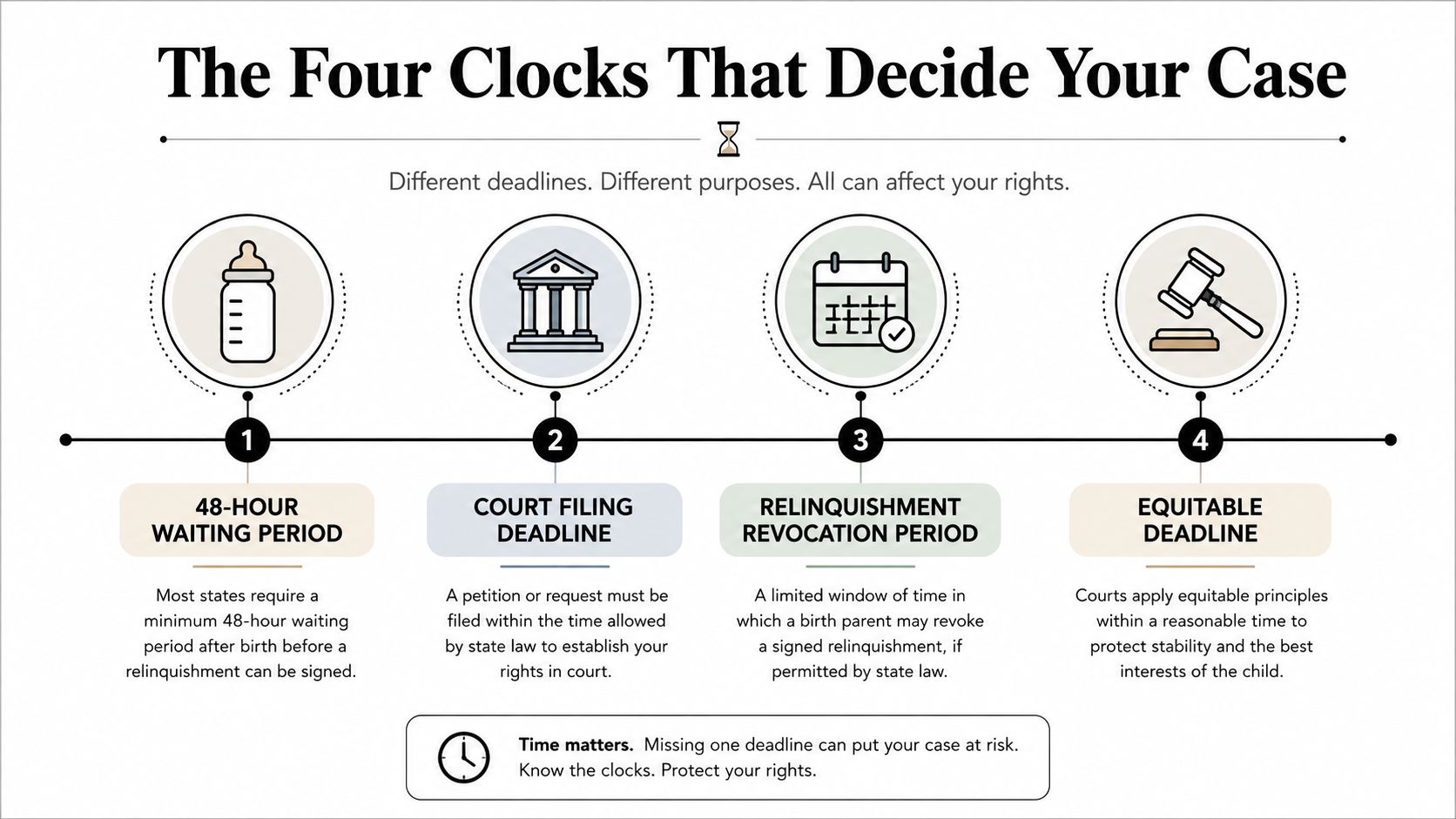
Your case may turn on four separate clocks:
- Pre-finalization revocation, based on the document signed and whether the adoption order has been rendered.
- The six-month post-decree period, which restricts attacks on a final adoption order.
- The fraud exception, which may apply when consent was obtained through fraud or a fundamental defect prevented a fair proceeding.
- The bill-of-review path, a narrow equitable remedy requiring demanding proof that ordinary legal remedies were unavailable despite diligence.
Practical rule: Your most painful facts matter only after the court determines that you have standing and used the correct legal path.
Act this week. Obtain complete copies of every affidavit, petition, termination order, notice, and final decree. Record the child's birth date, the date each document was signed, and the date each court order was entered. Those details will help a lawyer identify which clock controls and what action remains available.
Who Has Standing to Contest a Texas Adoption
Standing means the legal right to bring a particular challenge. A person can have a genuine emotional connection to a child and still lack standing to contest the adoption. Courts generally address that threshold issue before reaching the evidence about fraud, pressure, or the child's best interests.
The most obvious potential challengers are birth parents whose consent was never signed, was invalid, or was obtained through a legally recognized defect. A parent whose rights were terminated by court order usually must challenge the termination order itself rather than object to the later adoption. A managing conservator with court-ordered rights may also need to establish how that order affects notice, consent, or participation in the case.
Putative fathers face a separate analysis. A man who may be the biological father should investigate paternity, notice, and the Texas Paternity Registry immediately. Registration protects an opportunity to receive notice, but it doesn't by itself establish legal paternity or guarantee custody.
Category matters before evidence
Relatives, grandparents, siblings, and a non-biological spouse don't automatically receive a veto over an adoption. Their position may depend on an existing court order, a legal parent-child relationship, a pending intervention, or another recognized interest. If you're asking whether grandparents can stop a case, review the practical explanation of grandparent rights in Texas adoption disputes before filing anything.
The same principle applies to adoptive parents and the child. The court may appoint an attorney ad litem or another representative for the child, and the adoptive parents will have their own interests and legal responses. A child who is age 12 or older generally must consent to the adoption in writing or in court, unless the judge waives that requirement because adoption is in the child's best interest (Texas adoption consent requirements).
Stepparent Adoption in Texas is the most common Texas adoption and has its own practical issues involving the other parent's rights, notice, consent, and termination.
| Party Type | Standing Likelihood | Key Requirement |
|---|---|---|
| Birth parent | Depends on the record | Show a valid legal interest and identify a consent, notice, service, or termination defect |
| Putative father | Depends on paternity and notice | Investigate paternity and registry status promptly |
| Managing conservator | Fact-specific | Connect the court order to notice, consent, or participation rights |
| Grandparent or relative | Limited without an existing legal right | Establish a recognized legal interest rather than relying only on family relationship |
| Non-biological spouse or sibling | Usually limited | Show a court-recognized basis to intervene or challenge |
| Adoptive parent or child | Case-specific | Participate through counsel or a court-appointed representative when appropriate |
Before spending money on investigators, records, or petitions, determine which category you fit into and whether the adoption is pending or final. A strong fraud allegation filed by someone without standing can be dismissed without a meaningful review of the underlying facts.
The Four Clocks That Decide Your Case
A parent may discover a serious problem only after paperwork has been signed or an adoption decree has been entered. Texas law treats those moments differently. Your case is controlled by four clocks: pre-finalization revocation, the post-decree six-month limit, the fraud exception, and the bill-of-review path. Choosing the wrong clock can end the challenge before the judge reaches the facts.
Clock one: revocation before finalization
A birth mother's affidavit of relinquishment must be signed after birth, not before 48 hours after birth, which provides a statutory safeguard (Texas consent rules for adoption). If the affidavit was presented or signed too early, preserve hospital records, messages, and signing information immediately. The timing may determine whether the document was valid.
Before the adoption order is rendered, a required consent may be revoked by filing a signed revocation. For an affidavit of relinquishment without a stated irrevocability period, the revocation period ends on the 11th day after execution. Agency and non-agency documents may use different language, so read the actual affidavit rather than relying on a general summary. A focused explanation of how long a birth parent has to revoke consent in Texas can help you identify the first deadline.
Clock two: the final decree
Once the court signs the final adoption order, the rules change. Texas law generally bars an attack on the validity of the adoption order after six months from entry, including challenges based on paperwork or procedure (Texas Family Code Chapter 162). The controlling date is when the judge signed the order, not when the challenger discovered the possible defect.
Late discovery does not automatically restart the clock. Get a certified copy of the decree and confirm its signature date before deciding what remedy remains.
Clocks three and four: fraud and bill of review
Fraud must connect the misconduct to the consent or to the court's ability to decide the adoption. A false promise, pressure from someone who controlled the parent's circumstances, or a material misrepresentation may matter, but the claim needs specific evidence. Regret or a later change of mind is not enough by itself.
A bill of review is a narrow remedy, not a second opportunity to present evidence that should have been offered earlier. It may apply when fraud, official mistake, or another legally recognized circumstance prevented a person from fully litigating, and the person acted diligently. The applicable limits must be calculated from the order, notice history, discovery date, and available proof. Calling conduct “fraud” does not by itself overcome finality.
Deadline check: Gather the signed affidavit and every court order before deciding whether the case involves revocation, a direct attack, fraud, or a bill of review.
The following visual summarizes the four timing problems to review during the first consultation.
A short video explains why consent and finalization must be analyzed separately.
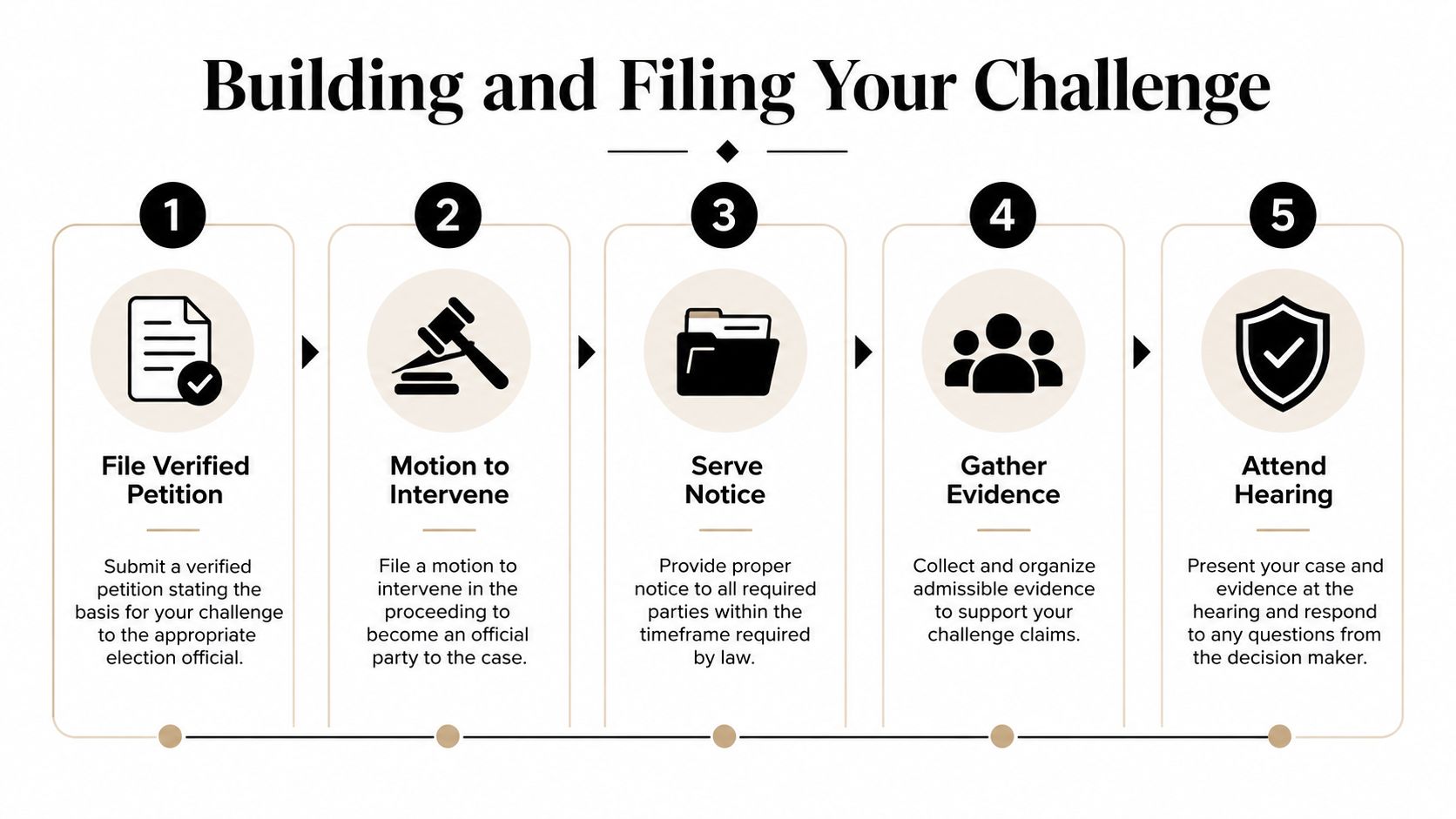
Building and Filing Your Challenge Step by Step
A contest should have a clear theory before it has a long story. The theory may be invalid consent, fraud, duress, lack of notice, defective service, or a problem with the termination order. Chapter 162 governs the adoption proceeding, while Chapters 161 and 166 may affect termination, consent, and related procedural questions.
Start with the court file
First, locate the county court and obtain the filed pleadings. If the adoption is pending, the response may involve a motion to intervene, a challenge to consent, or another filing that fits the existing case. If the decree is final, the filing must match the available post-judgment remedy. Don't file a generic objection and assume the clerk or judge will convert it into the correct legal vehicle.
Second, identify every person entitled to notice and complete service correctly. Texas child-welfare guidance emphasizes that contested adoption hearings require enough court time for a careful evidentiary presentation, and delays can occur when the docket isn't set for that type of hearing (Texas contested hearing guidance). Service errors can create a separate problem even when the underlying facts are serious.
Build evidence around the legal theory
Third, preserve records. Request or locate:
- Consent documents: Obtain every affidavit, acknowledgment, revocation, and document describing whether consent was irrevocable.
- Parentage records: Look for acknowledgments of paternity, registry information, and prior parentage orders.
- Court records: Collect termination pleadings, service returns, hearing notices, temporary orders, and the final decree.
- Communication evidence: Preserve texts, emails, voicemails, and social-media messages without editing them.
- Witness information: Identify hospital staff, agency workers, relatives, and others who personally observed the signing or notice process.
Fourth, use discovery only for facts tied to the challenge. Interrogatories, document requests, and depositions may test what the agency, adoptive petitioners, caseworkers, or other parents knew and when they knew it. Discovery should support a specific argument, not become an expensive search through every family conflict.
Fifth, prepare for mediation, temporary orders, and the contested hearing. Texas guidance recommends reserving enough time for the court to complete the hearing carefully, so raise scheduling needs early. Bring organized exhibits, available witnesses, and a short explanation of the remedy you want. The court needs to know whether you're asking to withdraw consent, postpone finalization, set aside an order, or pursue another legally available result.
Pending Adoption Versus Final Decree Outcomes Compared
The same allegation can have very different consequences depending on whether the judge has signed the final adoption order. A pending case still presents an opportunity to challenge consent, notice, service, or termination before the adoption becomes final. A completed decree triggers the strong finality policy in Texas Family Code § 162.012.
| Factor | Pending Adoption Challenge | Final Decree Challenge |
|---|---|---|
| Legal posture | The adoption is still before the court | The adoption order has already been signed |
| Main focus | Valid consent, notice, service, termination, and the child's best interests | Whether a legally recognized post-judgment remedy remains available |
| Possible relief | Revocation when allowed, denial of the petition, additional hearing, or other court action | Relief is narrow and doesn't automatically restore the prior relationship |
| Evidence | Documents and testimony can be presented before finalization | Evidence must address the specific basis for reopening the judgment |
| Practical leverage | Usually greater because the court hasn't completed the adoption | Much weaker because finality and stability control the analysis |
| Immediate priority | Stop missed deadlines and prepare for the hearing | Calculate the decree date and identify the correct challenge promptly |
A pending challenge doesn't guarantee that the birth parent will receive custody. It may preserve the right to participate and require the court to resolve disputed consent or termination issues. The judge continues to focus on the child's safety, stability, and best interests.
An attack on a final decree is different. A person may need to pursue a motion, restricted appeal, or bill of review, depending on the record and timing. The court may also conclude that the challenge is barred, procedurally defective, or unsupported by the required proof. Review this distinction in what happens if an adoption is challenged after finalization.
The practical difference: A parent who acts before finalization may ask the court to decide whether the adoption should proceed. A parent who waits may be asking the court to disturb a family that already has a final legal relationship.
What Real Texas Contested Cases Look Like
The following examples are realistic patterns, not predictions about any particular family. They show why the document, the date, and the person filing often matter more than the most compelling personal history.
Maria and the pressured signature
Maria signs an affidavit of relinquishment two days after giving birth. She says a hospital social worker told her that she would never see the child unless she signed immediately. Maria's first task is to obtain the affidavit, hospital records, messages, and names of everyone present.
If the document is revocable under its language and the adoption order hasn't been rendered, Maria must act through the available revocation procedure immediately. If that window has closed, she may need to prove that fraud or duress affected the consent itself. A general statement that she felt overwhelmed won't substitute for evidence of what was said, who said it, and why it overcame her free choice.
Lesson: Maria's most important clock is the pre-finalization and revocation clock, not the date she later began to regret signing.
Darnell and the old address
Darnell believes he's the biological father. He never received proper service in a termination proceeding because citation went to an old address, even though the case file may contain information showing where he could be found. He learns about the adoption only after relatives mention it.
Darnell needs counsel to review paternity, registry records, service returns, prior orders, and the final decree. A service defect can raise a due-process issue, but the timing of the decree and the available post-judgment remedy remain decisive. If he waits while trying to negotiate informally, he may lose the opportunity to present the issue.
For background on how custody-related facts are evaluated in Texas family disputes, the Casewell custody chances guide can provide general context, although an adoption contest requires a separate analysis of consent, termination, notice, and finality.
The Henderson grandparents
The Henderson grandparents want to adopt their grandchild while a stepparent adoption proceeds. They believe their family bond should control the result. The court, however, must first determine what legal rights the grandparents hold, whether they have standing to intervene, and how the competing adoption petitions affect the child's best interests.
The grandparents should gather existing conservatorship orders, placement records, communications, and evidence about the child's care. They shouldn't assume that being relatives creates an automatic right to block the stepparent adoption.
Lesson: Standing comes before a best-interest presentation. A strong family relationship helps only if the grandparents have a legal route to place that evidence before the court.
Your Next Steps and When to Call a Lawyer
The next 30 days should be organized around facts, not family arguments. Start with the dates. Confirm the child's birth date, the date each affidavit was signed, the date any revocation was delivered or filed, the date the adoption petition was filed, and the date of every order.
A practical action checklist
- Gather identity and relationship documents: Collect birth records, acknowledgment of paternity documents, prior conservatorship orders, and any paperwork showing your legal relationship to the child.
- Locate the court records: Contact the county clerk or use the court's records process to identify the adoption, termination, or parentage case. Ask for the complete file, not only the most recent order.
- Preserve communications: Save texts, emails, voicemails, letters, and social-media posts that may show fraud, duress, threats, promises, or lack of notice. Keep original versions and record when you received them.
- Request consent records: Obtain the exact affidavit or consent form. The language may determine whether revocation remains possible.
- Prepare a date summary: Write a short timeline with names, events, and documents. Don't rely on memory alone.
- Ask about hearings: Confirm whether a finalization hearing, temporary-orders hearing, mediation, or contested evidentiary hearing is already scheduled.
Decide how much help you need
A self-represented filing may be reasonable in a narrow situation where the document clearly allows revocation and the correct procedure is obvious. It becomes much riskier when service, discovery, termination orders, competing parties, or a final decree are involved. A lawyer should calculate the deadline and select the remedy before you spend time drafting a petition that doesn't fit the case.
The best interests of the child remain central. Even a parent who successfully contests the adoption doesn't automatically receive custody. The result may preserve the right to pursue a separate parentage, conservatorship, or possession case. A careful strategy protects the child from unnecessary disruption while addressing any genuine legal defect.
Law Office of Bryan Fagan, PLLC works with Texas families on adoption, guardianship, consent, notice, termination, and contested adoption matters. Schedule a consultation to review your documents and deadlines with a lawyer who can explain the available path without promising an outcome.

If you're facing a pending adoption or questioning a final decree, the Law Office of Bryan Fagan, PLLC can review the signed documents, service history, and critical dates with you. Visit the firm to schedule a consultation focused on protecting your legal rights and supporting the child's long-term stability.
