
You may be holding a signed adoption document while asking the question that feels impossible to answer: can birth parents change their mind after adoption in Texas? The honest answer isn't a straightforward yes or no. It depends on the form that was signed, the type of adoption, how much time has passed, and whether a judge has already signed the final adoption order.
That uncertainty is painful for everyone involved. A birth parent may be grieving, frightened, or reconsidering a decision made during an exhausting and emotional period. An adoptive family may be loving and hopeful while still watching the phone with anxiety. Texas law tries to protect both parental rights and a child's need for stability, but the rules are tightly timed and highly dependent on the documents.
When a Birth Parent Starts to Wonder Whether They Can Take It Back
At two in the morning, a birth mother sits in a dim nursery chair, holding her sleeping newborn. An envelope containing the relinquishment papers she signed rests nearby. She believed adoption was the right plan, yet the quiet makes the decision feel heavier. Her question is immediate and personal: can she bring her child home?

Across town, an adoptive couple watches the phone light up. They already love the baby, but placement may still depend on legal deadlines and the document that was signed. Their anxiety comes from knowing that important questions can remain open until consent becomes secure.
The answer depends on the legal moment
Texas law permits revocation in some circumstances, but there is no single answer for every adoption. The result can change according to the signed form, the adoption pathway, and whether a judge has entered the final order. Those details work like branches in a decision tree. Follow the wrong branch, and a family may misunderstand what options remain.
A voluntary relinquishment must be signed after the child's birth and no earlier than 48 hours after birth. The timing and effect of revocation depend on the affidavit's language and the statutory deadline described in the deadlines section below. Texas Family Code Section 162.011
A separate consent under Texas Family Code Section 162.010 may be revoked by filing a signed revocation before the court renders the adoption order. In practical terms, the chance to change course may close quickly, even while the court case is still pending.
The questions that usually control the analysis are:
- What was signed? A direct consent and a relinquishment affidavit may follow different rules.
- Which adoption type applies? Agency, independent, CPS-related, and safe-haven adoptions can use different statutory pathways.
- Has the court entered the final order? Once the adoption order is signed, the consent-based route generally ends.
- Was the consent valid? Fraud, duress, incapacity, or a serious procedural defect may raise a legal challenge separate from ordinary regret.
A change of heart deserves compassion, and it also calls for immediate legal review. Waiting for emotional certainty can allow a deadline to pass, while prompt advice may clarify which branch of the law applies and what steps remain.
How Texas Law Frames Adoption Consent in Plain English
Under Texas Family Code Chapter 162, signing an adoption consent is a formal legal act that can permanently shift parental rights. It carries consequences far beyond an informal promise between adults.
The document's wording helps determine which rights are being released, who receives them, and what conditions apply. One birth parent may sign a direct consent naming a specific adoptive parent. Another may sign a relinquishment affidavit transferring rights to an agency or licensed entity responsible for placement. Those documents can lead to different answers about whether, and for how long, a change of mind remains legally possible.
The document comes before the deadline
Before signing, a parent should slow down long enough to identify the document's legal path. The following details often determine what options remain:
- The type of document. Is it consent to a named adoption, or an affidavit of relinquishment?
- The receiving party. Does it name an adoptive parent, an agency, or another managing conservator?
- The revocation language. Does it make the relinquishment immediately irrevocable, or provide a defined period for revocation?
- The legal assistance provided. Was the parent separately represented or given court-appointed counsel when required?
- The execution details. Was it signed after the required waiting period and completed with the required formalities?
These safeguards support both finality and informed choice. An adoptive family needs a dependable legal foundation for the child's placement. A birth parent needs a real opportunity to understand what signing may permanently change. The child's best interests remain central because the court must consider safety, continuity, and long-term family relationships alongside compliance with the paperwork.
The broader adoption process has several stages, from selecting the adoption type through the final decree. The Texas Adoption Process Step by Step describes six core stages and can provide orientation, although it cannot replace advice about a specific document or deadline.
Consent also fits within a wider family-law framework. Chapters 162 through 166 address adoption proceedings, parent-child relationships, and related protections. A home study may affect whether an adoptive placement proceeds. Texas standards allow denial based on specified criminal-history findings and sustained abuse or neglect findings, so the home study functions as a child-safety review, not merely paperwork. (Texas home study requirements)
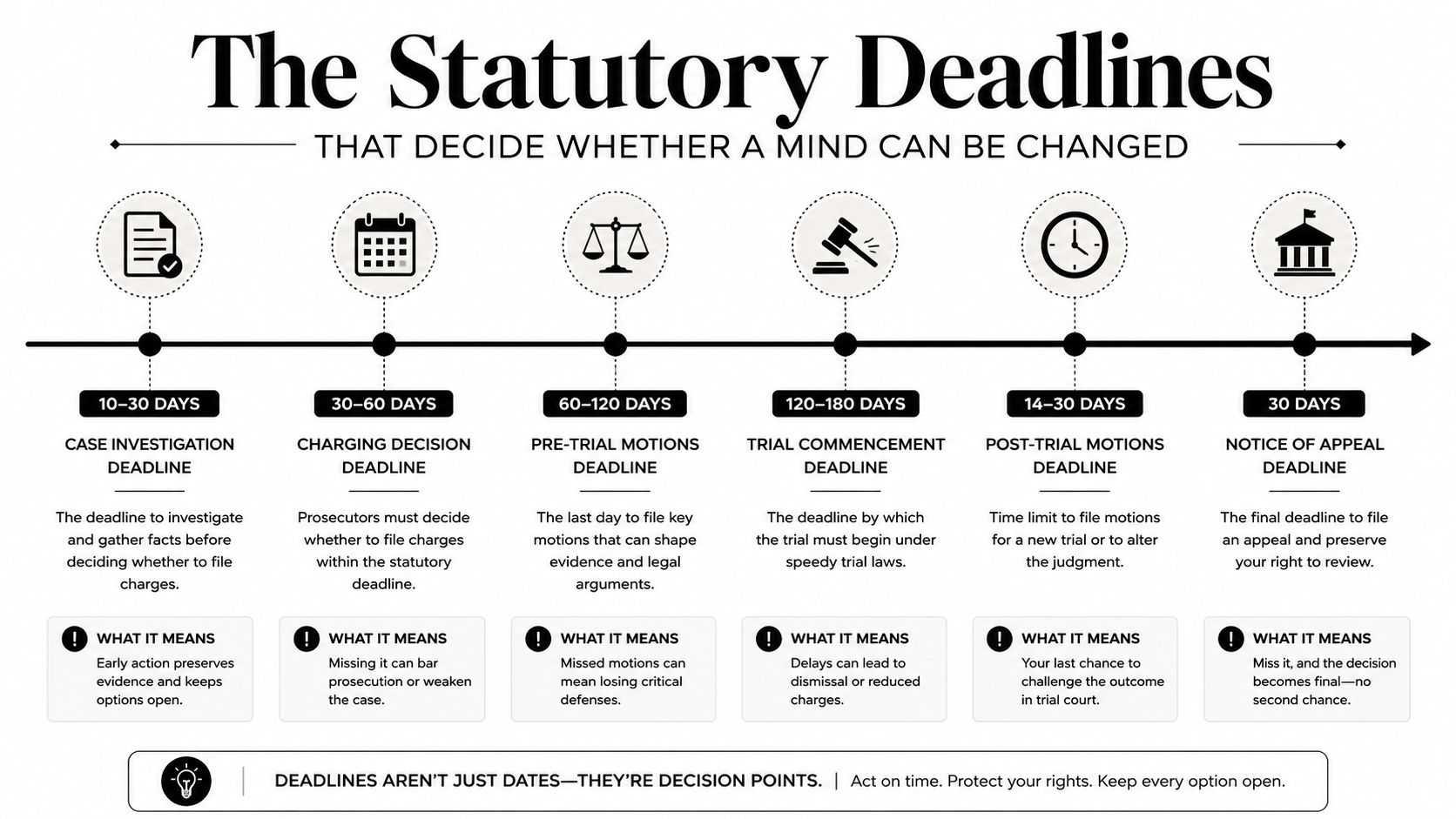
The Statutory Deadlines That Decide Whether a Mind Can Be Changed
A birth parent may hear “48 hours,” “10 days,” “60 days,” and “the final order,” then wonder which deadline controls. Texas law does not use one universal clock. The answer depends on the document signed, the adoption pathway, and whether the court has entered its order. The paper itself starts one clock, while the court's action can end the opportunity to revoke.
Birth comes first
A voluntary relinquishment must be signed after the child is born. It cannot be signed until 48 hours after birth. That waiting period gives a birth mother time beyond the immediate delivery period before signing a document that may permanently change the legal relationship with her child. (Texas Family Code Section 162.011)
The waiting period protects the parent's decision-making window. It does not make an early signature effective. If papers are presented before the period ends, pause and obtain legal advice before signing.
The signing date starts the next question
Texas distinguishes between consent and different forms of relinquishment. In some independent adoptions, the document may allow revocation for 10 days. It may also state that the consent is irrevocable for a period that cannot exceed 60 days. If the applicable document states no different period, the default may be 10 days. The details are summarized in Texas adoption consent and revocation rules.
As noted earlier, if no different period is stated, a voluntary relinquishment affidavit becomes irrevocable on the 11th day after execution. That rule may apply differently from the terms governing another consent document, so the document's exact language matters.
These deadlines can sound contradictory because they may belong to different forms or adoption structures. Counting from memory is unsafe. The attorney or agency handling the matter should review the signed affidavit, identify the applicable period, and confirm where a revocation must be filed.
Practical rule: Never rely on a verbal statement that “there's still time.” Get the document, calculate the deadline, and confirm where a signed revocation must be filed.
The final order is a hard cutoff
Under Texas Family Code § 162.011, a required adoption consent may be revoked by filing a signed revocation before the court renders the adoption order. Once the court signs that order, the adoption becomes final and generally irrevocable. The court's action can therefore end the revocation opportunity even if another deadline appears to remain.
A six-month residence requirement also commonly applies before a court may grant an adoption, although a court may waive it when doing so serves the child's best interests (Texas adoption residence requirement). That residence period is separate from revocation. Placement, consent, and finalization are different legal questions.
For a detailed discussion of the time a birth parent may have to act, consult the Texas revocation consent resource. If a deadline may be approaching, contact counsel immediately rather than waiting for a scheduled hearing.
How Revocation Rules Shift by Adoption Type
The phrase “I signed adoption papers” covers very different legal situations depending on which document was used and under what authority. The adoption route points to the governing rules, but the exact consent or relinquishment controls the analysis.
| Adoption Type | Governing Law | Revocation Window | Practical Effect |
|---|---|---|---|
| Agency adoption | Texas Family Code adoption provisions, including Chapter 162 procedures | The relinquishment may become irrevocable upon signing, depending on its terms | A birth parent may have little or no ordinary revocation opportunity after signing |
| Independent or private adoption | Chapter 162 and the signed consent or affidavit | The document may provide a 10-day period, or an irrevocable period capped at 60 days, depending on its terms | The birth parent must read the specific revocation language rather than assume a standard period |
| CPS or foster-to-adopt case | CPS proceedings and separate termination orders, with adoption proceedings afterward | Revocation generally is not available after parental rights have been terminated by a final court order | A parent usually must address the termination order itself, not simply withdraw adoption consent |
| Safe-haven relinquishment | Texas Baby Moses provisions and related adoption law | A 60-day cap can apply, after which the relinquishment is generally irrevocable | The statutory pathway is specialized and requires prompt legal review |
Why the categories matter
In an agency adoption, the agency may receive a relinquishment written to become irrevocable when signed. An independent adoption may identify a particular family and provide a defined period for revocation. Those terms shape the birth parent's available choices and the adoptive family's expectations.
CPS cases follow a separate path. In CPS cases, parental rights may already have been terminated through a separate DFPS action. The remaining question is whether the adoption consent itself was valid, or whether the parent must challenge the termination order through the limited procedures Texas law allows.
Safe-haven relinquishment has its own rules under the Baby Moses process. A parent using that procedure should have the documents and deadline reviewed promptly, because ordinary private-adoption assumptions may not apply.
The Texas affidavit of relinquishment resource explains why the affidavit's wording matters. For any family, begin by identifying the adoption type, gathering every signed paper, and asking an attorney to match each document with the governing Texas rule. That document-by-document review can show whether the issue involves a revocation period, a termination order, or the validity of the consent itself.
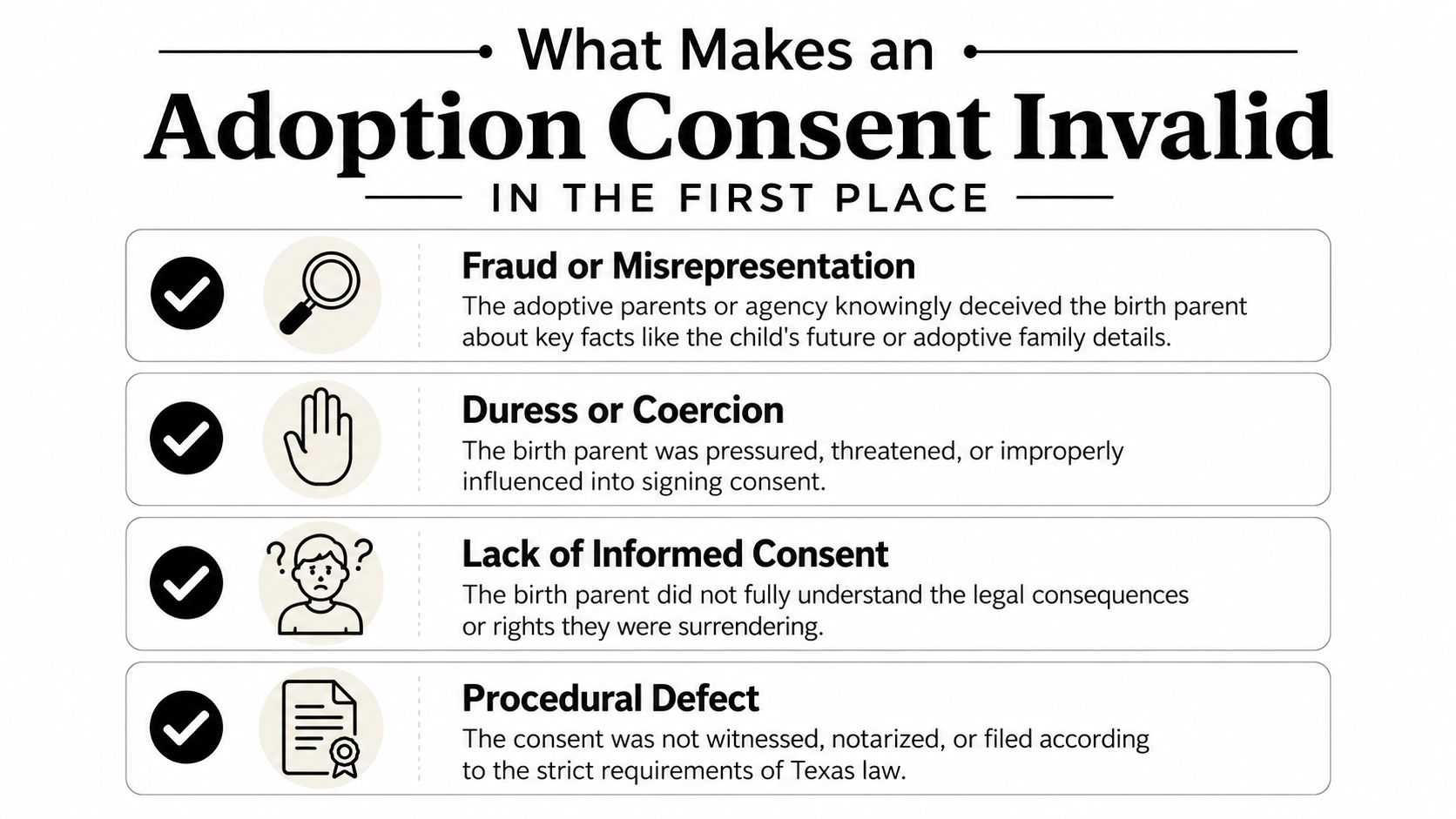
What Makes an Adoption Consent Invalid in the First Place
Regret and legal invalidity are distinct. A birth parent may feel remorse after a valid signing, especially after grief, family pressure, or separation, but that feeling alone does not undo the consent. A legal challenge usually requires evidence that the consent was not freely, knowingly, or properly given. For a detailed guide on what makes an adoption consent invalid in Texas, the signed document and the circumstances around it must be reviewed together.
Look for a defect in the decision or the document
Possible concerns include:
- Fraud or misrepresentation. Someone may have knowingly given false information about the adoptive family, the child's future, or the legal consequences of signing.
- Duress or coercion. Threats, control, or severe pressure may have made the decision involuntary.
- Lack of capacity. Intoxication, cognitive impairment, or untreated mental illness may have prevented the parent from understanding the document and signing knowingly.
- Procedural defects. A required witness, notary, language, venue, filing, or other execution step may have been missing or handled incorrectly.
- Lack of informed consent. The parent may not have understood that signing could end the legal parent-child relationship or surrender parental rights.
The details matter. Sadness or uncertainty does not automatically establish duress. A disagreement about an informal promise may not prove fraud. An attorney may need to examine messages, medical information, witness accounts, and the exact paperwork to determine whether the concern affects validity.
How a challenge begins
A birth parent may raise the issue through the appropriate petition, motion, or signed revocation, asking the court to decide whether the consent was valid before finalization. Timing matters because Texas law treats action before the final adoption order differently from an attempt to undo an adoption afterward, as explained in the Texas adoption consent requirements.
Preserve evidence promptly:
- Save texts, emails, and letters.
- Record who was present during signing.
- Keep hospital, counseling, and medical records.
- Obtain every affidavit and consent.
- Note the dates of birth, signing, placement, filings, and hearings.
The court still considers the child's best interests. A validity challenge asks whether the legal foundation for adoption was sound, not whether a valid deadline can be bypassed.
What It Actually Feels Like to Live Through the Revocation Window
A private-adoption birth mother signs a relinquishment affidavit on a Monday. By Wednesday, after leaving the hospital and sleeping poorly, she knows she wants to reverse course. She doesn't need another general explanation of adoption law. She needs someone to read the affidavit, calculate the deadline, prepare the written revocation, and confirm where it must be filed.
Every hour feels personal, but the legal system measures the situation through documents and dates. Her emotions deserve care, and the paperwork still must be completed correctly.
An adoptive family may experience the same period from the other side. A birth father contacts them after the applicable revocation date and says he never received proper notice. The family may feel joy, fear, guilt, and uncertainty at the same time. They may need an emergency hearing to determine whether the notice and consent process complied with Texas law.
The deadline is legal, but the experience is human. Sleep deprivation, grief, family pressure, and changing hospital circumstances can affect how a person understands a permanent decision.
Why both families need steady guidance
Birth parents shouldn't be shamed for asking questions after signing. Adoptive parents shouldn't be treated as though anxiety means they lack compassion. Both are living through a process that can change the child's future and the shape of an entire family.
A birth parent considering revocation should avoid disappearing, relying on a verbal promise, or assuming an agency will handle every filing. An adoptive family should preserve communications, follow counsel's instructions, and avoid confrontational contact that could worsen an already fragile situation.
The short window doesn't make the feelings short-lived. If the deadline passes, the legal consequences may continue for a lifetime. Early advice can't remove the pain, but it can prevent a family from losing options because no one understood which document controlled.
Practical Next Steps for Birth Parents and Adoptive Families
A worried birth parent may begin with one question: “Can I still change my mind?” The answer depends on the document signed, the kind of adoption involved, and whether the court has entered a final order. Start by gathering the paperwork, because the document often determines which legal path remains open.
Immediate steps for a birth parent
- Locate the controlling document. Ask the agency, attorney, or court for a complete copy if you do not have one. Check whether it is a consent, affidavit, or another form, and look for language describing revocability or irrevocability.
- Identify the applicable window. Confirm which of the revocation windows applies to your document, as explained in the deadlines section above. Also record the signing date, delivery details, and any court dates.
- Prepare a signed written revocation. The statement should identify the consent or affidavit clearly and say that you revoke it.
- File and deliver it correctly. Confirm whether it must be sent to the court, agency, attorney, or another designated recipient. Keep proof showing when and how it was delivered.
- Call a Texas adoption attorney promptly. A lawyer can assess whether the issue involves ordinary revocation, invalid consent, or a challenge to another order.
Do not wait for complete certainty before asking for advice. A lawyer can help separate an emotional question from the legal question, then identify the action that protects your rights. Once the controlling deadline has passed, the available challenge may become narrower and harder to prove.
Parallel steps for adoptive families
Adoptive parents should preserve the placement record. Keep the child's placement date, communications with the birth parents, agency records, signed documents, and court notices together. Confirm whether the child is in the family's legal possession and whether the home study and other approval requirements are complete.
Possible paths include uncontested finalization, a hearing about revocation, or a challenge to the validity of consent. These paths require different preparation. A family law attorney can help the adoptive family respond without treating the birth parent as an adversary or making contact more hostile.
The Law Office of Bryan Fagan, PLLC handles adoption and guardianship matters, including home-study preparation, relative placements, CPS-related adoptions, stepparent adoption, and final court proceedings.
Free legal aid may be appropriate for someone who meets income and eligibility rules. A private family law attorney may help when a filing is urgent, the adoption is contested, or the documents are complicated. The right choice depends on the facts, but speed matters more than certainty when a deadline may be running.
Your Next Step Toward Clarity and Peace of Mind
The most important answer to can birth parents change their mind after adoption in Texas is this: the form, the timing, and the court's action control the result. A direct consent may be governed differently from a relinquishment affidavit. An agency adoption may differ from an independent adoption. A pending case may offer options that disappear after the judge signs the final order.
That doesn't make the process hopeless. It makes early review essential. A birth parent who is questioning a decision deserves a calm explanation of the available legal path, not judgment. An adoptive family deserves an honest assessment of whether consent is secure, what remains before finalization, and how to protect the child's stability.
Texas courts look beyond adult preferences to the child's best interests and the possibility of a safe, lasting family relationship. That principle matters whether the family is pursuing a stepparent adoption, kinship placement, foster-to-adopt finalization, LGBTQIA+ adoption, or an open or closed domestic adoption.
If you're unsure which document was signed, don't try to solve the question by counting days alone. Gather the papers, write down the important dates, and request a personalized review before another deadline passes.
The Law Office of Bryan Fagan, PLLC helps birth parents and adoptive families understand consent, revocation, home studies, contested proceedings, and adoption finalization in Texas. Visit Law Office of Bryan Fagan, PLLC to request a free consultation and discuss the specific documents, deadlines, and child-focused legal options in your situation.
