 Skip to content

You may be standing in a Texas bedroom that's been carefully prepared for a child, wondering what comes next. Perhaps you're considering foster care but fear becoming attached. Maybe you're a stepparent, grandparent, aunt, uncle, or relative who wants permanent legal authority. Or perhaps you've welcomed a child into your home and need to understand whether fostering can lead to adoption.
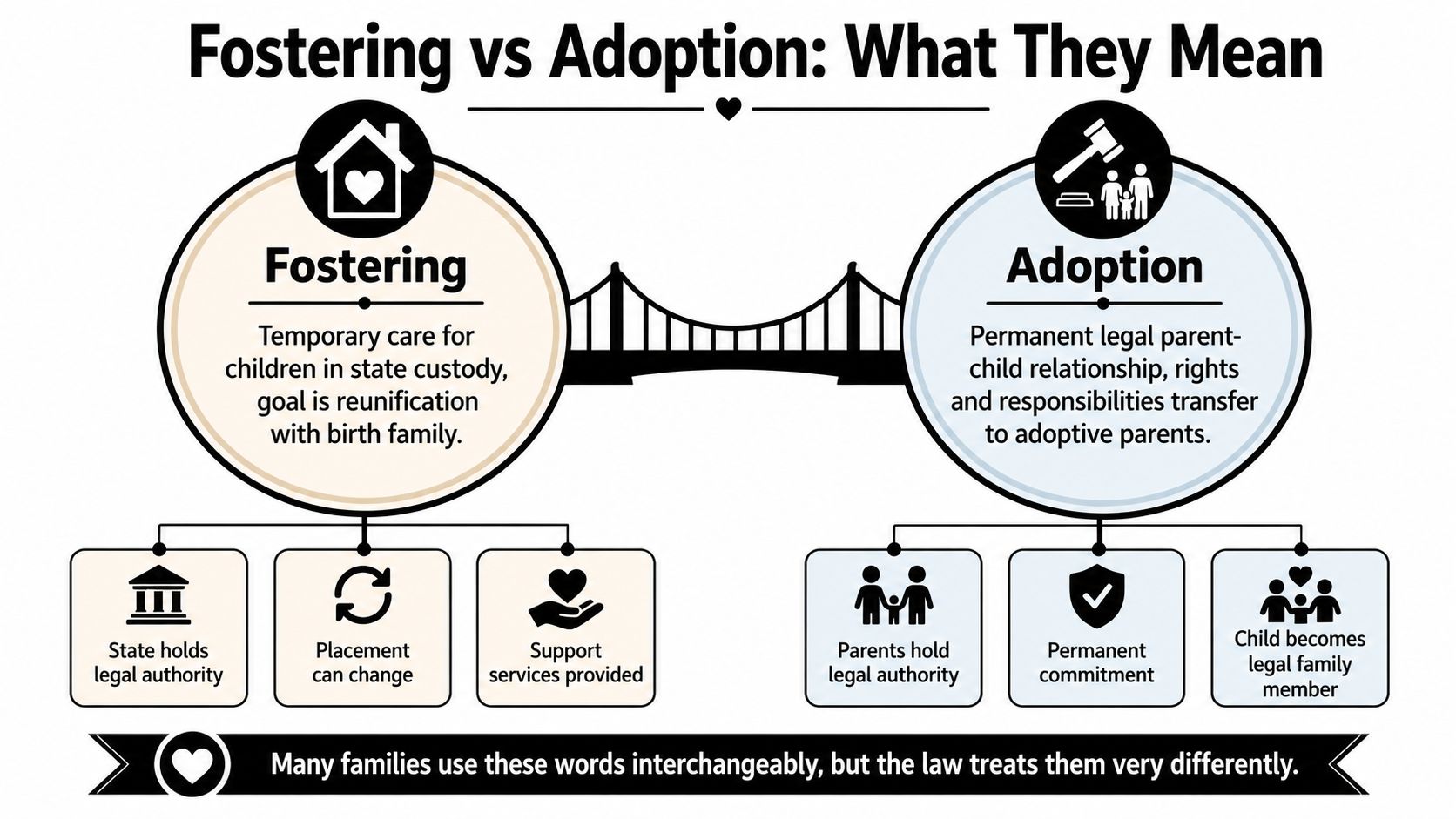
The difference between fostering and adoption begins with purpose. Foster care protects a child during a period of uncertainty, while adoption creates a permanent legal family. Both can be loving, meaningful choices, but they require different expectations, legal steps, and emotional preparation.
What Fostering and Adoption Actually Mean
Consider two Texas families. One couple accepts a child through the state child-welfare system. They provide meals, transportation, comfort, school support, and a safe home while the child's case moves through court. They may hope to adopt, but they also understand that reunification or another placement may occur.
A relative takes a different legal path when she adopts her niece. After the court completes the required process, she becomes the child's permanent legal parent. She assumes parental rights and responsibilities, and the child becomes part of her legal family.
Foster care is temporary care
Foster care is generally a temporary, state-supervised placement intended to protect a child while the state works toward permanency. The most common goal is reunification with the child's parents, although the case may later move toward relative placement, guardianship, or adoption.
A foster parent provides daily care, but fostering alone doesn't transfer full parental rights. The child may remain under state authority or court supervision, and important decisions can involve the Texas Department of Family and Protective Services, caseworkers, attorneys, and the court.
A foster placement can end through several outcomes:
- Reunification: The child returns to a parent when the court determines that return is safe.
- Relative placement: The child moves to a grandparent, aunt, uncle, adult sibling, or another approved relative.
- Guardianship: A caregiver receives lasting responsibility while important legal relationships may remain intact.
- Adoption: A court creates a new permanent parent-child relationship after parental rights are resolved.
- Aging out: An older child leaves care without one of the other permanency outcomes.
Adoption creates permanent legal parenthood
Adoption is a permanent legal relationship created by a court. It transfers parental rights and responsibilities to the adoptive parent or parents and generally ends the legal parent-child relationship with the birth parents.
After finalization, adoptive parents generally make decisions about education, healthcare, travel, residence, and daily life as legal parents. Adoption is designed to continue permanently, subject to limited legal exceptions.
Federal data shows why these terms shouldn't be treated as interchangeable. In fiscal year 2023, 175,283 children entered foster care, and 343,077 children were in foster care on September 30, 2023. During that year, 50,193 children exited foster care to adoption, while 77,809 children had a permanency plan of adoption on September 30, 2023. Those figures show that adoption is one possible outcome within foster care, not the definition of foster care itself. Federal foster-care dashboard information
Side-by-Side Comparison of the Two Paths
The practical difference becomes clearer when you compare authority, permanence, and family relationships. Foster parents care for a child within a public legal system. Adoptive parents become the child's legal parents after the court completes the adoption.
| Criterion | Foster Care | Adoption |
|---|---|---|
| Legal status | Temporary, state-supervised placement | Permanent legal parent-child relationship |
| Decision-making | Shared with DFPS, courts, and case professionals | Adoptive parents generally hold parental authority |
| Duration | Ends through reunification or another permanency outcome | Intended to continue permanently |
| Birth-family relationship | Contact may continue through visits or case planning | Prior parental rights generally end, though families may discuss ongoing contact |
| Financial planning | Families may receive support connected to the foster placement | Families may qualify for adoption assistance or expense reimbursement |
| Case ending | Reunification, relative placement, guardianship, adoption, or another outcome | Court finalization establishes the permanent relationship |
The central legal distinction: Foster care gives you responsibility for daily care without automatically giving you permanent parental rights. Adoption gives you permanent legal authority and the long-term duties of parenthood.
The national adoption system also includes private domestic, stepparent, kinship, and intercountry adoptions. A Child Welfare Information Gateway summary reported 80,598 adoptions in the United States in 2022 across available categories. It reported that 66.48% of domestic adoptions were from foster care, estimated 25,503 private domestic adoptions, and counted 1,516 intercountry adoptions. Separate federal reporting counted 53,665 children and youth adopted from foster care in 2022, showing that foster-care adoption is substantial but doesn't represent every adoption. Child Welfare Information Gateway adoption summary
In that same reporting, 57% of children adopted from foster care were adopted by foster parents, while 33% were adopted by relatives. That means a foster parent may later adopt, but the initial placement doesn't guarantee that result. Families considering long-term foster care may also benefit from Organic Fostering's long-term care guide, which provides broader context about caring for a child when adoption isn't the intended outcome.
For Texas-specific information, Foster Care and CPS Adoption in Texas addresses adopting a child from the Texas foster care system.
How Foster Approval Works in Texas
A prospective Texas foster parent does not open a bedroom and wait for a placement. DFPS uses an approval process designed to evaluate whether the home can safely meet a child's needs.
Imagine a couple named Elena and Marcus. They're both at least 21, financially stable, and ready to provide references. They gather personal-background information and, when applicable, proof of marriage or divorce. They also agree to background checks for adults in the household.
The approval steps
The couple begins by applying and completing training about children who've experienced abuse or neglect. Training helps them understand trauma, behavior, family contact, and the difference between providing care and assuming permanent legal parenthood.
DFPS requires a home study. A worker visits the home, speaks with household members, and considers the family's relationships, motivation, discipline approach, sleeping space, safety planning, and ability to support the child's cultural identity and sibling relationships.
The process also includes criminal-history and abuse-or-neglect checks for adults in the home. The purpose isn't to demand perfection. It's to identify whether the household can offer safety, patience, supervision, and honest cooperation with the child-welfare system.
DFPS states that it doesn't charge a home-study fee, but families can still face related expenses:
- Fingerprinting: DFPS lists a cost of $38.54 per person.
- Fire or health inspections: These generally range from $0 to $100.
- CPR or first-aid training: This commonly costs $25 to $50 or more per person.
These amounts come from Texas DFPS foster and adoptive applicant requirements. Families should confirm current charges before paying because administrative costs can change.
What the home study is really asking
A home study isn't only about whether the house is clean. It asks whether the adults understand the child's history, can manage difficult emotions, will support safe family contact, and can accept that the case plan may lead somewhere other than adoption.
You can review the application journey through this guide to becoming a foster parent in Texas. The strongest applicants approach approval with openness. They explain what they can handle, where they need support, and how they'll place the child's best interests above their own preferred outcome.

How Adoption Works Under Texas Family Code
Texas adoption procedures are governed primarily by Family Code Chapter 162, while Chapters 163 through 166 address related adoption matters, including termination, proceedings, and supporting legal requirements. The exact procedure depends on whether the case involves a stepparent, relative, foster placement, private adoption, or another family structure.
Consider a stepparent named Daniel who has raised his spouse's 13-year-old child for years. Daniel wants legal parenthood, but filing a petition is only one part of the process. The court must examine consent, notice, parental rights, and the child's best interests.
Consent must be identified early
Under Texas Family Code Chapter 162, a managing conservator generally must provide written consent unless that person is the petitioner. If the child's parent is married to the person seeking adoption, that parent joins the adoption petition, so the spouse's separate consent isn't required.
A child who is at least 12 years old must also consent in writing or in court. The court may waive that requirement when doing so serves the child's best interests, but families shouldn't assume a waiver will be automatic.
Daniel therefore needs to understand who has legal authority, whether another person's consent is required, and how the 13-year-old feels about the adoption. A child's voice matters, especially when the child understands the family relationships and the legal changes involved.
From petition to final decree
The family generally works through these stages:
- Case assessment: An attorney identifies parents, managing conservators, possessory conservators, required notices, and possible consent issues.
- Preparation: The family gathers records, completes required evaluations or studies, and prepares the adoption petition.
- Court review: The judge considers statutory requirements, parental rights, consent, and the child's best interests.
- Child's participation: When required, the child provides written or in-court consent.
- Finalization: The court enters a final decree, creating the permanent legal parent-child relationship.
A relative adoption and a foster-to-adopt case can involve different histories and court issues, even though both may end in adoption. In a foster-care case, parental rights may need to be terminated or otherwise resolved before adoption can proceed. A relative may already have a strong family bond but still must satisfy legal requirements.
The Texas adoption and Family Code guide for parents can help families identify questions before filing. Legal review is especially valuable when consent is disputed, a parent is absent, the child is older, or the proposed adoption affects ongoing family relationships.

Costs, Subsidies, and What Texas Families Actually Pay
Cost planning differs between foster care and adoption. A Texas family approved through DFPS generally doesn't pay a home-study fee, although approval-related expenses can include fingerprinting, inspections, and training costs.
Foster parents may receive support connected to the child's care. That support is intended to help meet the child's needs during placement. It isn't the same as income or compensation for becoming a parent.
Adoption expenses depend on the type of adoption. Public-agency adoption through DFPS is described as nominal in cost, while private child-placing agencies set their own charges. Families may also need legal representation, court services, records, travel, or other case-specific assistance.
Reimbursement for eligible expenses
For children adopted from foster care, Texas policy allows adoptive families to seek reimbursement of up to $1,200 for reasonable and necessary adoption expenses. Eligible expenses can include court costs, attorney fees, home-study fees, health examinations, transportation, and certain lodging and food costs. Texas DFPS adoption assistance information
A family nearing finalization should ask what the agency covers before committing to an expense. It should also obtain written estimates and preserve receipts.
Practical budgeting rule: Ask which costs qualify, request written estimates, and keep every receipt until the agency or attorney confirms that reimbursement is available.
Families managing disability-related needs may also need separate information about support programs. A resource explaining how to find autism therapy funding options may help identify questions to raise with providers, insurers, or public agencies. It isn't a substitute for Texas adoption-assistance advice, but it can be useful when planning for a child's ongoing care.
Texas families can also review the distinction between Texas adoption subsidy and federal adoption assistance before finalization. Ask specifically about eligibility, covered expenses, and deadlines rather than assuming that every cost will be reimbursed.
Timelines, Reunification Risk, and When Adoption Becomes Possible
Foster care doesn't follow a single calendar. A placement may continue while the court evaluates services, visitation, relative options, safety concerns, and the parent's progress. Adoption becomes possible only when reunification and other permanency options aren't viable and the legal requirements for adoption are satisfied.
The federal permanency-in-12-months measure counts exits to reunification, adoption, guardianship, or relative placement. Nationally, 35.2% of children entering foster care achieved one of those permanency outcomes within 12 months in the cited performance measure. This is a system-level measure, not a promise about an individual child's case. Federal Child and Family Services Review performance measure
Texas data reinforces the need for realistic expectations. DFPS reported that most children leave care to parents or relatives, roughly one-third are reunified, and about 8% exit through aging out. In FY2025, 9,876 children exited DFPS custody, and nearly three-quarters went to a parent or relative. Texas DFPS FY2025 presentation
When a foster parent may seek adoption
A foster parent may move toward adoption when the court and agency identify adoption as the permanency plan, parental rights have been terminated or otherwise resolved, and the child is legally available. The foster parent's preference alone doesn't change the case plan.
The legal transition requires more than a long placement. The court must address parental rights, required notices, consents, the child's best interests, and the final adoption decree. Court schedules, contested hearings, appeals, and case complexity can all affect timing.
Foster parents should prepare for two truths at once. They can love a child and still support reunification. If reunification fails, they can ask whether adoption or guardianship serves the child's needs without treating adoption as something they're automatically entitled to receive.
Choosing the Right Path for Your Texas Family
Foster care may fit adults who can provide stability while supporting safe reunification, family visitation, and court-directed planning. It requires emotional flexibility because the child may leave your home. That loss can be painful even when reunification is a healthy and successful result.
Adoption may fit relatives, stepparents, LGBTQIA+ couples, single parents, and other adults who are prepared to assume permanent legal responsibility. It can provide lasting authority and family security, but it also requires careful attention to consent, parental rights, family history, identity, and the child's wishes.
Guardianship deserves serious consideration, especially for older children and relatives who want to preserve family connections. Public-agency permanency planning considers both adoption and guardianship, and one FY2025 report recorded guardianship for 9% of children exiting care. Texas adoption from foster care was reported at 2,942 in FY2025, and the number had declined substantially since FY2019. Those figures don't independently show whether the system is improving or worsening. Some children may be reunified or placed permanently with relatives, while guardianship may preserve relationships that adoption would change. Public-agency FY2025 annual report%20-%20FY2025_FINAL%202.1.26.pdf)
Questions to ask before choosing
- Your emotional readiness: Can you care for a child without assuming adoption will follow?
- Your legal goal: Do you need permanent parental authority, or would guardianship meet the child's needs?
- The child's relationships: What contact with parents, siblings, relatives, and cultural community should continue?
- Your practical capacity: Can your household manage visits, appointments, trauma-related needs, school changes, and court involvement?
- Your family structure: Would stepparent, kinship, foster-care, private, LGBTQIA+, or single-parent adoption rules apply?
Adoption grants permanent legal authority. Foster care provides temporary care. The right choice depends on what your family can honestly commit to and what the child needs most.
The Law Office of Bryan Fagan, PLLC helps Texas families address adoption and guardianship matters, including preparation, consents, home-study concerns, court proceedings, finalization, and post-adoption questions. Families can seek guidance through offices serving communities across Texas or through virtual consultations.
The Law Office of Bryan Fagan, PLLC can help you evaluate foster care, adoption, or guardianship before you commit to a legal path. Schedule a free consultation by visiting Law Office of Bryan Fagan, PLLC to discuss your family's circumstances, required consents, home-study questions, and next steps toward a stable future for the child.

