 Skip to content

An adult adoptee sits at a kitchen table with a folder of old papers, wondering whether the answers they need are inside a Texas adoption file marked confidential. Across town, a hopeful adoptive parent may be asking a different question: does sealing mean the child's history disappears forever? Both concerns are understandable. Texas law protects private adoption information, but it also creates limited ways to obtain nonidentifying information, seek court access, or connect through mutual consent.
Sealing the Texas adoption file and who can open it depends on which record you mean, why access is needed, and which legal pathway fits the request. The court file, the Central Adoption Registry, and records held by the Texas Department of Family and Protective Services, or a private placement agency, are separate doors. Each door has a different key.
A Sealed File and a Lifelong Question
Maya was adopted as a baby and grew up knowing that her adoption was part of her story, even though many details remained private. As an adult, she wanted medical history and wondered whether the original court papers could explain what happened before her adoption was finalized. She didn't want to disrupt anyone's life. She wanted to understand her own.
A birth parent may carry a similar question from the other side. A parent who placed a child for adoption might want updated information, while an adoptive parent may need to understand what information can lawfully be shared with an adult child. These questions can bring hope, grief, fear, or all three at once.

Curiosity and privacy can coexist
Texas seals adoption records to protect the privacy of adoptees, adoptive parents, birth parents, and other confidential parties. That protection isn't meant to dismiss an adoptee's identity needs or punish a family member for asking questions. It recognizes that adoption affects several people, and each person may have legitimate privacy interests.
The law also doesn't treat every record as equally inaccessible. Some people may receive edited or de-identified information. Eligible adults may participate in the Central Adoption Registry. A court may authorize access when a person demonstrates legally sufficient good cause.
A sealed record is protected, not erased.
The pages ahead will separate these pathways in plain language. You'll learn what sealing means under Texas Family Code Chapters 162 through 166, who may ask a court for access, how a motion to unseal generally works, and why a request for an original birth certificate may follow a different process. You'll also see why the child's best interests and family unity remain important, even long after finalization.
What Sealing Really Means Under Texas Law
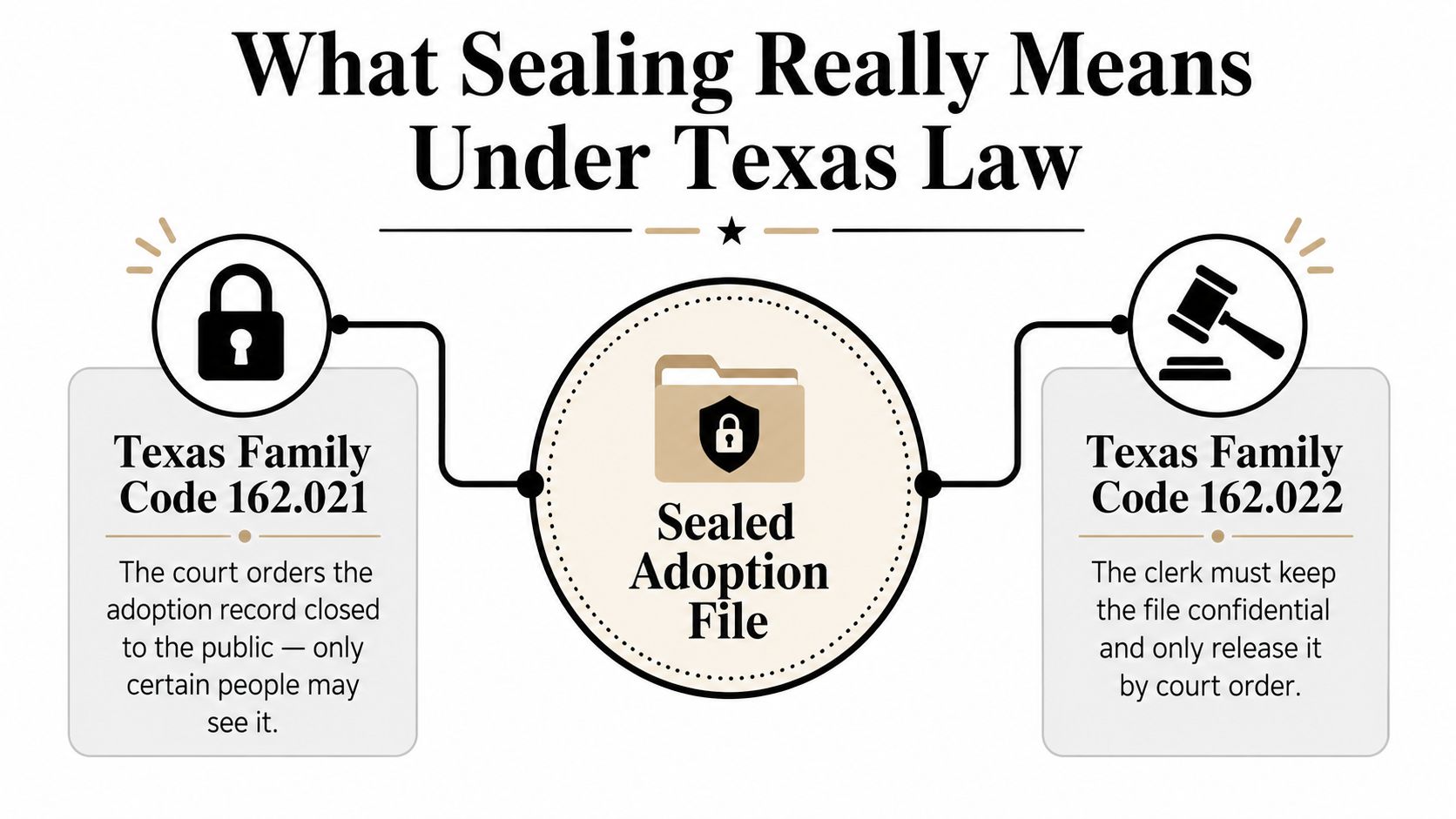
Under Texas Family Code §162.021, the adoption court may order the adoption file, the court minutes, or both sealed. Under §162.022, records concerning the child maintained by the district clerk after the adoption order are confidential. No person has an automatic right to inspect those records or obtain information from them unless the court that issued the adoption order finds good cause and authorizes access by court order. The statutory framework is available through Texas Family Code §162.022.
Think of the file as a sealed envelope stored in a courthouse vault. The envelope still exists. The papers inside haven't been destroyed. But a private request sent to the clerk doesn't open it. The adoption court decides whether the legal reason for disclosure is strong enough and, if so, what may be released.
Three records that people often confuse
The judicial adoption file contains documents filed in the adoption case. The court minutes are the court's official record of proceedings and orders. A judge may seal one or both under the statute. After finalization, the district clerk must treat records concerning the child as confidential.
Texas Vital Statistics is a separate part of the system. Sealing the court file doesn't eliminate the clerk's duty to transmit required adoption information to Vital Statistics. It also doesn't mean every request for a birth record is handled exactly like a request for the court file.
The Texas Department of State Health Services explains that adoption records are sealed after an adoption is granted and that identifying information about the biological family can't be released without a court order. For a practical explanation of the distinction between confidentiality and access, see how Texas adoption records are sealed and accessed.
The same general confidentiality framework applies whether the adoption involved a private placement, a relative, or the Stepparent Adoption in Texas, which is the most common Texas adoption and has its own legal process. The important point is simple: sealing protects the record, but it doesn't destroy the record or guarantee that every related document is unreachable.
Three Different Doors on the Adoption File
Many families use the phrase “the adoption file” as though it means one folder held in one place. In practice, three different record systems may be involved. The right request depends on whether you want confidential court documents, contact with a consenting relative, or a redacted agency record.
| Record Type | Who Controls Access | Typical Access Pathway |
|---|---|---|
| Sealed judicial adoption file | The court that issued the adoption order | A court order based on legally sufficient good cause |
| Central Adoption Registry | Texas through a mutual-consent system | Registration by an eligible adult and a match with another registered relative |
| DFPS or private placement agency records | DFPS or the agency that handled the placement | An agency request, usually with required redactions and confidentiality protections |
The first door is the courthouse
The sealed judicial file is the most restrictive door. It generally contains identifying adoption information and is controlled by the adoption court. A person who wants those documents must direct the request to that court rather than treating it like an ordinary clerk-record search. A private request alone doesn't automatically open the file.
The court may authorize only particular documents or information. It may also deny access, release a redacted version, or impose limits designed to protect another person's privacy.
The second door is mutual consent
The Central Adoption Registry operates differently. Adults who are 18 or older and who fall within the statutory categories may register, including adult adoptees born in or placed for adoption in Texas, birth parents, and biological siblings of adult adoptees. A connection can occur when another eligible relative has also registered and the required consent structure is satisfied.
Registration isn't a court-file request. It doesn't give someone unrestricted access to confidential judicial records. It offers a structured way for eligible relatives to locate one another without automatically exposing the sealed file.
The third door belongs to an agency
DFPS records and private placement-agency records aren't necessarily stored with the court. For a closed CPS adoption, DFPS says an adoptee may request a redacted copy when DFPS participated in the placement and adoption. A private agency may hold its own records instead.
Texas guidance also recognizes that adoptive parents and adult adoptees may receive edited, nonidentifying historical, social, educational, or genetic-history information when they establish identity and legal entitlement. The practical distinctions are discussed in Texas Family Code §162.018 and access to adoption records.
Who Has Standing to Petition the Court
“Standing” sounds technical, but the basic question is practical: does this person have a legally recognized reason to ask the court to consider access? Texas law identifies several people who may have a pathway to request adoption-related information, although having a pathway to petition doesn't guarantee that the judge will grant the request.

The people behind the legal categories
An adult adoptee may seek information connected to their own adoption. A birth parent may petition when the circumstances support disclosure. An adoptive parent may need records related to the adoption, although the court still weighs confidentiality and the rights of others.
A managing conservator, guardian, or legal custodian may have a role when the request concerns a minor adoptee. Texas guidance also identifies limited access to social, health, educational, and genetic-history information for certain people in those roles.
The law recognizes two additional family relationships in particular circumstances:
- A surviving spouse of a deceased adoptee may seek certain information when that spouse is the parent or guardian of the adoptee's child.
- An adult descendant of a deceased adoptee may qualify to seek certain adoption-related information.
The exact request matters. A person asking for nonidentifying medical history may be asking for something different from a person asking for names, addresses, or the complete court file.
Good cause is more than a personal wish
“Good cause” means the request must have a legally sufficient reason that outweighs the privacy interests protected by the sealed record. A judge may consider a serious medical need, an identity-related need, or another compelling circumstance. The court may also consider whether a narrower disclosure would address the need without exposing unnecessary identifying information.
Ordinary curiosity, family-tree research, or a desire to reconnect socially won't usually establish good cause by themselves. That doesn't make those feelings unimportant. It means the court must balance them against the confidentiality promised to other adoption participants.
If an order will direct Texas Vital Statistics to release records, the order must identify the records to be released and the person authorized to receive them. A broad request that says "open the adoption" may not give the judge enough precision to protect everyone involved.
How a Motion to Unseal Actually Works
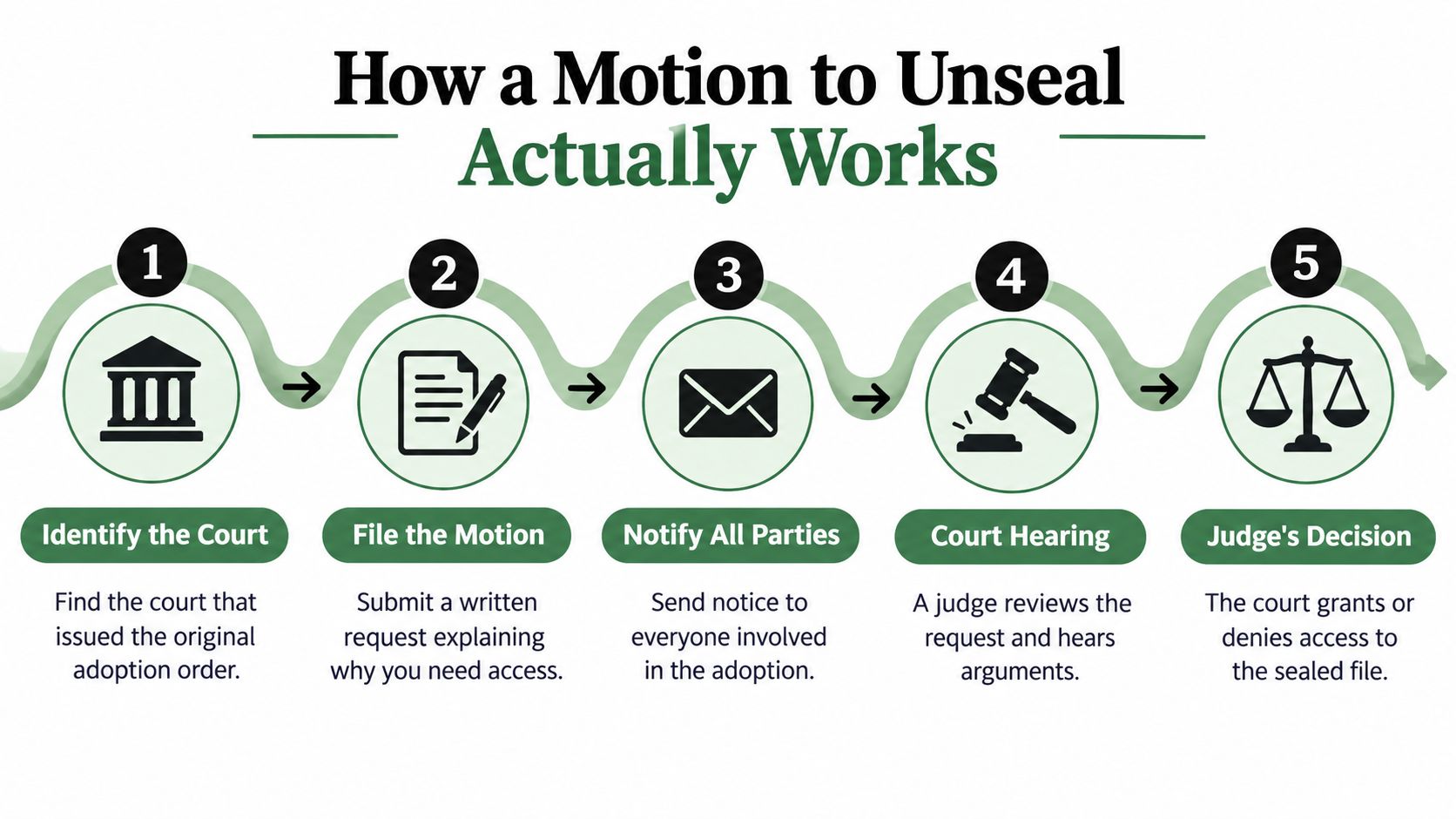
Consider an adult adoptee who has learned that the adoption occurred in a Texas county but doesn't know which documents still exist or which office controls them. The first conversation with an attorney usually focuses on the goal. Is the person seeking medical history, an original birth certificate, identifying information, or a complete court file? That answer can change the recommended path.
The person must identify the court that issued the original adoption order. This may require locating the adoption decree, checking available family papers, contacting the appropriate clerk for limited procedural information, or gathering agency documentation. The request should go to the adoption court, not just a general records office.
Preparing the request
A motion to unseal should identify the specific documents sought. It should explain the legally sufficient reason for disclosure, describe why the requested information is necessary, and address privacy risks to the adoptee, birth parents, adoptive parents, and other confidential parties.
Supporting materials may include the adoption decree, medical documentation, proof of identity, or records showing why a narrower release wouldn't meet the need. The motion should be sworn when appropriate and should present the facts carefully rather than relying on emotional urgency alone.
A focused request gives the court more room to protect privacy while addressing a real need.
The proper parties may need notice of the motion, and the court may schedule a hearing. Notice and service requirements can depend on the circumstances, the identities available, and the court's instructions. An attorney can help determine whom to notify and how to handle information that itself is confidential.
What happens at the hearing
At a hearing, the judge may ask why the information is needed, whether the request could be satisfied with a redacted record, what harm disclosure could cause, and whether the person has explored the Central Adoption Registry or an agency request. The judge may grant the motion, deny it, or authorize only limited documents or information.
Court dockets vary by county, so no responsible attorney can promise a uniform timeline. A request may involve locating an old file, identifying interested parties, arranging notice, and waiting for a hearing date. The court's decision may come after argument or after additional information is provided.
Required adoption information still moves from the clerk to Texas Vital Statistics even though the court file remains sealed. For a closed DFPS adoption, an adoptee may be able to request a redacted copy from DFPS when the department participated in placement and adoption. DFPS and a private agency aren't interchangeable, so identifying who handled the placement matters.
Once the motion and supporting papers are ready, families may need reliable court-compliant document printing for organized copies, exhibits, and service materials. Printing doesn't replace legal review, but complete and readable filings help avoid preventable administrative problems. A plain-language overview of the court process is also available through how to unseal adoption records in Texas.
Privacy, the Child's Best Interests, and Likely Outcomes
Texas's confidentiality rules exist because adoption changes a child's legal family while preserving sensitive information about several adults. Birth parents may have expected privacy. Adoptive parents may have shared personal records during the process. The adoptee may need information about identity or health. A judge has to consider all of those interests together.
The child's best interests remain important after finalization. For a minor, that may mean protecting stability and safety. For an adult adoptee, best interests may include access to meaningful medical or identity information, but the court still must decide how much disclosure is necessary and how much private information should remain protected.
A court may reach several outcomes:
- Redacted disclosure, with names or other identifying details removed.
- Limited disclosure, restricted to specified documents or information.
- Full access, when the court finds the legal standard satisfied.
- Denial, if the reason doesn't establish good cause or privacy concerns outweigh the request.
- Referral to another pathway, such as the Central Adoption Registry, DFPS, a private agency, or Vital Statistics.
An adult adoptee who knows the identity of every parent named on the original birth certificate may obtain a noncertified copy without a court order. That route doesn't open the sealed court file and doesn't authorize disclosure of confidential third-party information.
The result can depend on the county, the judge, the records available, and the specific reason for the request. Careful preparation matters because the court isn't deciding whether a person's feelings are valid. It is deciding what information may be released lawfully while protecting the people connected to the adoption.
Common Misconceptions Worth Clearing Up
Myth that sealed means destroyed
Truth: Sealing is a confidentiality measure. The adoption file remains in existence, and the adoption court controls access. Texas Family Code §§162.021 and 162.022 distinguish between keeping records confidential and destroying them. The court may authorize access when good cause is shown.
Myth that a closed adoption is completely inaccessible
Truth: A closed adoption doesn't create one universal lock. Texas guidance distinguishes between sealed identifying records and limited access to nonidentifying or mutually authorized information. Adoptive parents and adult adoptees may receive edited, nonidentifying historical information, while eligible relatives may use the Central Adoption Registry when the required mutual-consent structure is satisfied. See the Texas adoption records access guidance.
Myth that any relative can request the whole file
Truth: Family connection alone doesn't create an automatic right to inspect the sealed court record. A relative may qualify for a specific type of information or may have a registry pathway, but a complete court file generally requires an order from the adoption court based on good cause.
Myth that a court order is required for every birth record request
Truth: The original birth certificate has its own rules. An adult adoptee who knows the identity of every parent named on the original certificate may obtain a noncertified copy without a court order. That limited route doesn't open the adoption file or permit access to other confidential information.
Myth that DFPS records and court records are the same
Truth: DFPS may hold a separate case record and may provide a redacted copy in qualifying closed CPS adoptions. A private placement agency may hold different records. Before filing anything, identify which organization handled the placement and what document you need.
When to Talk With a Texas Adoption Attorney
The sealed court file, Central Adoption Registry, and DFPS or agency records are separate doors, each with its own key. An attorney can help identify the information you need, such as nonidentifying history, an original birth certificate, a registry match, or a court motion based on good cause. Bring the adoption decree, registry confirmation, identity documents, and relevant medical records to a consultation with the Law Office of Bryan Fagan, PLLC.
The Law Office of Bryan Fagan, PLLC can explain which record holder to contact and discuss the right path for your family.

