 Skip to content

You've just left the courthouse after a judge signed your child's final adoption decree. Your family may be celebrating a highly meaningful milestone, only to discover that the birth certificate still doesn't show the child's adoptive information. That confusion is understandable. In Texas, court finalization and vital-record processing are separate steps, and completing one doesn't automatically complete the other.
Reporting a Texas adoption to Vital Statistics helps create a new birth record that reflects the adoption. The process requires careful coordination among the district clerk, attorney, adoptive parents, and Texas Department of State Health Services (DSHS). It also carries privacy consequences because the original adoption-related record is sealed. Understanding the process can help your family avoid preventable returns and delays while protecting the child's legal identity and future access to records.
The Journey from Courtroom to Birth Certificate
After a final adoption hearing, a family might leave court believing every government record will update automatically. Consider a Texas family whose stepparent adoption has just been granted. The judge signs the final Decree of Adoption, relatives celebrate, and the family begins using the child's new surname. Later, when the family tries to obtain a replacement birth certificate, they learn that the court decree alone didn't update the state's birth record.
Texas divides these responsibilities. The district court grants the adoption and issues the final decree. DSHS Vital Statistics then handles the adoption-related birth-record process. For a child born in Texas, the adoptive parent or attorney generally works with the district clerk to submit a completed Certificate of Adoption, Form VS-160, certified by the clerk, along with a certified copy of the final decree. DSHS uses those materials to create a new birth record with the adoptive information. The adoption filing process is described in Texas guidance on changing a birth certificate after adoption.
Why the decree matters
Filing an adoption case isn't enough to trigger this process. DSHS begins its adoption-related birth-certificate work only after the court grants the adoption and issues a final decree. If the adoption occurred outside Texas but the person was born in Texas, DSHS may still process the Texas birth record. Texas Vital Statistics cannot create an adoption birth certificate for someone born in another state.
This distinction is more than paperwork. The new record supports the child's identity for future needs, while the original record is sealed under Texas's adoption privacy framework. A complete submission honors both parts of the transition, the family's new legal relationship and the child's protected record history.
Practical rule: Treat the signed, certified decree as the court milestone, not as proof that the birth-record update is finished.
Understanding Who Files the Adoption Report
Families commonly use one of three filing paths. The correct choice depends on the adoption case, the documents already prepared, and who is coordinating with the district clerk.
Attorney-assisted filing
An attorney may prepare or coordinate the VS-160 packet after finalization. This route can be useful when the case includes unusual custody facts, a name change, missing court paperwork, or questions about how the decree and form should align. The attorney or office may work with the district clerk, obtain the needed certification, and submit the materials to DSHS.
Before relying on this path, ask who will send the packet, which documents will be included, and how you'll receive proof of delivery. Families should also keep their own complete copy, even when counsel handles the mailing.
Parent-initiated filing
Adoptive parents can also organize the submission themselves when the decree and identifying information are straightforward. The parent gathers the original VS-160, valid government photo identification, the required fee, and any supporting decree or certification required by the form. The packet is then sent to the DSHS address listed for Vital Statistics or delivered through an available agency location.
This option gives parents direct control, but it also places responsibility for checking every field and certification on the family. A parent who chooses this route should compare the decree, VS-160, and identification carefully before sending anything.
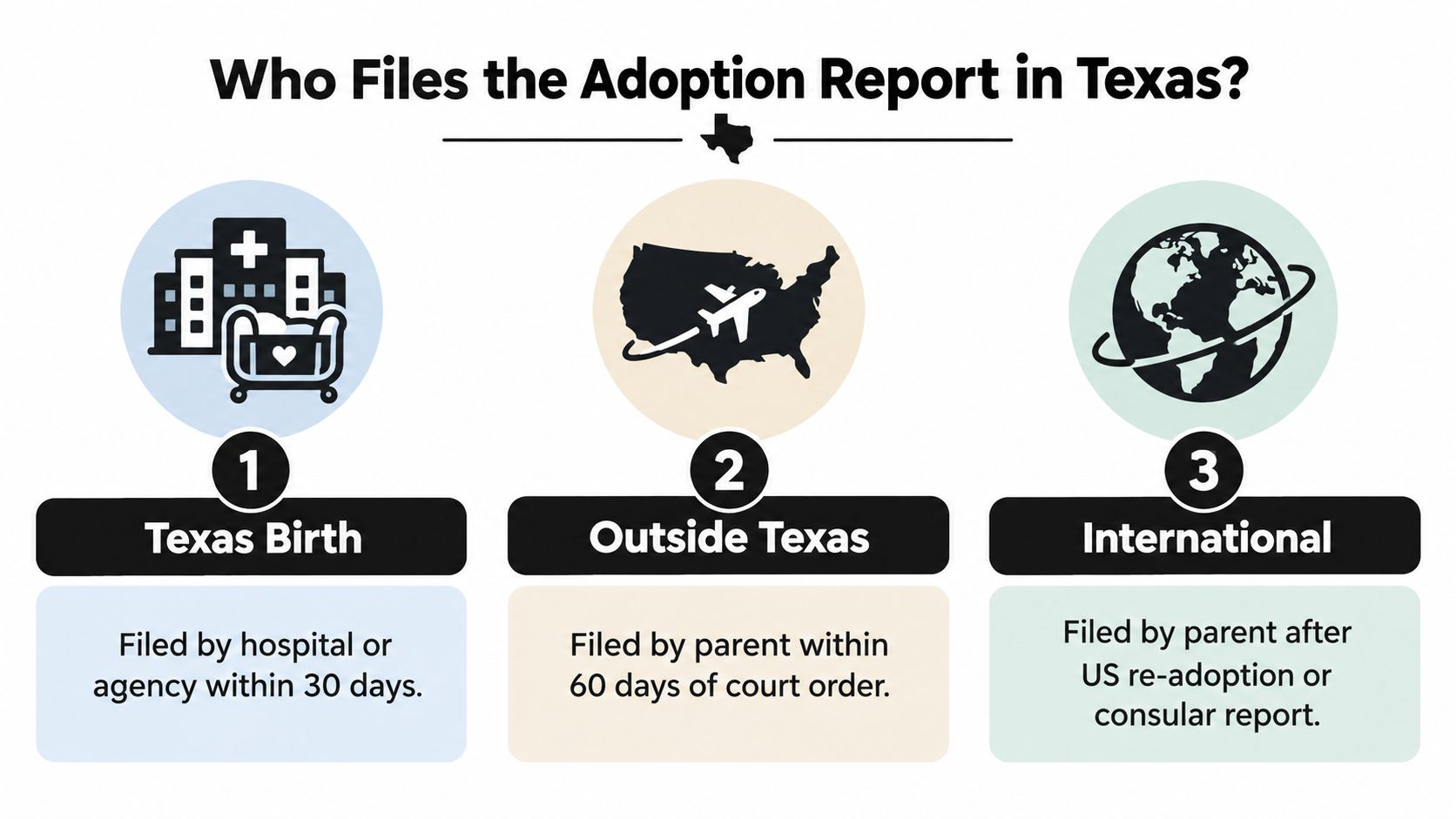
District-clerk-assisted filing
The district clerk may assist with certification and submission, particularly when the court requires the clerk to complete Section 5 of VS-160. This can reduce uncertainty about whether the court's certification is visible and properly completed. It doesn't remove the need for the family or attorney to verify the rest of the packet.
For families considering Stepparent Adoption in Texas, the most common Texas adoption, knowing who handles the post-decree filing can prevent an assumption that the court automatically sends every record to DSHS.
Navigating the VS-160 Certificate and Documentation Requirements
A signed adoption judgment can mark the legal end of the case while the birth record remains unchanged. Form VS-160 connects those two systems. It gives Texas Vital Statistics the information needed to locate the existing record and prepare the post-adoption record.
For a Texas-born child, use the child's pre-adoption information for the applicable fields, including the name, date of birth, sex, and place of birth. The parents' names are also required for Texas-born adoptions. This may feel counterintuitive after the court has recognized the child's new identity, but the earlier details act like an address for the existing birth record. If they do not match, processing can slow down while the agency seeks clarification.
The certification point many families miss
Section 5 on page 3 must be completed and certified by the district clerk. If the clerk does not properly certify that section, the applicant must attach a certified copy of the final Decree of Adoption with original certification. DSHS does not accept photocopies, alterations, strike-throughs, or handwritten write-overs in place of an acceptable original filing.
| Document | Requirement | Certification Needed |
|---|---|---|
| Form VS-160 | Complete applicable sections, sign the original, and use pre-adoption identifying information | The court clerk must complete and certify Section 5 |
| Final Decree of Adoption | Include it when the certification or filing instructions require it | Attach a certified copy with original certification if Section 5 is not properly certified |
| Government photo identification | Attach valid identification for the applicant | The identification must be government-issued and valid |
| Applicable fee | Include the amount required by the current DSHS schedule | Confirm the current amount before submission |
Before mailing, compare every name, date, and place of birth across the decree, VS-160, and identification. A mismatch can create the same kind of delay as a missing document. Families preparing a packet can also review this guide to essential Texas adoption required documentation.
The current DSHS VS-160 instructions identify a $25 correction-to-birth-certificate fee and a $15 Central Adoption Registry fee per Texas adoption decree. These fees apply to standard correction filings, so confirm the current schedule before mailing because requirements can change.
Document check: If a form contains an error, do not cover it with correction fluid or write over it. Begin again with an acceptable original application.
Special Considerations by Adoption Type
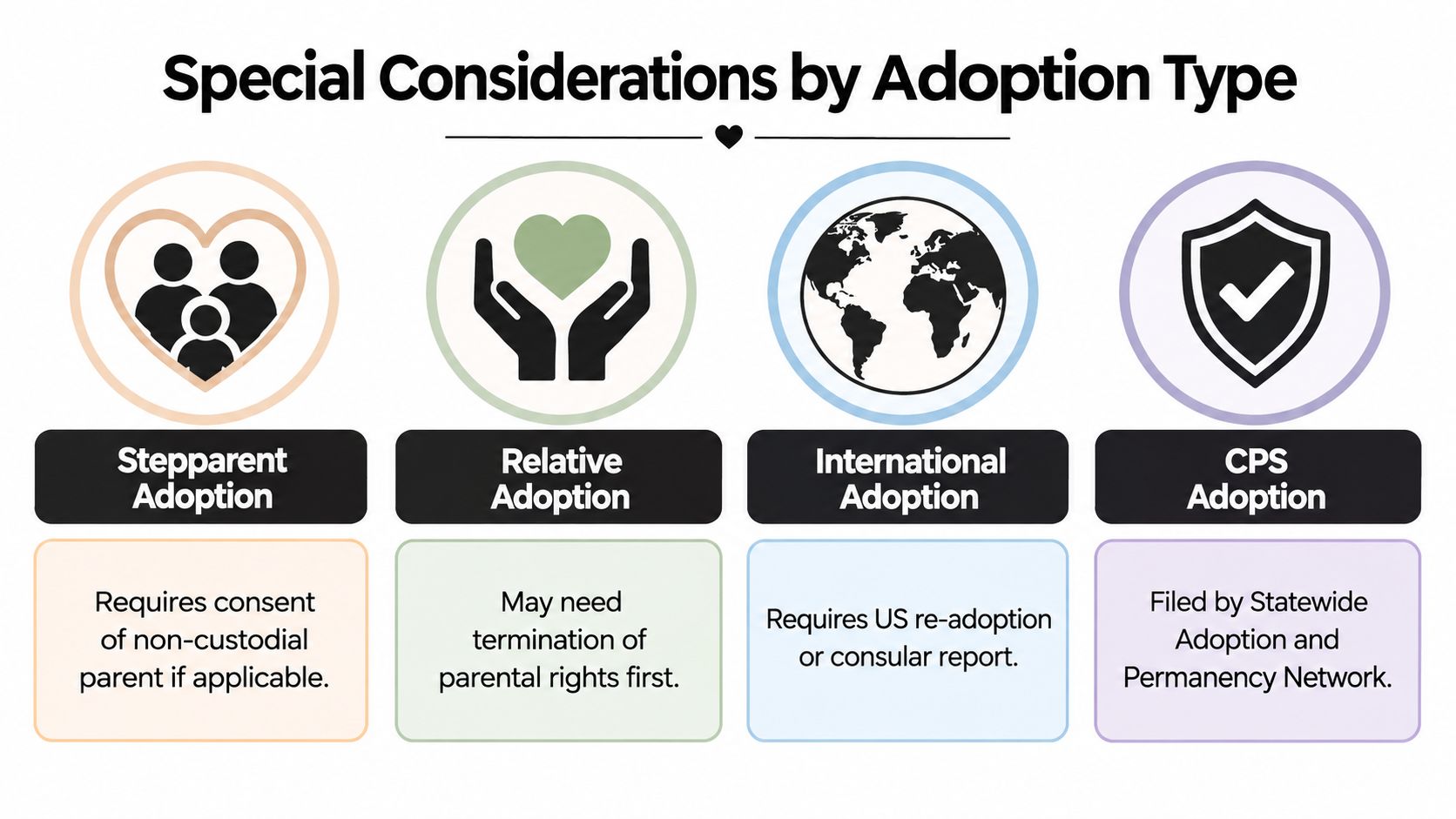
The adoption type affects the court work and may affect the information needed for the vital-record filing. The birth location remains especially important. Parents' names are required for a Texas-born adoption, while they aren't required for a foreign-born adoption on the VS-160.
| Adoption type | Court and family consideration | Vital-record point |
|---|---|---|
| Stepparent adoption | The case may involve consent or termination issues involving a noncustodial parent | Use the final decree and the child's pre-adoption information consistently |
| Relative or kinship adoption | Relatives may need to address parental rights before finalization | Confirm that the decree identifies the child and adoptive relationship accurately |
| International adoption | The family may need a United States re-adoption or a consular report process | Texas Vital Statistics can't create an adoption birth certificate for a person born in another state; foreign-born filings follow different documentation rules |
| CPS adoption | State or agency professionals may coordinate court and permanency documents | Confirm who is responsible for submitting the applicable record materials |
Examples from family life
In a relative adoption, a grandparent may be focused on school enrollment, medical records, and daily care. The legal team must also make sure the final decree and VS-160 use matching identifying information. A mismatch can create an administrative problem even when the family's underlying relationship is clear.
A family completing an international adoption should avoid assuming the Texas process applies in the same way. The child's place of birth controls which vital-record agency can create or amend a record. If the child wasn't born in Texas, Texas Vital Statistics can't process an adoption birth certificate for that person.
CPS and foster-care adoptions can involve several professionals, including attorneys, agency representatives, and court personnel. The child's best interests remain central, but responsibility for the post-decree record filing should still be identified clearly so no one assumes another person has completed it.
Processing Timelines and Confirmation Steps
DSHS processing begins after the court has granted the adoption and issued the final decree. The timing can vary depending on whether the first submission is complete, whether certification is clear, and whether DSHS must return the packet for correction.
A reliable post-filing routine protects your family from uncertainty:
- Create a complete copy. Scan the signed VS-160, decree, identification, fee documentation, and any supporting materials before delivery.
- Use trackable delivery. Keep the mailing receipt, tracking information, and delivery confirmation with the adoption file.
- Record the submission details. Note the date sent, destination, and documents included.
- Watch for a return. A returned packet doesn't mean the adoption failed. It usually means a documentation or certification problem must be corrected.
- Confirm the new record. The process is complete when DSHS has approved the filing and issued the new birth record reflecting the adoptive information.
Keep court documents and Vital Statistics correspondence in one secure file. Future school, medical, travel, or identity needs may require access to the new record and proof of the adoption.
If processing takes longer than expected, review the retained copy first. Check whether Section 5 was certified, whether the original form was used, and whether every required fee and identification document was included. If the packet was returned, work with the attorney or district clerk on the specific defect rather than altering the original submission.
Common Mistakes to Avoid During Reporting
The most common error is ordering a standard birth certificate when the family needs an adoption-related new-record process. A regular certificate order doesn't replace the need for the original VS-160 and the final adoption documentation.
Other mistakes are often simple but consequential:
- Missing clerk certification: Section 5 isn't completed or the certification isn't visible. Ask the district clerk to review it before submission.
- Using the new name too early: The VS-160 must use the child's pre-adoption identifying information where the form requests it, so DSHS can locate the existing record.
- Sending a copy instead of an original: DSHS doesn't accept photocopies, alterations, strike-throughs, or write-overs for the application.
- Overlooking identification: A valid government-issued photo ID must accompany the submission.
- Mismatching records: Compare names, dates, sex, and place of birth character-for-character across the decree, form, and identification.

A stepparent adoption offers a familiar example. The child may receive a new surname in the decree, while the VS-160 still asks for the prior name to identify the existing birth record. Both facts are correct, but they serve different purposes. Careful review keeps the legal transition from becoming an avoidable administrative setback.
When to Seek Legal Guidance
Many straightforward filings can be organized by parents, especially when the decree is complete and the clerk has properly certified the VS-160. Legal guidance becomes more valuable when the case involves contested parental rights, complicated custody history, a missing or unclear decree, an adoption completed outside Texas, or uncertainty about the child's place of birth.
An attorney can help separate two questions that families often blend together:
- Did the court legally finalize the adoption?
- Did DSHS receive an acceptable request to create the new birth record?
Those questions may involve different documents and different government offices. If a packet has been returned, don't assume you must start the adoption case over. The next step may be correcting a certification, replacing an unacceptable form, or clarifying which agency has authority over the birth record.
Families can also benefit from learning how clear legal education is created for people facing difficult decisions. X8 Web Design's guide to legal content that converts offers broader context on explaining legal services in accessible language. For personal help with the legal and administrative path, families can review how to choose the right adoption attorney in Texas.
The Law Office of Bryan Fagan, PLLC helps Texas families with adoption and guardianship matters, including court preparation, finalization, and documentation questions connected to Vital Statistics. Contact the firm when you need a clear review of your situation and a plan centered on the child's best interests.
Schedule a free consultation with the Law Office of Bryan Fagan, PLLC to review your final decree, VS-160 filing, and any Vital Statistics concerns. The firm serves Texas families through adoption and guardianship guidance, helping you take the next step with greater clarity and confidence.

