
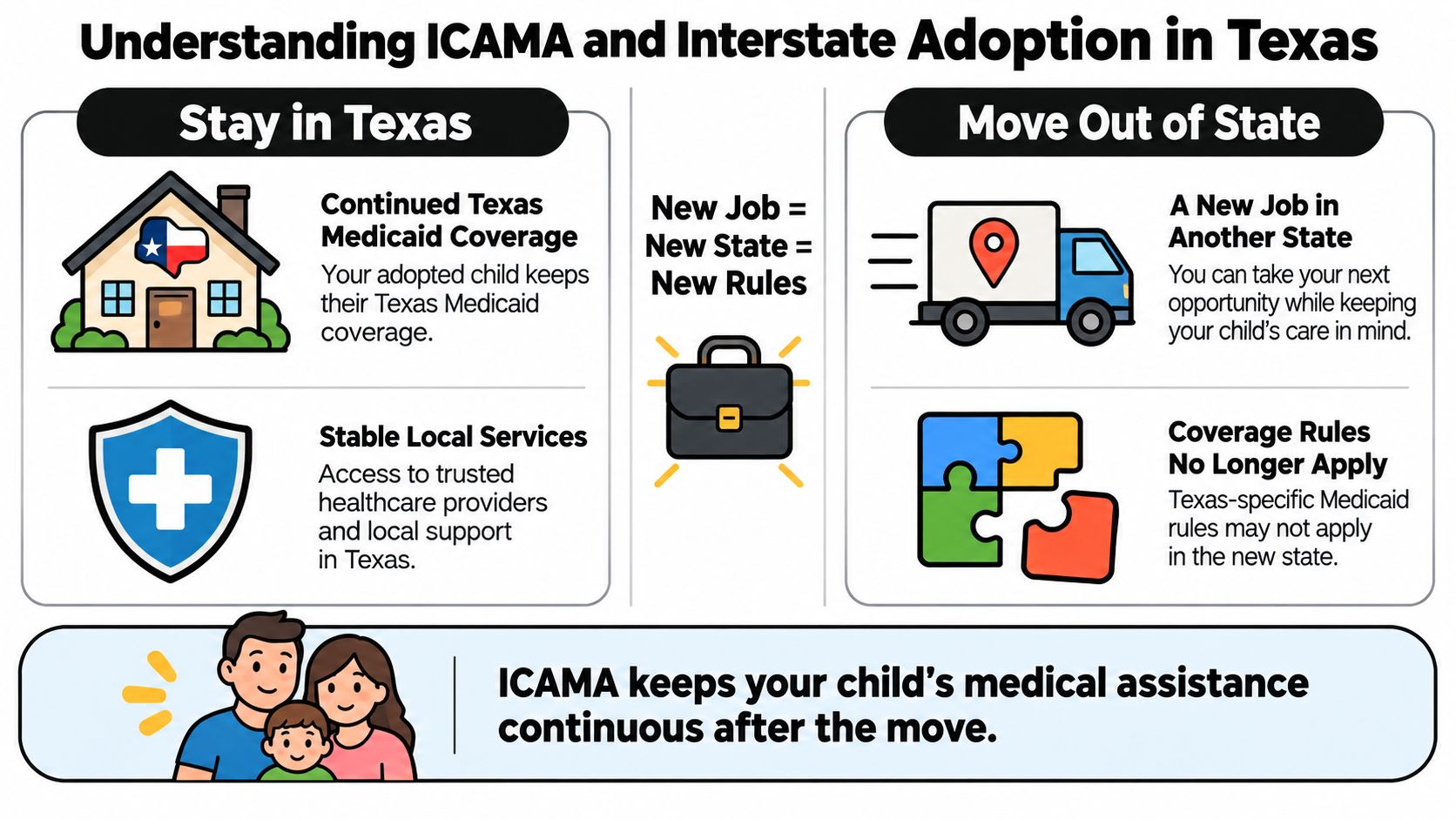
ICAMA is a federal compact that helps children receiving adoption assistance keep Medicaid when they move across state lines, and Texas joined ICAMA in 1995. It protects continuity of medical assistance, but it doesn't replace every placement or adoption requirement.
You may be reading this because your family has finalized an adoption in Texas and a new job is taking you to another state. Perhaps you're a relative caring for a child, a stepparent preparing to adopt, or a foster parent trying to understand what happens to medical coverage after finalization. Moving is already emotional. Adding unfamiliar state agencies, adoption-assistance agreements, and Medicaid forms can make the transition feel much heavier.
The good news is that you can break the process into manageable pieces. The key is to understand what ICAMA, the Interstate Compact on Adoption and Medical Assistance, does, what it doesn't do, and which documents your family should protect.
Understanding ICAMA and Interstate Adoption in Texas
ICAMA is best understood as a coordination system. It helps states communicate when a child receiving qualifying adoption assistance moves from one state to another, so the child can continue receiving adoption-related medical assistance in the new state of residence.
Texas families often confuse ICAMA with ICPC, the Interstate Compact on the Placement of Children. The names sound similar, but the jobs are different. ICPC focuses on the safety, approval, and supervision of an interstate child placement during an adoption or other placement process. ICAMA focuses on Medicaid and adoption-assistance coordination after a qualifying assistance agreement exists.
Two compacts, two different questions
Ask ICPC: “May this child be placed across state lines, and what protections must be completed before the move?”
Ask ICAMA: “How will this child's adoption-related medical assistance be activated or continued after the move?”
For example, Texas Family Code Section 162.101 requires certain adoption or managing-conservatorship petitions to address whether an interstate placement complies with ICPC, or why ICPC doesn't apply. That filing issue is separate from later Medicaid coordination. Families should not assume that ICPC approval automatically activates medical coverage, or that an ICAMA notice authorizes a child to travel before placement approval.
If a Texas family is considering adopting a child from another state, the interstate adoption and ICPC guide can help clarify the placement side of the process.
The larger principle is simple: a child shouldn't lose adoption-related medical support solely because the family crosses a state border. Still, continuity depends on the child's assistance category, the sending and receiving states' procedures, and complete documentation.
The History and Purpose of the Compact
Federal adoption-assistance law created important benefits but left states with a practical problem. The Adoption Assistance and Child Welfare Act of 1980, Public Law 96-272, established adoption-assistance programs and federal funding for financial and medical support. It didn't create a uniform process for administering those benefits when an adoptive family relocated.
The problem continued after the Consolidated Omnibus Budget Reconciliation Act of 1985 required states to provide Medicaid eligibility to children whose adoption-assistance agreements were issued by another state. The requirement established the protection, but states still needed a workable way to exchange notices, verify agreements, and activate coverage.
ICAMA supplied that administrative framework through uniform procedures, forms, and state-level coordination. The Council of State Governments ICAMA overview identifies 48 states and the District of Columbia as members, while other state materials describe New York as an associate member and broader participation. Texas joined the compact in 1995, after ICAMA had already expanded to approximately 30 states.
Continuity is the central protection
The compact's core promise is continuity. When an eligible child moves with an adoptive family, the child should not lose adoption-related medical assistance because the family now lives elsewhere. ICAMA can also apply when a child is adopted across state lines from the beginning, provided the adoption-assistance arrangement qualifies.
This doesn't mean every benefit works identically in every state. State-funded assistance programs can have different reciprocity rules, and provider access remains local. ICAMA connects agencies, but it doesn't erase differences in managed care, prior authorization, covered services, or provider enrollment.
For a family researching placement requirements, Interstate Adoption and the ICPC in Texas addresses what applies when a child crosses state lines for adoption. Keeping that placement question separate from the later medical-assistance question prevents costly confusion.
Step by Step ICAMA Process for Texas Families
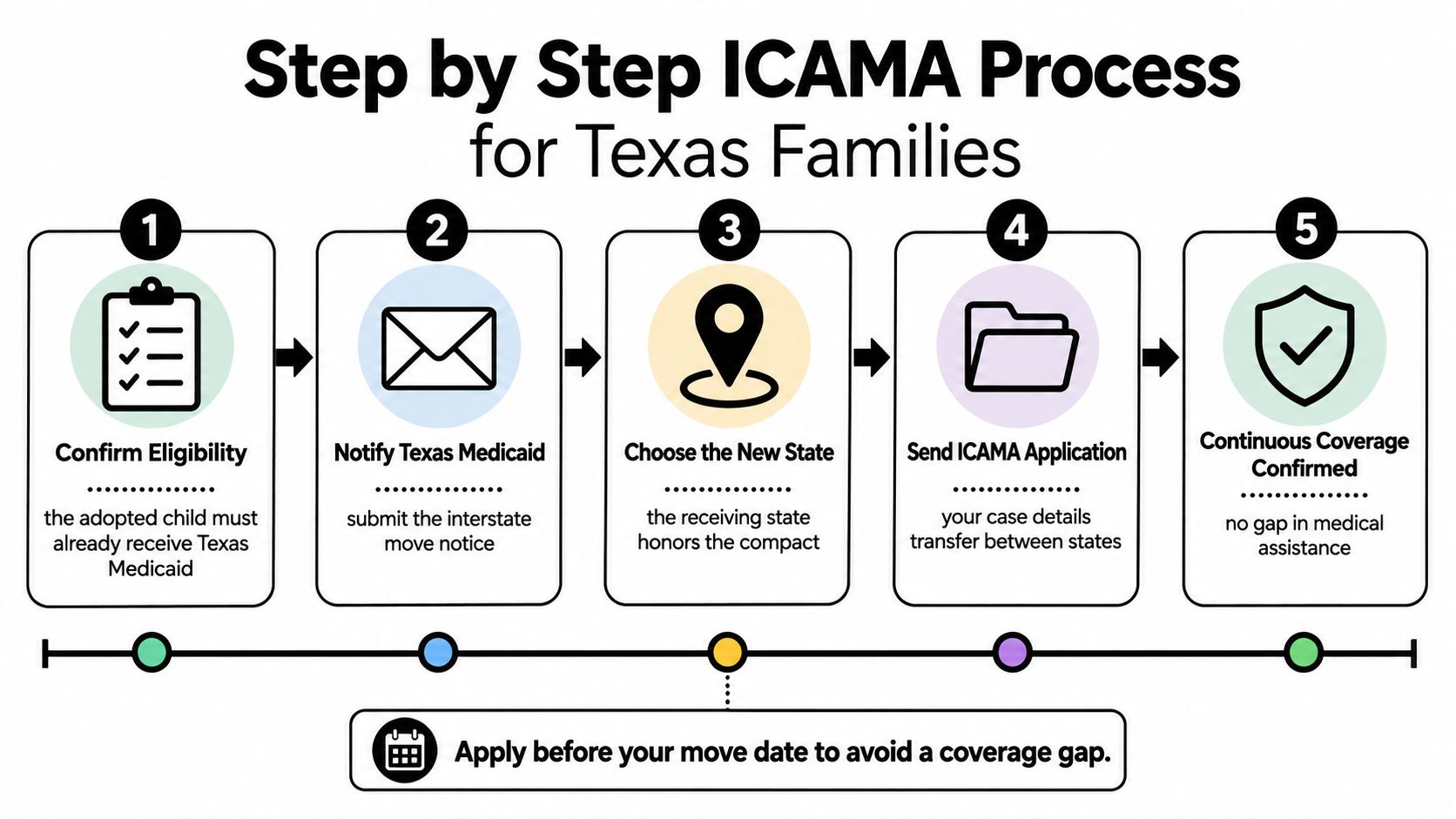
A successful transition usually begins before the moving truck arrives. The family, the originating state, Texas DFPS when applicable, and the new state must each handle part of the administrative work.
Confirm the assistance category
Start with the executed adoption-assistance agreement. Don't rely only on the adoption decree or a recollection that Medicaid was available. The agreement identifies the program and helps determine which state remains financially responsible for the adoption assistance.
For a Title IV-E agreement, federal Medicaid eligibility rules are especially important. For state-funded assistance, reciprocity may depend on the other state's rules and the receiving state's policy.
Notify the originating state
Tell the state that issued the adoption-assistance agreement about the planned relocation. Request written instructions for the interstate transfer and ask who will send the ICAMA notice. Keep copies of every message, form, and confirmation.
Texas DFPS uses ICAMA Form 7.1, Notice of Medicaid Eligibility/Case Activation, together with the current adoption-assistance agreement, to transmit the request to the child's new state of residence when Texas is coordinating the case.
Coordinate with the new state
The receiving state handles Medicaid enrollment or activation in the child's new residence state. Federal Medicaid guidance says that, for a child receiving Title IV-E adoption assistance, the residence state is responsible for enrollment and may not require a new Medicaid application for an interstate transfer accompanying that assistance.
That doesn't mean you should wait passively. Ask when the notice arrived, whether the records are complete, what effective date will apply, and when the new identification card will be issued.
Protect your records
Create one digital and paper file containing:
- The assistance agreement: Keep the fully executed agreement and any renewal or amendment.
- ICAMA correspondence: Save the transmission date, confirmation numbers, and names of agency contacts.
- Coverage information: Preserve the prior Medicaid identification number and proof of the last active coverage date.
- Medical records: Carry prescriptions, treatment plans, provider contacts, and prior-authorization information.
- Written decisions: Request denials, delays, or closure notices in writing so you can respond accurately.
Practical rule: Apply before the move date whenever possible. Administrative eligibility and actual provider access don't always begin at the same moment.
For a broader roadmap from preparation through finalization, review the Texas adoption process step by step.
Medicaid Eligibility and Continuity of Care
The most important comparison is between Title IV-E adoption assistance and state-funded adoption assistance. The source of the assistance affects how Medicaid eligibility works when a family moves.
| Assistance category | Core Medicaid rule | What the family should verify |
|---|---|---|
| Title IV-E adoption assistance | Medicaid eligibility is mandatory and doesn't depend on household income, whether subsidy payments or services are currently being received, or whether the adoption decree has been entered. | Confirm that the agreement is current and that the receiving state has received the interstate notice. |
| State-funded adoption assistance | Coverage and reciprocity can vary by state. | Confirm whether the sending state covers recipients after relocation and whether Texas will continue or activate coverage under its policy. |
For a Title IV-E child, the adoption-assistance agreement is the controlling eligibility document. The family shouldn't have to re-prove financial need after moving, and the residence state is responsible for enrollment. The federal Medicaid guidance also says the state may not require a new Medicaid application for an interstate transfer accompanying Title IV-E adoption assistance. See the federal Medicaid guidance on children with Title IV-E adoption assistance.
Assistance state and residence state
These terms help explain the division of responsibility. The assistance state generally remains financially responsible for the adoption-assistance benefit it negotiated. The residence state is where the child lives and normally handles Medicaid enrollment and local administration.
Texas DFPS states that it authorizes Medicaid for children living in Texas when another state issued the adoption-assistance agreement. Texas also states that if another state doesn't cover recipients of state-funded adoption assistance, Texas continues Medicaid coverage under its policy. That protection can be important, but families living outside Texas should ask about provider limitations because Texas Medicaid coverage may be limited to Texas-enrolled providers.
The phrase “portable Medicaid” can therefore mislead. Eligibility may continue across state lines while provider networks, claims processing, prior authorization, and covered services remain tied to a particular state. Before relocation, ask the new agency for the effective date, managed-care assignment if applicable, provider directory, and instructions for urgent care.
The distinction between federal and state assistance is explained further in this guide to Texas adoption subsidy versus federal adoption assistance.
Common Pitfalls and Timeline Considerations
A family can do everything with good intentions and still encounter a coverage delay. Consider a Texas couple who finalized an adoption, accepted a job in another state, and assumed the child's Medicaid card would work after the move. They packed medical records but didn't send the current adoption-assistance agreement or confirm who would transmit the ICAMA notice.
The new state couldn't complete activation without the required records. The child remained legally eligible, but the family had trouble scheduling care because the administrative file wasn't ready. That difference between legal eligibility and operational access is where many families experience stress.

Documents and timing matter
Texas DFPS states that an adoption-assistance agreement must be negotiated and signed before the adoption is consummated. Families should raise subsidy and medical-assistance questions before finalization, not assume a later adoption order will create benefits automatically.
For Texas state adoption assistance, the child must not qualify for Title IV-E assistance, must meet the program's special-needs definition when the adoptive placement agreement is signed, and must have been considered for placement without assistance unless that effort would conflict with the child's best interests. The program can include Medicaid, monthly assistance, and reimbursement for eligible non-recurring expenses. Reimbursement for those expenses cannot exceed $1,200 per adoption, and DFPS lists monthly amounts of $400 for the Basic service level or T3C Basic package and $545 for Moderate, Specialized, or Intense service levels or other T3C packages. These figures and eligibility rules are described by Texas DFPS adoption assistance information.
Before finalization or relocation, confirm:
- The agreement status: Is it signed, effective, and current?
- Annual verification: Has the state requested evidence that the agreement remains effective or has been renewed?
- The transmission record: Has ICAMA Form 7.1 and the agreement reached the receiving state?
- Provider access: Can the child's existing specialists bill the new plan?
- Appeal instructions: Do you know how to challenge a denial, closure, or lapse?
A valid adoption order matters a great deal, but finalization alone doesn't answer every Medicaid question. The child's assistance category and current documentation matter too.
How a Texas Adoption Attorney Can Help
Interstate benefits work best when someone reviews the entire picture rather than one form in isolation. A Texas adoption attorney can examine the adoption-assistance agreement, identify whether the arrangement is Title IV-E or state-funded, and explain which agency should act before and after the move.
The attorney can also help with the underlying adoption process. Texas Family Code Chapter 162 addresses standing, required parties, consents, the child's consent when applicable, residence requirements, and best-interest findings. Chapters 163 through 166 address related adoption and parent-child matters, so families should receive advice based on their actual relationship to the child and the type of adoption involved.
For example, a stepparent adoption may require careful attention to the other parent's rights and consent. A kinship adoption may involve relatives who already provide daily care but need to confirm standing, placement history, and subsidy eligibility. LGBTQIA+ parents, single parents, birth parents considering an open adoption, and foster families each bring different legal and emotional concerns. In every case, the child's safety, stability, and best interests remain central.
Preparation makes advocacy stronger
Bring the following to a consultation:
- Adoption documents: Petition, orders, consents, and final decree if already entered.
- Assistance records: The executed agreement, renewal notices, Medicaid card, and agency letters.
- Move details: Current residence, planned destination, expected move date, and new contact information.
- Care information: Diagnoses, providers, prescriptions, therapies, and pending appointments.
- Agency history: Names, dates, forms sent, and any written denial or closure notice.
The Texas DFPS guidance on adoption assistance and interstate coordination can help families identify the agency questions that need answers. If you're evaluating outside professional support for a legal practice, you can also compare marketing plans for law practices, a separate resource from SimpleLab Digital.
The Law Office of Bryan Fagan, PLLC handles adoption and guardianship matters, including stepparent, relative, foster care, LGBTQIA+, special-needs, and interstate cases. The firm offers consultations across Texas, including virtual options, and can help families prepare documents, understand home-study and finalization requirements, and address adoption-assistance concerns.
The Law Office of Bryan Fagan, PLLC can help you review an ICAMA transfer, adoption-assistance agreement, or Texas adoption plan with your child's best interests in mind. Visit Law Office of Bryan Fagan, PLLC to schedule a free consultation and take the next step with clear, compassionate legal guidance.
