 Skip to content
You may be sitting at a kitchen table right now with a folder full of clinic papers, consent forms, and a signed gestational agreement, wondering one hard question.
Are we protected?
That question is more common than most families expect. In Texas, a gestational agreement isn't something you want to leave in a drawer and hope for the best. The law treats this process as more than a private promise between caring adults. It asks a court to step in before birth and confirm that the agreement meets the rules Texas has set for parentage, safety, and family stability.
For intended parents, that can feel comforting and stressful at the same time. For a gestational carrier, it can feel like one more legal step in an already emotional journey. But when you understand how the process fits together, the statute starts to feel less like a maze and more like a path.
What Family Code 160.756 Really Does for Texas Families
The papers are signed. The clinic is ready. Everyone agrees on the plan. Then a quieter question shows up.
Will a Texas court treat this arrangement the way your family expects?

A signed agreement and a validated agreement serve different jobs
A gestational agreement is an important starting point. It records consent, expectations, and responsibilities. But Texas families usually need more than a signed contract. They need a court order that confirms the agreement meets Texas requirements and places legal parentage on solid ground before the child is born.
That is what §160.756 does in real life.
It helps turn a private agreement into a court-approved parentage framework.
A simple comparison helps here. The agreement works like architectural plans for a house. Validation works like the city approval that lets the project go forward without a dispute over whether the structure was allowed in the first place. The plans matter. The approval changes what those plans mean legally.
Validation is one stop in a larger court journey
Many people first hear about validation as if it were a single hearing and nothing more. In practice, families are usually walking through a sequence. Eligibility matters. Timing matters. The right county matters. Post-birth steps matter too.
That bigger view is often what brings relief.
Instead of asking only, "Did we sign the right document?" families can ask a better question: "Have we set this up so the court can recognize the intended parents and protect the child from avoidable parentage confusion?" That shift matters because validation connects to more than one chapter of the process. It can overlap with adoption rules, home study questions, medical proof, and the final paperwork that follows birth. Families who want a clearer picture of that overlap often benefit from reading about when surrogacy and adoption intersect in Texas.
Why this matters so much emotionally
Validation often changes the emotional temperature in the room.
For intended parents, it can replace a vague fear with a concrete court order. For a gestational carrier, it can confirm that the arrangement has been reviewed in a formal legal setting, not left to guesswork or last-minute hospital stress. For everyone involved, it creates a clearer path for the child's legal identity from day one.
The statute may read like procedure. Its practical purpose is family stability.
And that is the heart of this section. Section 160.756 is not just about getting a judge to sign off on a contract. It is about fitting that agreement into a full Texas legal process so the path from pregnancy to parentage is clearer, steadier, and less likely to unravel at the worst possible moment.
The Core Conditions a Court Must Find
A validation hearing is often less dramatic than families fear. It usually feels more like a careful inspection before a long trip. The judge is checking whether the legal vehicle is safe, complete, and ready to carry everyone from pregnancy to parentage without avoidable trouble later.
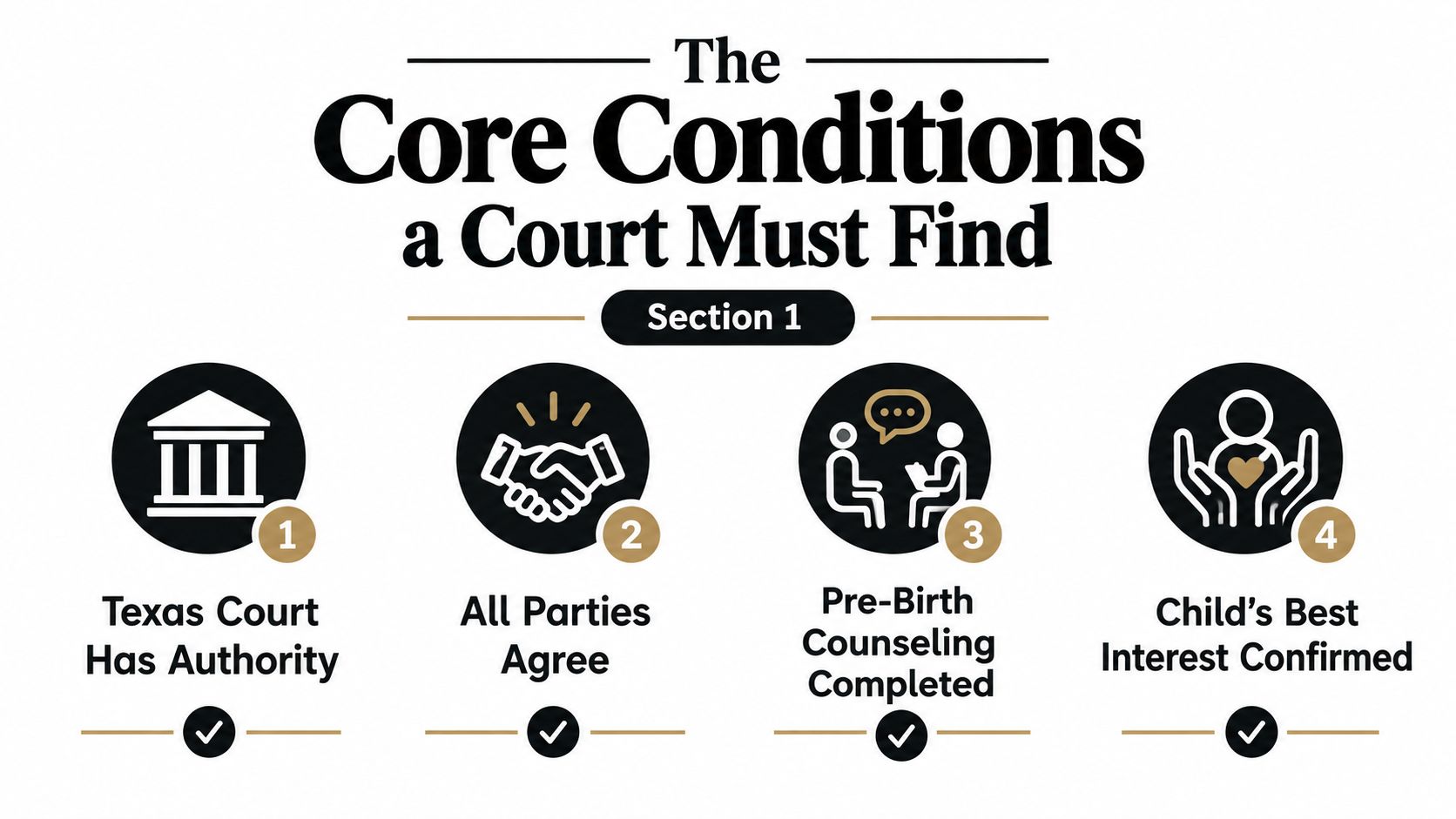
What the judge is actually deciding
The court is not only reviewing whether everyone signed a contract. The court is deciding whether this arrangement is legally sound enough for Texas to recognize it before the child is born. That is why this part of the process connects to medical evidence, consent, expense planning, and sometimes adoption-style screening.
Several findings usually matter:
- The court has authority to hear the case. The judge must have jurisdiction over the people involved and over the subject matter.
- There is medical support for using a gestational carrier. The court looks for evidence that the intended mother cannot carry a pregnancy to term or would face an unreasonable risk by trying to do so.
- The intended parents have been screened if required. Unless the home study requirement is waived, the court looks for the kind of evaluation Texas often uses to assess adoptive-parent fitness.
- Everyone entered the agreement knowingly and voluntarily. Consent matters, and the court wants confidence that no one was pressured or confused about the terms.
- The gestational carrier meets the health-history requirements. The court looks at whether she has previously been pregnant and given birth, and whether another pregnancy would create an unreasonable risk to her or the child.
- The agreement addresses pregnancy-related medical expenses. The written terms should clearly assign responsibility for reasonable health-care costs, including costs that can arise after a termination of pregnancy.
That list can feel clinical. Its purpose is personal. These findings help reduce the kind of uncertainty that can otherwise surface at the hospital, on a birth record, or in a later parentage dispute.
Why Texas asks for more than signatures
Texas treats validation as part of a larger courtroom journey, not a one-page approval. A judge wants to see that the adults planned for the medical realities, the legal responsibilities, and the child's status after birth. That is why families are often surprised to learn that a gestational agreement can borrow ideas that feel familiar from adoption proceedings.
For intended parents, the home study question often causes the most confusion. People sometimes assume surrogacy and adoption live in separate legal boxes. In practice, Texas can require some of the same readiness review. Families who have also explored Relative and Kinship Adoption in Texas often recognize that pattern.
A simple way to read this section is to ask: has the court been given enough to trust the plan?
What attorneys usually gather before the hearing
Preparation here looks less like one signing appointment and more like building a clear record for the judge.
Common materials include:
- Physician letters or medical records addressing why the intended mother cannot safely carry a pregnancy
- Home study paperwork if the court expects that review
- Signed consents and supporting documents showing each party understood the agreement
- Medical history information for the gestational carrier relevant to prior pregnancy and current risk
- A complete written agreement that clearly assigns responsibility for pregnancy-related expenses
Each document answers a specific judicial concern. Together, they tell a connected story. The agreement was carefully formed, the medical basis exists, the parties understood their roles, and the court can validate the arrangement with fewer unanswered questions.
Who Qualifies and Who Is Affected by the Agreement
A Texas gestational agreement works a little like a relay race. Each person has a defined lane, and the court wants to see that no one is missing from the exchange. If a role is left out or described loosely, the problem is not technical. It can affect who is recognized as a legal parent after birth.
That is why this part of the process deserves slow, careful reading.
The intended parents must fit the legal framework
Texas uses a fairly specific model for intended parents in a gestational agreement. In many cases, the intended parents must be married to each other, and both of them must be actual parties to the written agreement, not background figures who merely support the plan.
That point matters in real life. A couple may divide tasks so that one spouse handles the clinic, the agency, or the finances. Court review is different. The judge is looking at legal parentage, not household logistics. If the agreement is meant to establish parentage for two intended parents, both need to be fully included in the document and the court process.
Some families compare this with adoption because both paths ask a court to confirm who will hold parental rights and responsibilities. A separate resource on Who Can Adopt in Texas? Eligibility Requirements explains the basic requirements to become an adoptive parent in Texas.
The gestational carrier is more than a signer
The gestational mother is not just someone who agrees to carry a pregnancy. The court looks at whether she fits the legal and medical profile Texas expects for this kind of arrangement.
In practical terms, the carrier should have prior experience with pregnancy and delivery. The court also considers whether another pregnancy would pose an unreasonable risk to her or to the child. Those questions are easy to overlook because families often focus first on trust and personal fit. The courtroom lens is different. The judge is asking whether this arrangement is structured safely enough to validate before a child is born.
Medical decisions also affect timing and expectations. Some intended parents reviewing treatment options want to compare IVF outcomes by age as part of the bigger picture, especially when clinic planning and legal timing are moving together.
Who is legally touched by the agreement
The agreement directly shapes the rights, duties, and expectations of more people than many families expect. It is not only about the intended parents and the carrier. Spouses, if any, can matter. The court matters too, because validation turns a private agreement into something the legal system will recognize.
| Party | Role in the Agreement | What the court is looking for |
|---|---|---|
| Intended Parent One | Seeks recognition as a legal parent | Must fit the statutory structure and be a party to the agreement |
| Intended Parent Two | Seeks the same parentage order | Must also be properly included in the agreement |
| Gestational Mother | Agrees to carry the pregnancy | Must meet the required medical and prior-pregnancy criteria |
| Spouse of the Gestational Mother, if applicable | May need to join or consent depending on the circumstances | Must be addressed so parentage is not left uncertain |
| Court | Reviews the full arrangement before birth | Must be satisfied that the legal conditions have been met |
A simple way to read that chart is this. The agreement does not just record everyone's hopes. It assigns legal consequences to specific people.
That is why families sometimes feel surprised here. Emotionally, everyone may already know who the parents are. Legally, Texas still requires the right people to be named, included, and placed in the correct role before the court will validate the arrangement.
Timing, Jurisdiction, and the Path to the Courtroom
A family can do many things right and still run into trouble if the calendar is wrong.
That surprises people. They may have chosen a clinic, agreed on terms, and built trust with the gestational carrier. Then the legal process asks a different question. Was each step taken in the right order, in the right place, and early enough for the court to act?
That is why validation helps to view the case as a courtroom journey, not a single hearing. The agreement is one document in a chain. Signing, filing, residency, the pre-birth review, and the post-birth notice all connect.
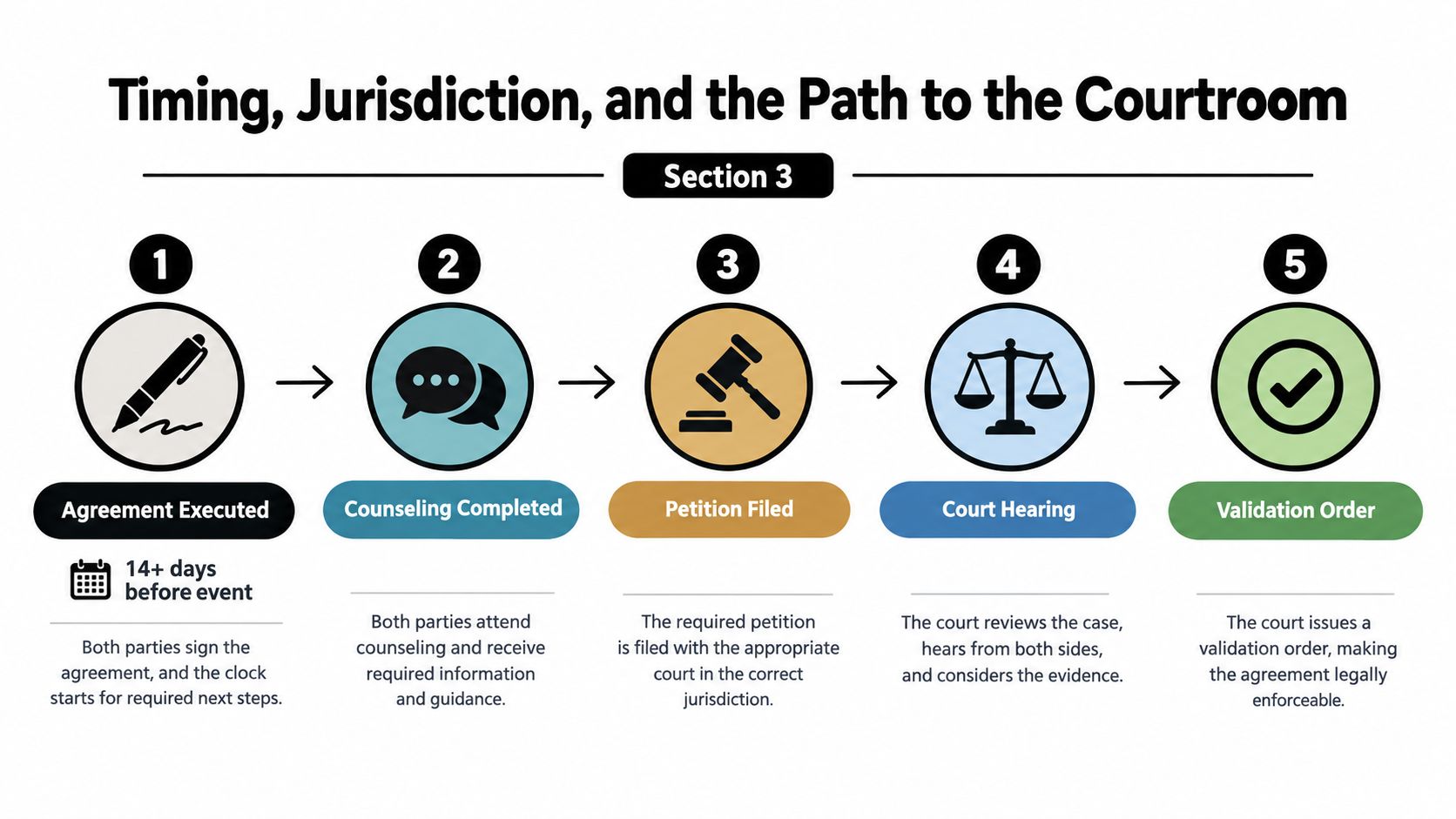
The clock starts before pregnancy begins
One of the easiest mistakes to make is waiting too long to sign. Texas generally requires the gestational agreement to be executed at least 14 days before the embryo, egg, or sperm transfer used for conception or implantation. In plain terms, the law wants the legal groundwork finished before the medical step happens.
A simple comparison helps here. Court validation works a lot like boarding a flight. If you arrive after the gate closes, having a ticket does not solve the timing problem. A well-written agreement signed too late can create real enforceability concerns.
The filing location matters too. Texas requires the court to have the right connection to the family. In general, that means the residency conditions must be satisfied before the validation petition is filed, and the petition needs to include the agreement itself. If your family is coordinating care or delivery across state lines, the place of birth and the place of the court case may both matter. That question often comes up in adopting a child born through surrogate outside Texas.
What the courtroom path usually looks like
Families often feel calmer when they can see the route ahead. In many Texas cases, the path looks like this:
- Complete and sign the agreement early so the timing requirement is met before transfer.
- Confirm residency and party details before filing, including whether any spouse must be included.
- File the validation petition in the proper Texas court with the agreement attached.
- Appear for the pre-birth hearing so the judge can decide whether the legal requirements have been met.
- Obtain the validation order and keep preparing for the post-birth filing that finalizes parentage.
Each of those steps supports the next one. If one piece is skipped, the judge may not have a clean record to approve.
A short overview can help visualize how legal preparation fits into a larger surrogacy journey:
Birth is not the end of the legal process
Families sometimes feel a rush of relief after the validation hearing. That makes sense. But the case still needs one more legal handoff after the child is born.
Texas law requires a post-birth notice to the court within a set deadline tied to the assisted reproduction timeline. After that notice is filed, the court can enter the parentage order and address any remaining transfer-of-custody requirements reflected in the statute. This is the part many people miss because they assume the pre-birth order completed everything.
A practical habit helps. Ask your lawyer for one calendar with every legal date on it: the signing date, the transfer date, the filing date, the hearing date, the expected due date, and the post-birth notice deadline.
That single calendar often prevents the most common timing problems.
How Validation Connects to a Texas Adoption
A validated gestational agreement may answer major parentage questions before birth. It does not always make the rest of the family-law process disappear. For some Texas families, adoption-related requirements still shape the court's review, the records they gather, and the work completed after birth.
The connection is practical. Validation is one courtroom step in a larger journey, not a separate legal island.

One family planned ahead
A married couple completed the agreement, addressed the court's requirements, and gave their attorney the needed materials early. They understood that Texas adoption law can require an evaluation under Family Code §162.003, conducted under Chapter 107 unless the court waives it. The process may involve interviews, household and background information, and financial and medical records, as described in Texas Family Code Chapter 162.
Their preparation gave the judge a consistent record. The agreement, supporting documents, and later filings fit together. Everyone could see what had been completed and what remained.
Another family focused only on the contract
A different family signed its agreement and organized everything around clinic milestones. The legal checklist received less attention. Later, the family learned that court requirements connected with the broader adoption framework had not been coordinated.
That problem may be fixable, but it can cause delay, added expense, and uncertainty at a time when parents and carriers already have much to manage.
Medical preparation and legal preparation often happen together. Families preparing for embryo transfer may also seek practical wellness guidance, including stress reduction for IVF success.
Why Chapter 162 can remain relevant
Texas law provides that an adoption court generally cannot grant an adoption until the child has lived with the petitioner for at least six months. The court may waive that period when the child's best interest supports doing so. The surrounding adoption rules also require the court to confirm that legal requirements are satisfied and that adoption serves the child's best interest.
If those findings are made, the court shall grant the adoption under Texas Family Code §162.016(b). The resulting order establishes the parent-child relationship for all purposes under §162.017(a).
Families whose post-birth process includes record changes should also review practical guidance on changing a birth certificate after adoption in Texas. A validation order may be an important part of the journey, while adoption filings and updated records can complete the legal picture.
Pitfalls That Can Derail a Validated Agreement
A couple signs an agreement, schedules embryo transfer, and assumes the legal work is finished. The pregnancy progresses smoothly, yet the court later finds that a filing, deadline, or required finding was missed. The contract may look careful on paper while the legal sequence remains incomplete.
Where families get into trouble
Texas validation works like a chain. Timing, court authority, required evidence, and post-birth steps must connect. A weak link can delay protection for the intended parents and gestational carrier.
Under Texas Family Code §160.754, failing to validate before birth can leave the agreement unenforceable. The gestational mother may then be treated as the presumed parent, and an intended parent may still face child-support liability. These consequences explain why validation belongs in the family's early planning, not at the end of the pregnancy.
| Do | Don't |
|---|---|
| Check the signing date early and confirm the agreement is in place before the statutory pre-transfer window closes | Don't let the clinic schedule decide legal timing by default |
| Take the home study or evaluation process seriously if the court requires it | Don't assume surrogacy removes every adoption-style screening issue |
| File in the proper court with the agreement attached once residency conditions are satisfied | Don't treat a private file folder as a substitute for filing |
| Calendar the post-birth notice and assign one person to monitor it | Don't assume birth completes every legal step |
Good intentions cannot repair a missed legal sequence.
Why these errors hurt so much
Families are often focused on medical appointments, travel, embryo transfer, and maintaining trust between everyone involved. Legal deadlines can seem distant beside those immediate concerns. A missed step, however, may not become visible until the child is born, when the available time and options are narrower.
Validation is therefore part of the legal foundation for the family. Counsel should review the agreement as a connected courtroom process, checking the pre-transfer requirements, the court filing, related adoption issues, and the post-birth notice plan. A written checklist gives each person a clear responsibility and helps reveal gaps before they affect the child's legal status.
Practical Steps and a Gentle Path Forward
A family may reach the courthouse with medical records, a signed agreement, and a child on the way, yet still have unanswered legal questions. Validation works like a connected chain. Each link, from eligibility to filing to post-birth action, supports the next one. A lawyer can help you place those links in the correct order.
A working checklist for your next meeting
Bring these questions and documents to your next legal conversation:
- Marriage and party status: Are both intended parents married to each other and named in the agreement?
- Medical support: Do you have evidence showing that the intended mother cannot safely carry the pregnancy or would face an unreasonable risk?
- Carrier qualifications: Are the gestational carrier's prior pregnancy and current health fully documented?
- Home study or waiver: Has your attorney determined whether the court may require a home study, or whether a waiver may apply?
- Timing review: Was the agreement signed early enough in relation to the embryo transfer?
- Residency review: Do the facts satisfy the Texas residency requirement?
- Petition packet: Is the agreement attached and ready to file with the validation petition?
- Expense language: Does the agreement clearly identify responsibility for reasonable pregnancy-related health-care expenses, including expenses after termination?
- Post-birth notice plan: Who will track the filing deadline after assisted reproduction?
- Related family-law steps: If adoption procedures overlap with your matter, have evaluation, consent, and finalization requirements been reviewed?
A written checklist assigns responsibility. It also gives the family a way to find missing documents before a deadline becomes urgent.
Keep the child's best interests in view
Texas family law repeatedly asks whether the arrangement protects the child. Adoption law uses the same guiding concern. At finalization, the court must determine that the adoption requirements have been met and that adoption is in the child's best interest. Once those findings are made, the court shall grant the adoption under the applicable Texas adoption provisions.
The final order matters because it turns intended parenthood into a legally recognized parent-child relationship. It provides legal security alongside the care the family already plans to give.
You don't have to sort this out alone
A fertility clinic coordinator, mental health professional, and separate counsel may each handle a different part of the process. Some families also consult a Texas family-law firm that works with adoption and guardianship matters, such as the Law Office of Bryan Fagan, PLLC, for document preparation, timing review, and court planning.
Assign one person to track the sequence. That person can maintain the agreement, medical records, filing materials, court dates, and post-birth notice deadline.
A calm plan is better than a rushed fix. Address a gestational-agreement problem before the transfer whenever possible, rather than waiting until after birth.
Readers searching for Family Code 160.756 validating a gestational agreement Texas usually want practical answers. They want to understand where they stand, what the judge may examine, and how validation connects with adoption and post-birth requirements.
The statute is detailed, but the process becomes easier to manage when each requirement is treated as part of one courtroom journey.
If you are preparing a gestational agreement in Texas, reviewing timing questions, or examining how parentage and adoption rules fit together, the attorneys at Law Office of Bryan Fagan, PLLC help families review the process from filing through final court orders. You can schedule a free consultation to discuss your facts, timeline, and next legal steps.

