 Skip to content
Texas does not automatically open sealed adoption records. Under Family Code 162.018, eligible adoptees and adoptive parents can receive edited historical information, while identifying records usually require a court order or meeting narrow Vital Statistics rules.
That distinction matters when a family has spent years with unanswered questions. A mother may be trying to understand a child's health background, an adult adoptee may be searching for an original birth certificate, or a stepparent may be trying to gather the right paperwork without sending requests to the wrong office. In Texas, the answer depends on what record you want, who is asking, and which custodian holds the file.
Understanding What Family Code 162.018 Allows
A lot of families start with the same hope. They want one file that explains everything, maybe a medical history, maybe a birth name, maybe a clue about a biological parent they've never met. Texas law does not work that way. Family Code 162.018 creates a limited-access system, not a general open-door policy, and that difference saves families from a lot of frustration.

What the statute actually protects
Under the statute, adoptive parents may receive records and information about the child's history maintained by DFPS, a licensed child-placing agency, or another placement entity. Once the adoptee is an adult, the adoptee and adoptive parents may receive edited copies, but the redactions must protect the identities of biological parents and other confidential people.
That means Texas recognizes two categories of information. There's nonidentifying history, such as background details, and there's identifying information, which stays protected unless a separate legal path opens it. Texas government guidance also explains that adoption records are sealed after adoption is granted, and identifying information generally can't be released without a court order. For readers comparing options, the adoption records resource for Texas families is a useful starting point for the terminology and common record types.
A practical way to think about the rule
If the file is about the child's history, the law often allows edited access. If the file would reveal a parent's identity, a protected relative, or a sealed court record, the process gets more formal. That's why a request can be completely reasonable and still go to the wrong place if it's aimed at the wrong custodian.
Practical rule: Start by asking whether you need history, identity, or a court record. Those are not the same request, and Texas treats them differently.
The safest mindset is simple. Ask for the right type of information the first time, and you're far more likely to get a useful answer instead of a denial letter or a referral to another office.
Requesting Nonidentifying Adoption History
The cleanest requests are the ones that match the statute. If you want background information, health history, or other nonidentifying details, the goal is not to force the agency to disclose names. The goal is to get the history file with the identities removed by the proper placing entity.
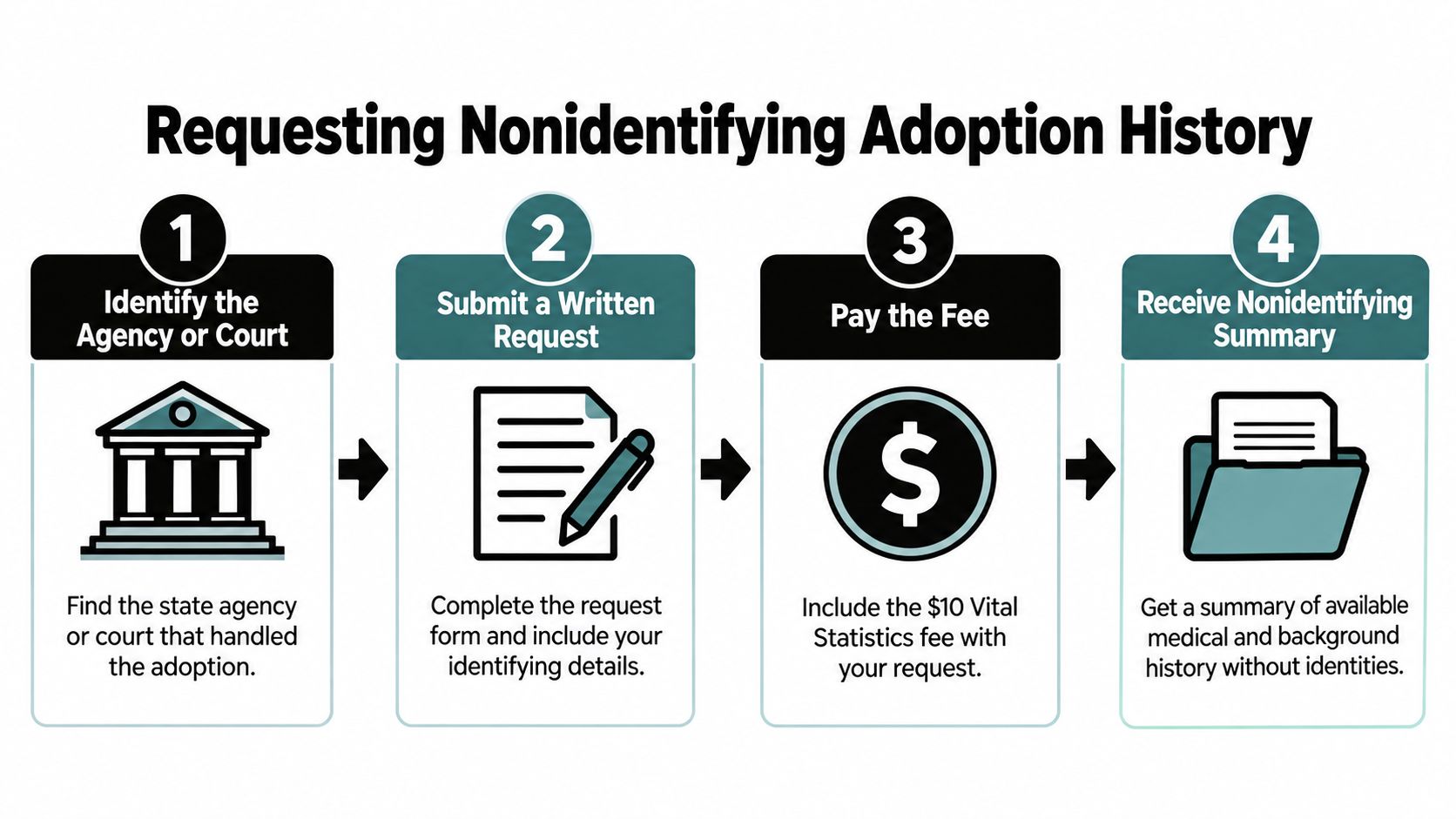
Four steps that avoid the most common mistake
Identify the agency or entity that kept the file.
That may be DFPS, a licensed child-placing agency, or another placement entity. If the adoption came through CPS, the closed records are typically with DFPS.Submit a written request for the child-history file.
Say clearly that you want nonidentifying information and that identifying details should be removed before release.Separate the history request from sealed-record requests.
A child-history file is not the same thing as a sealed court file or a Vital Statistics file. Mixing those up usually slows everything down.Keep every written response.
If the agency treats history records like sealed identity records, those letters help show where the request got stuck.
The reason this works is simple. The placing entity, not the requester, performs the redaction. That's why a polished request often produces better results than a broad one.
What you can expect to receive
DSHS maintains closed agency records and health, social, educational, and genetic-history information, which can give families meaningful background even when identities stay protected. For some families, that kind of information answers the urgent questions, especially when they're trying to understand inheritance patterns, developmental concerns, or a child's early care history.
If the adoption involved termination issues first, a resource like Termination of Parental Rights Before Adoption can help explain why that step sits at the center of most Texas adoptions. TPR is the necessary first step in most adoptions, and that reality shapes which records exist later.
When a family asks for “the adoption file,” the office on the other end may hear a completely different request. Precision helps the people reviewing the file help you faster.
The key is patience with structure. A short, specific written request usually beats a long emotional explanation when you're dealing with sealed records and multiple custodians.
Pathways to Identifying Records and Birth Certificates
When families want identity information, Texas offers two different routes, and they do not lead to the same result. One path is a court-order process aimed at sealed records. The other is a narrower administrative process for an adult adoptee who qualifies for an original birth certificate copy without going to court.
The court-order path
For identifying adoption records, the operational benchmark is a court order, not a routine records request. Texas DSHS says adoption records are sealed after finalization and identifying information can't be released without a court order. The practical sequence is to identify the court that granted the adoption, obtain a certified order that directs Vital Statistics to release the records, and make sure the order names the records and the recipient.
The application also has to be completed carefully. DSHS requires the Court Ordered Open Sealed File application without cross-outs, correction tape, or white-out, along with government-issued photo identification, the required $10 payment, and the names of the parents listed on the original birth certificate. If the court or cause number is unknown, DSHS provides a Request for Identity of Court of Adoption.
The narrower birth-certificate route
Texas also allows a different path for an adult adoptee who is at least 18 and knows the identity of every parent named on the original certificate. In that situation, the adoptee may obtain a noncertified copy of the original birth certificate without first getting a court order.
That route is narrower than people expect. It does not open the sealed adoption file, the agency records, or all court documents. It only concerns the original birth certificate copy, so a family looking for broader information still may need a separate legal process.
Why people get delayed
The biggest mistake is assuming one request reaches every record. County court-clerk records, state-held birth records, and agency files may each sit with different custodians. The most efficient families separate the question of “who adopted whom” from the question of “who held the birth record” and the question of “who keeps the closed history file.”
Plain answer: If you want identity information, first decide whether you're asking for a sealed court file or an original birth record. Those are different doors, and Texas uses different keys for each one.
Choosing the Right Record Custodian
A lot of delays come from one problem. The request goes to the wrong office. Texas adoption records aren't all stored in the same place, so the correct custodian depends on how the adoption happened and what the family wants to learn.
| Custodian | What it commonly holds | Best fit for the request |
|---|---|---|
| DFPS | Closed records for adoptions handled through Texas CPS | Nonidentifying history or closed CPS-related records |
| DSHS | Vital Statistics records, sealed birth record procedures, Central Adoption Registry | Original birth certificate issues, sealed-record applications, registry participation |
| Private child-placing agency | Placement files and adoption history for agency-run adoptions | Nonidentifying history from a private placement |
For adoptions handled through Texas CPS, DFPS maintains relevant closed records. For private-agency adoptions, the placement agency may keep the file, or the information may sit with the Central Adoption Registry maintained by DSHS. That registry exists as a voluntary mutual-consent mechanism, so adult adoptees, birth parents, and biological siblings can register a willingness to exchange identifying information. It doesn't automatically open sealed files, and it doesn't guarantee contact.
A careful request starts by matching the adoption source to the record holder. That's especially important in private placements, where one family may assume DSHS has everything, while the actual history file sits with the agency that arranged the placement.
For readers also gathering birth-record paperwork, the adoption birth certificate guide can be a helpful companion piece. It's easier to move forward when the birth-record question and the adoption-record question are kept separate from the start.
The right custodian is often more important than the perfect letter. If you send the right request to the wrong office, the result is still delay.
The emotional part matters too. Families aren't being difficult when they ask for these records. They're trying to make sense of a child's story, and the law just asks them to do it through the proper channel.
Navigating Court Petitions and Contested Releases
Sometimes a standard request gets nowhere, or the family needs identifying information that can't be released through an ordinary administrative process. In those cases, a court petition becomes the practical next step. That process is formal, but it's built to balance confidentiality with a legitimate need for access.
What a strong petition usually needs
A petition should name the specific records sought, identify Vital Statistics as the custodian when sealed state records are involved, and state who should receive the records if the court grants relief. That precision matters because DSHS requires any order to identify Vital Statistics, specify the records, and name the person authorized to receive them.
A vague order is one of the fastest ways to lose time. If the order doesn't tell the agency exactly what to release and to whom, the file may bounce back for clarification. For readers who want a plain-language walkthrough of that process, how to unseal adoption records in Texas is a useful reference point.
Sample language that stays focused
A petition doesn't have to be ornate. It has to be clear. Language such as, “The petitioner requests a certified order directing Vital Statistics to release the sealed adoption records to the named recipient,” is far better than a broad request for “all relevant records.”
Service rules and local procedure can vary, so a petition also needs to be filed in the correct court and handled the right way. When a release is contested, the court will look closely at the requested scope and the reasons given for opening the file.
If you're comparing outside support resources, the legal services marketing guide is a good example of how legal information should be organized for readers, with clarity and a narrow focus. That same principle applies to sealed-record petitions, keep the request tightly drafted and tied to the exact record you need.
Practical Tips, Timelines, and When to Seek Legal Help

Most delays come from avoidable mistakes, not from bad intentions. Gather government-issued identification early, confirm the names listed on the original certificate, and keep every letter, email, and form in one folder. If the request involves a sealed birth record, remember the $10 Vital Statistics fee and make sure the paperwork is completed without cross-outs, correction tape, or white-out.
The mutual-consent registry can also be worth considering when the goal is connection rather than a court order. It won't open a sealed file on its own, but it can create a path for adult adoptees, birth parents, and biological siblings who all want the same exchange.
When legal help makes sense
Some families can manage a simple request on their own. Others hit a wall because parentage is unclear, multiple agencies are involved, or the release is contested. That's when a Texas adoption lawyer can help sort out which office has the record, which petition fits the facts, and whether a court order needs tighter wording before it's filed.
A careful lawyer can also help parents and adult adoptees think through the human side of the process. A records search can reopen old grief, bring relief, or do both at once. The law can't control the emotion, but it can create a path that respects privacy while still pursuing truth.
If you're ready to take the next step, the safest move is to get advice before sending another broad request. The right guidance can turn a frustrating paper chase into a manageable plan.
The Law Office of Bryan Fagan, PLLC helps Texas families with adoption, record access, and the court steps that often come with sealed files and birth certificate issues. If you need help sorting out DFPS, DSHS, or Vital Statistics paperwork, visit Law Office of Bryan Fagan, PLLC to schedule a free consultation and get clear guidance on your next step.

