 Skip to content
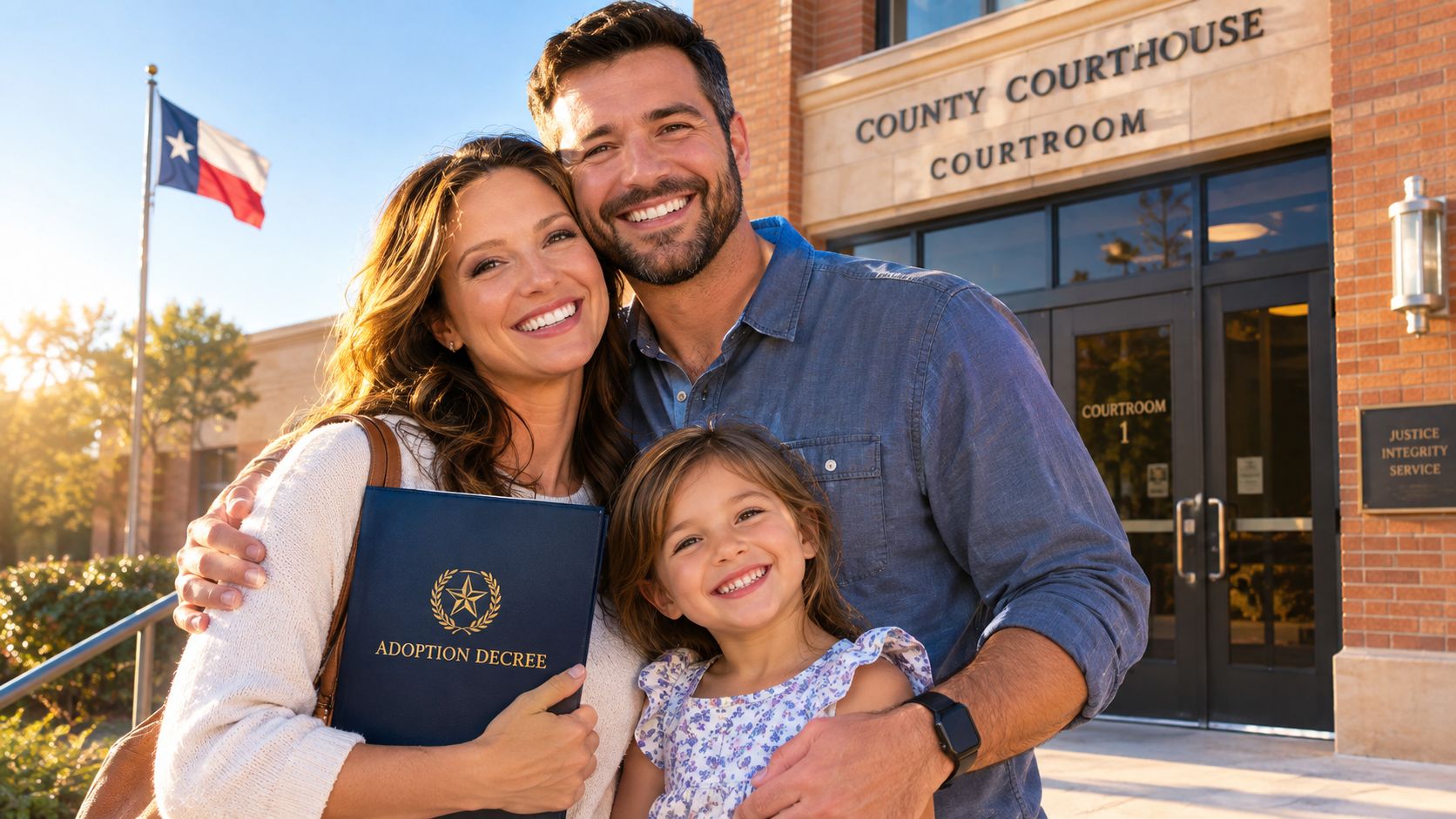
You've just left a Texas courtroom with a signed adoption decree in your hands. Your child may be smiling, tired, or taking in the moment. You may feel relief, joy, and a long list of practical questions at the same time. What does the decree change at school, at the doctor's office, in an inheritance matter, or when an agency asks you to prove that you're the legal parent?
Texas Family Code Section 162.017 supplies the answer. The family code 162.017 legal effect of a Texas adoption decree reaches far beyond the courtroom. It creates a permanent legal parent-child relationship, gives the adopted child the legal status of a child born to the adoptive parent for important purposes, and provides the foundation for handling records, inheritance, benefits, and family relationships after finalization.
The Moment the Judge Signs Your Adoption Decree
The courtroom may become very quiet after the judge signs. A family that spent months preparing documents, completing interviews, answering difficult questions, and waiting for a hearing may walk into the hallway carrying a few pages that look ordinary. Legally, those pages can reshape the family's future.
Section 162.017 says that an adoption decree establishes the parent-child relationship between the adoptive parent and child “for all purposes.” The Texas statute also gives the adopted child the same inheritance status as a biological child, allowing the child to inherit from and through the adoptive parents as though born to them. Read the full Texas Family Code Section 162.017 before relying on a general explanation, because the exact order and the surrounding facts still matter.
Why the document matters
The signing isn't merely a ceremonial conclusion. In a case involving termination and adoption together, the court generally addresses termination when it renders the adoption order. The decree then becomes the operative proof of the adoptive parent's legal status in later matters involving government agencies, medical providers, schools, insurers, and estate administration.
A family may also need supporting records. Certified copies of the decree, an amended birth record, and, in an international matter, recognition or validation paperwork can each serve a different purpose. Families handling documents in another language may also benefit from reviewing these adoption document translation certification rules before submitting records to an agency or court.
The emotional moment in the hallway is only the beginning of the practical work. The next step is understanding what “for all purposes” means and how to show other people that the new legal relationship exists.
What Section 162.017 Actually Says in Plain English
The statute's central phrase is direct. An adoption order “establishes the parent-child relationship between the adoptive parent and the child for all purposes.” In plain English, the order doesn't create a limited role that applies only at home. It creates the legal relationship of parent and child across the areas where Texas law recognizes that relationship.
The statute also treats the adopted child as having the same inheritance status as a biological child. Texas statutory terms such as “child,” “descendant,” and “issue” generally include an adopted child unless a specific law or document clearly provides otherwise. That matters when a family reviews a will, a trust, an intestate estate, or another legal instrument.
Translating the rule step by step
First, the court enters an order. The signed decree should clearly identify the child, each adoptive parent, and the relief granted. Counsel should review the final document carefully because later agencies and courts may rely on it as evidence of parental status.
Second, the new relationship takes legal effect. The adoptive parent assumes the legal position associated with a biological parent. That position includes the authority and responsibilities connected with parental care, custody, and control.
Third, the relationship carries into other legal settings. The child's status can affect inheritance, descent and distribution, and the interpretation of other laws or legal documents. It isn't limited to who picks the child up from school or consents to medical care.

A Stepparent Adoption in Texas is one common setting in which this complete legal relationship becomes important. The family's personal history may be blended, complex, or emotional, but the statute focuses on the legal effect of the order once the court enters it.
The phrase “for all purposes” doesn't mean every future question has an automatic answer. A will may contain specific language. A foreign adoption may require Texas recognition steps. A grandparent-access question may involve another part of the Family Code. Section 162.017 supplies the foundation, while the facts and related law determine how that foundation operates.
Rights, Duties, and Status Created by the Decree
A final adoption decree has a two-sided effect. It establishes the adoptive parent-child relationship and, in a proceeding that includes termination, replaces the prior legal parent-child framework addressed by the court. The adoptive parent becomes responsible for the child's legal care, custody, and protection, while the child gains the legal status connected with being that parent's child.
That status can affect everyday decisions and long-term planning. The adoptive parent can use the decree when dealing with a school, physician, insurer, government office, or estate representative. The child can be treated as the adoptive parent's child for inheritance purposes, subject to any specific law or document that provides otherwise.
The practical balance
Adoptive parents gain legal authority, but adoption isn't only about authority. It also carries continuing responsibilities. A parent must provide care and support, make decisions in the child's best interests, and protect the child's physical and emotional welfare. The decree gives the family permanence, not permission to disregard the child's needs.
The adopted child's legal status can also affect family identity and records. A surname change may be included in the order, but the decree and related record procedures should be reviewed rather than assumed. The same is true for benefits, insurance enrollment, and other administrative matters.
| Party | Rights Gained | Duties Owed | Prior Legal Ties |
|---|---|---|---|
| Adoptive parent | Legal parental status, custody, and decision-making authority | Care, protection, support, and parental responsibility | The decree creates the new legal relationship |
| Adopted child | Status as the adoptive parent's child, including statutory inheritance treatment | The child remains subject to ordinary legal rules that apply to children | Prior legal arrangements are affected by the order and related termination findings |
| Former legal parent | Rights depend on the order and applicable law | Duties depend on the court's termination and support orders | The prior parent-child framework may be replaced when termination and adoption are joined |
| Adoptive relatives | The adopted child may inherit from and through adoptive parents and their relatives under the statute | Estate planning should use clear, consistent documents | Specific wills, trusts, or laws may require separate interpretation |
Families often need help turning legal status into usable proof. A certified copy of the decree can be important when an agency questions who may consent to treatment, enroll a child, or receive protected information. A practical overview of the rights of adoptive parents can help families identify questions to raise with counsel.
Section 162.017 also preserves a limited grandparent-access provision. Adoption doesn't automatically eliminate a biological or adoptive grandparent's ability to seek reasonable possession or access under Texas Family Code Chapter 153. That provision doesn't erase the adoptive parent's new legal status, but it does show why families should avoid broad assumptions about every relationship after finalization.
Real Texas Families and How the Statute Applies
Consider a blended family in which a stepparent has cared for a child for years. After the court addresses the required legal issues and enters the adoption decree, the stepparent is no longer the adult who helps with homework and medical appointments. The decree establishes the stepparent's legal parent-child relationship for all purposes covered by the statute.
A kinship family may arrive at the same legal destination through a different path. A grandparent or another relative may already be providing daily care, managing school routines, and preserving sibling connections. The adoption decree changes the relative's legal position from caregiver or family member to adoptive parent, while giving the child the statutory inheritance status connected to the adoptive family.
Different paths, one legal effect
In a Department of Family and Protective Services case, termination and adoption may be handled in the same proceeding. The court addresses the end of the prior legal framework and the creation of the adoptive relationship as part of the final order. The Texas Child Protection Law Bench Book describes adoption as ending the court's continuing monitoring role and placing permanent parental responsibility with the adoptive parents.
An adult adoption can have a different emotional history and a different practical purpose. An adult and adoptive parent may want to formalize a long-standing family bond, clarify inheritance treatment, or address a cross-border or immigration-related record issue. Section 162.017 applies broadly to an order of adoption, but the parties still need to confirm what additional records or recognition steps a specific agency requires.
Practical rule: The statute doesn't rank stepparent, kinship, agency, LGBTQIA+, or adult families. The court order creates the legal relationship, while the case facts determine the process used to reach it.
After the judge signs, the family may need to update school records, medical files, insurance information, and other records. The decree can establish the legal status immediately, but each institution may still ask for a certified copy or another approved document before changing its files.
After Finalization, What Changes in Daily Life
The decree changes the family's legal status immediately, but practical updates often happen through separate administrative steps. The Texas Department of State Health Services maintains Texas birth records, including records involving in-state and out-of-state adoptions, while it doesn't conduct the adoption proceeding itself. Families can review the Texas adoption information from Vital Statistics to identify the records process that fits their circumstances.
A useful after-decree checklist
Order certified copies. Ask the district clerk or the appropriate records office how to obtain certified copies of the signed decree. Keep copies in a secure location and use them when a school, doctor, insurer, probate representative, or government agency needs proof of status.
Address the birth record. An amended birth certificate or other updated record may be needed for administrative purposes. The exact procedure can depend on whether the adoption occurred in Texas, elsewhere in the United States, or in another country.
Review inheritance documents. Section 162.017 gives the adopted child the same inheritance status as a biological child and generally allows the child to inherit from and through adoptive parents and their relatives. A family should still review wills, trusts, beneficiary designations, and other documents because specific language may affect how an estate is handled.

Update daily records. Give the school, medical providers, insurer, and relevant agencies the documents they request. A certified decree may be more useful than an informal explanation that an adoption was finalized.
Handle cross-border matters carefully. For a foreign adoption, federal Social Security guidance describes Texas recognition requirements and indicates that a foreign decree may need validation by a Texas court before Texas treats it as legally valid and enforceable. Immigration, benefits, and government-record questions should be reviewed with counsel familiar with the specific documents.
The adopted child's relationship with adoptive parents and their relatives can affect estate planning and descent analysis. At the same time, the statute preserves a limited grandparent-access route under Chapter 153. That doesn't mean access is automatic. It means a family should obtain advice before promising or denying contact based only on a general understanding of adoption law.
Families looking for a practical post-hearing list can review what happens after an adoption is final in Texas. A careful follow-through protects the child's stability and makes the decree easier to use in real life.
Related Texas Statutes and Case Law That Shape 162.017
A Texas adoption decree does not stand alone. It is the final piece in a legal process that may include termination findings, eligibility requirements, consents, and the court's best-interest determination. Section 162.017 explains what the signed decree does after those steps are complete. The statutes below help show how that result is reached and applied.
| Statute | Function | Connection to 162.017 |
|---|---|---|
| Chapter 161 | Addresses termination of the parent-child relationship | Termination findings may precede or accompany the adoption |
| Chapter 162 | Governs adoption proceedings and decrees | Supplies the procedure for the order whose legal effect Section 162.017 defines |
| Section 162.006 | Addresses adoption of adults | Shows that adoption law also applies outside child adoptions |
| Section 162.012 | Addresses the statutory period for attacking an adoption order | The six-month limit to attack an adoption order makes prompt legal review important when someone identifies a serious problem |
| Section 162.017 | Defines the legal effect of the adoption order | Establishes the parent-child relationship for all purposes and addresses inheritance |
| Chapter 153 | Contains grandparent possession and access provisions | Preserves a limited route for a grandparent to seek access after adoption |
Read the Texas Family Code adoption provisions alongside the specific petition, consent documents, termination findings, and signed decree. The statute supplies the framework, while the court file supplies the facts. Together, they help explain how the decree affects records, inheritance questions, and family relationships.
Texas appellate decisions also show why the order can matter years after finalization. An inheritance dispute may require a court to determine the adopted child's status under Section 162.017. A case involving termination and adoption in the same proceeding may require attention to both the former legal relationship and the new adoptive relationship. Other decisions examine the limited circumstances in which a party may challenge or seek to vacate an adoption decree.
Those decisions work like signposts, not a substitute for reviewing the family's documents. The wording of the decree, the type of adoption, the child's best interests, and any cross-border record issue may change the analysis. A parent who is unsure how the order affects a birth record, an estate, or a grandparent-access question should have the actual court file reviewed.
Frequently Asked Questions About Adoption Decrees in Texas
Can a birth parent revoke consent after the decree?
Once the court has entered the final adoption decree, Section 162.017 establishes the adoptive parent-child relationship for all purposes. A challenge isn't the same as an informal request to change one's mind. Because adoption orders have a narrow statutory framework for attack, anyone concerned about consent or finalization should speak with counsel promptly.
How does the child receive an amended birth certificate?
The adoption court handles the adoption proceeding, while the Texas Department of State Health Services maintains Texas birth records. Families should follow the Vital Statistics process for the relevant adoption and use the signed decree and any other required documents.
Does the child keep inheritance from biological relatives?
Section 162.017 gives the adopted child inheritance status through the adoptive parents and their relatives as though the child were born to them. Whether the child may inherit from a biological relative can depend on that relative's will, the governing law, and the circumstances of the adoption. Don't assume that every estate will be treated the same way.
Can a grandparent seek access after adoption?
Adoption doesn't automatically eliminate the rights of a biological or adoptive grandparent to seek reasonable possession or access under Chapter 153. A grandparent doesn't receive automatic visitation because a family connection exists. The facts and statutory requirements must be evaluated separately.
How does adult adoption differ?
An adult adoption formalizes a parent-child relationship involving an adult rather than a minor. Section 162.017 still provides the broad legal effect of an adoption order, including inheritance treatment, but records, consent, agency, immigration, and cross-border questions may require additional review.
How the Law Office of Bryan Fagan Can Guide Your Family
Adoption paperwork should reflect the family's real situation and the child's best interests. Before finalization, counsel can help review the petition, home-study materials, consents, notices, and proposed decree. After the hearing, counsel can explain how Section 162.017 affects certified copies, birth records, inheritance planning, agency filings, and questions involving relatives.
A Texas home study, also called a pre-adoptive home screening, examines matters such as home safety, available space, household relationships, health, motivation, discipline views, cultural identity, and the ability to preserve sibling relationships. DFPS also describes interviews and background checks as part of the process, and families pursuing its foster-adoption pathway must permit criminal-history and abuse-or-neglect checks on adults in the household. The process is preparation for permanency, not a demand that a family be perfect. Review the DFPS home-study guidance and ask questions early.
The Law Office of Bryan Fagan, PLLC handles stepparent, kinship, agency, CPS-related, domestic, international, LGBTQIA+, and adult adoption matters, with offices serving Houston and surrounding Texas communities and virtual consultations available statewide. A confidential consultation can help protect your family's paperwork, timeline, and rights from the initial filing through the signed decree and the administrative work that follows.
The Law Office of Bryan Fagan, PLLC offers guidance for adoptive parents, birth parents, and relatives who need a clear plan for finalization and the legal effects of Section 162.017. Visit Law Office of Bryan Fagan, PLLC to schedule a free consultation about your Texas adoption decree, records, inheritance questions, or next steps.

