 Skip to content
You've completed the home study, gathered the required paperwork, and waited through every step of the adoption process. Now the final hearing is on your calendar, and one question may keep coming back: Who must attend the Texas adoption hearing?
Texas Family Code § 162.014 provides the starting point for that answer. The rule is designed to make sure the court hears from the people whose presence matters to the adoption, while also allowing limited flexibility when attendance would create a serious difficulty. Understanding the rule can help you arrive prepared and focus on the meaning of the day, your child's move toward permanent family unity.
The Final Hurdle – Understanding Who Must Be Present
A few minutes before a hypothetical adoption hearing, an adoptive parent checks the family's folder again. The final orders are there. Identification is ready. The child is dressed for court, but everyone feels nervous. The parents wonder whether a caseworker will attend, whether the child must speak, and what happens if one spouse faces a genuine obstacle to appearing.
Those concerns are understandable. An adoption hearing carries enormous emotional weight, but it isn't meant to be a surprise test. Family Code § 162.014 creates a structure for attendance, helping the judge confirm that the legal requirements have been met and that the adoption serves the child's best interests. The petitioner must attend, subject to the limited exception discussed below. A child who is 12 or older must also attend unless the court waives that requirement because attendance would not serve the child's best interest. You can review the statutory attendance guidance in the Texas Children's Commission Bench Book.
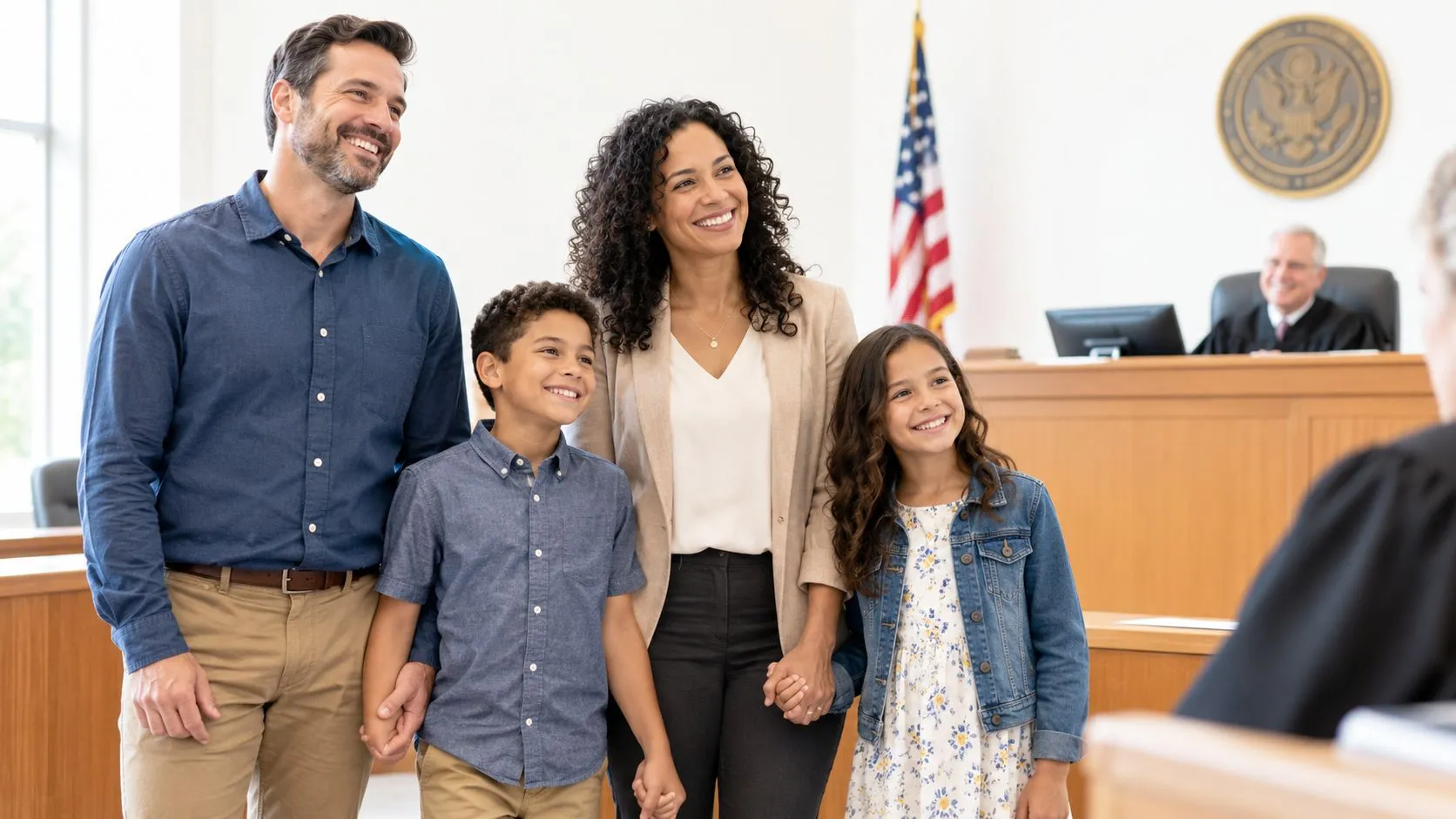
Why attendance matters
The final hearing is more than a filing appointment. Texas child-welfare guidance describes the hearing as a structured proceeding involving the adoptive parents, the assigned caseworker, and the child's legal advocate or CASA. Their participation helps the court address the child's situation from the necessary legal and welfare perspectives.
For families involved with DFPS, the hearing also represents the point at which conservatorship transfers to the adoptive parents and the Department closes its case for that child. That makes attendance part of the legal transition from placement to permanent family status, not merely an administrative formality.
A helpful way to think about the hearing: the court is confirming that the right people are present before it recognizes the permanent legal relationship.
The rules can apply across many family stories. They may arise in a stepparent adoption, a relative or kinship adoption, a private domestic adoption, an LGBTQIA+ adoption, or a CPS-related adoption. The details of each case differ, but the court's focus remains the same: whether the adoption is legally ready and consistent with the child's best interests.
If you want a plain-language overview of the event itself, Finalizing a Texas Adoption: The Final Hearing explains what happens at the hearing that makes the adoption legal.
Decoding the Statute – Mandatory and Permissive Attendance
The easiest way to understand Family Code § 162.014 is to separate required attendance from possible excuses. The statute does not treat every person connected to an adoption in exactly the same way.
Who must plan to attend
The petitioner is the person or people asking the court to grant the adoption. In practical terms, that means the adopting parent or parents named in the petition must attend the hearing.
When two spouses file together as joint petitioners, both generally need to plan to appear. The statute creates a narrow exception. One spouse may be excused if appearing would be unduly difficult and the other spouse is present. That isn't an automatic option based on convenience, work scheduling, travel preferences, or ordinary nervousness. The court must address whether the circumstances justify excusing the spouse.
The child's age also matters. A child who is 12 or older and is the subject of the adoption must attend, unless the court waives attendance because doing so would be in the child's best interest. This requirement recognizes that an older child may have an important perspective on the legal change taking place.
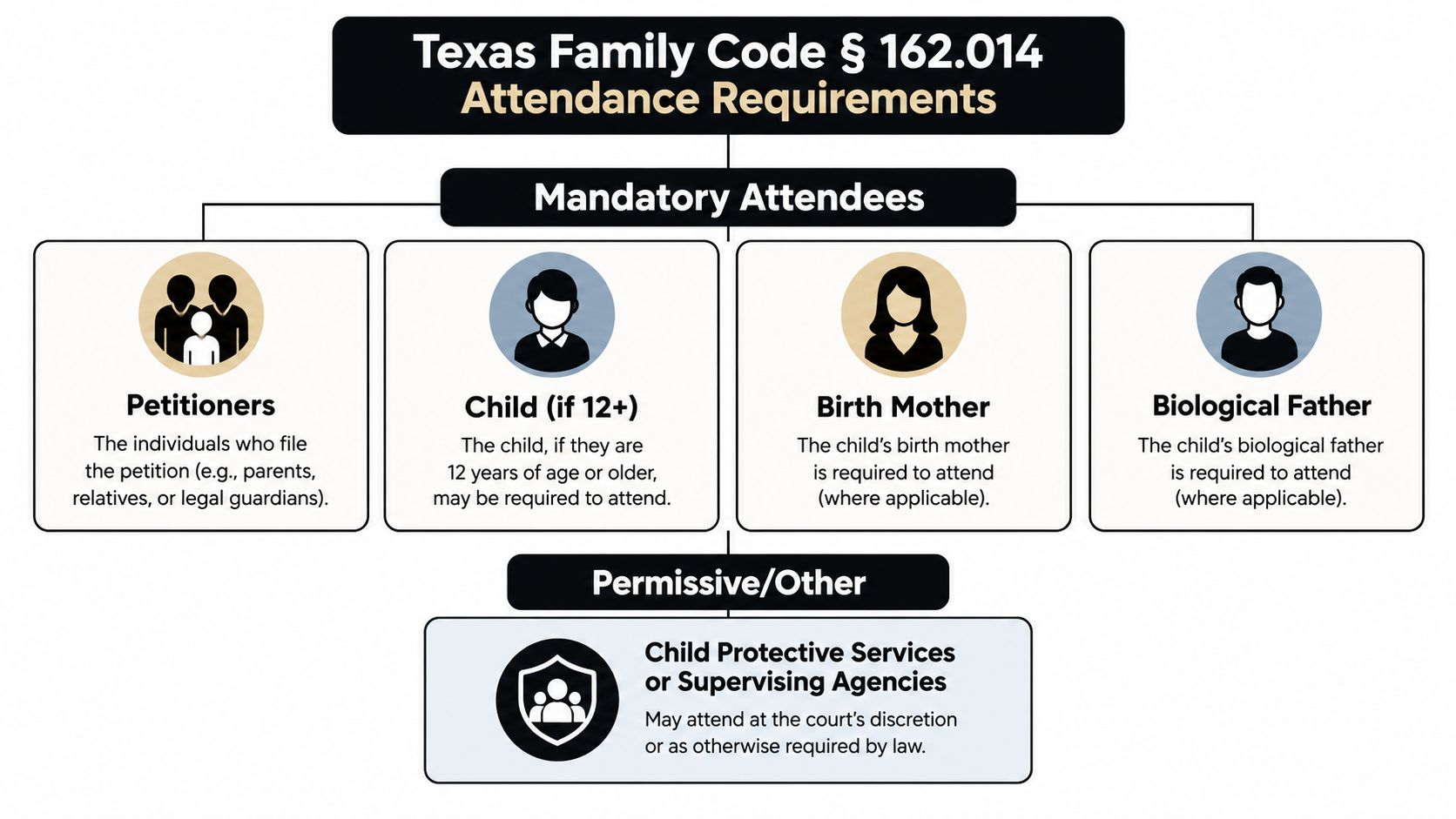
The infographic includes other people who may participate in an adoption proceeding. However, the specific attendance rule in § 162.014 establishes the requirements for the petitioner and, when applicable, the child who is 12 or older. It should not be read as creating an automatic attendance requirement for every person or agency represented in a visual overview.
What “joint petitioners” means
Suppose a married couple files one adoption petition together. They are joint petitioners because they are asking the court to grant the adoption as a couple. Both spouses should prepare to attend unless one spouse has a circumstance that may qualify as undue difficulty and the court approves an excuse.
The safest approach is to raise the issue early with your attorney and the court. Don't assume that a phone call, email, or informal explanation automatically changes the attendance requirement.
Why the older child's attendance receives special attention
The attendance rule recognizes that older children may understand the adoption and experience its effects in a more direct way. The court may want the child present as part of the final proceeding, while still retaining the ability to waive attendance when presence would not serve the child's best interest.
For example, a child may be facing a serious emotional, medical, or safety-related concern. The court, not the family alone, decides whether a waiver is appropriate. The child's welfare remains the guiding consideration.
The following video may provide additional context for families preparing for an adoption hearing:
Child Adoptions vs. Adult Adoptions – Different Rules Apply
Texas adoption law isn't one universal checklist. The answer to family code 162.014 who must attend the texas adoption hearing depends first on whether the case concerns a child or an adult. Applying the rule for one type of adoption to the other can create confusion at a time when careful preparation matters.
A side-by-side comparison
| Type of case | Attendance rule | Possible flexibility |
|---|---|---|
| Adoption of a child | The petitioner must attend. A child who is 12 or older must also attend. | The court may excuse one spouse in a joint petition when appearing would be unduly difficult and the other spouse is present. The court may waive the child's attendance when doing so is in the child's best interest. |
| Adoption of an adult | The petitioner and the adult being adopted must attend under Texas Family Code § 162.505. | Attendance may be waived for good cause. |
For an adult adoption, the person being adopted is an adult participant in the legal proceeding. Texas Family Code § 162.505 separately addresses that situation and requires both the petitioner and the adult to attend unless the court finds good cause for a waiver. You can learn more about that distinct process through this resource on adult adoption in Texas.
Why the distinction matters
A child adoption typically concerns the court's decision to establish a permanent parent-child relationship for a minor. Depending on the case, the process may involve adoptive parents, a caseworker, a child's legal advocate, and other participants connected to the child's welfare.
An adult adoption has a different family and legal context. The adult being adopted can express a personal decision about formalizing the parent-child relationship, and § 162.505 supplies the attendance rule for that type of case. The court may still require particular filings or proof, but you shouldn't assume that a child-adoption procedure applies automatically.
Texas also treats the adoption hearing as the finalization milestone. DFPS describes the final court hearing as the point when conservatorship transfers to the adoptive parents and the Department closes its case for that child, as reflected in the Texas Family Code statutes. That transition explains why the court takes attendance seriously in a child adoption.
If you're unsure which category fits your family, identify the person being adopted first. Then ask your attorney to confirm the governing statute, the people required to appear, and whether any special request must be filed before the hearing.
Handling Exceptions – Waivers, Excuses, and Virtual Options
A required attendee may face a real obstacle. A child may be distressed by appearing in court. One spouse may have a circumstance that makes attendance unduly difficult. A family may also wonder whether a remote appearance is possible.
The key point is simple: don't treat an absence as an informal arrangement. A waiver, excuse, or remote appearance should be addressed with the attorney, court, and other professionals involved before the hearing begins.
Step one involves identifying the problem early
Tell your attorney as soon as you learn that someone may be unable to attend. Explain the specific situation, not just the conclusion that attendance is difficult. The court needs enough information to evaluate the request under the applicable standard.
For a child who is 12 or older, the court may waive attendance when doing so is in the child's best interest. The question isn't whether attending would be inconvenient. The question is whether requiring the child to appear would conflict with the child's welfare.
For one spouse in a joint petition, the issue is undue difficulty. That standard requires more than a preference for avoiding the hearing. The spouse should be ready to explain why appearing would create an exceptional burden and why the other spouse's presence can allow the case to proceed appropriately.
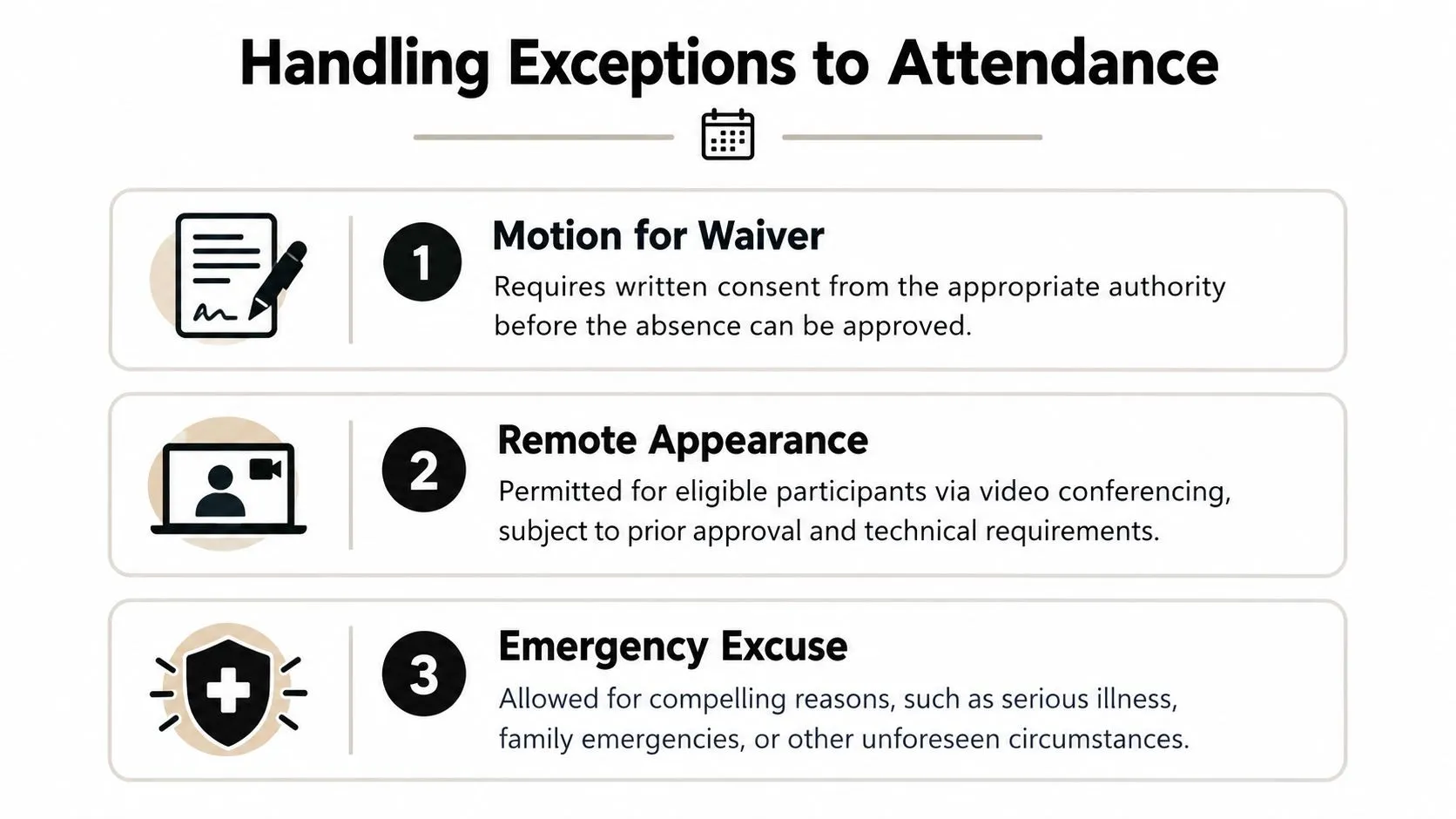
Step two involves making the request properly
Your attorney can help determine whether the circumstances call for a written motion, supporting declaration, medical information, or another form of documentation. The precise filing depends on the court and the facts of the case.
A request should clearly identify:
- The person affected: State whether the request concerns a petitioner, a child, or another participant.
- The reason: Describe the practical, medical, emotional, or other circumstance creating the problem.
- The proposed solution: Explain whether the request seeks a complete waiver, an excuse for a spouse, or permission to appear remotely.
- The child's interests: Address how the requested accommodation protects the child's stability, safety, and emotional well-being.
If the biological father is unknown or the case involves questions about notice and consent, the legal issue may require separate attention. A resource explaining what happens if the biological father is unknown may help you identify questions to raise with counsel.
Step three involves confirming remote attendance
Some courts may permit a participant to appear by videoconference, but remote attendance isn't guaranteed just because technology is available. Ask the clerk or your attorney whether the judge permits it in your case and whether a formal request is required.
Confirm the connection instructions, hearing time, identification requirements, and whether the participant must remain visible for the proceeding. A virtual appearance still requires attention and preparation. It shouldn't be treated as an informal video call.
Practical rule: If someone may not be physically present, obtain court approval before the hearing date whenever possible. An approved plan is much safer than hoping the judge will resolve the issue at the last moment.
Preparing for the Big Day – What to Bring and Who Else Should Come
Attendance is only one part of preparation. Families also need to know who may be involved and which materials should be ready for review. Texas child-welfare guidance says the adoptive parents, the assigned caseworker, and the child's legal advocate or CASA should always be present in the structured proceeding.
That group can feel larger than expected, especially for parents who imagined a short appointment with only the judge and their immediate family. Their presence serves a purpose. Each participant helps the court understand whether the legal and child-welfare pieces are ready for finalization.

Build a simple hearing checklist
Your attorney can tell you exactly what the court expects in your case. As a practical starting point, gather the following:
- Identification: Bring the identification requested by your attorney or court.
- Court papers: Keep copies of the petition, notices, proposed final orders, and other filings in one organized folder.
- Consent materials: Include relevant consent or relinquishment documents if your attorney has instructed you to bring them.
- Case contacts: Save the names and telephone numbers for your attorney, caseworker, CASA, and court contact.
- Child-focused items: Prepare anything your attorney recommends to help the child feel calm and supported.
Don't bring documents just because an internet checklist mentions them. Adoption cases vary, and an outdated or unnecessary document can create more confusion than reassurance. Ask your legal team to confirm the final packet.
Prepare the child with honesty and calm
Children may feel excited, worried, quiet, or uncertain. Avoid promising that the hearing will feel a certain way. Explain that a judge will ask questions and that trusted adults will be nearby.
If the child is 12 or older, remember that attendance is generally required unless the court grants a best-interest waiver. Speak with the attorney and the child's legal advocate about age-appropriate preparation. The child shouldn't feel responsible for making the adults happy or for deciding the entire case.
Expect a serious but supportive setting
The hearing is a legal proceeding, but it can also be a meaningful family moment. Dress appropriately, arrive or connect early, silence notifications, and follow the judge's directions. Your attorney can explain who may speak, what questions may arise, and whether relatives should attend as emotional support.
The court's structured approach is intended to protect the child and confirm that the adoption is ready to become permanent. Preparation allows you to spend less energy worrying about logistics and more energy recognizing what the day means for your family.
Your Path to Permanency – Next Steps and Resources
Family Code § 162.014 is not merely a rule about filling seats in a courtroom. It helps the judge confirm that the petitioner is present, that an older child is included when required, and that any request for an exception receives proper consideration. Those safeguards support a careful transition toward permanent legal family status.
The process begins long before finalization. Families may move through applications, evaluations, home-study work, consent or parental-rights issues, agency coordination, and court filings. The details differ for private adoptions, stepparent adoptions, kinship placements, LGBTQIA+ adoptions, foster-care adoptions, and adult adoptions, but each family benefits from knowing which legal framework applies to its situation.
Keep your preparation focused
Start by confirming whether your case is a child adoption or an adult adoption. For a child adoption, identify every petitioner, determine whether the child is 12 or older, and ask whether any participant may need a waiver or remote-appearance request. For an adult adoption, review the separate attendance rule under § 162.505.
Then coordinate with the professionals connected to the case. Confirm the hearing date, appearance method, required documents, and contact information. If you want to study the wording of statutes and compare legal materials, a guide to legal database options can help you find and organize research, but online research shouldn't replace advice about your specific hearing.
The most reassuring preparation is specific preparation. Know who must attend, know what request must be made, and confirm the plan with the court before the hearing.
You don't have to go through the final stage alone. A Texas adoption attorney can help you interpret the attendance rule, prepare filings, communicate with DFPS or other professionals, and protect the child's best interests throughout finalization. When the legal details are handled carefully, your family can approach the hearing with greater confidence and attention to the permanent relationship being created.
The Law Office of Bryan Fagan, PLLC helps Texas families prepare for adoption hearings, attendance questions, waivers, and finalization proceedings with compassionate legal guidance. Schedule a free consultation by visiting Law Office of Bryan Fagan, PLLC to discuss your family's hearing requirements and next steps toward permanency.

