 Skip to content
A family preparing for adoption may hear the words “race” and “religion” during an agency meeting and immediately worry that Texas law could stand between them and a child. A birth parent may also wonder whether a request for a family who shares the child's background or faith is legally allowed. Relatives and stepparents often face the same uncertainty while trying to protect a child's identity and preserve family unity.
The phrase family code 162.013 race and religion in Texas adoption placement often points readers toward the wrong statute. Section 162.013 doesn't create a race-matching rule. It addresses what happens to a pending adoption if petitioners die or divorce. The rules that address race and ethnicity appear elsewhere, while cultural and religious support require a careful, individualized review focused on the child's best interests.
A Family at the Crossroads of Race and Religion in Adoption
Consider the Garza family in San Antonio. They're an interfaith Catholic and Methodist household completing a home study through a private agency for a biracial toddler. The family has prepared a bedroom, discussed parenting roles, and talked openly about how they'll help the child understand both sides of the child's heritage.
During one meeting, the caseworker mentions Texas Family Code § 162.013. The Garzas leave the conversation worried. They wonder whether the statute prevents a transracial placement, whether their interfaith home could be viewed as unsuitable, or whether the court expects the child to be placed with a family of a particular race or religion.
Those fears are understandable. Adoption combines legal rules with personal questions about identity, belonging, family traditions, and a child's connection to community. A family may want to honor a child's language, food, holidays, religious practices, or relationship with relatives without turning those needs into a race-based barrier.
The central point: Section 162.013 is a narrow procedural rule. It isn't the Texas statute that prohibits race-based denial or delay of an adoption.
The law separates several questions that are often blended together. One question asks what happens if an adoption case is interrupted by death or divorce. Another asks whether a court or agency may use race, color, or national origin when deciding placement. A third asks how a family can support a child's cultural or religious needs.
Those questions involve different legal layers, including Texas Family Code provisions, federal placement requirements, and the separate federal framework that applies to proceedings subject to the Indian Child Welfare Act. The answer for the Garzas isn't a simple race match or religious match. It's an individualized review of whether the proposed home can provide safety, stability, family connection, and meaningful support for the child's needs.
What Texas Family Code § 162.013 Actually Says
Section 162.013 addresses a pending adoption case when a petitioner dies or when joint petitioners divorce before the court enters the adoption decree. Its subject is the status of the lawsuit, not the race or religion of the child or prospective parents. The text of Texas Family Code § 162.013 describes the procedural outcomes.
The rule works differently depending on the family structure:
- If the sole petitioner dies, the court must dismiss the adoption suit.
- If one joint petitioner dies, the case continues.
- If joint petitioners divorce, the court must abate, or temporarily suspend, the suit unless one original petitioner amends the case to proceed alone.
If the case cannot continue, the child is returned through the applicable child-welfare or licensed-agency process described by the statute. That result can be emotionally difficult, but it reflects the court's need to confirm who remains legally able to pursue the adoption and provide the child with a permanent home.
What the statute doesn't decide
Section 162.013 does not say that a child must be placed with a same-race family. It also doesn't authorize a court to delay an adoption to create a religious match. The race and ethnicity rule appears in § 162.015, while agency placement decisions may also be governed by federal requirements and DFPS policy.
Readers sometimes encounter § 162.013 while reviewing a stepparent case because a stepparent adoption is often filed by a family already raising the child. A plain-language resource on Stepparent Adoption in Texas describes the most common Texas adoption and how it works, but the death and divorce provisions still need to be read separately from race and religion questions.
The wording matters. A procedural statute can determine whether a lawsuit continues, but it doesn't answer every best-interests question in the adoption process. For race and ethnicity, readers should look to § 162.015 and the placement rules that apply to the particular case.
The Statutory Framework Around § 162.013
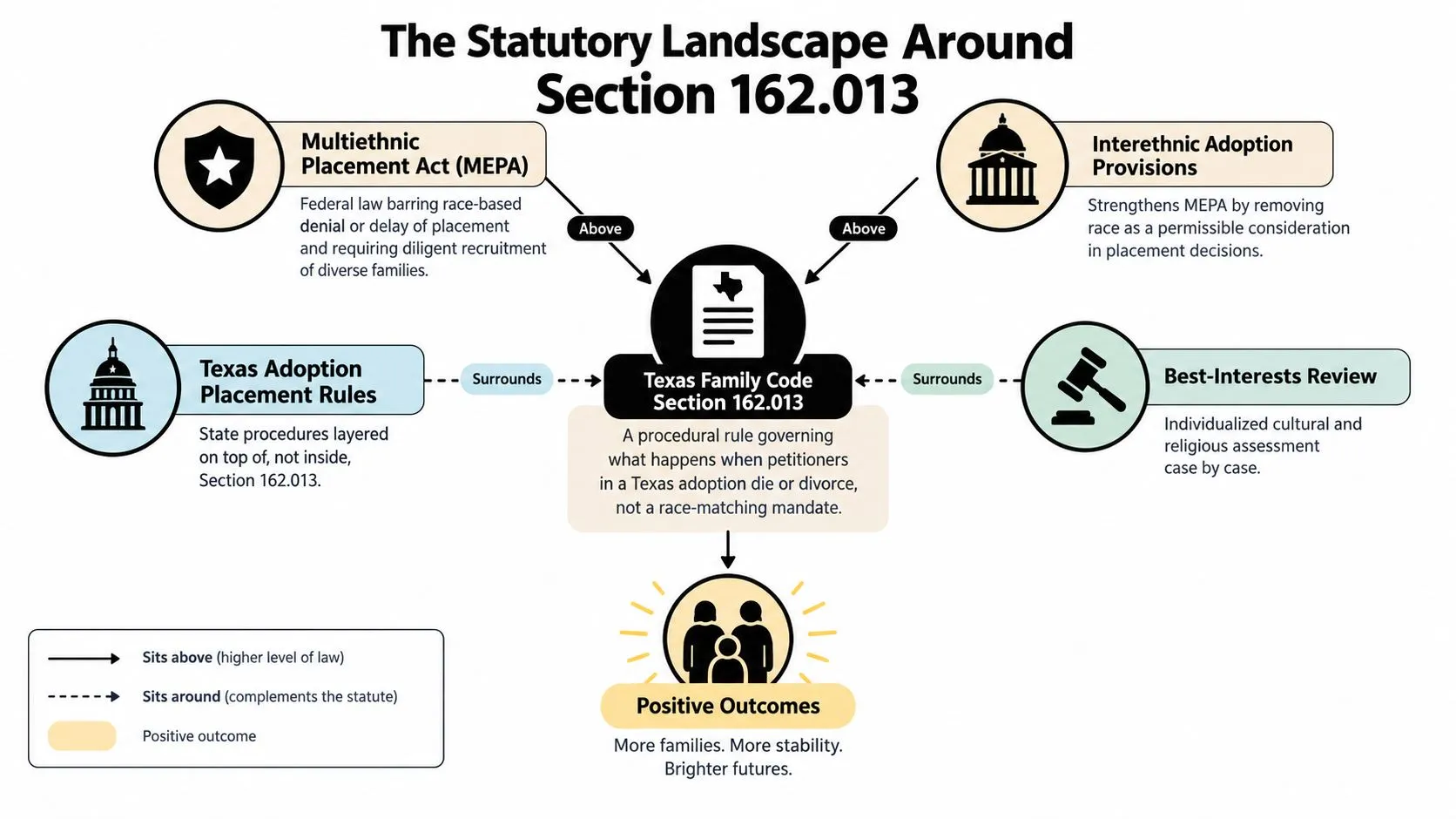
A Texas adoption case may sit at the intersection of several legal rules. Section 162.013 addresses what happens when a petitioner dies or divorces during the case. Section 162.015 governs race and ethnicity in the court's adoption decision. Federal placement requirements may apply to agencies, while a proceeding involving an Indian child may fall under the separate federal framework of the Indian Child Welfare Act.
Section 162.013 works like a procedural hinge. It can determine whether an adoption lawsuit continues after a major change involving a petitioner, but it does not decide whether a child should be placed with a family of a particular race or religion. Those questions belong to other laws and to the child's individualized needs.
The federal Multiethnic Placement Act and its Interethnic Adoption Provisions restrict the use of race, color, and national origin in placement decisions. Texas DFPS guidance explains that these characteristics generally cannot serve as placement factors except in rare, documented, individualized circumstances. DFPS also states that a birth parent's request for placement based on race, color, or national origin must be rejected because federal law does not allow that request to control placement.
Texas Family Code § 162.015 supplies the state rule for the court's adoption decision. In determining the child's best interest, a court may not deny or delay an adoption, or otherwise discriminate, because of the child's or prospective adoptive parents' race or ethnicity. The statute excludes proceedings subject to the Indian Child Welfare Act, leaving that separate federal framework in place. Readers can review the Texas rule addressing race and ethnicity in adoption.
Why the rules must be read together
A child's language, food, community ties, family relationships, or religious practices may require thoughtful support. That individualized inquiry is different from using race as a shortcut for matching or rejecting a family. Families handling tribal, state, and federal questions can review how tribal, state, and federal jurisdiction interact in a Texas adoption. The child's circumstances and the type of proceeding determine which rules apply.
Prohibited Race Decisions and Permitted Cultural or Religious Accommodation
The clearest boundary is this: a court or agency may not deny, delay, or discriminate in an adoption because of the child's or prospective parent's race or ethnicity. DFPS guidance likewise says race, color, and national origin should not be placement factors except in rare, documented, individualized circumstances.
That rule prevents a blanket policy such as refusing every white family for a Black child or refusing every Black family for a white child. It also prevents an agency from treating a prospective parent's race as an automatic reason to reject an application. A family's ability to meet the child's needs must be examined on its own facts.
The analysis becomes more careful when the family or child identifies a specific cultural or religious need. A teenager who speaks a heritage language may benefit from a home prepared to maintain language learning and cultural relationships. A child who follows particular religious practices may need caregivers willing to support appropriate food, holidays, worship, or family connections. Those are not automatically race-matching decisions.
The practical dividing line
| Prohibited Under § 162.015 and MEPA | Permitted Cultural or Religious Accommodation |
|---|---|
| Rejecting a family because of the applicants' race or ethnicity | Considering whether the family can support a child's identified cultural needs |
| Delaying placement to locate a same-race home | Helping a child maintain language, traditions, relatives, or community ties |
| Treating race, color, or national origin as a routine placement preference | Evaluating a family's willingness and ability to support the child's religious practices |
| Automatically honoring a birth parent's race-based request | Listening to cultural concerns and addressing them through lawful, individualized planning |
| Assuming a same-race placement is always in the child's best interest | Reviewing the child's actual relationships, needs, safety, and stability case by case |
DFPS guidance says workers may consider cultural needs and religious upbringing, but it also explains that a child isn't required to follow a foster parent's religion. That distinction protects the child's identity without making a caregiver's faith an automatic barrier.
A family may ask an agency to document the specific need being considered. Is the child already practicing a faith? Does the child have relatives who can help preserve cultural ties? Can the proposed parents support those relationships? The answers should relate to this child, not to a generalized belief about people of a particular race or religion.
Prospective parents can also review guidance on whether you can choose adoptive parents in Texas while remembering that private adoption arrangements and agency placements may involve different procedures. A legal professional can help identify which rules apply before a family makes a promise or challenges a placement decision.
Common Scenarios Texas Families Face
Legal principles become easier to understand when attached to ordinary family decisions. The following examples are representative situations, not predictions about how every court will rule.
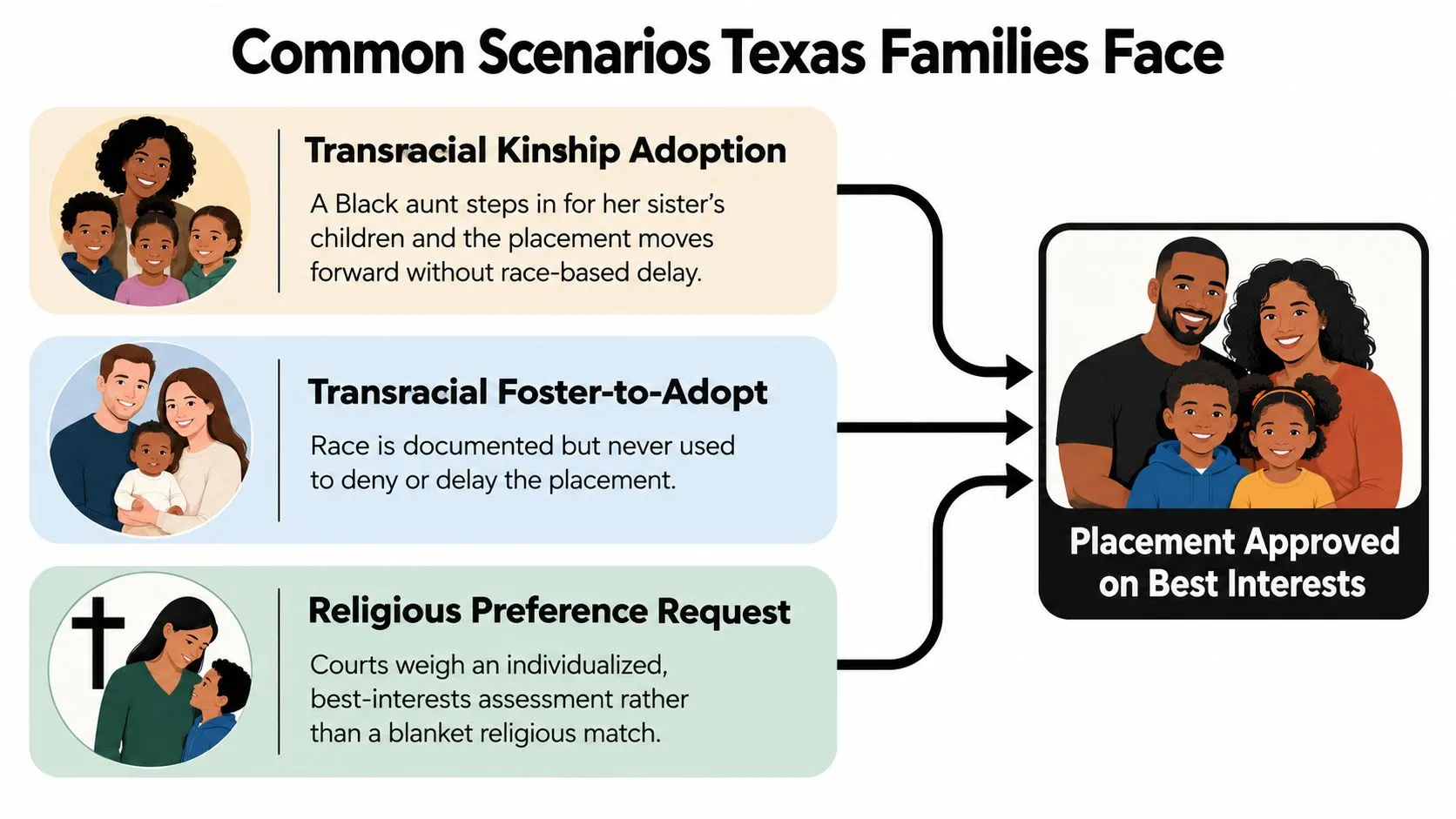
A Black aunt caring for her sister's children
A Black aunt steps forward to adopt her sister's children. The children are already connected to her, know her home, and rely on her family relationships. The aunt's race may be part of the family history, but the court shouldn't approve the placement only because of race or reject another family only because of race.
The court's inquiry would focus on the children's safety, attachment, continuity, family relationships, and the aunt's ability to meet their needs. The case may involve kinship-placement rules, best-interests findings, and any applicable child-welfare requirements. The relevant point is that a relative placement can be supported by family connection and individualized facts, not by a blanket race preference.
A Christian-Hindu blended household
A stepparent in a Christian-Hindu family seeks legal parental rights for a child who has Hindu relatives and established religious practices. The family may discuss vegetarian food, holidays, temple visits, religious instruction, and the child's relationship with extended family.
Religion isn't automatically a barrier to the adoption. The court or agency can examine whether the adults are prepared to respect and support the child's existing practices. The focus should remain on the child's welfare and family relationships, not on forcing the child into the stepparent's faith.
A birth parent requests a same-race family
A birth mother asks a private agency to place her newborn only with a same-race family. The agency should listen respectfully to the concerns behind the request, which may involve identity, family history, or fear that the child's background will be ignored. But DFPS guidance states that a biological parent's request based on race, color, or national origin must be rejected when federal law applies.
The agency may explore lawful ways to support the child's cultural needs, such as maintaining family connections or identifying community resources. It can't turn the request into a rule that excludes otherwise qualified families. The court's inquiry remains tied to the child's best interests and the legal requirements governing the specific adoption.
In each scenario, the emotional concern deserves respect. The legal decision still must distinguish an individualized plan for the child from race-based selection.
Practical Tips for Agencies, Courts, and Adoptive Families
A careful adoption file should show what decision-makers considered and why. Agencies, courts, and families have different responsibilities, but each can help prevent confusion by keeping race separate from legitimate cultural and religious planning.
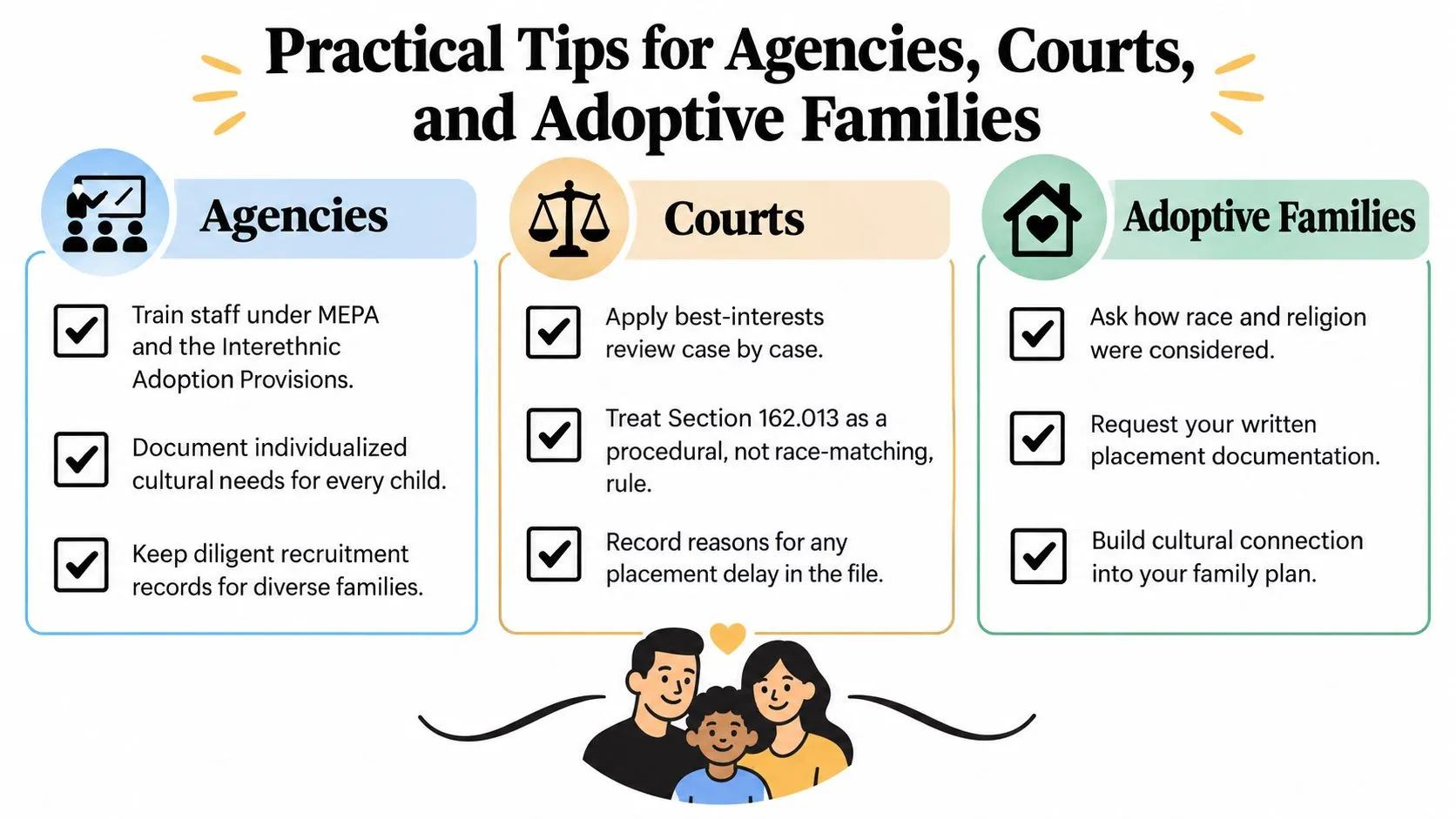
For agencies
- Train placement staff: Teach workers how the Multiethnic Placement Act, the Interethnic Adoption Provisions, § 162.015, and DFPS policy limit race-based decisions.
- Document the child's actual needs: Record specific cultural, language, family, or religious needs instead of relying on broad statements about race or ethnicity.
- Handle race-based requests carefully: Explain to birth parents that an agency cannot treat race, color, or national origin as a controlling placement preference when federal law prohibits it.
- Preserve the reasoning: If an unusual individualized circumstance requires consideration of race, color, or national origin, document the facts and required internal review rather than using an informal preference.
For courts
A court should distinguish a best-interests finding from a race preference. The order and hearing record should make clear whether the court considered family relationships, stability, safety, cultural support, religious practices, or another child-specific fact.
The court should also avoid treating § 162.013 as a race-matching rule. If petitioners die or divorce, the court follows the procedural directions in that statute. If the question is whether race or ethnicity may delay or deny an adoption, the court must apply the separate rule in § 162.015, along with any applicable federal requirements.
For adoptive families
Families can prepare before a placement decision becomes urgent:
- Discuss culture openly: Identify the child's language, relatives, traditions, community ties, and religious practices.
- Build practical support: Find people who can help the child maintain meaningful cultural or faith connections.
- Ask precise questions: Request an explanation of which factors the agency considered and whether the concern involved a specific child need or a prohibited race preference.
- Keep important records: Save the home-study documents, agency communications, placement materials, and court notices.
- Prepare for review: Be ready to explain how your household will support the child without requiring the child to abandon existing identity or beliefs.
Families exploring faith-based providers can also review information about a religious exemption for an adoption agency in Texas. The existence of a faith-based provider doesn't erase the need to examine the child's needs and the legal rules governing placement.
A Texas home study is an important part of that preparation. It evaluates the applicants, household members, and other relevant people in the home. The evaluator must visit the home at least once, and the process includes interviews, safety questions, background and registry checks, and an assessment of family interactions and the child's functioning. Families can learn more from the Texas home-study requirements for prospective adoptive parents.
Best-Interests Recap and Your Next Step
Four points should remain clear:
- Section 162.013 is procedural: It addresses what happens to a pending adoption when a sole petitioner dies, a joint petitioner dies, or joint petitioners divorce.
- Race-based denial or delay is prohibited: Texas Family Code § 162.015 and federal placement requirements prevent courts and agencies from using race or ethnicity as a blanket reason to reject or postpone adoption.
- Some cases require a separate federal analysis: Proceedings subject to the Indian Child Welfare Act are governed by that federal framework rather than treated as ordinary § 162.013 cases.
- Cultural and religious support can matter: A child's specific cultural or religious needs may be considered when the inquiry is individualized and connected to the child's welfare.
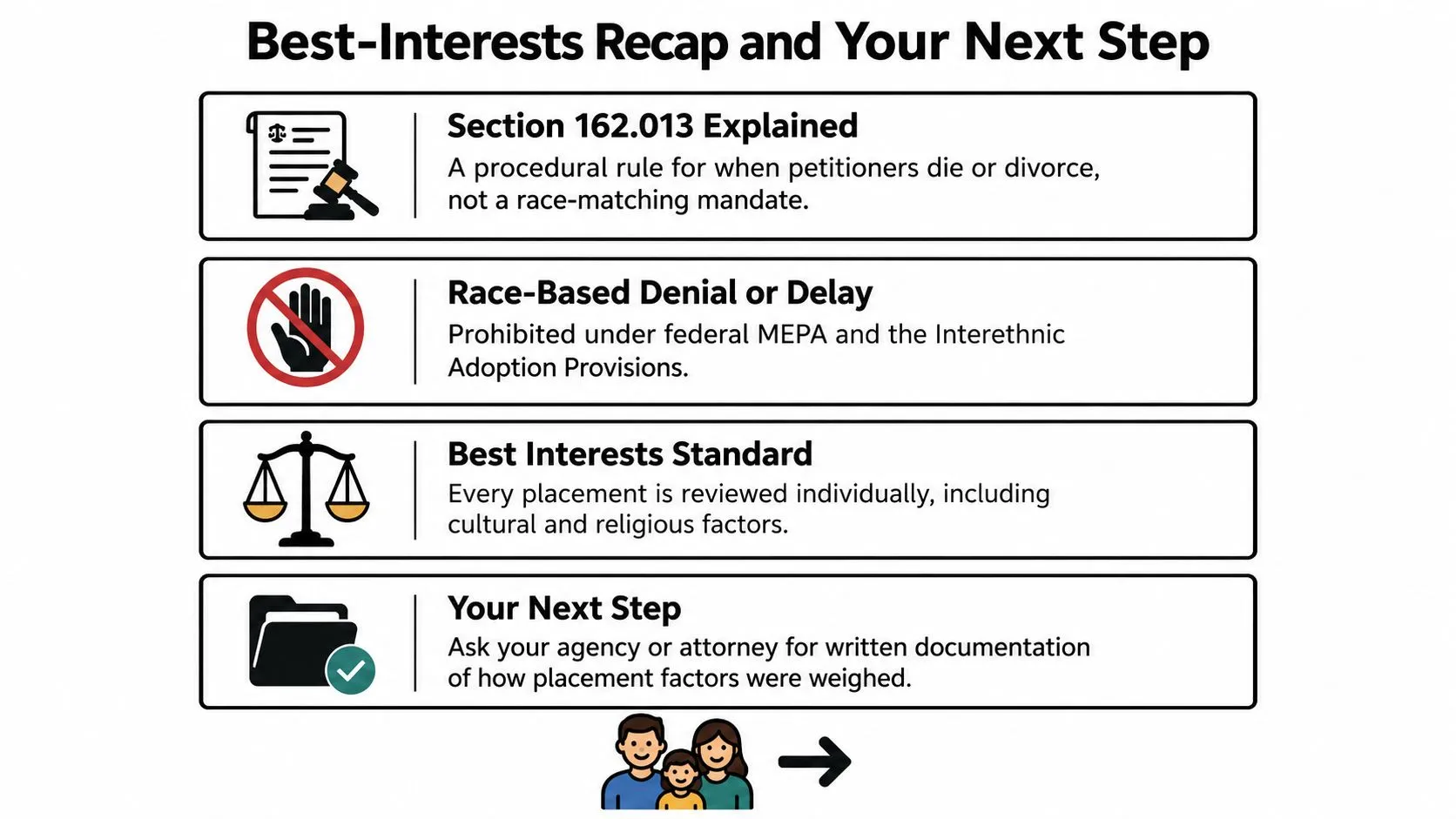
The guiding question is always the child's best interest. That standard doesn't require a family to erase a child's culture or faith. It also doesn't permit an agency or court to use race as a shortcut for deciding who can parent.
If you're a prospective adoptive parent, birth parent, relative, or agency professional, consider scheduling a free Texas adoption consultation before a placement dispute grows more difficult. Bring your existing home study, agency paperwork, and information about any pending court dates so the attorney can review the immediate legal issues during the initial 30-minute consultation. Transracial and interfaith adoptions can be approached thoughtfully when everyone understands the difference between prohibited discrimination and meaningful support for the child.
Frequently Asked Questions About Race and Religion in Texas Adoption
Can a Texas adoption agency refuse to work with me because of my race?
Generally, an agency may not deny or delay placement because of a prospective parent's race, color, or national origin. Federal placement requirements and DFPS guidance restrict those characteristics as placement factors, subject to narrow, documented, individualized circumstances. The applicable framework includes the federal and Texas placement guidance explained by DFPS.
Can a birth parent in Texas require a same-race adoptive family?
A birth parent's race-based placement request can't control a placement when federal law prohibits the agency from using race, color, or national origin that way. The agency should listen to the parent's concerns and address lawful cultural needs without turning a same-race request into a blanket exclusion. The controlling analysis comes from the federal placement requirements and the agency rules described above.
Does § 162.013 let a court delay or deny adoption to match a child's religion?
No. Section 162.013 addresses the procedural effect of a petitioner's death or divorce, not religious matching. Religious practices may be considered as part of a child-specific best-interests review, but the statute doesn't authorize a court to delay or deny an adoption to create a religious match.
How does the Indian Child Welfare Act interact with § 162.013?
Proceedings subject to the Indian Child Welfare Act follow that separate federal framework, which Texas Family Code § 162.015 expressly preserves. A family should identify possible tribal connections early because the applicable rules may differ from an ordinary adoption case.
The Law Office of Bryan Fagan, PLLC helps Texas families with home studies, agency paperwork, placement questions, and adoption finalization, including transracial, interfaith, stepparent, relative, and CPS-related matters. Schedule a free consultation by visiting Law Office of Bryan Fagan, PLLC and bring your current documents and court information for a focused review.

