
Adoption finalization should bring relief, but many parents spend the weeks afterward carrying a quiet fear. They wonder whether a biological parent, relative, or someone who disagrees with the adoption could return years later and try to undo the family they've built. That worry is understandable, especially when the adoption process involved grief, conflict, or complicated questions about consent.
Texas Family Code § 162.012 provides an important boundary. It establishes a six-month limit to attack an adoption order, helping protect children and adoptive families from living under indefinite legal uncertainty. The rule is strict, and understanding how it works can replace frightening assumptions with a clearer sense of what finalization means.
Finding Peace of Mind After Finalization
A couple brings their newly adopted child home. They've prepared a bedroom, introduced the child to extended family, and started building routines that make the household feel whole. Still, one question keeps returning during quiet moments: “Could someone challenge this adoption later?”
That question doesn't mean the parents lack confidence in their family. It means they understand how significant the court order is. Adoption changes a child's legal relationship with the adults who raise them, and families naturally want reassurance that the final decree means what it says.

Finality protects a child's daily life
Texas law recognizes that a child needs more than a paper judgment. A child needs the freedom to form attachments, settle into school and medical routines, and understand where home is without adults repeatedly threatening to reopen the family's legal foundation.
That's the purpose behind the family code 162.012 six month limit to attack an adoption order. Under the statute, the validity of an adoption order generally can't be attacked after six months from the date the judge signed it. The rule applies to efforts that seek to overturn the order directly and to lawsuits that try to undermine it indirectly.
This finality isn't meant to dismiss the pain of a birth parent or excuse an unfair process. It reflects the court's responsibility to protect the child's long-term stability. Before an adoption is finalized, the court must address the legal requirements that apply to the case. After finalization, the law gives the child and adoptive family a point at which the order becomes secure.
A family should not live in permanent suspense
Consider a relative adoption. A grandparent may step forward after a child has experienced instability. The grandparent may be focused on preserving family connections, keeping the child safe, and providing a dependable home. If the adoption could be challenged without a firm endpoint, even a successful placement could remain emotionally fragile.
The same concern can arise in a stepparent adoption, a private adoption, or an adoption connected to foster care. Each family's history is different, but children benefit from a clear legal status and adults who can make decisions with confidence.
If you're worried about what happens after finalization, the Texas guide to challenging an adoption after finalization can help you identify the questions that deserve prompt legal attention.
The practical meaning: Finalization is intended to create permanence, not a temporary arrangement that adults can revisit whenever conflict returns.
The six-month rule is therefore more than a deadline in a statute book. It is a legal shield around the child's future. Families should still take concerns seriously and obtain advice quickly, but they don't have to assume that an adoption can be attacked forever.
How the Six Month Clock Actually Works
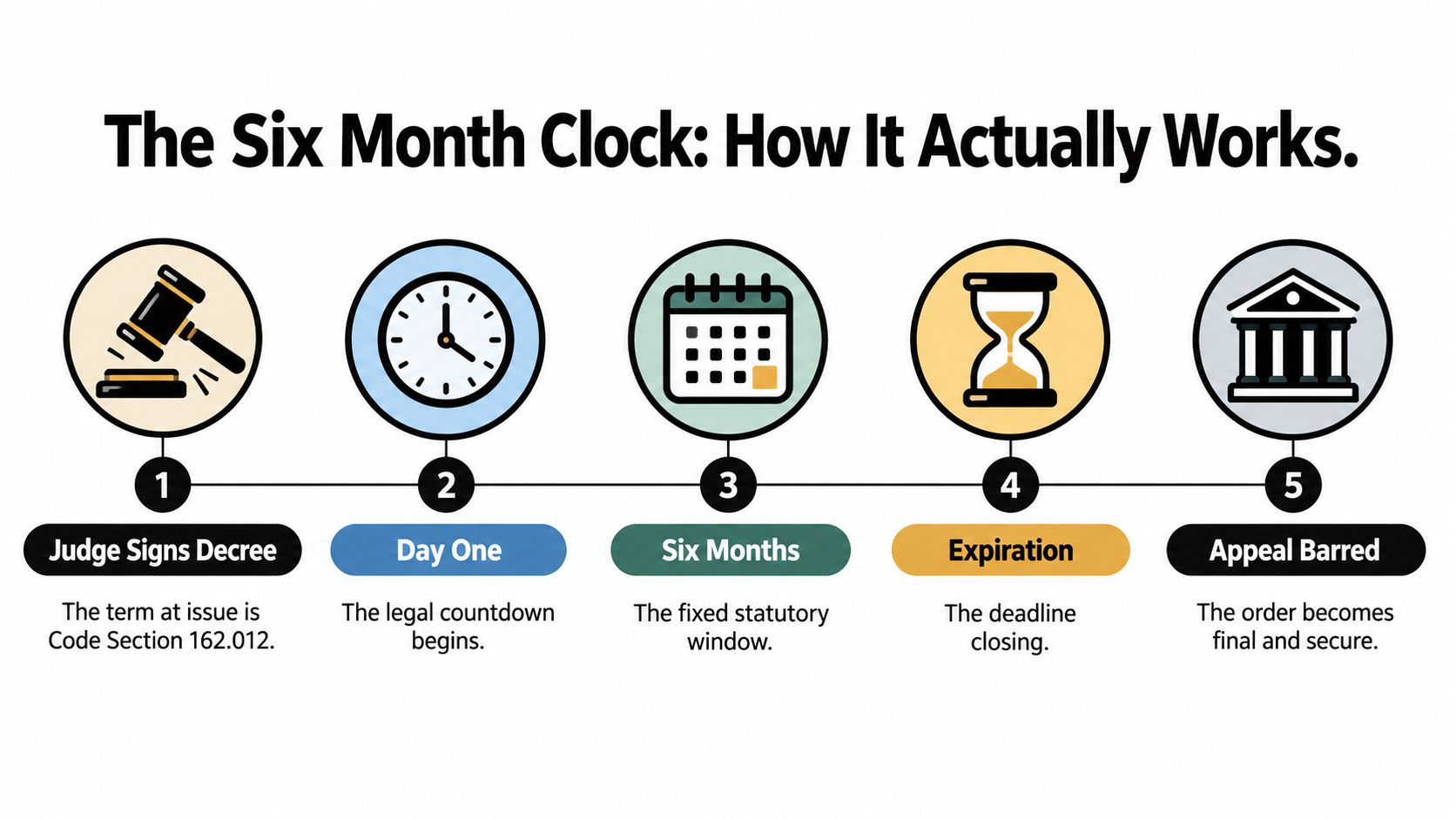
A parent or relative may learn about a possible legal problem after an adoption has been finalized. The first question is often, “When did the deadline begin?” Under Texas Family Code § 162.012, the answer is tied to one specific event: the date the judge signs the adoption order. The clock does not begin when someone receives a copy in the mail, when the clerk finishes processing paperwork, or when a person discovers an alleged mistake.
Texas law provides that the validity of an adoption order is not subject to attack after six months from the date the order was signed. The statute also states that this rule overrides Texas Rule of Civil Procedure 329, which might otherwise affect the timing of challenges to judgments. The statutory language appears in Texas Family Code Chapter 162.
Follow the legal timeline
The signed decree works like the starting point on a legal calendar. The relevant events unfold in this order:
-
The judge signs the decree. This event starts the statutory period. The filing date, hearing date, or date the family celebrates at home does not control the calculation.
-
The legal countdown begins. Anyone who believes a serious legal problem exists should seek advice promptly. Delaying while collecting information can leave an attorney less time to review the record and prepare the proper filing.
-
The six-month window runs. The statute creates a defined period for attacking the adoption order. The period does not restart each time someone learns a new fact or becomes dissatisfied with the result.
-
The deadline expires. Once the statutory window closes, the law generally bars efforts to challenge the validity of the adoption order.
-
The adoption gains strong finality. Direct and collateral attacks are generally barred after the deadline. That finality gives the child and family a more secure legal foundation.
A direct attack asks the court to change or set aside the adoption decree itself. A collateral attack uses another proceeding to undermine the decree indirectly. A petition to vacate, a bill of review, or a lawsuit with a similar label may still qualify as an attack if its purpose is to invalidate the final adoption order.
Why the label doesn't control
A different title does not necessarily create a different deadline. Texas Family Code § 162.012 examines the substance of the legal action, not only the name on the first page.
Calling a filing a “petition to vacate” does not automatically create a new opportunity to challenge the decree. Describing the case as a collateral proceeding may not avoid the statute either. If the requested relief would place the adoption order's validity in question, the six-month bar may apply. The same strict timing principle applies to termination orders, as explained in this guide to the Family Code 161.211 six-month limit to attack a termination order.
Timing also matters before an adoption becomes final. In many cases, Termination of Parental Rights Before Adoption is a necessary step because the court must resolve another parent's legal status before granting the adoption.
Write down the signature date: Keep a complete copy of the signed decree and confirm the date on which the judge signed it. Treat that date as a critical legal milestone.
If a parent or relative believes something went wrong, waiting for emotions to settle can create risk. Prompt legal review gives an attorney an opportunity to examine service, consent, termination orders, pleadings, and the court's jurisdiction while relevant records and evidence are easier to locate.
What It Means to Attack an Adoption Order
The word attack can sound harsher than the legal meaning. It doesn't necessarily describe a person's character or motives. In this context, an attack is a legal effort to invalidate, vacate, overturn, or otherwise undermine a final adoption order.
A birth parent may believe they weren't properly included. A relative may claim that important information was withheld. An adoptive parent may discover a paperwork problem and fear that the decree is vulnerable. The emotional reasons differ, but the legal question is whether the requested court action would call the adoption order's validity into question.
Direct and collateral challenges
A direct challenge openly asks the court to set aside the adoption. The filing may say that the decree should be vacated or declared invalid.
A collateral challenge takes a less obvious route. Instead of asking directly for the adoption order to be undone, a party may ask another court or use another type of proceeding for relief that would effectively defeat the adoption. Texas courts treat the substance of that request as important.
The distinction matters because some people assume a new label creates a new legal opportunity. It generally doesn't. If the proceeding is designed to undo the adoption order, the six-month finality rule may apply even if the pleading uses different terminology.
Why courts protect permanence
An adoption order doesn't affect only the adults who appeared in court. It affects the child's identity, home, relationships, medical decisions, inheritance interests, and emotional security. Endless litigation can place a child in the middle of adult conflict and make ordinary family life feel conditional.
Texas Family Code § 162.012 therefore creates a strong boundary around final adoption judgments. The statute does not invite families to ignore serious concerns before finalization or during the six-month period. Instead, it tells parties that legal objections must be raised promptly, while the court can still examine the record and address an appropriate claim.
A person considering a challenge should obtain advice based on the actual decree and case file. The Texas resource on contesting an adoption may help explain the types of issues that can arise, but general information can't determine whether a specific case is timely or legally viable.
The child's best interests remain central
Finality can feel unfair to an adult who believes the process was wrong. Yet the court must also consider what continued uncertainty would do to the child. A child shouldn't have to wait indefinitely for adults to resolve competing claims to parenthood.
That balance is one reason the deadline is so strict. It encourages parties to raise concerns when the court can address them, while protecting the child from a legal status that remains permanently unsettled.
Common Myths About Exceptions and Loopholes
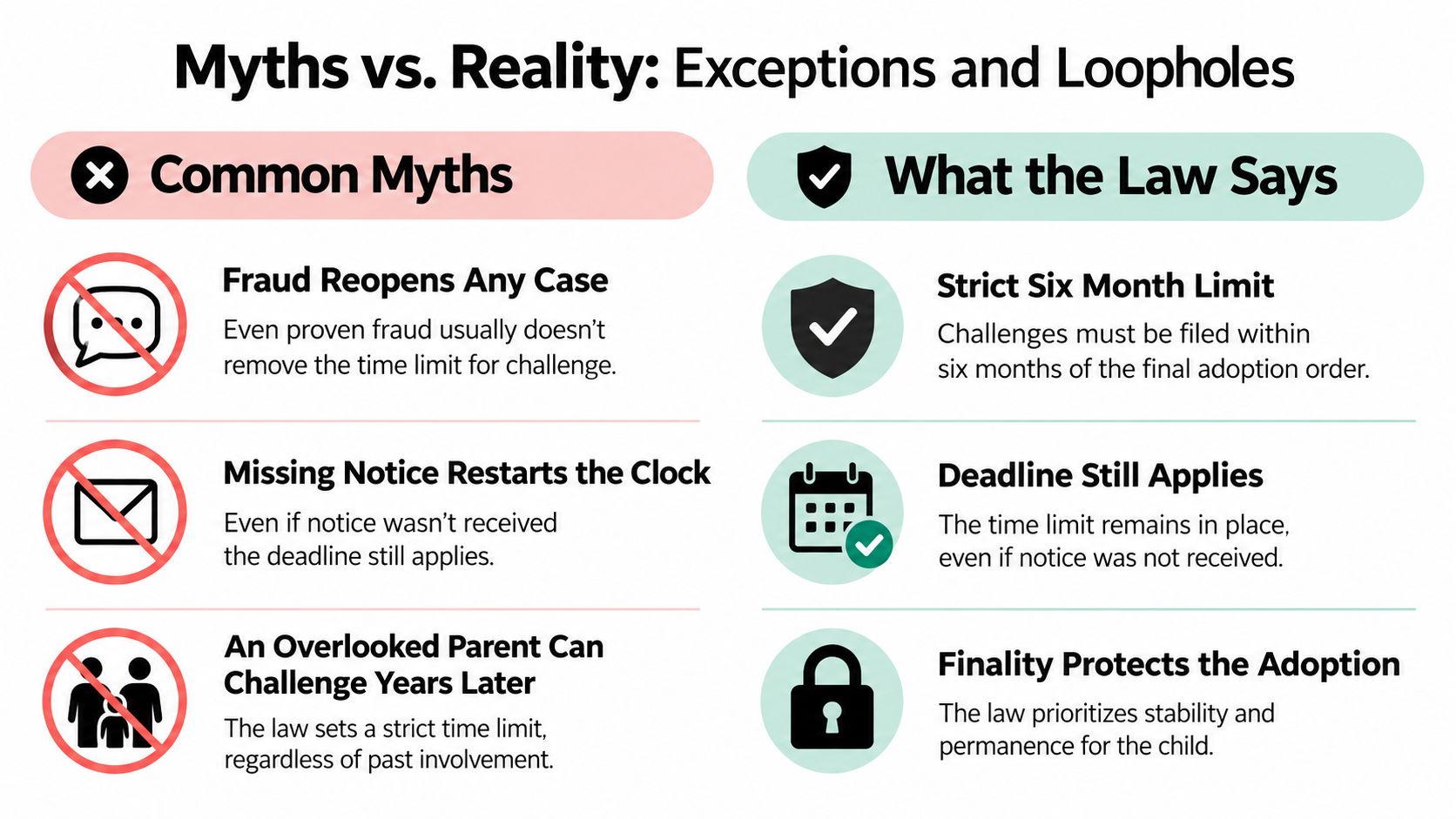
Adoption disputes often grow more frightening because people hear broad statements such as, “Fraud means the case can always be reopened,” or, “A missing biological parent can challenge the adoption years later.” Those statements can lead families to either panic unnecessarily or delay action when immediate legal advice is needed.
The statute and recent Texas authority point to a much narrower reality. Texas treats the six-month limit as a strong finality bar, and recent practitioner commentary discussing a 2026 Texas appellate decision explains that both direct and collateral attacks were barred after the deadline. The same discussion states that allegations involving lack of service, failure to join a biological parent, or fraud did not fit a broad exception. See the discussion of Texas Family Code § 162.012.
Myth one fraud automatically reopens an adoption
Fraud allegations are serious, but seriousness doesn't create an unlimited right to challenge a final adoption. A person who believes deception affected the case should speak with a lawyer immediately and preserve evidence. After the statutory period closes, however, the claim may still be barred if it is an attack on the adoption order.
Myth two missing notice restarts the clock
A person may feel certain that lack of notice should allow a challenge at any time. The recent authority described above rejects the idea that a notice allegation automatically defeats finality after the deadline. Whether a court had jurisdiction and whether a party received legally required notice can involve complex questions, so those concerns should be reviewed promptly rather than saved for years later.
Myth three an overlooked parent can always return
A biological connection alone doesn't establish an unlimited right to undo a final adoption. Parentage, notice, consent, termination, and jurisdiction may all matter before finalization. Once the six-month bar applies, the fact that someone now wishes they had participated doesn't automatically create a loophole.
A careful distinction matters: A possible jurisdictional issue should be investigated quickly. It should not be treated as a promise that the adoption can be reopened after the deadline.
Families sometimes confuse “the law allows a court to consider a serious problem” with “the law guarantees a late challenge will succeed.” Those are very different ideas. A lawyer must examine the order, the pleadings, the service record, and the specific relief requested before offering a responsible opinion.
The safest response to a suspected defect is not to search for a clever label. It's to gather the complete court file and obtain timely advice. That approach protects the child's interests while giving each adult a fair opportunity to understand what the law permits.
Building a Secure Foundation Before the Deadline
The strongest protection for an adoption begins before the judge signs the final decree. A family can't rely only on the six-month finality rule. The legal foundation should be carefully built through the required consent, termination, investigation, placement, and court-approval steps that apply to the specific adoption.
Texas adoption cases generally proceed under the Family Code's adoption provisions in Chapters 162 through 166. The exact path depends on whether the case involves a stepparent, relative, private placement, foster care, LGBTQIA+ parents, or another family structure. The court's central concern remains the child's best interests and whether the legal requirements have been satisfied.
Start with legal parentage
In many stepparent adoptions, the child's other legal parent must consent or have parental rights terminated before the adoption can proceed. Texas permits a stepparent and spouse to file the adoption request together with a request to terminate the other parent's rights when the facts support that approach. The Texas State Law Library explanation of stepparent adoption describes these basic requirements in plain language.
This step can be emotionally difficult. A stepparent may already be the person who handles school, appointments, meals, and bedtime. Even so, a strong existing relationship doesn't replace the court's need to resolve the other parent's legal rights.
Confirm residence and eligibility requirements
Texas law also addresses the child's residence with the petitioner. In a stepparent case, the child generally must have lived with the petitioner for at least six months before the court may grant the adoption, although a judge may waive that requirement when doing so serves the child's best interests.
Other family relationships have their own requirements. Texas Family Code § 162.001 includes eligibility paths for certain former stepparents, relatives, and caregivers. Depending on the situation, the statute addresses the child's age, termination of one parent's rights, managing conservatorship, actual care, possession and control, and consent from a parent whose rights haven't been terminated. Review the eligibility provisions under Texas Family Code § 162.001 with counsel before assuming a family relationship alone is enough.
Keep each stage organized
A secure adoption record should tell a consistent story from the first filing through finalization.
- Consent and notice: Identify every person whose consent or notice may be required and document how the legal process addressed them.
- Home study and investigation: Complete any screening or home-study requirement that applies to the case and respond promptly to requests for information.
- Termination orders: Confirm that any termination of parental rights was properly requested, heard, and signed before the adoption depends on it.
- Final hearing: Bring the necessary documents and be prepared to explain the child's relationship with the petitioner and the family's plans for care.
- Signed decree: Obtain the final order and preserve the judge's signature date in the permanent case records.
The goal isn't to create a perfect-looking file for its own sake. It's to give the court reliable information and give the child a stable legal foundation. Careful preparation reduces avoidable disputes and helps families move toward finalization with fewer surprises.
Protecting Your Family with Experienced Legal Guidance
Families often reach the final hearing exhausted. They've completed forms, answered personal questions, gathered records, attended appointments, and managed the emotional needs of a child who may already see the petitioner as a parent. It's tempting to treat the final signature as a formality.
That can be a mistake. The final decree is the document that establishes the adoption, and the date the judge signs it starts the six-month period under Texas Family Code § 162.012. A careful legal review before that moment can identify missing consent, notice concerns, unresolved termination issues, or inconsistencies in the court record while there's still an opportunity to address them.

What to do before finalization
If your hearing is approaching, gather the complete file rather than relying on memory. Include the adoption petition, consents, affidavits, service documents, termination orders, home-study materials, and any prior orders involving conservatorship or possession.
Ask counsel to review:
- Whether the correct parties were identified
- Whether required consent or notice was properly handled
- Whether the court has authority to decide the case
- Whether residence, possession, or eligibility requirements apply
- Whether the proposed decree accurately reflects the relief requested
- How to preserve the signed order and signature date after the hearing
Birth parents, adoptive parents, stepparents, relatives, and foster caregivers may need different advice. A birth parent may need to understand whether a concern involves regret, an alleged defect in consent, or a jurisdictional issue. An adoptive family may need help confirming that every procedural step is documented. A relative may need guidance about whether adoption or guardianship better protects the child's needs.
What to do after an order is signed
If you already have an adoption decree and someone has raised a challenge, don't respond based on a phone call, social media post, or general internet advice. Preserve every notice and message, obtain the court file, and speak with a Texas family law attorney as soon as possible. The timing of the signed order and the exact relief requested may determine whether the statute applies.
If you're outside the six-month period, that doesn't mean every concern should be ignored. It does mean you need a precise legal analysis, not a broad assumption that fraud, missing notice, or an overlooked parent automatically creates an exception.
Peace of mind comes from preparation: A family deserves to understand both the strength of its decree and the limited steps available if a genuine legal concern appears.
A compassionate attorney should explain the options without inflaming fear. The purpose of legal guidance isn't to turn every family disagreement into a lawsuit. It's to protect the child, respect the adults involved, and help the family make informed decisions before time limits close.
The Law Office of Bryan Fagan, PLLC offers guidance on Texas adoptions, termination of parental rights, stepparent and kinship matters, consent questions, and finalization issues. Schedule a free consultation through Law Office of Bryan Fagan, PLLC to review your adoption order, confirm the relevant signature date, and understand what steps may protect your family.
