 Skip to content

Your father's unpaid bills are spread across the kitchen table. He seems confused about a notice threatening his housing, and you're worried someone is taking advantage of him. You want to help today, but you don't know whether being his adult child gives you the authority you need.
Families searching for emergency guardianship in Texas often face this mix of urgency, fear, and uncertainty. The right next step starts with identifying the immediate danger, choosing the correct legal process, and planning for what happens after the court acts.
Understanding Emergency Guardianship in Texas
Suppose your father can no longer explain a threatening financial transaction or understand why his housing is at risk. That situation calls for a different legal analysis than a disagreement about how he spends his money. Emergency guardianship concerns immediate protection, not whether relatives approve of someone's choices.
Under Texas Estates Code §1251.001, a court needs substantial evidence that the person may be incapacitated and probable cause to believe the person, their estate, or both need immediate protection. In plain English, the judge needs concrete support for both the person's difficulty making decisions and the danger that cannot safely wait.
What the court is being asked to authorize
The proposed ward is the person who may need protection. The proposed guardian is the person asking for legal authority to help. An estate, in this setting, means the person's money and property, not just assets left after death.
The court can tailor authority to personal needs, financial protection, or both. It doesn't automatically give the guardian control over every part of the person's life. For example, evidence of an urgent threat to a bank account doesn't, by itself, explain why someone should control the person's daily care.
Texas Emergency Guardianship at a Glance
| Question | What the reader should identify |
|---|---|
| Who needs protection? | The proposed ward and their present circumstances |
| What cannot safely wait? | A specific threat to personal safety, property, or both |
| What supports the concern? | Records, direct observations, and other corroboration |
| What authority would address it? | The particular decisions or transactions requiring court authorization |
| Who could serve? | A proposed guardian whose qualifications can be explained |
Protection without erasing dignity
The probate-court process asks a judge to examine the emergency rather than accept a relative's conclusions. The person at the center of the case still deserves a voice, legal safeguards, and respect for decisions the order doesn't transfer.
Practical rule: Describe the danger first. Then explain the smallest amount of legal authority needed to address it.
This overview illustrates how the emergency request connects to court review and limited protection.
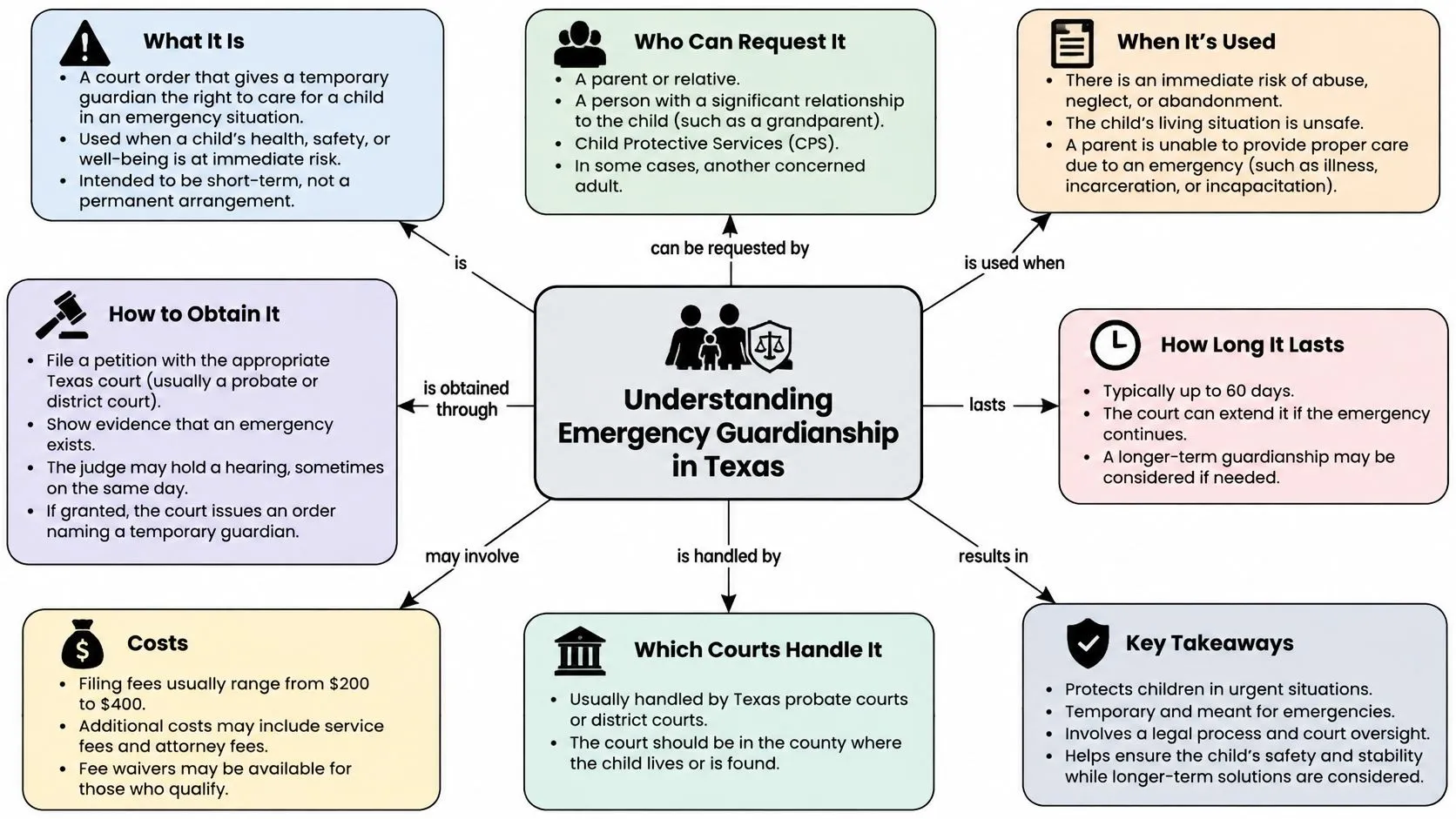
It's understandable to want broad authority when you're frightened. A focused request, however, helps keep the court's attention on your loved one's actual needs rather than the family's understandable anxiety.
Choose the Correct Legal Pathway
Not every family emergency belongs in a guardianship case. An incapacitated adult's financial crisis, a child's unsafe placement, and a relative's wish to adopt involve different questions. Before preparing paperwork, identify whose rights are involved and what protection you need.
Choosing the Correct Texas Legal Pathway
| Route | Who or what is at risk | Typical protective focus | Key question before filing |
|---|---|---|---|
| Adult emergency guardianship | An adult who may be incapacitated, their property, or both | Immediate, limited decision-making authority | What documented danger cannot wait? |
| Ordinary guardianship | A person with continuing decision-making needs | A longer-term court-supervised arrangement | What support will remain necessary after the crisis? |
| Temporary child custody | A child whose care or safety requires court attention | Temporary placement and parenting arrangements | Which court has authority over this child? |
| Protective-order evaluation | A person facing abuse or threatening conduct | Safety-focused relief appropriate to the circumstances | Is protection from someone's conduct the central need? |
| Adoption | A child and the people seeking to become legal parents | A permanent parent-child relationship | Have parental-rights and adoption requirements been addressed? |
For an adult, ask counsel whether an existing lawful decision-making arrangement can address the problem without a new guardianship. The firm's overview of Texas guardianship laws provides related context. If dementia-related bills and household management are part of the concern, Velma's guide for families navigating dementia finances can help you organize practical questions, although financial guidance doesn't create legal authority.
When a child needs emergency protection
A child's presence in Texas doesn't automatically resolve an interstate custody question. Under Texas Family Code §152.204, temporary emergency jurisdiction requires the child to be physically present in Texas and abandoned, or to need protection because the child, a sibling, or a parent faces mistreatment or abuse.
Tell counsel about existing custody orders, pending cases, and everyone involved. A Texas emergency order isn't automatically a permanent custody decision. Coordination with the appropriate interstate court may be necessary.
When the family's goal is adoption
Don't treat Texas Family Code Chapters 162–166 as one emergency application. For the child-adoption questions discussed here, Chapter 162 provides the relevant adoption framework. Counsel should identify which provisions apply to your family rather than assuming every chapter applies.
The adoption petition must address each living parent's legal status. Depending on the circumstances, parental rights must already be terminated, termination must accompany the adoption, or the stepparent exception must apply because the parent retaining rights is the petitioner's spouse.
Preparation then moves through distinct stages:
- Resolve the legal foundation. Identify consent, termination, and any requested waiver with counsel.
- Prepare for assessment. Gather household information and complete the applicable home-study process.
- Support the transition. Keep the child's relationships, stability, and best interests central.
- Prepare for finalization. Chapter 162 generally requires the child to live with the petitioner for at least six months, unless the court waives that period in the child's best interest.
A grandparent seeking permanence needs a different plan than a stepparent or foster parent. Finalizing a Texas Adoption: The Final Hearing explains the hearing that makes an adoption legal.
Gather Evidence for an Urgent Petition
A worried family member may know something is wrong without knowing how to prove it. Start by separating what you personally observed, what someone told you, and what records show. That distinction helps your attorney present an accurate account without turning uncertainty into an allegation.
Supporting a loved one also means approaching sensitive records with patience and respect.

Build a record that connects danger to relief
Create a dated timeline. Include what happened, who witnessed it, what document supports it, and why delay could cause harm. Preserve original messages and documents rather than editing them into a more persuasive story.
Organize the material into clearly labeled groups:
- Medical information. Records or observations addressing the person's present ability to understand and respond to the crisis.
- Financial and housing records. Statements, overdue notices, disputed transfers, eviction correspondence, and communications about threatened losses.
- Agency and law-enforcement material. Available police reports, Adult Protective Services information, or relevant contact details.
- Photographs and witness information. Images that accurately show the concern, along with the names of people who directly observed events.
- Urgent communications. Messages from care providers, landlords, financial institutions, or others explaining what action is needed.
Texas guidance supports an evidence-based emergency workflow and distinguishes medical support from a universally required medical certificate. A certificate of medical examination isn't legally required for temporary guardianship, although the state guardianship office seeks one when available, as reflected in Texas protective-services guidance. That distinction doesn't mean medical evidence is irrelevant or that an individual court won't need meaningful support for the claimed incapacity.
Turn a broad fear into a focused request
Consider a hypothetical daughter who says her mother may lose her home. That statement raises concern, but it leaves important questions unanswered.
A stronger presentation would include the actual housing notice, unpaid bills, relevant medical information, and messages showing why her mother cannot respond safely. Counsel can then evaluate whether a narrowly defined request concerning those obligations fits the documented emergency.
A useful evidence packet answers both questions: What is happening, and why does this particular court-authorized power address it?
The sworn application must identify the proposed ward, describe the imminent danger, specify the protection requested, provide supporting facts, and explain the proposed guardian's qualifications. Give your attorney unfavorable facts too, including documents that contradict your understanding. An accurate record is more useful than a carefully selected one that leaves the court surprised.
Prepare and File the Emergency Application
Filing begins with confirming the appropriate probate court for the proposed ward's circumstances and location. Don't assume the courthouse nearest your own home is the correct place. Ask counsel to resolve the filing location before preparing a court-specific packet.
The sequence below shows the main preparation stages, but the county's current procedures still control the presentation.
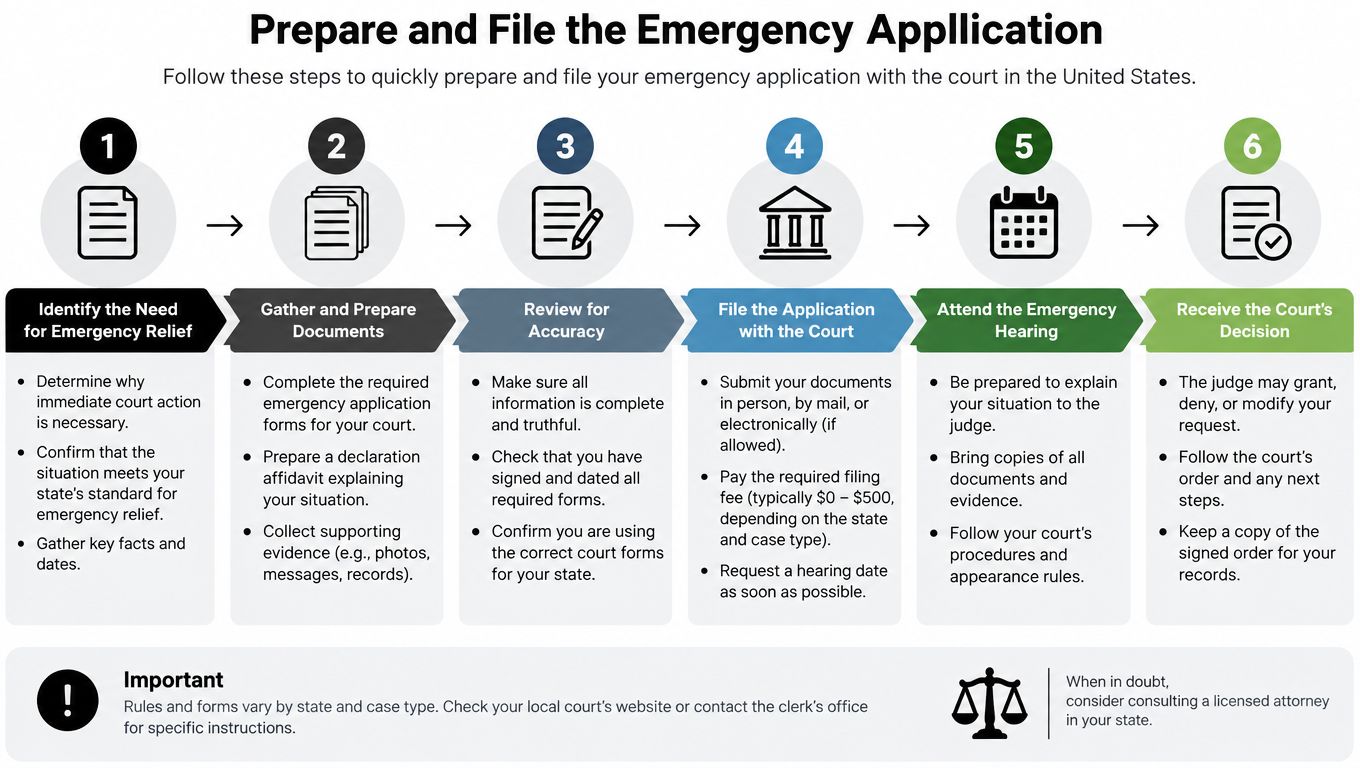
Assemble a packet someone else can follow
A court-ready application should let the judge move easily between the request and its supporting records. Use descriptive exhibit labels, a clear index, and consistent names. Avoid submitting a large collection of messages without explaining their relevance.
Your preparation checklist should include:
- The sworn application. Review names, locations, emergency facts, and requested relief for accuracy before signing.
- Proposed guardian information. Supply the qualifications and other information counsel needs to evaluate the proposed appointment.
- Supporting exhibits. Match each important factual statement to the relevant document or witness.
- Related proceedings and opposition. Identify known cases, counsel, disputes, and information relevant to notice.
- A proposed order for review. Make sure the requested language matches the protection you can support.
The firm's resource on legal guardian documents can help families organize document questions before meeting with counsel. It shouldn't replace the forms and instructions applicable to your particular court.
Verify local emergency procedures
County practice matters. The Texas guardianship practice guidance on temporary guardianship and emergency relief identifies an important Travis County requirement: counsel seeking emergency temporary guardianship relief should first confer with the court investigator or assistant investigator. Notice to an opposing party's attorney may also be required unless the court directs otherwise.
Ask the clerk about filing, assignment, and how emergency requests reach the judge. The clerk can explain administrative procedures, while your attorney should address legal sufficiency and strategy. File as early as practical, retain complete copies, and confirm what has been accepted rather than assuming an uploaded document has reached the right person.
For child-related emergency filings, don't import probate procedures into a custody case. Dallas County's emergency workflow generally calls for filing and assignment before presentation, with an exception when the clerk's office is closed and immediate judicial action is necessary. Counsel should verify the current local rule and arrange prompt docketing of any emergency action.
Use this video alongside, not instead of, advice about the procedure in your county.
Before leaving the filing stage, confirm who will communicate the hearing information and what additional materials counsel needs. Clear responsibilities help a frightened family avoid duplicate filings and missed messages.
Prepare for the Emergency Hearing
The hearing isn't a test of who loves your relative most. The judge needs to decide whether the evidence supports immediate intervention and whether the requested powers fit the danger. Prepare to explain the facts calmly, even if another relative disputes your account.
An effective presentation connects the person's current limitations with a specific consequence of waiting. Saying your brother has always been irresponsible is less useful than presenting a documented threat and explaining why he cannot safely address it now.
Understand the participants and safeguards
The proposed ward isn't merely the subject of the family's discussion. Under the statutory safeguards described earlier, an attorney ad litem is appointed when the person hasn't already retained independent counsel. That lawyer represents the proposed ward, not the applicant or the family as a group.
Court-investigator involvement may also require interviews or additional information. Prepare your loved one for contact without coaching their answers or promising a particular result.
Before the hearing, discuss these questions with your attorney:
- Evidence gaps. Which important facts depend on assumptions rather than direct knowledge?
- Witness roles. Who can explain the medical, financial, or safety issue from personal observation?
- Opposition. What does the other relative dispute, and what records address that disagreement?
- Notice concerns. Has counsel identified any unresolved service or presentation issue?
- Qualifications. Can the proposed guardian explain how they'll carry out the requested responsibilities?
Expect a decision tailored to the evidence
Consider contrasting hypothetical requests. A son presents records supporting urgent authority over a threatened financial obligation. His evidence may support a property-related request without establishing a need to control his mother's personal care.
A daughter presents a separate request involving personal safety but asks for unrestricted control of all assets as well. The judge may question why the financial authority is necessary. In either example, the family should be prepared for narrower relief than it initially sought.
Hearing preparation: Answer the question asked, identify the supporting record, and say clearly when you don't know.
The judge may limit, delay, or deny relief if the emergency, requested powers, or procedural foundation isn't adequately established. An emergency label doesn't resolve disputed facts.
If the court approves an appointment, don't assume the signed order alone allows immediate action. Confirm with counsel how the required oath or declaration and bond must be completed before the order becomes effective. Ask for a plain-English explanation of the final order before presenting it to a bank, care provider, or other institution.
Complete the First 60 Days
The most important work may begin after the hearing. Temporary authority is a responsibility to carry out a defined task under court supervision, not permission to manage everything.
A temporary emergency guardianship generally lasts no more than 60 calendar days, subject to an applicable statutory extension; the extension mechanism associated with a pending contest isn't permission for indefinite emergency management. Texas Estates Code §1251.101 also makes the order evidence of authority only within its expressly stated powers and duties.
Use this timeline as an organizational aid. Follow the actual order and counsel's calendar rather than treating an illustrated interim milestone as a universal court deadline.
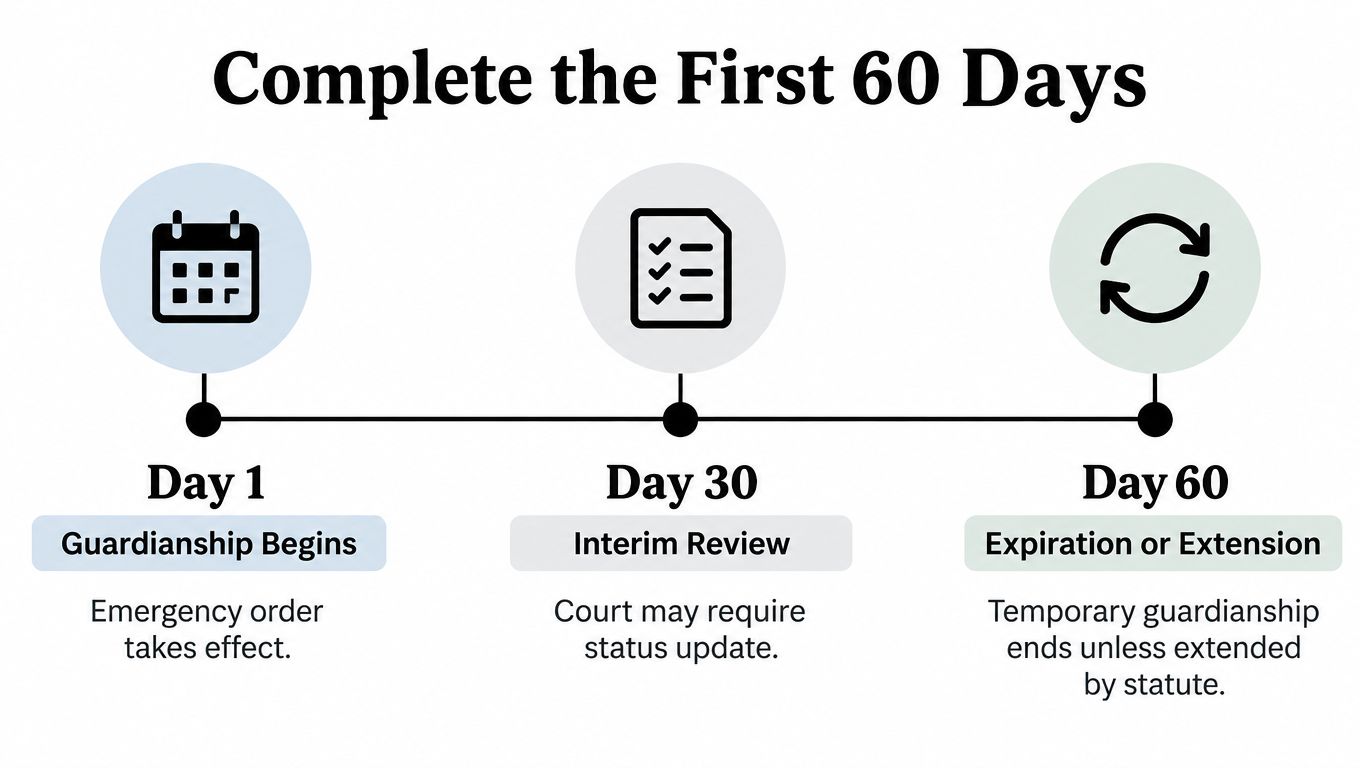
Begin with qualification and a working calendar
Before taking action, obtain confirmation that the required qualification steps are complete. Keep the effective order and qualification records together so you can explain your authority without relying on memory.
Build a task calendar with counsel:
- Activation tasks. Complete the required oath or declaration and bond process, and confirm when authority becomes effective.
- Notice tracking. Record who handles service or notice, what remains outstanding, and where proof is stored.
- Court obligations. Enter every reporting, hearing, contest, and expiration date applicable to this case.
- Institutional communications. Keep a log of documents provided to financial institutions, care providers, and others.
Don't use the filing date, hearing date, and effective date interchangeably. Ask counsel which date controls each obligation.
Keep a daily action record
Create a working inventory of property and decisions within your authority. For each transaction, preserve the date, purpose, amount, recipient, receipt, and connection to an authorized task. Keep personal expenses and your loved one's transactions clearly separated in your records.
Before signing anything, compare the proposed action with the order. A request from a bank employee or facility representative doesn't expand your powers. If a document asks you to accept obligations you don't understand, pause and get legal advice.
Respect decisions that remain with your loved one. Explain what you're doing in language they can understand and include them where possible. Protection should preserve dignity and family connection, not unnecessarily exclude the person from their own life.
Plan the transition before authority ends
Schedule a progress review with counsel while there's still time to act. Ask whether the immediate danger has changed, whether the person can resume ordinary decision-making, and whether a different lawful arrangement can meet the remaining need.
If ongoing guardianship appears necessary, discuss the permanent proceeding and the additional preparation it requires. Don't assume the emergency evidence automatically resolves the longer-term case.
As expiration approaches, confirm what authority ends, what records or reports remain due, and how institutions will learn about the change. A pending plan isn't the same as a new order. The transition should leave your loved one with a lawful, understandable arrangement rather than another avoidable crisis.
Avoid Pitfalls and Get Legal Help
The easiest mistake is asking the court for what would make caregiving simpler rather than what the evidence justifies. Another is obtaining an order and then treating its limits as administrative details. Both can distract from the person's actual safety needs.
A careful attorney can help separate an urgent legal problem from a family disagreement. That support is especially useful when relatives oppose each other, property access is disputed, records are extensive, or your loved one has trouble participating confidently.
Check the weak points before they become setbacks
Review the proposed approach with these risks in mind:
- Unsupported allegations. Identify what corroborates each serious concern.
- Overbroad requests. Remove powers that don't connect to the documented danger.
- The wrong proceeding. Distinguish adult incapacity from child custody, abuse protection, and adoption.
- Incomplete disclosure. Tell counsel about related cases, especially out-of-state child proceedings.
- Assumed procedures. Verify local requirements instead of copying another county's packet.
- Unexamined documents. Read the order before signing or authorizing anything.
- An unfinished transition. Assign responsibility for the next lawful arrangement.
Choose counsel who can explain the whole process
Ask a prospective attorney who will handle emergency communications, how they evaluate evidence, and what happens if the requested relief is contested. Ask how the office will track qualification, reporting, and expiration obligations after appointment.
Discuss costs and scope of representation early. The firm's overview of guardianship attorney fees can help you prepare questions, but request an explanation specific to your circumstances rather than assuming every case involves the same work.
For relatives considering adoption later, ask how temporary safety planning can preserve appropriate family connections while the separate permanency questions are resolved. Adoption preparation should focus on the child's best interests, not the adults' preferred outcome. The Texas Adoption Home Study Explained describes what that assessment evaluates and when a waiver may be considered.
You don't need to arrive with every answer. Bring the urgent notices, relevant orders, a short factual timeline, and your questions. Clear legal guidance can help you protect a vulnerable person without overlooking their rights.
The Law Office of Bryan Fagan, PLLC helps Texas families evaluate emergency guardianship, prepare court applications, and plan for the responsibilities that follow an appointment. Visit Law Office of Bryan Fagan, PLLC to schedule a free consultation, discuss your loved one's immediate risk, and identify the documents and next steps appropriate to your situation.

