 Skip to content

At the kitchen table, a Texas couple might be talking through the same questions many hopeful parents face: Which adoption path fits us? Will an agency work with us? How do we make sure both of us are legally recognized as parents? These questions can feel especially heavy when you're excited about building a family but unsure where to begin.
Texas permits gay couples to adopt, but knowing that doesn't answer every practical question. The right process depends on your family, the child's circumstances, and the kind of adoption you're pursuing. Whether you live in Houston, Dallas, Austin, San Antonio, or a smaller community, understanding the legal steps can help you move forward with care and confidence.
A Hopeful Starting Point for Texas Families
Adoption is both a legal process and a deeply personal decision. You may be considering adopting together, becoming a parent to your spouse's child, or providing a permanent home to a child you've fostered. Each path can bring different paperwork, screening, court requirements, and conversations with birth parents or relatives.
It's also normal to worry about how an agency or evaluator will respond to your family. The fact that a couple is legally eligible doesn't mean every provider will be equally experienced or welcoming. Families outside major cities may have fewer nearby options, but distance alone doesn't mean adoption is out of reach. Virtual consultations and geographically flexible home-study resources may help you explore providers beyond your immediate area.
Start with the child's needs and your family's legal situation. The adoption route should fit both, rather than forcing your family into a process that doesn't match your circumstances.
This guide walks through legal recognition, adoption pathways, the Texas process, and ways to respond if a provider's practices create barriers. It also considers the emotional work that can continue after placement, including helping a child understand adoption and supporting their identity and connections.
You don't need to have every answer before you ask for guidance. A useful first step is to gather what you already know about the child, identify any existing legal parent or guardian, and write down your questions about agencies, court orders, and parentage. That gives you a clearer starting point for a conversation with an adoption professional.
The Legal Foundation for Same-Sex Adoption
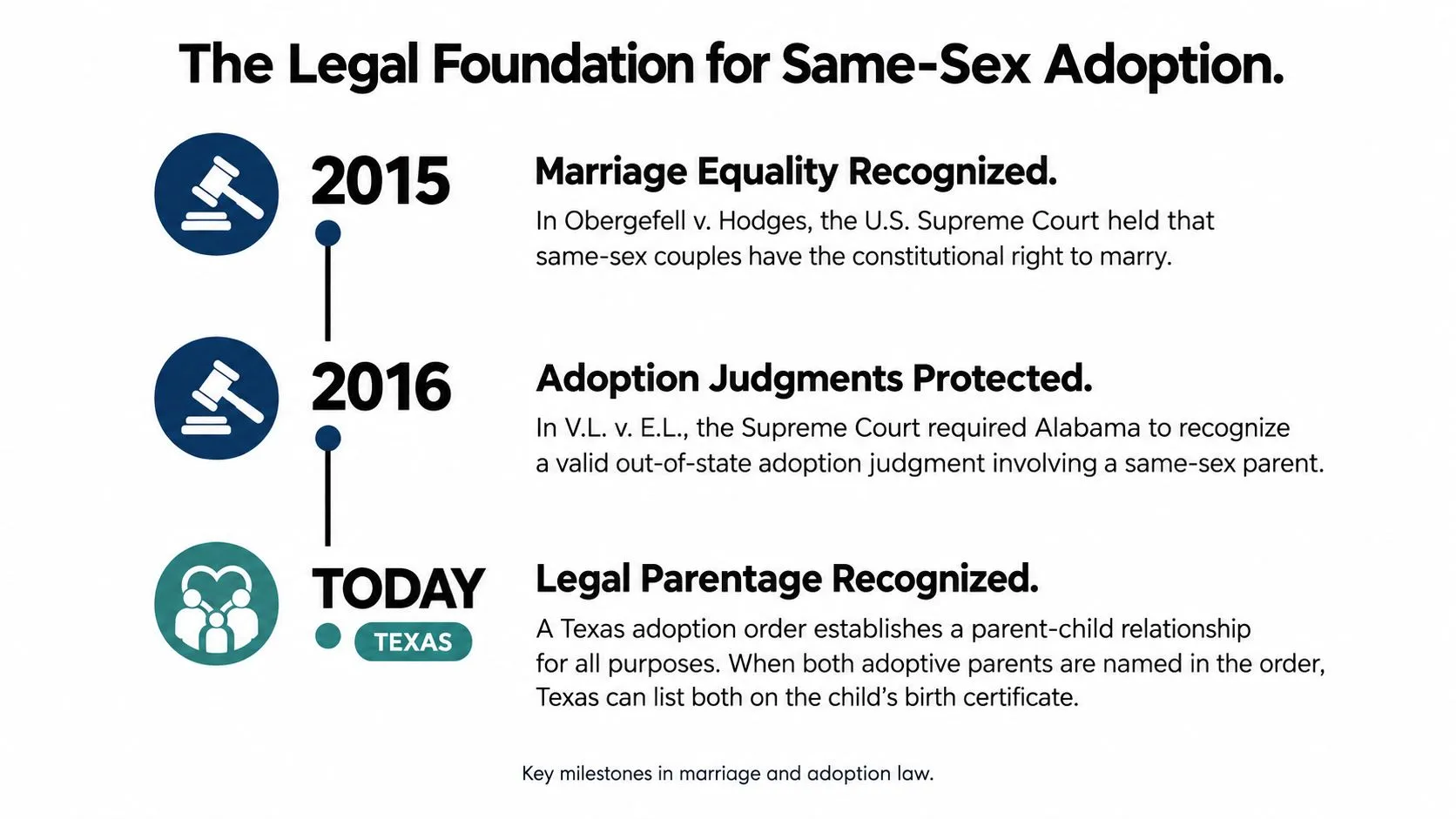
Same-sex couples may pursue adoption in Texas. The U.S. Supreme Court's 2015 decision recognizing same-sex marriage nationwide strengthened legal recognition of married couples, including their family relationships. Texas adoption procedures are primarily addressed in Family Code Chapters 162 through 166. The exact requirements depend on the type of adoption and the facts of the case, so legal eligibility and the steps needed to complete an adoption are related but separate questions.
The history of adoption rights helps explain why formal court orders still matter. Canada approved same-sex adoption without restrictions in 1999. The Netherlands followed in 2001, and South Africa and Sweden adopted comparable policies in 2002. In England and Wales, the Adoption and Children Act 2002 enabled gay and lesbian couples to adopt jointly. Iceland's Parliament approved equal access to adoption, parenting, and assisted insemination in 2006, and France approved same-sex marriage and adoption in 2013. The Netherlands permitted joint adoption by same-sex couples in 2000, and more than 30 countries had followed by 2024, according to the history of LGBT adoption.
In Texas, the right legal route depends on who is already a parent and how the child came into the family:
- Joint adoption means both spouses petition to adopt a child together.
- Second-parent or co-parent adoption is a way to establish legal parentage for a partner when the other partner is already the child's legal parent, subject to the case's facts and applicable law.
- Stepparent adoption allows a spouse to seek adoption of the other spouse's child through the court process.
A birth certificate or marriage certificate may not answer every question about a parent-child relationship. A formal adoption decree can establish legal parentage through a court order, which matters when a family must show who has parental rights and responsibilities. The Texas second-parent adoption process can help families understand why it's important to assess the right legal approach for their situation.
Adoption Pathways Available to Gay Couples in Texas
The best route depends on whether you're seeking to adopt a child who needs a permanent home, completing a private placement, or securing the legal status of a child already in your family. Ask what each path requires, how it handles parentage, and what contact with birth parents or relatives may look like.

Public and private adoption
Public adoption through foster care may fit families open to fostering a child while the child's case moves toward a permanent plan. Foster care prioritizes the child's safety and may include efforts to reunify the child with birth parents when appropriate. Adoption may become an option if reunification isn't possible and the court approves a permanent plan.
Private agency adoption may fit families seeking to adopt through an agency. The agency can explain its process, screening, and expectations for contact with birth parents. Independent adoption may involve a direct arrangement with birth parents, with legal support to address the required consents and court process.
Adoption within an existing family
If one spouse is already a child's legal parent, second-parent or stepparent adoption may help establish the other spouse's legal parent-child relationship. This can be especially relevant when a child was born through assisted reproduction or has been raised by both partners, but only one is legally recognized as a parent.
Kinship adoption is another possibility when a relative cares for a child. A grandparent, aunt, uncle, or other relative may be exploring adoption as a way to provide lasting legal security. The needs and legal status of the child will shape what the court requires.
Before choosing a route, ask providers how they work with LGBTQ+ families, what happens if birth parents change their plans, and how both intended parents will be recognized in court. Public foster care, private placement, and an adoption within an existing family don't use interchangeable procedures.
Walking Through the Texas Adoption Process
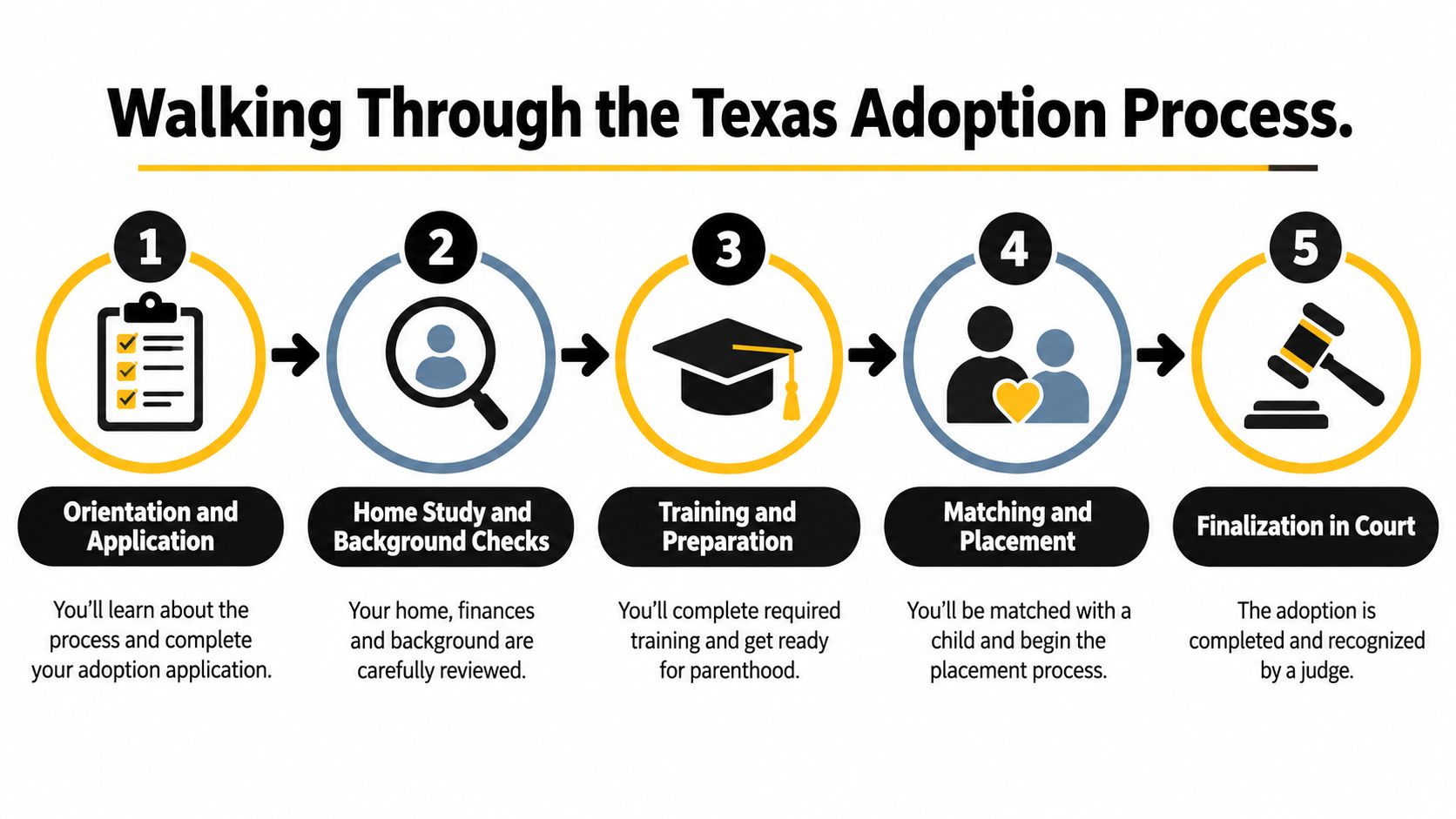
Texas adoption procedures vary by case, but most families can expect a series of stages: learning about the route, completing screening, preparing for placement, and asking the court to finalize the adoption. Family Code requirements and agency procedures can differ, so confirm what applies to your case.
From application to preparation
Orientation and application: Learn how the program works, identify the adoption type you're pursuing, and complete the provider's application. Start gathering identity, household, and personal-history documents that the agency or attorney requests.
Training and screening: Foster care and agency programs may require training to prepare parents for a child's needs. Screening can include interviews, background checks, and a home study or other pre-adoptive assessment. A home study is a review of your household, readiness, and ability to care for a child. It isn't a test of whether your family looks a certain way.
Matching and placement: If you're pursuing an agency or foster-care adoption, a match or placement may follow after the required preparation. The child's needs and safety guide the process. For a relative or stepparent adoption, the path may focus more on the child's existing relationships and legal parentage.
Placement and finalization
After placement, the case may require supervision or reports before the final hearing. Keep records about the child's adjustment, care, and relationships, and respond promptly to requests from the agency or court. Families should ask which reports apply to their case rather than assume every adoption follows the same schedule.
Texas law generally requires a child to live with a prospective adoptive parent for at least six months before the court may grant an adoption. A judge may waive that period when doing so serves the child's best interests. The court, not the family, decides whether a waiver is appropriate. This requirement appears in Texas Family Code Chapter 162.
For a stepparent adoption, the stepparent and the child's legal parent who is married to the stepparent typically file together. The other legal parent's rights generally must be addressed before adoption can be granted. The judge must also decide that adoption serves the child's best interests. Families can review when to hire a Texas adoption attorney to understand how legal guidance can help protect an adoption from delays and challenges.
The video below offers another way to follow the general process. Your own case may require different steps.
Common Barriers and How to Move Past Them
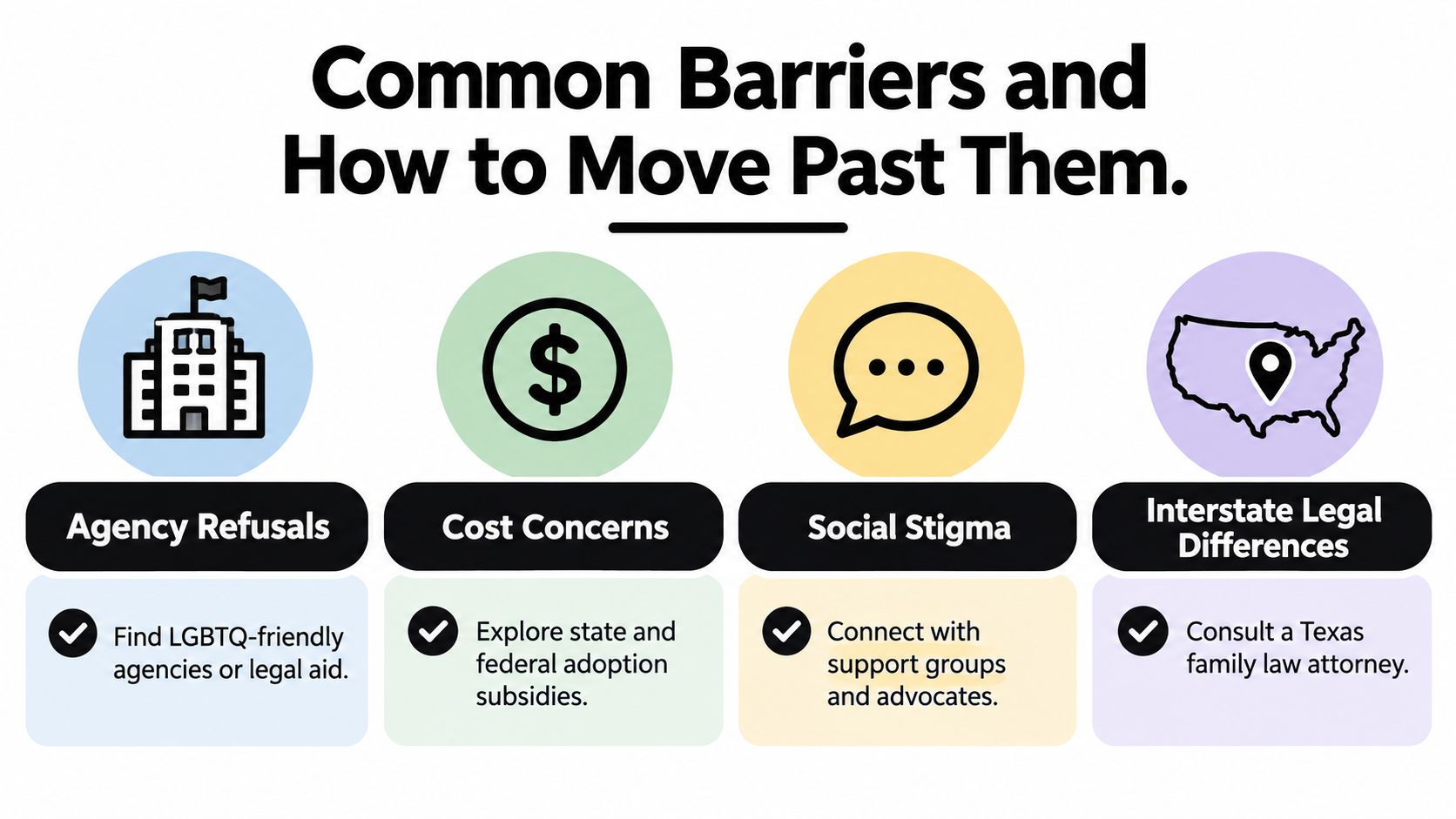
Legal recognition doesn't guarantee an easy path through every agency, home study, or court process. LGBTQ+ families can encounter providers who have limited experience with same-sex parents or rely on assumptions about what a family should look like. That concern may be more pressing for families in rural areas or smaller communities, where the local choice of agency or evaluator may be limited.
Research on same-sex couples outside large metropolitan areas found that 80% of participants encountered at least one barrier that disrupted the process. In that study, 18% had difficulty finding a local agency willing to work with same-sex couples, and 41% were uncertain whether a co-parent adoption would be completed. These findings are described in research on barriers to LGBTQ+ adoption. They don't predict what any particular Texas family will experience, but they show why it helps to ask direct questions early.
Practical ways to assess a provider
When you contact an agency or evaluator, ask whether they have worked with LGBTQ+ adoptive parents and how they handle both intended parents' roles during screening and court preparation. Ask whether interviews or parts of a home study can be completed virtually if travel is difficult. You can also ask how the provider addresses a co-parent or second-parent adoption when one partner is already the child's legal parent.
If a provider declines to work with you, keep the communication and note what reason was given. You may want to seek another qualified provider and ask an attorney whether the refusal raises legal or procedural concerns. Review the provider's policies before investing time in a process that may not fit your family. Information about religious exemptions for Texas adoption agencies can help families understand why agency policies deserve careful attention.
Access can also be affected by distance, cost, and uncertainty about what the court will require. A virtual consultation, an evaluator with a broader service area, or a referral from a family-law professional may help identify workable options. Comparative research involving LGBTQ+ adoptive parents across several countries also cautions that legal recognition alone doesn't remove institutional barriers. A thoughtful plan includes both legal eligibility and practical access.
Keep the focus on clear answers. Ask who will complete each part of the process, what records they need, and how the court will establish each intended parent's legal relationship with the child.
A Look Inside One Texas Family's Adoption Journey
Consider a fictional couple in a mid-sized Texas city who decide to foster with the hope of adoption if the child's case eventually allows it. At their first meetings, they ask how training works, what the home study will cover, and whether both of them will be treated as prospective parents. Their questions help them find a provider prepared to explain the process without assuming one partner is the “real” parent.
They complete the required preparation and welcome a child into their home. The child's biological mother remains part of the case, and the couple must balance hope for a permanent family with respect for the child's existing relationships. They ask what contact may continue and follow the case plan instead of promising the child an outcome the court hasn't approved.
During the placement period, the couple keeps notes about school routines, health appointments, and the child's adjustment. They also preserve the child's connections to important people when that is consistent with the child's safety and case plan. These records aren't a substitute for the agency's reports or court findings, but they help the parents speak clearly about the child's daily life.
As the case moves toward a hearing, the couple prepares to explain how the adoption would support the child's stability and welfare. They understand that the judge must consider the child's best interests and that any adoption order depends on the legal status of the case. The hearing feels emotional, not because the paperwork is confusing, but because it marks a major change in the child's legal family.
Every real case is different. The story shows why patience, honest communication, and a child-centered approach matter from placement through finalization.
Costs and Timelines You Can Plan Around
Adoption costs depend on the path, provider, and services required. Families may need to ask about home-study expenses, court filing fees, agency or attorney fees, post-placement reports, and travel. The amount and timing can vary, so get a written explanation of expected charges before you commit to a provider.
| Expense Category | Typical Range | Often Reimbursable in Foster-to-Adopt | Notes |
|---|---|---|---|
| Home study | Varies by provider and case | Ask the agency or program | Confirm what screening and visits are included. |
| Court filing fees | Varies by court and case | Ask whether assistance may apply | Check which filings your case requires. |
| Agency or attorney fees | Varies by service and adoption type | Ask about foster-care support | Request an explanation of the work covered. |
| Post-placement reports | Varies by case | Ask the agency or program | Confirm how many reports are required for your case. |
| Travel | Depends on placement location | Ask the agency or program | Consider visits, appointments, or court travel. |
The table intentionally doesn't give dollar ranges because fees vary and no verified figures are available here. Ask providers whether payment can be scheduled, whether a fee may be reduced or reimbursed, and what support may apply to a foster-care adoption. Families can also review Texas private adoption cost categories while building a budget.
Timelines also differ. Foster-care cases depend on the child's circumstances and court decisions, while private adoption can involve waiting for a match and completing required steps. A child's required residence period before finalization may affect timing, though a judge can waive it when the child's best interests support doing so.
Make a planning list before you begin: identify likely expenses, ask when each payment is due, and leave room for changes in scheduling or required reports. A provider should be able to explain which items are estimates and which are set by the court or program.
Questions Texas Families Ask Most Often
Can both spouses be named in an adoption petition? Depending on the adoption type and the family's circumstances, spouses may pursue a joint adoption. In a stepparent adoption, the stepparent and the child's legal parent who is their spouse typically file together.
What does second-parent adoption do? It establishes a legal parent-child relationship for a partner when the other partner is already the child's legal parent, subject to the applicable Texas process. A lawyer can review how the child came into the family and what court steps apply.
What if a birth parent changes their mind after consenting? Consent, termination of parental rights, and the timing of a change of mind depend on the case and applicable law. Don't assume an initial agreement makes adoption final. Get legal guidance promptly if a birth parent withdraws or disputes consent.
Can an adopted child access original birth records later? Access depends on the records involved and the laws and procedures that apply. Ask the adoption professional or attorney handling the case what records will be sealed, maintained, or available, and how to preserve the child's important history.
Adoption creates a lasting legal relationship, but the process also carries deep personal meaning for children, adoptive parents, birth parents, and relatives. Clear answers can help families make decisions that support the child's safety, identity, and lasting connections.
The Law Office of Bryan Fagan, PLLC helps Texas families understand adoption and guardianship options, prepare for home studies, and move through court proceedings, including LGBTQIA+ adoption matters. If you're considering adoption by a same-sex couple, visit Law Office of Bryan Fagan, PLLC to schedule a free consultation and discuss the legal steps for your family.

