 Skip to content

You may be sitting at the kitchen table with an agency brochure, an unfinished application, and a question that feels bigger than either: How do we choose the right adoption path? Comparing international adoption vs domestic starts with understanding your family's hopes, but it also means looking at uncertainty, legal responsibilities, and the support a child may need. You don't have to answer everything today. You need a clear place to begin.
Two Texas Families at the Starting Line
Consider two hypothetical Texas families. A Houston couple feels drawn to adopting a child from their ancestral homeland. They hope to share familiar foods, family stories, and a language that connects generations.
In Dallas, a stepfather already helps with homework, packs lunches, and comforts his wife's daughter after difficult days. He wants their legal relationship to reflect the family life they've built. His question isn't where to find a child. It's how to protect an existing bond.
These families face different practical decisions, even though both are considering adoption.

Start With the Relationship, Not the Ranking
For the Houston couple, useful questions include whether a country's program accepts their circumstances and whether they can manage travel and paperwork abroad. For the Dallas stepfather, the first task is understanding the child's current legal relationships, not comparing agencies.
| Decision point | Domestic adoption | International adoption |
|---|---|---|
| Starting relationship | May involve an existing family bond or a new placement | Involves adopting a child born outside the United States |
| Main legal focus | The applicable Texas pathway and parental rights | Foreign adoption requirements plus U.S. immigration |
| Financial planning | Depends on the particular domestic pathway | Must account for cross-border services and documentation |
| Family preparation | Child's relationships, history, and care needs | Those needs plus birth-country connections and immigration records |
Neither family should choose a path because someone calls it easier. A familiar relationship can still involve difficult legal questions, and a meaningful heritage connection doesn't remove international requirements.
The child's best interests should lead the decision. Ask what stability you can offer, whose relationships need protection, and what uncertainty your household can handle without losing its footing.
The same questions matter for birth parents and relatives. A grandmother considering adoption may also need to explore guardianship or another caregiving arrangement. Legal permanence deserves careful thought, not pressure to choose before the family understands its options.
What Each Adoption Path Actually Means in Texas
Domestic adoption is an umbrella, not a single process. Private infant adoption involves a new placement with an adoptive family. Stepparent adoption concerns a spouse's child, while kinship or relative adoption involves a child already connected to the family.
Adoption through the Texas foster care system, including cases involving the Department of Family and Protective Services, or DFPS, is another domestic route. Don't treat foster placement itself as a promise of adoption. Ask the child's case team about the current permanency plan and whether reunification remains under consideration.
Understand the Words Before Signing the Forms
A home study is an assessment of the prospective parents and their household. An adoption decree is the court's order completing an adoption. A managing conservator is a person or entity with court-assigned responsibilities for a child, while termination of parental rights means legally ending a parent-child relationship.
These terms describe different pieces of a case. Being a child's daily caregiver doesn't necessarily mean you hold every legal right needed to adopt.
- Private infant placement: Ask how the agency handles matching, birth-parent support, openness, and unsuccessful placements.
- Stepparent adoption: Gather existing custody orders and identify every parent whose rights require review.
- Kinship adoption: Bring the child's family history and any caregiving or court documents.
- Foster care adoption: Work from the child's actual legal status and case plan, not an assumed outcome.
When discussing Texas Family Code Chapters 162–166, don't assume that each chapter supplies a separate adoption requirement. Chapter 162 is the adoption chapter. A lawyer should identify the provisions that apply rather than hand every family the same statutory checklist.
International Adoption Adds Another Legal System
The 1993 Hague Adoption Convention provides a framework for Convention-country cases. The U.S. Department of State is the U.S. central authority, and USCIS handles the suitability and immigration decisions described later.
Non-Hague cases follow a different route. “Legacy” shouldn't be understood to mean that every non-Hague case is an old or simpler case, and families shouldn't use Hague forms as a universal checklist.
International Adoption for Texas Families concerns adopting a child born outside the United States. The firm's guide to international adoption steps in Texas offers a starting point for organizing questions about that additional legal process.
Timelines From Application to Finalization
An adoption calendar is useful only when you know what must happen before the next milestone. Ask what “starting” means in an estimate: contacting an agency, submitting an application, completing a home study, or receiving a match.
Those aren't interchangeable starting points. Nor is bringing a child home always the same as completing every legal requirement.
Timeline Milestones Across Adoption Paths
Use this table to identify questions for your provider and attorney, rather than to predict a completion date.
| Milestone | Private Infant | Stepparent | Kinship | Foster Care | Hague International |
|---|---|---|---|---|---|
| Application | Agency and legal intake | Petition planning | Caregiving and legal review | Provider and case-team review | Accredited provider intake |
| Home study | Confirm required assessment | Ask about applicable requirements or exceptions | Confirm case-specific requirements | Coordinate with provider | Suitability and country criteria |
| Training | Ask what the agency requires | Ask what applies | Identify preparation needs | Confirm provider requirements | Confirm provider and country requirements |
| Matching or referral | Birth-parent and agency process | Existing relationship | Existing relationship | Child-specific placement process | Foreign-country referral |
| Placement | Address legal and care arrangements | Child may already live at home | Child may already live at home | Review placement and case status | Follow approved foreign process |
| Post-placement supervision | Confirm visits and reports | Verify applicable requirements | Verify applicable requirements | Coordinate case reports | Confirm reporting obligations |
| Finalization | Texas court review | Texas court review | Texas court review | Texas court review | Foreign adoption or custody, plus U.S. legal review |
Separate Your Tasks From Other People's Decisions
You can gather records, respond to requests, and prepare your household. You can't set a birth parent's decision date, a foreign authority's referral schedule, or the court's calendar.
A relative with complete records may be ready to move forward, but unresolved parental rights can still change the schedule. Likewise, a completed international dossier doesn't tell you when a referral will arrive.
The visual below provides a broad comparison. Any duration estimates shown are illustrative, not a verified deadline or a promise for your case.
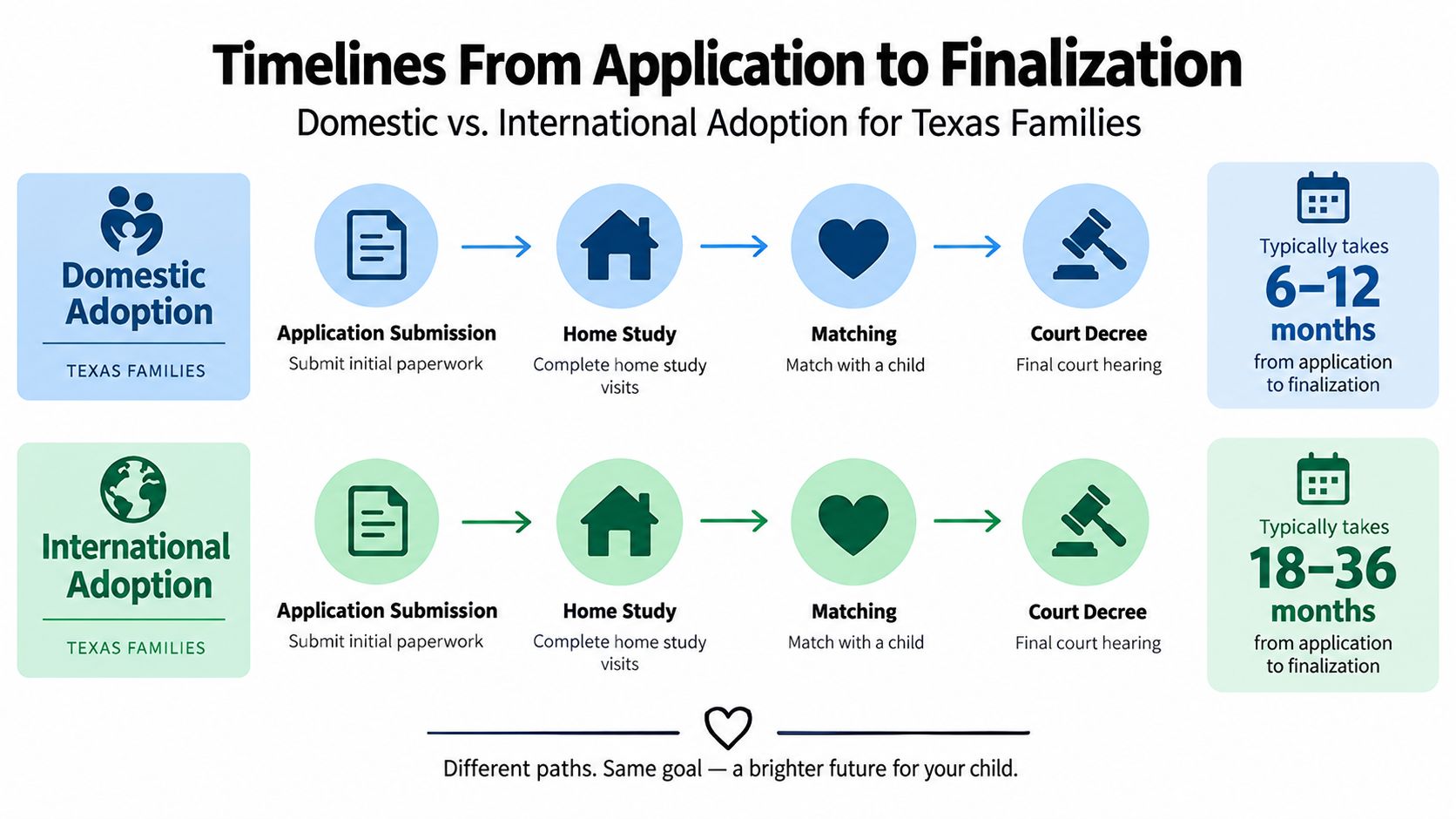
Request a written milestone plan that identifies the next task, who controls it, and what could require updated documents. That gives you something more useful than a single completion estimate.
Avoid assuming that stepparent or kinship adoption is automatically fastest because the child already lives with you. An existing bond changes the placement question, but it doesn't settle every legal issue.
Costs by Stage and the Risks Hidden in the Totals
A total price doesn't tell you how much money is at risk. Broad estimates put domestic infant adoption at roughly $20,000–$45,000 and international adoption at about $20,000–$50,000, illustrating substantial overlap rather than a reliable price ranking, as reflected in this published adoption-cost comparison.
A separate federal report shows why international estimates need careful unpacking. For fiscal year 2024, providers reported $17,500–$62,263 for core Convention-country services, with a median below $41,795; reported country-specific services ranged from $3,750–$34,450, and estimated accreditation-entity fees ranged from $916–$2,098 per family, according to the Department of State's intercountry adoption fee report. Those categories may exclude or incompletely capture home studies, legal work, medical examinations, passports, visas, travel, translation, and reporting.
Ask What Triggers Each Payment
Build a stage-by-stage budget before signing a provider agreement.
- Application and assessment: Identify intake charges, home-study expenses, and update fees.
- Provider services: Ask which payments cover completed work and which depend on a match or referral.
- Legal and court work: Separate routine filing and finalization from contested issues or additional proceedings.
- Travel and documents: Include translation, authentication, immigration work, and possible schedule changes.
- Reporting and follow-up: Ask what continuing services cost and who performs them.
Don't assume a fee is refundable because an adoption doesn't complete. Request the contract language describing refunds, credits, transfers, and expenses already paid to others.
Compare the Consequences of an Unsuccessful Placement
In private infant adoption, birth-parent decision-making deserves respect, not treatment as a transaction to secure. State-law requirements, an out-of-state match, or a placement that doesn't finalize can also affect your budget.
International cases add exposure to country eligibility rules, foreign proceedings, immigration decisions, and program changes. Ask what happens financially if a referral cannot proceed or a program stops accepting cases.
The guide to international adoption costs can help you prepare questions for a written estimate. The decisive question is which losses your family could absorb while remaining able to meet a child's needs, not which brochure shows the lowest total.
Legal Requirements and Consent Under Texas Law
Loving a child and having legal permission to adopt are different questions. Before filing, identify the existing orders, legal parents, managing conservators, and any unresolved parental-rights issues.
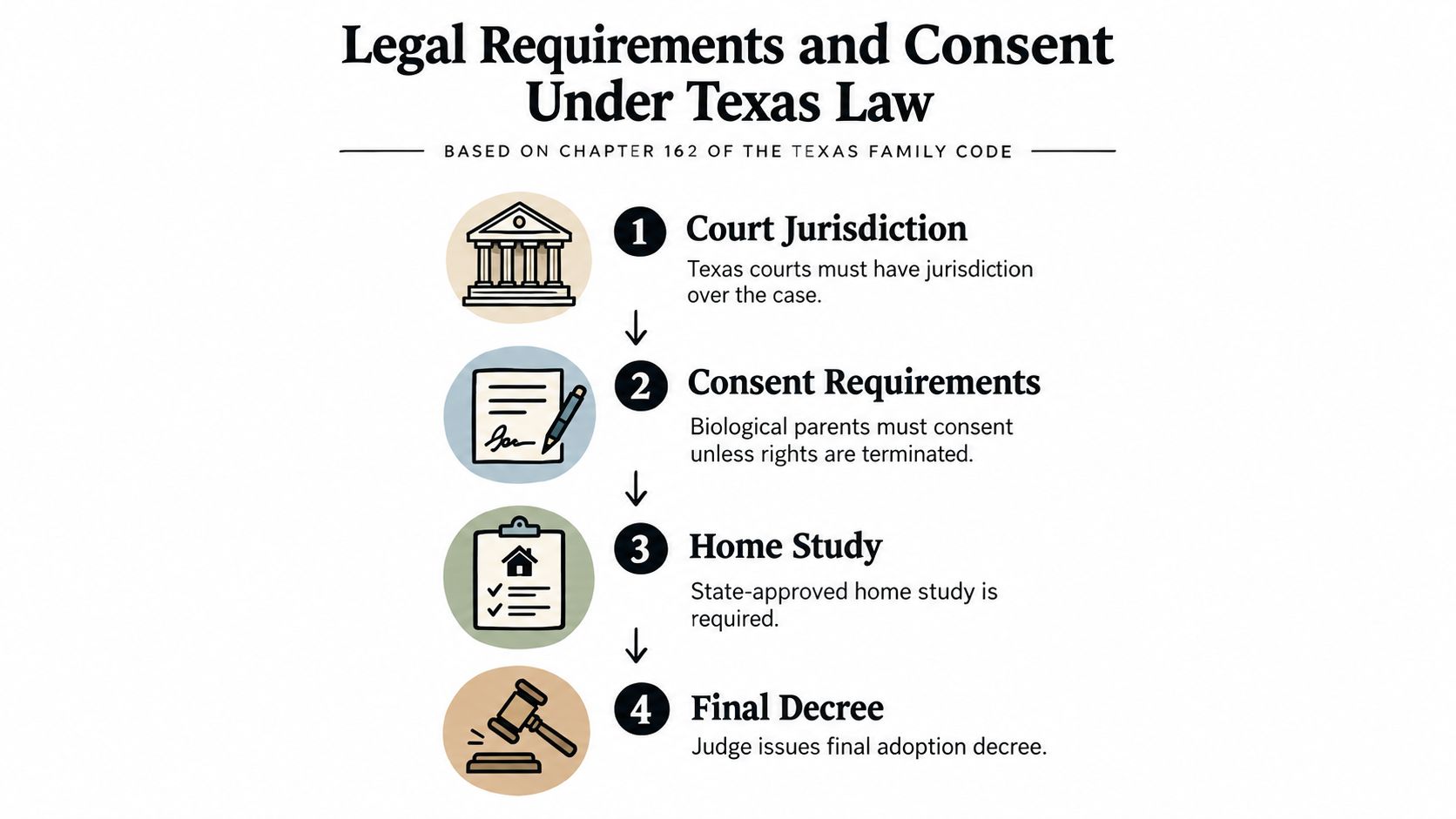
Under Texas Family Code Chapter 162, written consent is generally required from each managing conservator unless the petitioner is the managing conservator; a court may waive consent refused or revoked without good cause and must decide that issue without a jury. A child at least 12 years old must consent in writing or in court unless the court permits a waiver, and a parent married to a stepparent petitioner must join the petition but need not separately consent, as provided in the Texas adoption statute.
Apply the Rule to the Actual Family
For the hypothetical Dallas stepfather, his wife's participation doesn't resolve every issue involving the other parent. The lawyer still needs to examine existing rights and orders.
For a relative caregiver, family agreement isn't a substitute for reviewing who has legal authority. Familiarity with the family may help gather information, but it doesn't create automatic consent or a guaranteed shortcut.
This flowchart is an overview, not a complete case-specific checklist. Its simplified statements shouldn't replace a review of applicable consent rules, assessments, or exceptions.
Follow the Hague Sequence Carefully
The Department of State identifies these central steps for a Hague adoption:
- Choose a provider. Select an accredited or approved U.S. adoption service provider.
- Establish suitability. File Form I-800A with USCIS.
- Receive a referral from the child's country.
- Obtain USCIS approval that the child is eligible to immigrate.
- Adopt or obtain legal custody in the child's country.
- Secure the immigrant visa before bringing the child home.
The required home study examines health, finances, household conditions, background, and country-specific criteria. Families shouldn't accept a Convention-country placement before USCIS approves Form I-800A.
Ask your attorney and provider to explain which approval you have in hand and which remains outstanding. A referral, an adoption order, and immigration approval serve different purposes.
Post-Placement Obligations Most Families Underestimate
The homecoming deserves celebration. It also deserves an organized document folder and a clear follow-up plan.
Domestic adoption includes much more than infant placement: federal fiscal year 2023 data reported 50,193 children exiting foster care to adoption and 48,459 legally free for adoption at year end, according to the Administration for Children and Families foster care dashboard. These children and their families may bring established case records, relationships, and care plans into their adoption journey.
Protect the Documents That Protect the Child
Ask which supervision visits, reports, home-study updates, or other compliance records your case requires before finalization. Don't assume that every domestic pathway has identical post-placement requirements, particularly when a child already lives with a relative or stepparent.
For international adoption, confirm the country's reporting expectations and who will coordinate them. Treat the completed foreign adoption and the child's U.S. immigration or citizenship status as separate documentation questions, a concern highlighted by Pew Research Center's discussion of international adoption and citizenship.
- Court records: Preserve the final decree, foreign orders, and any Texas recognition or readoption documents.
- Immigration records: Keep the actual visa classification and citizenship evidence. Ask counsel what an IR-2 or IH-4 designation means in your child's specific case rather than treating either as a universal adoption label.
- Identity records: Retain original and amended birth records, name-change documents, and explanations of birth-date discrepancies.
- Health and origins: Save available medical, social, and birth-family history, including documents you cannot yet interpret.
Plan for Questions That Arrive Later
The guide to readoption in Texas after international adoption can help you prepare for a legal review of the foreign decree and related records. Ask what additional Texas action, if any, fits your child's circumstances.
A child may later need help understanding missing history, racial identity, or connections to a birth country. Consider culturally competent counseling and transracial-parenting support without assuming that shared heritage answers every question.
Access to identifying information also deserves careful planning. Preserve what you lawfully receive, and don't promise future access that may depend on record restrictions or applicable law.
Matching the Right Path to Your Family
The following hypothetical profiles aren't eligibility decisions. They show how family circumstances can point toward a useful first conversation.
Family life includes play, paperwork, and room for a child's own story.

A Family Prepared to Explore Foster Care Adoption
A married couple has a limited budget and feels open to an older child or siblings. They have no particular connection to a foreign country. Exploring Texas foster care adoption with DFPS or an appropriate provider may fit their circumstances.
They should ask about child-specific support needs and possible adoption assistance, not assume every expense will be covered. Their willingness to provide care must remain separate from any expectation that a foster placement will become permanent.
Decisive factor: Choose the care responsibilities you can sustain, not simply the pathway with the smallest proposed bill.
An Austin Parent Considering Infant Adoption
A single LGBTQIA+ prospective parent hopes to parent an infant and is comfortable discussing ongoing contact with birth family. A licensed private domestic agency may be an appropriate place to explore that goal, subject to an individual eligibility and provider review.
An out-of-state match should prompt questions about the Interstate Compact on the Placement of Children, commonly called ICPC. The parent also needs a candid conversation about openness, boundaries, and what happens if a placement doesn't proceed.
The strongest fit includes respect for the birth parent's choices and readiness for an uncertain matching process.
A conversation about these choices can help partners and support people understand the same concerns.
A Couple With Strong Birth-Country Connections
A couple with deep ties to a particular heritage country may reasonably explore Hague international adoption. They should confirm that their circumstances fit that country's current requirements before committing funds.
A cultural connection can guide the search, but the family must also accept cross-border uncertainty and protect the child's independent relationship with their origins.
A Gentle Next Step for Your Family
Choosing an adoption pathway isn't a test of how determined you are. You can be committed to parenting and still decide that a particular financial, legal, or emotional risk doesn't fit your household.
Private infant, stepparent, kinship, and foster care adoption begin from different relationships. International adoption adds another country's process to the family's planning. The sensible choice is the one that fits your circumstances while keeping the child's safety, identity, and lasting stability at the center.
Bring Your Questions, Not a Finished Plan
You don't need an agency contract or a completed home study before seeking legal guidance. A consultation can begin with what you know, what remains uncertain, and what relationship you hope to protect.
Prepare a short folder before the conversation:
- Existing documents: Bring custody orders, placement paperwork, or any agency agreement you're considering.
- Family circumstances: Describe who lives in the home, who currently cares for the child, and what support you have.
- Budget concerns: Identify expenses you can manage and losses you couldn't comfortably absorb.
- Unanswered questions: Include eligibility, parental rights, guardianship alternatives, and the next appropriate filing or assessment.
For additional preparation, When to Hire a Texas Adoption Attorney addresses how legal guidance can help protect an adoption from delays and challenges. You can also revisit the earlier international-adoption guidance and the parental-rights provisions in Chapter 162 before making commitments.
A useful first conversation should leave you understanding your next step, whether that means gathering an order, asking a provider for clearer terms, or reviewing the legal position of a child already in your home. You're allowed to move carefully. Family unity is worth thoughtful preparation.
The Law Office of Bryan Fagan, PLLC helps Texas families with domestic and international adoption, guardianship questions, and the legal work leading to finalization. Visit Law Office of Bryan Fagan, PLLC to schedule a free consultation about your family's circumstances, the risks you're weighing, and a practical next step.

