 Skip to content

The bathroom light feels too bright. Your period is late, or a condom broke, or you can't remember whether you took a pill on time. You're on the floor with your phone, reading symptom lists and trying to work out what every ache might mean. If you're feeling paranoid about pregnancy, you're not alone, and you don't need to feel ashamed.
First, get clearer about the medical uncertainty: what happened, when to test, and when to contact a clinician. If a pregnancy is confirmed, you can then explore parenting, adoption, and termination without being pushed toward one path. You don't have to solve everything tonight.
A Moment Many People Recognize
A person sits awake after a missed period, replaying the last few weeks. Maybe a condom slipped. Maybe sex happened close to an expected period, but the cycle has been irregular before. Each search result seems to offer a new symptom to fear, and reassurance lasts only until the next worry appears.

That fear can feel overwhelming, but it isn't proof that you're pregnant. A late period, nausea, breast tenderness, and tiredness can have different causes, and symptoms alone can't confirm pregnancy. A home test, used at the right time, can give you more useful information than repeatedly checking your body or searching online.
There are two separate questions to handle, and you can take them one at a time. The first is medical: could you be pregnant, and what should you do to find out safely? The second only arises if pregnancy is confirmed: what do you want to do next?
You might consider parenting, adoption, or termination. You're allowed to gather information, talk with a qualified medical professional, and take time to think about what matters to you. No one should use your fear or uncertainty to pressure you into a decision.
What Pregnancy-Related Anxiety Is
Pregnancy anxiety describes intense worry about becoming pregnant, being pregnant, or giving birth. Tokophobia is a clinical term for severe fear of childbirth or pregnancy-related experiences. Having a worry does not automatically mean you have a mental-health condition. Fear is not a personal failing.
Anxiety can work like a smoke alarm: it calls for attention, but its volume alone cannot tell you what is happening medically.
A Systematic review of tokophobia prevalence covering 33 studies across 18 countries, involving 853,988 pregnant women, estimated worldwide pooled prevalence at 14%, with a 95% confidence interval of 12% to 16% and individual estimates ranging from 3.7% to 43%. Researchers used different definitions and assessment tools, so these figures describe study populations rather than your individual situation.
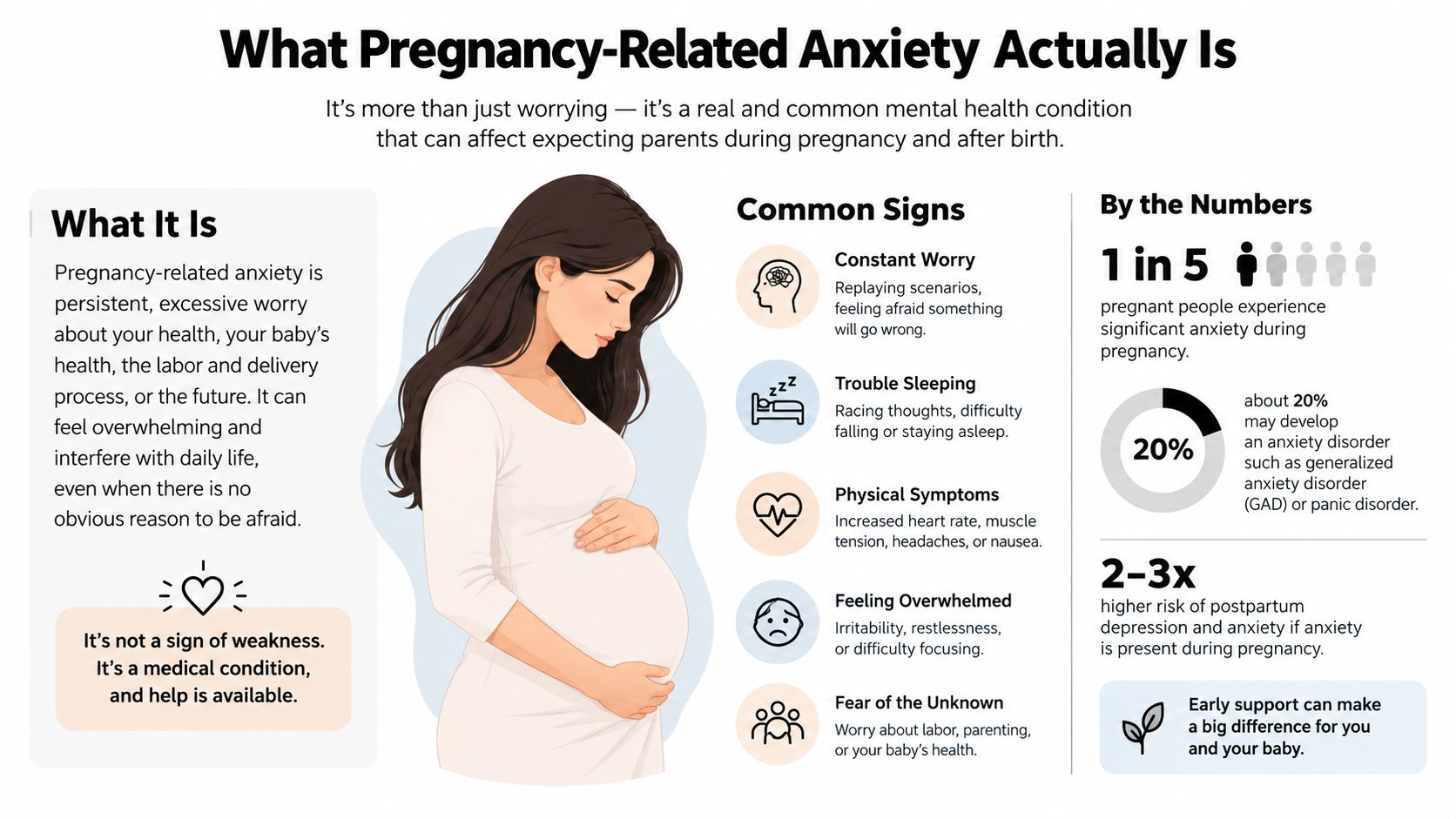
Fear exists on a spectrum, from worry that comes and goes to distress that disrupts daily life or leads to avoidance. Estimates also vary across populations and study methods. The useful question is how the fear affects you: whether it feels manageable or is interfering with everyday activities.
An obstetric clinician or mental-health professional can help assess that distinction and discuss support. You can also find help for health anxiety through Refresh Psychiatry & Therapy. Seeking support leaves your choices open. If pregnancy is confirmed, medical clarity and anxiety care can support a pressure-free consideration of parenting, adoption, or termination, without treating distress as a decision about which path you want.
Why the Fear Feels So Real Right Now
Pregnancy worry often begins with a specific uncertainty: a condom broke, a pill was late, a period didn't arrive, or sex happened without contraception. A missed period can also be unsettling when cycles aren't predictable. In the middle of that uncertainty, it's easy to treat every body sensation as evidence, even though symptoms can't tell you whether pregnancy has occurred.
There is real context behind these fears. The CDC reports that 45% of U.S. pregnancies were unintended in 2011, and its estimates show a decline from 43.3% in 2010 to 41.6% in 2019. The unintended-pregnancy rate also fell from 42.1 per 1,000 females ages 15–44 in 2010 to 35.7 per 1,000 in 2019, a 15% reduction. (CDC information on unintended pregnancy)
Most unintended pregnancies result from not using contraception or from inconsistent or incorrect use. The CDC's historical estimates indicate that people using contraception consistently and correctly accounted for 5% of unintended pregnancies. That context helps explain why a contraceptive mishap can feel frightening, but it doesn't calculate the chance of pregnancy from a particular encounter. The timing of sex, ovulation, contraceptive method, and correct use all matter.
A useful distinction: A real risk deserves sensible follow-up. It doesn't mean your worst fear is already happening.
Instead of trying to estimate risk from symptoms, write down what happened and when, then follow a testing plan or contact a clinician for advice. A clinician or pharmacist can help clarify questions about contraception and testing. If you're unsure what happened or when your period is due, say so. You don't need perfect information to ask for help.
When and How to Test Without Making Fear Worse
A pregnancy test can be negative even when it's too early to detect a pregnancy. FDA guidance says urine hCG may be detectable about 12–15 days after ovulation in a typical 28-day cycle. Because ovulation, implantation, cycle timing, and hCG production vary, 10–20% of pregnant people may not test positive on the first day of a missed period. (FDA guidance on home pregnancy tests)
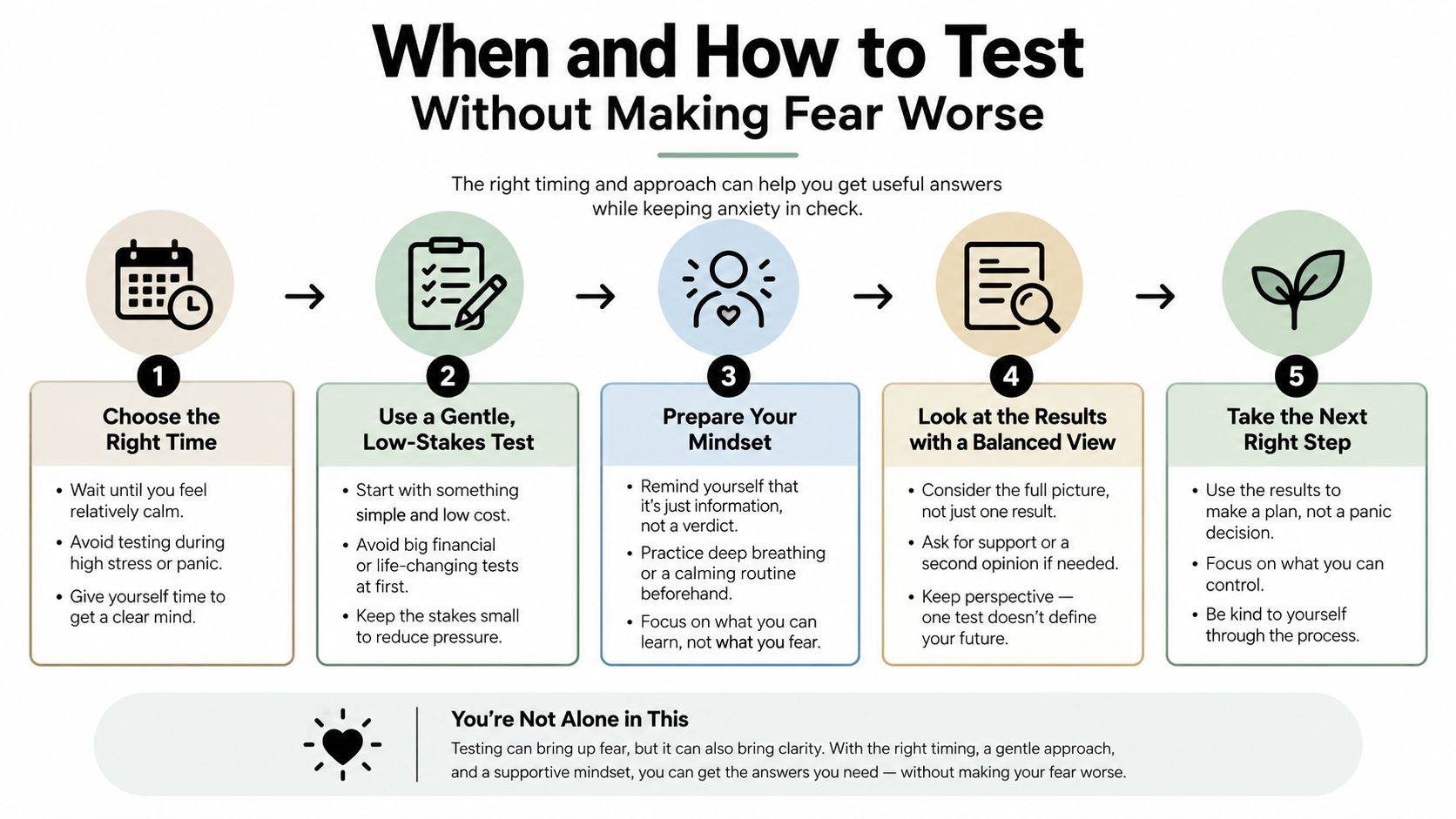
A calm testing sequence can reduce confusion:
- Check the instructions. Follow the specific test's directions, including how to use it and when to read the result.
- Choose sensible timing. Test after your expected period rather than immediately after sex. A test taken too soon may not detect pregnancy.
- Use first-morning urine when repeating a test. Urine may be more concentrated then, which can improve detection.
- Repeat if your period remains absent. If the result is negative but menstruation hasn't started, repeat the test with first-morning urine.
- Ask for clinical confirmation when needed. Contact a clinician if the result doesn't fit your symptoms or timing, or if you're unsure how to interpret it.
Drinking a lot of fluid before testing can dilute urine and contribute to a false-negative result. Repeating tests over and over in a short period may not answer the underlying timing question, so follow the kit instructions and seek clinical guidance if uncertainty continues.
Some symptoms need prompt attention regardless of a home test result. Heavy bleeding, fainting, severe one-sided pelvic pain, or shoulder pain require urgent medical assessment. A negative early urine test doesn't by itself rule out a developing pregnancy complication.
When Worry Becomes Something a Doctor Should Know About
Some concern is a reasonable response to uncertainty. It may be time to talk with a clinician if fear keeps returning, takes over your attention, or makes daily life difficult. Practical signs include persistent intrusive thoughts, repeated requests for reassurance, compulsive symptom or test checking, disrupted sleep, and trouble functioning at work, school, or home.
A systematic review covering 36 studies found a pooled prevalence of approximately 15.2% for any anxiety disorder during pregnancy. ACOG recommends standardized, validated anxiety screening at the initial prenatal visit, later in pregnancy, and postpartum. You can raise ongoing fear directly with an obstetric or mental-health clinician and ask what screening or support is appropriate. (Review of anxiety disorders during pregnancy)
Anxiety doesn't look the same for everyone. Some people feel a steady, hard-to-control worry; others experience sudden panic symptoms, obsessive thoughts or checking, distress connected to trauma, or depression. A clinician can help distinguish among these experiences and discuss care options. You don't need to decide what diagnosis fits before asking for help.
If you're pregnant and worried, screening or reassuring test results don't make your feelings less important. You can tell your care team that the fear is affecting your sleep or daily routine, and ask about mental-health support alongside medical care.
Thoughts of self-harm, inability to care for yourself, or losing contact with reality require urgent emergency evaluation. If you or someone with you is in immediate danger, contact emergency services or go to an emergency department.
Three Real Options and No Pressure to Choose Yet
If a pregnancy is confirmed, or if you're trying to understand what you might do, you don't have to reduce the decision to a yes-or-no question about parenting. The possibilities include parenting, adoption, and termination. People may feel uncertain or pulled in different directions, and the choice can involve personal beliefs, relationships, finances, safety, health, and available support.
| Option | Key Decisions | Time Pressure | Texas-Specific Note |
|---|---|---|---|
| Parenting | What care, practical support, and family help would you need? | Medical care and available time-sensitive services can affect planning. | A medical clinician can explain pregnancy care and discuss questions about your health. |
| Adoption | Would you like to learn about adoptive families or open and closed arrangements? | You can gather information before making a commitment. | Consent and legal procedures matter; get qualified Texas legal guidance before signing documents. |
| Termination | What medical information and support would help you consider this option? | Availability and timing can depend on medical and legal circumstances. | Speak with a qualified medical provider about current care and legal questions. |
Adoption is an information-gathering process, not a promise you have to make at the start. You can ask about prospective adoptive parents, communication after placement, and what legal steps may apply. For an overview of birth parent rights in a Texas adoption, seek advice from a qualified professional who can explain your situation without pressuring you.
Partners, parents, religion, finances, immigration concerns, safety, and prior children may shape what feels possible. No single factor determines what you should choose. If you're considering adoption because a relative may care for the child, or because a stepparent is part of your family, those are distinct legal paths. Stepparent Adoption in Texas describes the most common Texas adoption and how it works.
How Adoption Works in Texas Step by Step
Adoption has separate legal stages, like checkpoints on a map. Knowing what each stage involves can help you ask questions without treating every conversation as a commitment. Adoption remains one option alongside parenting and termination; learning its rules does not decide your pregnancy outcome.
Understand placement, consent, and court approval
Texas Family Code Chapter 162 governs adoption petitions, consent, and court approval. Before approval, a child generally must have lived with the petitioner for at least six months, and a child 12 or older must consent in writing or in court unless the judge waives that requirement in the child's best interest. (Texas Family Code Chapter 162)
Consent requirements depend on whose legal rights are involved.
Written consent is ordinarily required from a managing conservator unless that person is the petitioner. A court may waive that consent if refusal or revocation occurred without good cause. In a stepparent adoption, the parent married to the petitioner joins the petition without providing separate consent. Ask a lawyer which requirements apply before signing documents.
Start with the child's needs and the right provider
Texas public foster and adoptive applicants must be at least 21, financially stable, and responsible adults; the approval process includes an application, references, relevant marriage or divorce records, background checks, and training. (DFPS adoption requirements)
A home study must be completed before approval through a child-placing agency licensed by DFPS. (DFPS home-study information; DFPS adoption FAQs) These public-program requirements concern prospective caregivers, not a birth parent's eligibility to ask about adoption.
The assessment examines household safety and the family's ability to support a child over time. Interviews and a home review may address motivation, health, relationships, discipline, and sensitivity to abuse or neglect. Respect for birth families, cultural identity, and sibling connections also matters.
Prepare for review and finalization
A grandparent, aunt, uncle, or other relative still needs the required assessment. Relatives and stepparents can gather records and consider school, transportation, counseling, family contact, and sibling relationships. These practical details help connect the legal process to the child's daily life.
For birth-parent questions, giving a baby up for adoption in Texas explains more about exploring this process. Ask how placement, consent, and final court approval differ in your circumstances.
Taking the Next Step with the Right People Beside You
You can ask for help before you know what you want to do. If pregnancy is possible, start with reliable testing and medical advice when timing or symptoms are unclear. A test answers one question, like turning on a kitchen light; it doesn't settle every decision ahead. If worry keeps disrupting daily life, tell a clinician rather than relying on repeated reassurance.
A positive result opens separate conversations about health, emotional support, and choices: parenting, adoption, and termination. Ask a clinician about medical care and what is available in your circumstances, and a qualified legal professional about legal questions. You deserve information without pressure to choose.
For prospective caregivers, the at least 21 requirement and other DFPS foster and adoptive requirements are covered in the step-by-step discussion above.
The Law Office of Bryan Fagan, PLLC helps Texas families with adoption and guardianship, including birth parents, relatives, stepparents, foster parents, and hopeful adoptive parents. Its Texas adoption legal services page explains the firm's adoption support. For emotional support in the Vernon area outside Texas, the Vernon counsellor directory offers local counseling resources.
Before speaking with an attorney, write down what feels unclear and ask which procedures apply to you. Getting information doesn't commit you to adoption. Your next step can protect your health, respect your choices, and, when considering placement, keep the child's best interests central.
The Law Office of Bryan Fagan, PLLC offers guidance on consent questions, home studies, and court procedures. If you're exploring adoption, schedule a free consultation through the Law Office of Bryan Fagan, PLLC.

