 Skip to content
Texas Family Code §162.003 mandates a court-ordered pre-adoptive social study, also called a home screening, conducted under Chapter 107 standards before an adoption placement can proceed. This screening is a mandatory gatekeeping step for prospective adoptive parents in Texas.
You may be at the beginning of an emotional journey, sitting at a kitchen table with adoption forms nearby and wondering whether your home is ready to welcome a child. The legal language can feel intimidating, especially when you see the phrase “pre-adoptive home screening” connected to Texas Family Code §162.003.
The screening isn't designed to judge whether your family is perfect. It gives the court and adoption professionals a structured way to evaluate safety, stability, household relationships, and readiness. The focus remains the best interests of the child, while giving you clear expectations and an opportunity to address concerns before approval.
Your Adoption Journey Meets the Law
Maria and Daniel had spent months discussing adoption. They had talked about bedrooms, child care, school routines, and how they would answer a child's questions about their adoption story. When their agency told them they needed a home screening, they worried that one imperfect closet or an unfinished repair could end their hopes.
That fear is common. Families often hear “home study” and picture an inspection where someone searches for reasons to say no. In reality, the evaluator is gathering information about the home and the people who live there. The process helps determine whether the household can provide a safe, stable, and nurturing environment for a child.

A protective step, not a punishment
Texas requires this evaluation because adoption permanently changes a child's legal and family relationships. Before approval, professionals need a reliable picture of the household, including its physical conditions and its relationships. The Texas Department of Family and Protective Services describes the pre-adoptive home screening as part of a broader approval process that includes background checks and must be completed before a family can be approved to adopt. Texas DFPS explains the home screening and approval process.
That requirement can apply whether you're pursuing a private domestic adoption, a foster care adoption, or a relative placement pathway. A stepparent, grandparent, married couple, unmarried couple, or single parent may have different personal circumstances, but each family must still be evaluated under the applicable process.
The screening also supports family unity. By discussing discipline, communication, expectations, and support systems early, a family can prepare for challenges before a child enters the home. If the evaluator identifies a repair, missing safety feature, or household issue, addressing it can strengthen the family's readiness rather than weaken its future.
Practical perspective: The purpose isn't to find a flawless household. It's to confirm that a child will enter a home where adults have prepared thoughtfully and can respond to the child's needs.
What Texas Family Code 162.003 Requires
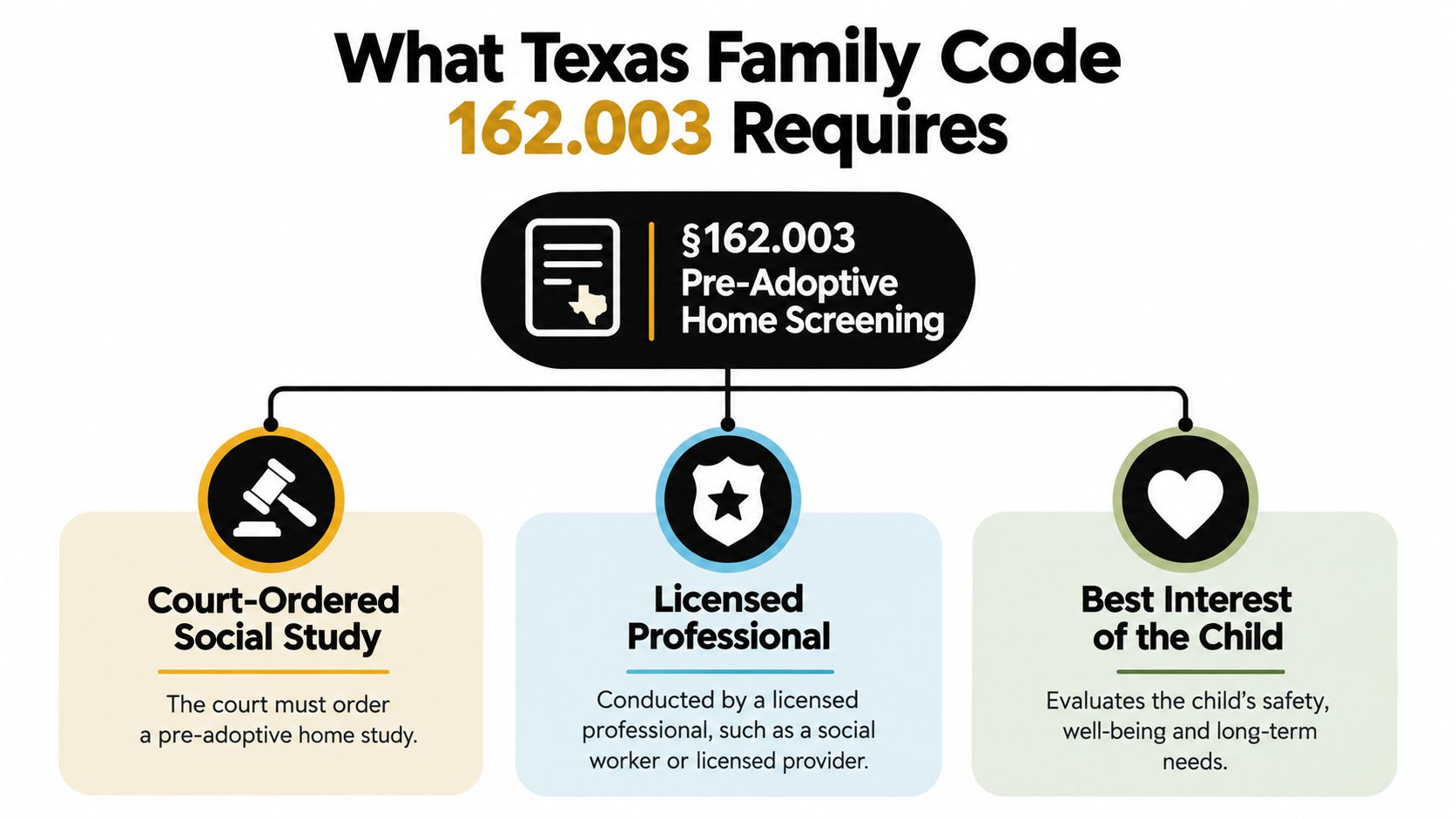
The simplest way to understand §162.003 is to separate the legal words into three ideas:
- The court orders a social study.
- The study follows professional standards.
- The evaluation helps determine whether adoption approval serves the child's best interests.
Texas Family Code Chapter 162 makes the adoption evaluation a mandatory step in Texas adoption cases. The Texas Children's Commission bench book explains that the court-ordered pre-adoptive social study must be conducted as provided by Chapter 107 and connects that requirement to Section 162.003. The Texas Children's Commission bench book describes the statutory requirement.
That means the home screening isn't merely a helpful recommendation from an agency. It functions as a legal gatekeeping milestone. A family may have strong intentions, financial stability, and deep love for a child, but the required evaluation still must be completed before the family can receive approval through the applicable adoption process.
What “social study” means in everyday language
A social study is a professional evaluation of the prospective adoptive home and family. It isn't limited to the building itself. The evaluator considers the household's relationships, motivation to adopt, health, discipline approach, and ability to provide appropriate care.
The screening helps answer practical questions:
- Is the home reasonably safe for the child?
- Is there suitable space for the child and the household?
- Do the adults understand the responsibilities of adoption?
- Can the family discuss the child's history and needs openly?
- Do household members support the adoption?
- Are there concerns that need attention before approval?
Families often benefit from reviewing the Texas adoption home study requirements before the evaluator visits. Preparation doesn't mean rehearsing answers. It means understanding the process, organizing information, and identifying questions you want to discuss with your attorney or agency.
The law's structure reflects a basic principle: adoption should move forward when the placement supports the child's safety, permanence, and well-being. The screening protects children while also giving prospective parents a fair chance to show how their home and family can meet those needs.
The Core Components of the Home Screening
A home screening looks at more than whether a family has an extra bedroom. DFPS guidance treats the home visit as a practical review of conditions that can affect a child's safety and daily life. The evaluator also considers the people in the home and the family's readiness to parent.
The physical environment
The evaluator may assess whether the home is:
- Clean and safe: The residence should be maintained in a condition that doesn't present obvious dangers.
- Free of obvious fire hazards: Clutter, unsafe wiring, blocked exits, or other visible risks may require attention.
- Equipped with smoke detectors: Working safety devices are part of the home's basic readiness.
- Appropriate for water safety: Pools, ponds, hot tubs, and other water features may require safeguards.
- Large enough: The evaluator considers whether the home has sufficient space for the prospective household and the child.
These standards aren't meant to measure style or wealth. A modest home can be appropriate, while a larger home can still have a safety problem. The question is whether the environment is suitable for the particular child and household.
The people who make the home
The evaluator also examines the family system. That can include interviews with adults and children who live in the residence, discussions about family relationships, and questions about motivation, discipline, health, and cultural sensitivity.
For example, a couple may agree that they want to adopt but disagree about discipline. A grandparent may be committed to caring for a grandchild while another adult in the home feels uncertain. These aren't automatic reasons for denial. They are issues that should be discussed openly so the family can build a consistent plan.
Preparing for the visit
Walk through your home with a child's perspective in mind. Secure hazards, confirm that safety devices work, organize medication and cleaning supplies, and think about how the child will sleep, play, study, and receive privacy.
A practical guide to the top components of a Texas adoption home study can help you create a preparation list. The goal isn't to stage a perfect visit. It's to resolve reasonable concerns and be ready to explain how your household will support the child's needs.
Who Must Comply and How the Process Works
A family may finish pre-service training feeling ready for the next step, only to learn that approval also depends on a formal home screening. DFPS describes the screening process as beginning after pre-service training. From there, the evaluator builds a record through interviews, observations, documents, and other relevant information.
The process usually follows this sequence:
- Complete the required preparation. Prospective parents finish pre-service training and begin the approval process.
- Provide household information. The evaluator learns about the adults and children in the home, family relationships, health, motivation, and parenting plans.
- Take part in interviews. Household members may have individual or joint interviews. Certain nonresident family members may also be interviewed when their role matters to the child's care.
- Allow a home visit. At least one visit lets the evaluator assess the living environment in person, rather than relying only on descriptions or paperwork.
- Identify other relevant contacts. When appropriate, the evaluator may contact neighbors, school personnel, clergy, or other community members.
- Complete documentation and review. DFPS handbook guidance uses Form 2191 to document the screening. A supervisor must review it within 10 working days of receipt, and approval must occur before final verification or approval. Federal child-welfare guidance summarizes Texas home study requirements.
The screening works like assembling a clear family portrait from several photographs. One interview cannot show the whole picture. The evaluator compares information from conversations, the home visit, records, and appropriate outside contacts to understand whether the household can support the child safely and consistently.
The requirement may apply to families pursuing foster care or private adoption. Families living outside Texas who seek a Texas placement also need current home study documentation. DFPS states that Texas may place children with out-of-state families only when they have a current home study.
For a plain-language explanation of The Texas Adoption Home Study Explained, prospective parents can review what the study examines and when it may be waived. A waiver depends on the facts and applicable legal requirements, so families should obtain case-specific advice before relying on one.
Common Misconceptions About the Home Study
Misconception one: “My house must be perfect.”
The evaluator isn't looking for a magazine-ready home. The review focuses on safety, cleanliness, space, and household suitability. A family can have ordinary clutter or ongoing projects and still be prepared to adopt, but an unresolved hazard may need attention before approval.
Misconception two: “The evaluator is trying to disqualify me.”
The evaluator's role is to gather and assess information. Honest answers are more useful than polished answers. If you're nervous about parenting a child with trauma, managing a blended household, or explaining adoption to relatives, discussing those concerns can show thoughtful preparation.
Misconception three: “Only traditional families qualify.”
The available guidance focuses on the household, its members, safety, relationships, motivation, discipline, and readiness. It doesn't create a separate rule in the cited materials that excludes LGBTQIA+ parents, single parents, kinship caregivers, or blended families.
A blended household may include a stepparent, children from an earlier relationship, grandparents, adult children, or frequent caregivers. The evaluator needs to understand who lives in the home, who regularly participates in care, and how the adults will protect the child's stability.
A thoughtful answer is stronger than a rehearsed answer. Explain your support network, acknowledge challenges, and show how you'll respond to the child's individual history.
Kinship families may be moving quickly because they already care for a relative. That urgency doesn't eliminate the need to address safety and household readiness. Families considering Foster Care and CPS Adoption in Texas should also distinguish adoption from reunification issues and obtain advice about the child's current legal status.
Documentation, Background Checks, and Timelines
An adoptive couple may arrive at the agency ready to welcome a child, only to discover that several records are still missing. That moment can feel discouraging, but the file works like a map. It lets the evaluator compare the household's documents with what interviews and the home visit show.
DFPS includes background checks in the broader approval process, and the home study must be documented before final approval. Ask your agency or attorney for a written materials list at the beginning. Depending on the adoption pathway, the file may include identity information, household details, health information, references, training records, and consent documents. This guide to essential documents for a Texas adoption home study can help you organize questions and records.
Complete background-check consent forms carefully. If several adults live in or regularly participate in the household, consistent authorization documents help prevent avoidable follow-up. A resource explaining how to create background check consent forms may clarify commonly used authorization language. Your adoption professional should confirm which forms Texas law and the relevant agency require.
The review point
DFPS handbook guidance calls for Form 2191 documentation and supervisor review within 10 working days of receipt. This is an internal quality-control step, not a promise that the entire adoption process will finish within that period.
Timing may change if records are incomplete, household members are unavailable, background questions need clarification, or safety updates remain. Families living outside Texas should ask how their agency defines “current” and what must be updated when circumstances change, especially before a Texas placement.
What Happens If You Do Not Comply
Without an approved home study, an adoption placement cannot move forward through the required approval process. That doesn't mean a family is permanently rejected because a smoke detector is missing or a document needs correction. It means the concern must be addressed before the process can safely proceed.
Delays may arise when a family doesn't complete required training, misses interviews, withholds relevant household information, fails to provide requested records, or leaves a known safety issue unresolved. A denial or unfavorable recommendation may also result when the evaluator identifies concerns that the family hasn't corrected or cannot adequately explain.
The right response is to find out exactly what remains unresolved. Ask for the concern in writing when possible, gather the supporting documents, complete repairs, schedule missed interviews, or request clarification about the next review step. Keep copies of your communications and avoid making major decisions based on an informal comment alone.
Responding with care
A home screening protects the child who may soon depend on your family. It also protects you by identifying problems before placement, when there is more time to prepare. Treat the evaluator's questions as an opportunity to strengthen your parenting plan, not as a personal attack.
The legal framework also extends beyond the screening itself. Chapters 162 through 166 of the Texas Family Code may affect different parts of an adoption matter, including the court process, parental rights, and finalization issues. The exact requirements depend on whether the matter involves a stepparent, relative, private domestic placement, foster care, or another adoption pathway.
If your home study is delayed, denied, or tied to a complicated family situation, speak with an experienced adoption attorney before assuming your options have ended. Legal guidance can help you understand the concern, protect the child's interests, and choose a practical next step.
Frequently Asked Questions for Prospective Parents
Does a kinship adoption still require a home screening?
A relative may already know and care for the child, but that relationship doesn't automatically remove the need to evaluate the home. The screening still addresses safety, space, household members, relationships, and readiness. Kinship families should ask whether any special procedure applies to their situation and obtain advice before relying on an assumption.
How does a stepparent adoption fit into the process?
A stepparent adoption involves a family structure that may already be established, but the court still needs information about the household and the child's best interests. The adults should be prepared to discuss daily care, discipline, the child's relationship with each parent, and the practical effect of the adoption. Review the specific requirements for your case with counsel because consent, termination, and finalization questions can be highly fact-specific.
Are LGBTQIA+ families evaluated under different safety standards?
The cited Texas guidance focuses on household safety, suitability, relationships, motivation, discipline, and readiness. It doesn't establish a separate physical-home standard for LGBTQIA+ families. If an evaluator raises a concern that appears unrelated to the child's safety or your ability to parent, document what occurred and discuss it with an attorney.
What happens in a blended household?
The evaluator may need to understand the role of stepparents, adult children, grandparents, frequent caregivers, and other people who regularly visit or provide care. Be candid about household relationships and explain how the adults will present consistent expectations to the child.
What can I do if approval is delayed or denied?
Request a clear explanation of the missing information or concern. Then ask your agency or attorney whether the issue can be corrected, whether additional documentation is needed, or whether a formal response or review is available. Don't move forward with a placement while assuming the home study requirement will be overlooked.
The Law Office of Bryan Fagan, PLLC offers free consultations to help Texas families understand adoption and guardianship questions, including home study concerns, kinship matters, stepparent adoptions, LGBTQIA+ adoptions, and CPS-related cases.
The Law Office of Bryan Fagan, PLLC helps Texas families prepare for adoption, address home study concerns, and complete the legal steps toward finalization with a focus on the child's best interests. Visit Law Office of Bryan Fagan, PLLC to schedule a free consultation and discuss your family's next step with an adoption attorney.

