
Texas law does not set a minimum number of years of residency before you can file to adopt, but Texas Family Code § 162.009 requires the child to live with the adoptive petitioner for at least 6 months before the court can grant the adoption, unless the court waives that rule in the child's best interest. The real question isn't how long you've lived in Texas, it's whose clock is actually running.
Texas law does not set a minimum number of years of residency before you can file to adopt, but Texas Family Code § 162.009 requires the child to live with the adoptive petitioner for at least 6 months before the court can grant the adoption, unless the court waives that rule in the child's best interest. The real question isn't how long you've lived in Texas, it's whose clock is actually running.
If you've been worrying that you moved here too recently to build your family through adoption, you're not alone. Many people assume the law measures the parent's years in Texas, when the statute focuses on the child's placement and the court's best-interest review.
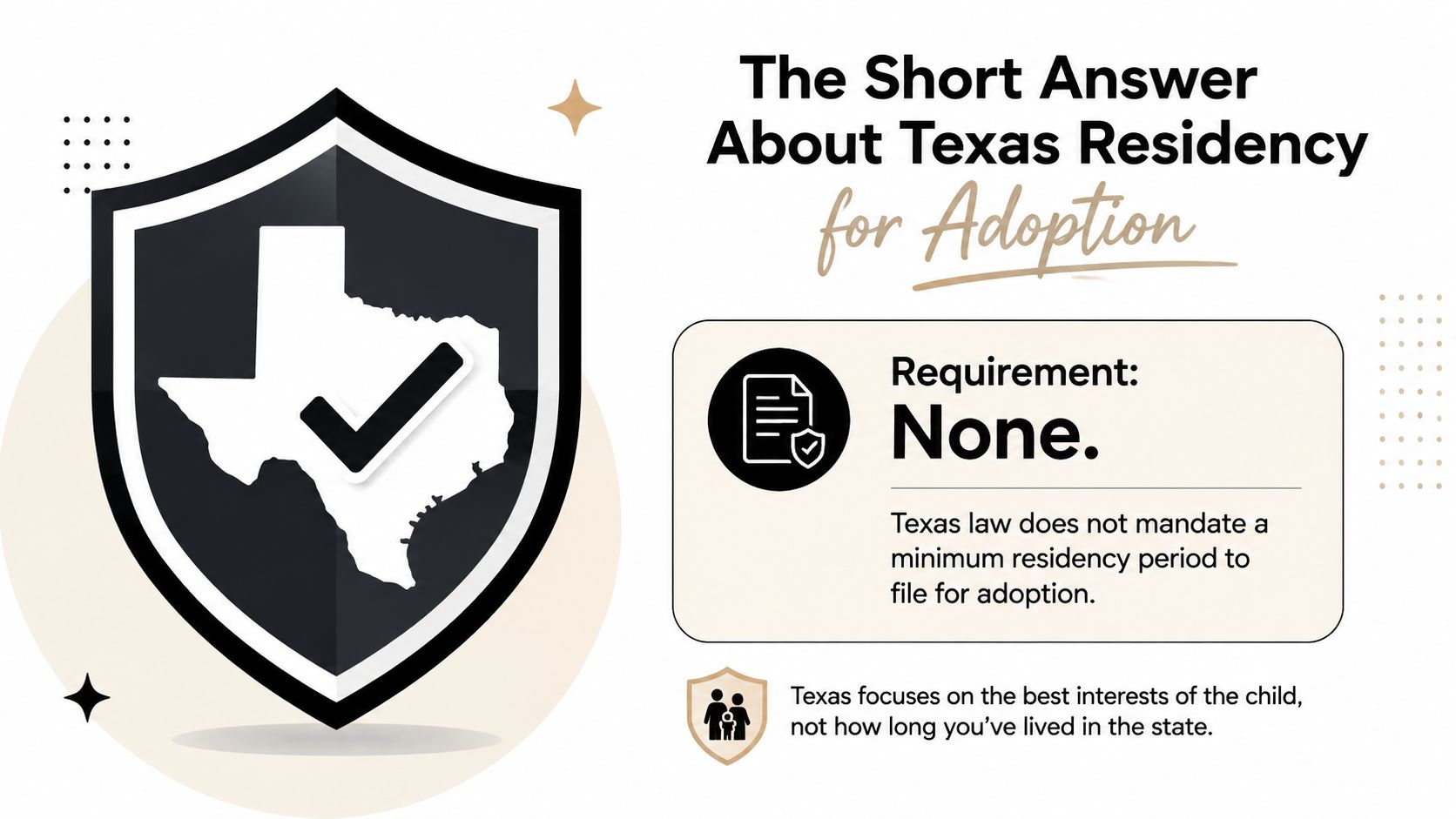
The Short Answer About Texas Residency for Adoption
Texas adoption law does not require you to live in Texas for a specific number of years before you can file to adopt. The key timing rule is that the child must live with the petitioner for at least 6 months before the court may grant the adoption, unless the judge waives that requirement because it is in the child's best interest, under Texas Family Code § 162.009. Texas Family Code § 162.009
That is the part many families miss. The key question is usually tied to the child's placement with the future adoptive parent, not to how long the parent has lived in Texas. So a parent who moved here last month may still be able to file, depending on the case and the rest of the requirements.
Practical rule: ask, “Has the child been in my home long enough for finalization?” before you ask, “Have I lived in Texas long enough?”
A simple way to think about it is this. Texas wants to know whether the child has formed a real home with you, whether the paperwork is in order, and whether the judge can safely enter a final order. That means the timeline is often shaped by placement, home studies, background checks, and parental-rights issues, not by a long Texas address history.
For a plain-English overview of Texas adoption timing and residency issues, this Texas adoption laws guide can help you see where the filing rules fit into the bigger picture.
What Texas Family Code Chapters 162 Through 166 Actually Require
Texas adoption cases do not rest on one short rule. They move through several connected chapters, and each one answers a different question about whether a child can be adopted safely and legally. Chapter 162 is the starting point for who may adopt, who may be adopted, and when a court may grant the petition, including the 6-month child-residency rule in § 162.009.
A better way to read the Family Code is to ask which part of the case the judge is checking at each step. One chapter addresses the petition, another deals with the home study, another focuses on termination of parental rights, and the later chapters cover disclosure, registries, and adult adoptions.
The main chapters in plain English
Chapter 163 deals with the home study and background screening process. For a broader statutory overview, Texas adoption and the Family Code explains how these provisions fit together. Texas DFPS says prospective foster and adoptive parents must be at least 21 years old, financially stable, and responsible, mature adults, and they must complete an application, provide background and lifestyle information, give references, agree to a home study, and allow criminal-history and abuse or neglect checks for adults in the household. Texas DFPS adoption requirements
Chapter 164 usually comes into play when parental rights must end before the adoption can move forward. That may happen through consent or through a court process, and it is one of the main reasons adoption cases take time. Chapter 165 deals with disclosure and registry issues, while Chapter 166 covers adult adoptions and other specialty matters.
A simple way to hold the structure in your mind is this:
- Chapter 162: who can adopt, who can be adopted, and the timing rule
- Chapter 163: home study, references, and background checks
- Chapter 164: termination of parental rights
- Chapter 165: disclosure and registry-related rules
- Chapter 166: adult adoptions and specialty situations
A judge is not just checking boxes. The court is looking for a safe, stable, legally clear path that protects the child's future.
That is why a case can feel slow even when everyone agrees the child belongs in the home. Texas law is built around permanency, not speed for speed's sake. If you are sorting through those moving pieces, When to Hire a Texas Adoption Attorney can help you see when legal help may keep the case from running into delays or avoidable challenges.
How the Six-Month Clock Works in Different Adoption Types
The six-month rule sounds simple until you apply it to real families. The question isn't just whether a child has lived in your home, it's whether the clock started at placement, at full-time caregiving, or at some later formal step in the case.
The clock starts in different places depending on the case
In a stepparent adoption, the child may already live with the stepparent and the legal parent, but the court still looks closely at when the child began living there in the adoptive role. In a kinship or relative adoption, a grandparent or aunt may have been caring for the child for years, yet the adoption timeline still turns on the formal placement and court process rather than just family history. In a CPS foster-to-adopt case, DFPS says that once the child has lived in the new home for 6 months, the family and CPS can make the adoption permanent. Texas DFPS child protection adoption guidance
Private agency cases usually follow the same basic placement logic. The child's move into the home is the event that starts the finalization clock, not the number of years the adoptive parent has been in Texas.
| Adoption Type | When the Clock Typically Starts | Common Waiver Trigger |
|---|---|---|
| Stepparent adoption | When the child begins living full time in the adoptive home | Best interest of the child |
| Kinship or relative adoption | When formal placement with the relative begins | Stability already proven in the home |
| CPS foster-to-adopt | When the child is placed in the foster/adoptive home | Child's need for permanency |
| Private domestic adoption | When placement with the adoptive parent begins | Best-interest finding by the court |
A waiver can matter when the child's circumstances make the usual timeline less helpful than harmful. That can happen when a child already sees the home as permanent, or when the facts show that waiting would not serve the child's best interest. Texas law gives the judge discretion, but it doesn't promise a waiver.
The best way to read the six-month rule is this. It's a safeguard that lets the court see whether the child is thriving in the home before finalizing something permanent.
Real Family Scenarios That Show How Timing Plays Out
A family law statute makes a lot more sense when you can put real people around it. These examples aren't about drama, they're about the ordinary moments where parents, grandparents, and children are trying to make a stable home official.
A stepparent in Houston
A stepfather has been raising his stepdaughter with his wife for months, and the child calls him dad every day. The biological father has signed an affidavit of voluntary relinquishment, so the big issue isn't whether the child belongs in the home, it's when the court can finalize it. In a case like that, the six-month clock usually tracks the child's full-time life in the home after the legal pieces are lined up.
A grandmother in San Antonio
A grandmother has cared for her grandson since birth, and the family already depends on her for school, meals, and medical appointments. The emotional bond is obvious, but the legal adoption still needs the court's final approval. The timing question becomes whether the formal adoptive placement has been in place long enough for the judge to finalize the adoption safely.
A private adoption in Dallas
A single mother works with an agency to adopt an infant, and everything moves quickly at first. Then the family realizes the court still wants the placement history, the home study, and the right documentation before finalization. In that kind of case, the waiver question may matter, but only if the judge finds it fits the child's best interest.
The law doesn't ignore family reality. It tries to match legal permanence to the child's actual life, not just the paperwork file.
For birth parents, that same structure matters too. The process should never move faster than informed consent, proper notice, and a clear understanding of what rights are being transferred. For relatives, it often means the law is catching up to a caregiving role that already exists.
Exceptions, Military Families, and Out-of-State Cases
Texas adoption rules do not treat every family the same way. Military service and interstate placement can change whose timeline matters and when a court will let the case move ahead.
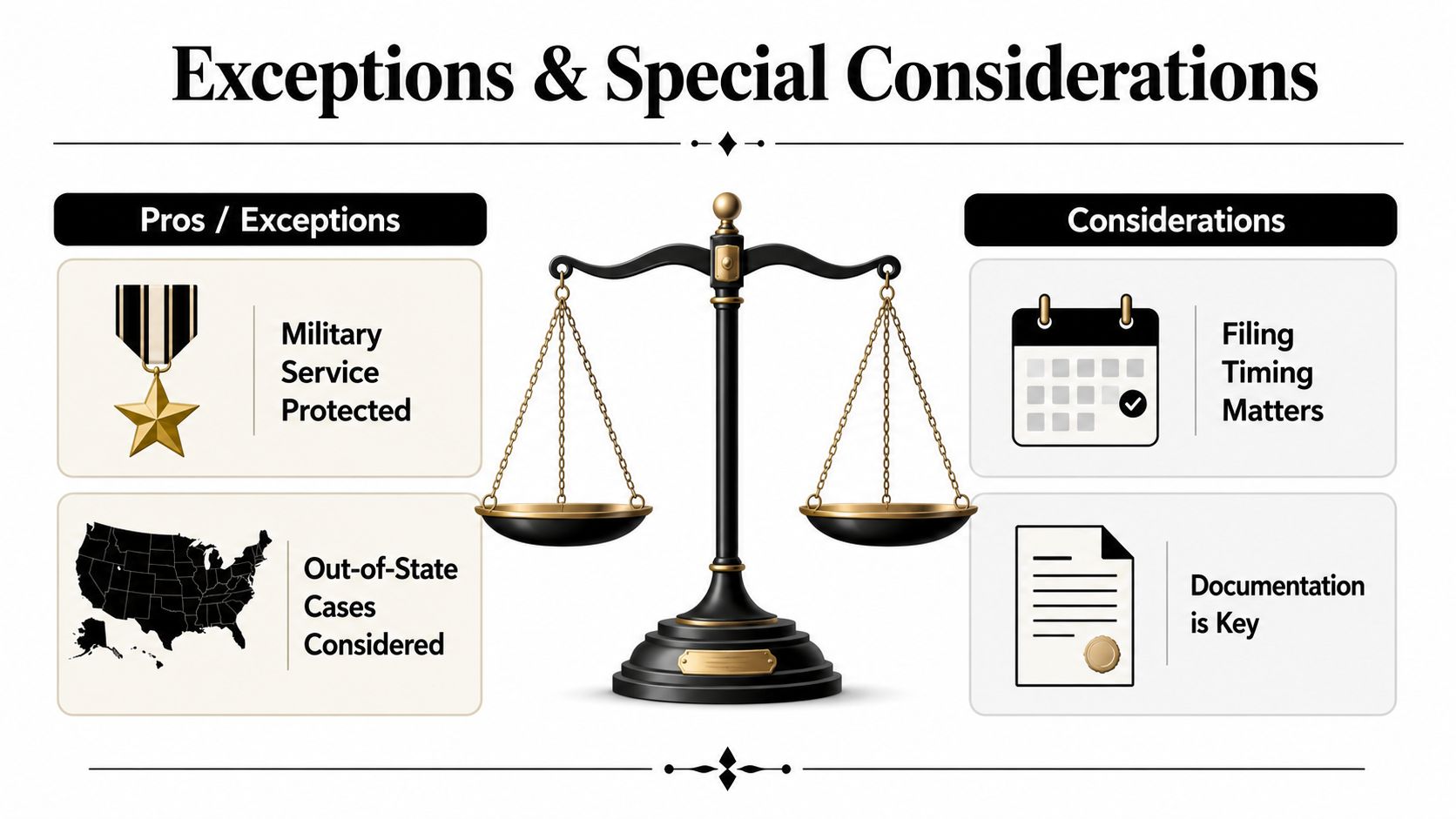
Texas Family Code § 162.0025 says military service cannot be used against a prospective adoptive parent just because that parent serves in the armed forces, including the Texas National Guard, another state's National Guard, or a reserve component. Texas Family Code § 162.0025 guidance
That protection matters because service should not become a penalty. A deployment, a transfer, or a service record does not automatically stop an adoption. The harder question is whether the family still meets the filing and placement rules the court uses to measure the child's connection to Texas. In some military cases, guidance still points to a 6-month Texas residency rule and a 90-day county rule before filing, while a service-related absence may be treated differently if the family meant to return to Texas. Texas military adoption guidance
Out-of-state placement adds another layer. Texas adoption guidance explains that families bringing a child across state lines may have to follow the ICPC, the Interstate Compact on the Placement of Children, before the placement can go forward. Texas adoption laws and ICPC guidance That process can affect when the child enters the home, which means it can also affect when the adoption clock starts to run.
The main point is straightforward. Military status cannot be used against you, but the filing rules and placement rules still control the court's timing analysis. If you are stationed in Texas, temporarily living elsewhere, or waiting on interstate approval, the case may move on a different schedule than a standard in-state adoption.
For families in that position, Military Adoption: Navigating the Path to Building a Family in Texas gives a helpful overview of the legal and practical issues military families face.
Documents, Venue, and the Court Process You Will Encounter
The residency question feels abstract until the paperwork starts to pile up. Then the process becomes concrete, because every form and document helps the court decide whether the adoption is ready for final review.
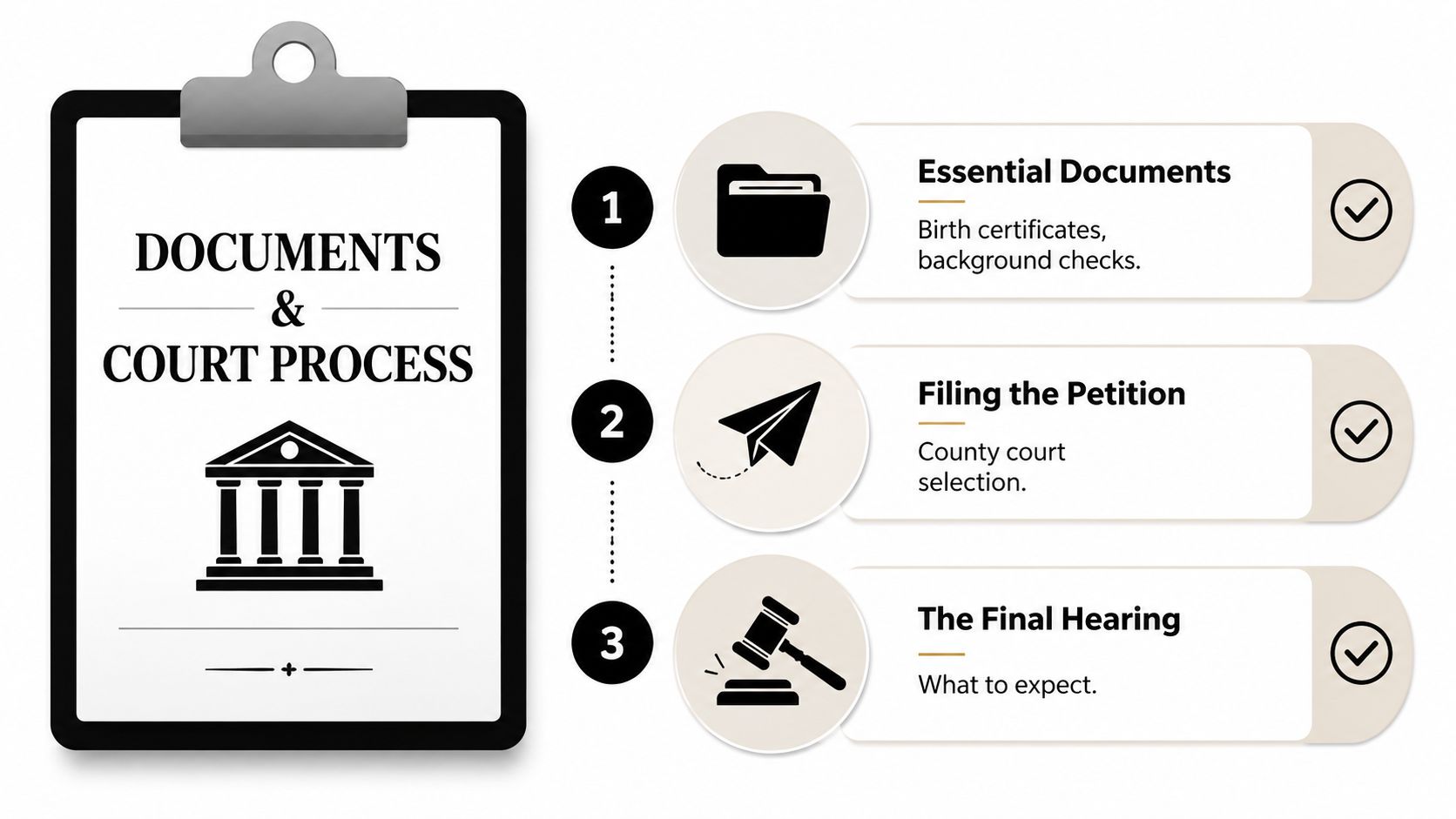
Your adoption packet usually turns on a handful of core items. Background screening and a home study are part of the process for prospective foster and adoptive parents, and the file often also includes the petition, proof that parental rights have been addressed, and the other papers the court wants to see before it can finish the case. Texas court resources on adoption explain that venue and filing requirements still matter even after the family is ready to proceed.
Three things to keep in order
- Essential documents: birth certificates, background checks, and anything that shows the child's placement history
- Filing the petition: the county court where venue is proper, usually tied to the child's residence or the adoptive parent's residence
- The final hearing: the judge reviews the file, asks questions if needed, and decides whether finalization serves the child's best interest
The venue question matters more than many families expect. Texas adoption cases are generally filed in the county tied to the child or the adoptive family, and the 90-day county residence issue can affect where the petition goes when the parent's own residency is part of the filing analysis. Local review matters even when the statewide rule is clear.
A clean file helps the court move faster. Missing documents do not just cause delay, they can keep a child in legal limbo longer than anyone wants.
A final hearing is usually less dramatic than people imagine, but it still matters a great deal. The judge wants to know the child is safe, the legal prerequisites are met, and the adoption fits the child's future. When the home study, background checks, and termination order line up, the hearing is often the last major step before permanency.
Your Next Steps and How an Attorney Can Help
If you're asking how long you must live in Texas to file for adoption, start with the child, not your calendar. Ask whether the child has been living with you, whether parental rights have been addressed, whether your home study and background checks are complete, and whether military, interstate, or CPS issues could change the timeline.
Texas adoption law gives families a path forward, but it also asks for patience and careful preparation. The 6-month rule is often the baseline for finalization, and a waiver may be possible when the child's best interest calls for it. That's the part that deserves close legal review, because the court's focus is always on permanence, safety, and family unity.
A Texas adoption attorney can help you sort out the filing timing, the right county, the documentation, and any waiver issue before the case gets stuck. That kind of guidance can be especially important in stepparent, kinship, foster, and military cases, where the facts are personal and the law has to fit real life.
If you're still unsure where your case stands, take the next step today and talk with a lawyer who handles Texas family formation with care. A short consultation can bring clarity to the timeline, the paperwork, and the path toward making your family legally whole.
The Law Office of Bryan Fagan, PLLC helps Texas families with adoption cases that involve residency questions, home studies, court filings, and finalization. If you're ready to understand what your timeline looks like, visit Law Office of Bryan Fagan, PLLC and schedule a free consultation to get guidance suited to your family's situation.
