
You've already picked an adoptive family, or maybe you're still deciding, and now the paperwork is sitting on the table. A birth parent in Texas can feel that moment in the chest, because the forms aren't just forms. They're part of the child's permanent story, and they also carry the financial rules that keep adoption expenses transparent and fair.
Texas handles that story in two tracks. One track is the medical and health-history disclosure a birth parent may be required to complete. The other is the financial disclosure side, where agencies must document what money moved, why it moved, and who can see the accounting. When you understand both, the process feels less mysterious and a lot more manageable.
A Birth Parent's First Questions About Adoption Paperwork
A birth mother sits at her kitchen table, phone in hand, waiting for the agency call that says the adoptive family has signed. Beside her is a stack of papers, and the hardest part is not the signatures. It's the fear of what she's being asked to reveal, and who will read it later.
That reaction is normal. Texas adoption paperwork asks for personal information because the child's file has to do more than close a case. It has to preserve health background, family history, and expense records that can matter years later if a doctor needs answers or if someone wants to understand how adoption costs were handled.
Two paper trails, one adoption
The first paper trail is medical. Texas requires certain health-history disclosures from the birth parent, and those disclosures don't disappear after placement. They become part of the child's lasting record, which is one reason the law treats them seriously.
The second paper trail is financial. Adoption services often involve agency pass-through expenses, and Texas rules require those charges to be tracked carefully and explained in writing. That's meant to protect everyone at once, the child, the birth parent, and the adoptive family.
Practical rule: if a form asks about a family medical condition, a pregnancy detail, or an expense estimate, treat it as part of the adoption record, not as a casual agency worksheet.
For families trying to sort out next steps, it helps to know that Texas adoption law is structured, not improvised. A birth parent may be asked to sign a relinquishment form, a family may be asked to review costs, and the agency may need to keep records for future access. If you want a plain explanation of how one key form works, Voluntary Relinquishment of Parental Rights in Texas describes how a birth parent voluntarily ends their rights for an adoption.
That structure matters because adoption is always about more than one day in court. It's about whether the child's story will stay clear and useful for the rest of their life.
What Texas Law Actually Requires From Birth Parents
Texas adoption law doesn't leave disclosure up to guesswork. The rules sit inside the Texas Family Code, especially Chapter 161 for voluntary relinquishment and Chapter 162 for adoption procedures, and those rules make disclosure part of the process itself. In other words, the law expects certain information to be gathered, preserved, and shared in the proper setting.
The legal trigger starts with relinquishment
When a birth parent signs an affidavit of voluntary relinquishment of parental rights, Texas law requires that parent to complete a medical history report under Family Code § 161.1031. That isn't just an agency preference. The statute creates the form requirement, which means the disclosure duty is built into the legal framework of termination and adoption.
The same framework also shows up in termination suits. The court must order each parent before the court to provide the medical-history information, and if the state is involved, that information must be kept in agency records and made available to the child's placement. That makes the disclosure process more than informal paperwork, it makes it part of the official adoption record.
Why the law treats this as necessary
Texas built these rules because children deserve access to their own background, especially their medical background. A child may not grow up in the same home as a birth parent, but that child still deserves a record that can help doctors, caregivers, and adoptive parents answer questions later.
The law also recognizes that disclosure can feel vulnerable. A birth parent is not being asked to narrate a perfect life. They're being asked to provide information that helps the child. That difference matters, because the process isn't about blame, it's about preserving facts that can protect a child's health.
A good adoption file should answer practical questions later, even if the adults involved are no longer in contact.
The Medical History Birth Parents Must Disclose
Texas is specific here, and that specificity helps. The adoption history materials must include the child's health status at placement and the birth parents' known medical history, plus other related background the parent reasonably knows. That can sound broad, but the everyday meaning is simple. The law wants enough information to help a child's future doctors see the whole picture.
What belongs in the record
Texas adoption history rules call for the child's health, social, educational, and genetic history report to include the child's health status at placement and the birth parents' medical, psychological, psychiatric, and related history to the extent known. The report also asks whether the birth mother consumed alcohol during pregnancy and whether the child has been diagnosed with fetal alcohol spectrum disorder. Those details matter because they can affect a child's long-term care.
The report may also include genetic diseases and disorders, causes and ages of death in the family, and any available psychological, psychiatric, social, or criminal history information. In practical terms, that means things like a known hereditary condition, a pattern of serious mental illness, or a relative's early death may belong in the file if the parent knows about it.
What “to the extent known” really means
That phrase matters because not every birth parent knows everything. Maybe a parent never met one side of the family. Maybe a grandparent passed away before any medical diagnosis was discussed. Texas law doesn't demand impossible answers.
If you don't know an answer, say so. If you know part of the answer, give the part you know. A note that says “unknown to me” is more useful than silence, because it tells doctors and adoptive parents where the information stops. It also avoids the false impression that a blank space means there was nothing to report.
Practical rule: if you're unsure, write down what you do know, and clearly mark what you don't know.
The point of these disclosures isn't to pry into private life. It's to build a file that can help a child years from now, when a pediatrician asks about family history and nobody wants to guess.
Financial Disclosures and Adoption Expense Rules
Money can make adoption feel confusing fast, especially when different parties are paying different costs. Texas tries to bring order to that process through rules for child-placing agencies and pass-through expenses. The goal is simple, a family should know what is being charged, why it's being charged, and how the agency accounts for it.
What agencies must document
Texas adoption expense rules require child-placing agencies to prepare an individual report for each case when they pass through expenses to the adoptive family. That report has to be organized by expense category and include the date, amount, and description of each expenditure. If someone asks for the accounting, the agency must provide an itemized list showing how the money was spent and whether there is a surplus.
The agency also has to give a written estimate of anticipated pass-through expenses before the family makes any financial commitment to the placement, except for unforeseeable medical and legal expenses. That protects families from walking into a financial arrangement blind.
The boundary birth mothers should know
Texas also draws a bright line around birth mothers. The agency must give written notice that a birth mother may choose not to relinquish the child, and the agency cannot seek repayment from her for adoption-service expenses. That protection matters because a birth parent should never feel trapped by a bill tied to the decision whether to place a child.
For families sorting through the money side of adoption, the legal checklist in Understanding Texas Adoption Financial Stability and Health Assessments, A Step by Step Guide can be a helpful companion read. It fits naturally with the expense rules because it walks through the kinds of review agencies and families often face before placement.
What this means in real life
A couple waiting on placement might see a line item for agency services, while a birth parent might worry whether accepting help means owing money later. Texas rules answer both concerns by requiring written estimates and itemized records, while also protecting the birth mother from repayment demands for adoption-service expenses.
That balance is important. It keeps the process transparent without turning a vulnerable decision into a financial trap.
Timing, Forms, and Who Keeps the Records
The timing of the medical form matters almost as much as the information itself. Texas requires the medical history report under Family Code § 161.1031 to be completed when the birth parent signs the affidavit of voluntary relinquishment. That means the disclosure is tied to the legal act that changes parental rights.
Where the form goes after it's completed
If the child is in CPS conservatorship, DFPS keeps the medical history form and makes it available to the child's placement. If the child is placed through a licensed private adoption agency, that agency keeps the form. Either way, the record doesn't vanish into a file drawer that nobody can reach later.
That matters because adoption records often have a long life. A family may need the information years after placement, and a child may later need a medical detail that nobody remembered at the time. The law builds in a keeper for the record so the information has somewhere to live.
The duty doesn't always end at placement
Texas also requires supplemental medical, psychological, and psychiatric information to be furnished later if it becomes available. That's the part many people miss. Disclosure is not always a one-time event. It can continue after placement if a parent learns something new.
If a birth parent later learns that a family condition was diagnosed, the better practice is to pass that information along in writing to the agency or custodian of the record.
That ongoing duty protects a child who may develop symptoms years later and need a more complete picture. It also helps adoptive parents avoid dead ends when they're trying to help a child get care.
For parents who want a process overview, Understanding and Filing Texas Consent to Adoption Forms is a practical companion because it focuses on the paperwork side of consent and filing. The medical history form travels with that same legal moment, even though the two documents serve different purposes.
Confidentiality Protections for Birth Parent Information
Texas asks for real disclosure, but it doesn't hand every detail to every person. The law protects privacy in specific ways, especially where identifying information is concerned. That balance matters because adoption files carry both medical history and personal family information.
Identifying information is not the same as medical background
Think of non-identifying information as background facts, things like health history, educational background, and general family medical patterns. Identifying information is the kind of detail that points to a particular person, such as a name or other direct identifying detail. The file can include both, but they are not treated the same way.
Texas adoption history rules require the report to include the child's health, social, educational, and genetic history, while also protecting identifying information about a deceased birth parent. That identifying information cannot be released until every surviving child is an adult or written consent is given. The law is trying to hold two truths at once, the child needs useful medical background, and families still deserve privacy.
How the record can be understood later
If you want a useful plain-English explanation of what kinds of information may be protected in a health file, the Ares PHI guide is a solid outside reference for understanding what counts as protected health information in healthcare settings. It helps readers see why a medical history file can be handled differently from a casual family conversation.
Texas also allows adopted adults to seek original birth and background information later through the records process. The internal process described in Are Adoption Records Sealed in Texas, How to Access Them helps explain that access is possible, but still bounded by confidentiality rules.
The result is a system that treats the adoption file as a medical document first and an identifying record second. That distinction is why the law can protect privacy without hiding the facts a child may need.
What Happens When Disclosures Are Incomplete or Missing
A birth parent leaves out a relative's mental health history because it feels too personal, or skips a pregnancy detail because the moment is overwhelming. That kind of omission is usually not treated like a dramatic legal scandal, but it can cause real problems later.
A small gap can become a big problem
Years after placement, a child starts showing symptoms and a doctor asks about family history. The adoptive parent opens the file and finds a blank where there should have been a clue. Maybe there was a known psychiatric pattern in the family, or a pregnancy-related detail that would have changed how a doctor interpreted the symptoms.
The harm isn't just emotional. It can delay accurate diagnosis and make it harder for doctors to ask the right follow-up questions. It can also create friction if someone later challenges whether the record was complete enough for the child's needs.
Financial problems can look different
If financial disclosures aren't handled properly by an agency, the issue usually shows up as a records problem, a billing dispute, or a licensing complaint. In more serious situations, it can lead to a referral to the Texas Department of Family and Protective Services for investigation. The common thread is the same, the paperwork was supposed to show where the money went and what the family agreed to.
Most of these problems are fixable if someone catches them early. A missing form can sometimes be corrected. A vague expense description can sometimes be clarified. But the earlier that happens, the better it is for everyone involved.
Practical rule: if you realize something was left out, correct it right away instead of hoping the gap won't matter.
Adoption works best when the record is honest, not perfect. Honest paperwork gives the child a better foundation, and that's the point Texas keeps returning to.
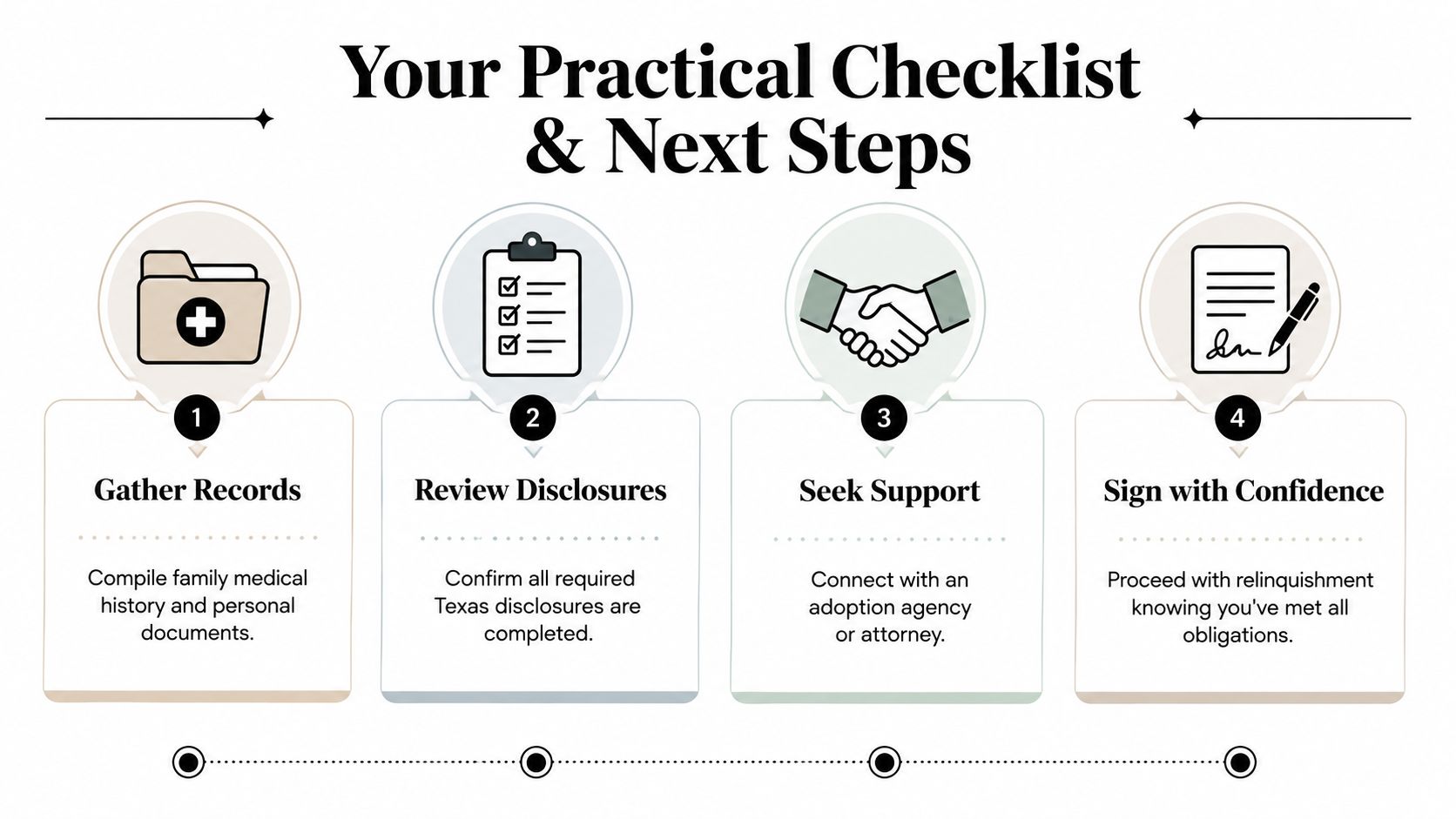
Your Practical Checklist and Next Steps
A careful paper trail starts before anyone signs. Birth parents and adoptive families both have an easier time later when the file already says who knows what, who is holding it, and what still needs to be updated if new medical information comes in after placement.
A simple checklist for the road ahead
- Gather family medical history early: Write down known conditions, causes of death, pregnancy details, and any mental health history you know before the relinquishment affidavit is signed.
- Ask for the expense estimate in writing: Texas rules require agencies to give a written estimate of anticipated pass-through expenses before financial commitment, except for unforeseeable medical and legal costs.
- Request the itemized accounting when needed: If you want to know how pass-through money was used, ask for the individual report that shows the date, amount, and description of each expense.
- Confirm who keeps the medical form: DFPS keeps it in CPS cases, while a licensed private adoption agency keeps it in private placements.
- Save new information after placement: If later medical, psychological, or psychiatric information becomes available, provide it in writing to the record holder so the child's file stays current.
| Disclosure Category | What Is Required | Who Retains It | When It Is Due |
|---|---|---|---|
| Medical history report | Health, genetic, psychological, psychiatric, pregnancy-related, and related history to the extent known | DFPS or licensed private adoption agency | At relinquishment |
| Expense report | Individual report by category with date, amount, and description | Child-placing agency | Before financial commitment, with itemized access on request |
| Supplemental updates | Later medical, psychological, and psychiatric information if it becomes available | Same record holder as the original file | After placement, when known |
A careful review before signing can prevent later confusion. That is true for birth parents, adoptive parents, and relatives stepping into caregiving roles. If you are comparing adoption paths like kinship care, foster care, or stepparent adoption, our team can help you understand how the paperwork changes from one path to another, including kinship adoption services and foster care adoption guidance.
If you are trying to sort out medical history forms, expense disclosures, or the timing of a relinquishment in Texas, the Law Office of Bryan Fagan, PLLC can walk you through the paperwork in plain English. Visit Law Office of Bryan Fagan, PLLC to talk through your situation and get legal guidance that fits your family's next step.
