
You may be hopeful, nervous, and unsure what to do first. Perhaps you've connected with an expectant parent, or you're a relative caring for a child and wondering whether adoption can provide lasting stability. In Texas, private placement adoption can offer a direct path to permanency, but it still requires careful legal oversight, proper consent, approved studies, and court findings focused on the child's best interests.
The process can feel personal because it is personal. A compassionate plan protects the child, respects birth parents, and gives prospective parents a clear path from preparation to finalization.
Understanding Private Placement Adoption in Texas
Maria and Daniel had prepared a nursery, reviewed their finances, and spoken with an expectant parent considering adoption. Their excitement came with practical questions. Could they work directly with the expectant parent? Did an agency have to be involved? Could a lawyer arrange the match? What would happen at the hospital, and what would the court require?
Texas offers more than one adoption path, and the lawful intermediary line matters. In a private placement adoption, a child may be placed through an independent arrangement or through a licensed agency. A foster care adoption follows a different route, generally involving the Texas Department of Family and Protective Services and the child welfare system. An agency may provide matching, counseling, placement services, and supervision.
A private placement can suit families with an existing connection to a birth parent, as well as relatives, stepparents, and other caregivers. The direct relationship does not make the legal process informal. Texas still requires lawful placement, valid consent, required evaluations, and court review. Payments also need careful attention. Families should ask which expenses are permitted and who may receive them, rather than treating every adoption-related cost as automatically allowed.

The best-interest standard
Texas Family Code Chapters 162 through 166 provide much of the framework for adoption, parent-child relationships, termination, consent, and related court procedures. Adult agreement is only one part of the case. The court must decide whether adoption supports the child's long-term welfare and a stable family relationship.
Texas had an estimated 7,168 adoptions in 2023, according to Adoption by the Numbers 2025. Private domestic adoptions accounted for 39.96% of the state's total, while foster care adoptions represented 58.33%. The report also lists 7,265 total adoptions in 2022 and 8,522 in 2019, reflecting a decline in total adoption activity across those years while private domestic adoption remained a substantial part of Texas family formation.
Private adoption services also have a long history in Texas. The Gladney Center for Adoption is described by the Texas State Historical Association as the oldest adoption service in Texas and one of the oldest in the United States. Reporting on Gladney indicates that it had completed approximately 30,000 placements by the 2020s (Texas Observer).
Practical rule: A private arrangement remains a court-regulated adoption. The relationship may start privately, but the legal result depends on lawful placement, valid consent, required evaluations, and a best-interest finding.
Communication expectations should be discussed early. An open adoption may include agreed contact, updates, or information sharing. A closed adoption may involve little or no continuing contact. Those expectations deserve careful drafting because a heartfelt promise and an enforceable legal term are not always the same.
Before contacting a professional, review the Texas rules for advertising or seeking a birth mother privately. Early advice can help a hopeful connection remain within Texas placement and expense rules.
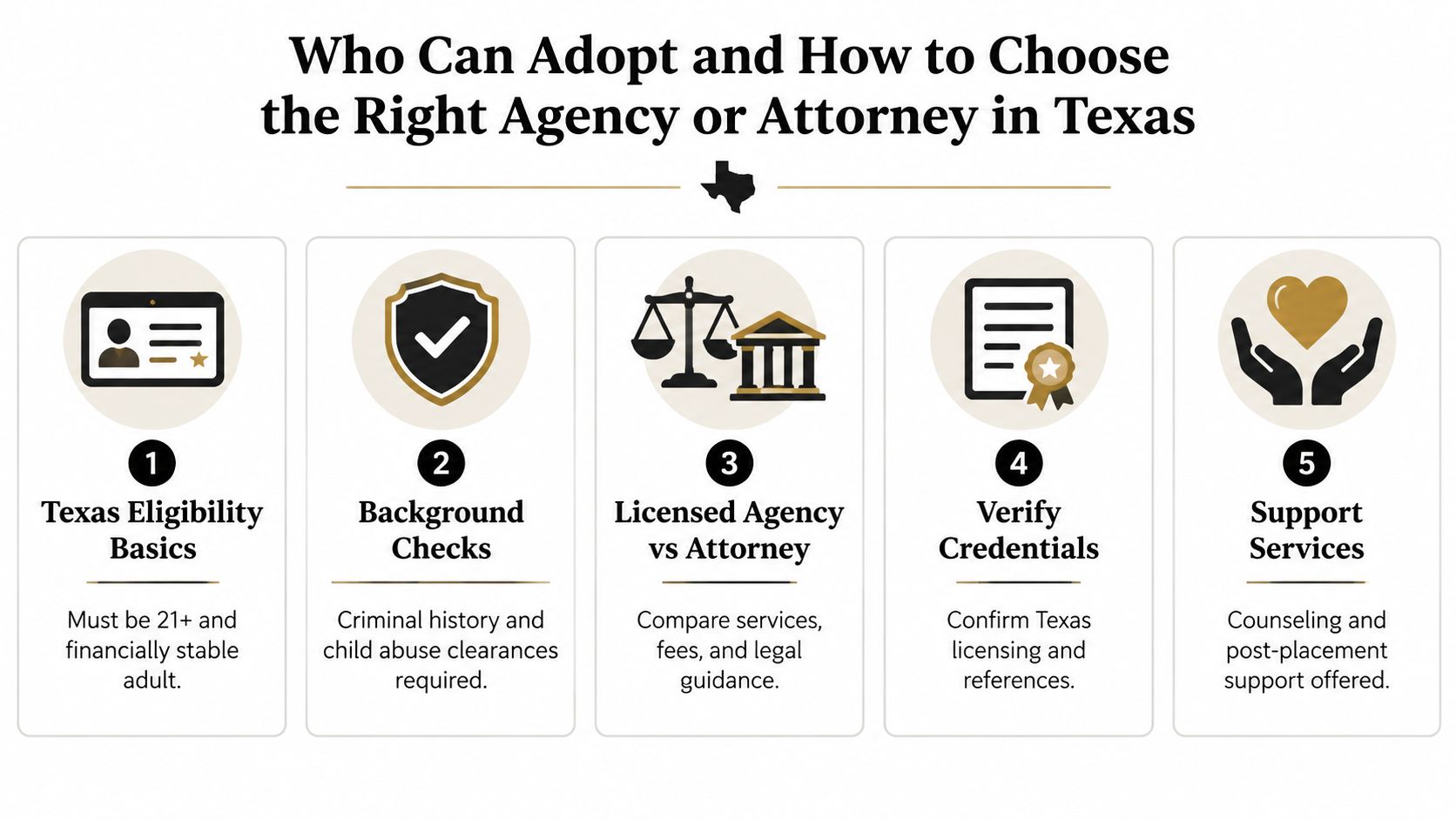
Who Can Adopt and How to Choose the Right Agency or Attorney
Texas law allows an adult to petition to adopt a child. That broad starting point doesn't mean every case follows the same procedure, and it doesn't mean a prospective parent can arrange every part of a placement independently. The court will examine the child's best interests, required evaluations, parental rights, and the facts surrounding the proposed adoption.
The most important distinction in private placement cases concerns who may act as an intermediary. Texas Department of Family and Protective Services guidance explains that private adoptions may be independent or agency-based. Texas child welfare guidance also identifies licensed child-placing agencies as the entities that may serve as intermediaries between a prospective adoptive parent and an expectant parent. State summaries further explain that lawful non-agency placements are limited to placements made by legal parents or managing conservators (Texas DFPS private adoption guidance).
A lawyer can represent a prospective parent or birth parent. Representation isn't the same as matching or brokering. An attorney who explains rights, prepares pleadings, reviews consents, and appears in court is performing legal work. That role should not be confused with an unauthorized promise to locate a child or arrange a placement outside the lawful intermediary structure.
A careful professional-selection checklist
Ask each agency or attorney direct questions before sharing sensitive information or signing an agreement.
- Confirm the role: Ask whether the professional provides legal representation, counseling, placement services, or intermediary services. The answer should be specific.
- Verify credentials: Confirm agency licensing when an agency will facilitate the placement, and ask the attorney who will handle the court filings and consent documents.
- Review expenses: Texas generally prohibits offering or receiving anything of value for placing a child for adoption, except narrow categories such as reasonable legal, medical, and counseling expenses. Ask for a written explanation of every proposed payment.
- Discuss the home study: Find out who completes it, what household members must participate, and how approval will be documented.
- Plan for support: Birth parents should have access to understandable counseling and independent advice about consent. Adoptive parents should know who will coordinate supervision and reports after placement.
- Watch for red flags: Be cautious if anyone promises a guaranteed placement, asks for unexplained payments, pressures a birth parent to sign quickly, or says court approval is merely a formality.
Background screening is part of responsible preparation. Families and professionals can use a resource explaining a Childcare background check to understand the general purpose of criminal history and child safety screening, although the adoption professional must identify the Texas-specific requirements for the case.
For families weighing legal representation, how to choose the right adoption attorney in Texas offers useful questions to raise during an initial conversation. Families may also review When to Hire a Texas Adoption Attorney for a factual overview of why legal guidance can protect an adoption from delays and challenges.
Navigating the Texas Private Placement Process From Home Study to Court Filing
A private placement succeeds when each stage supports the next. Families shouldn't treat the home study, consent, placement, supervision, and court filing as separate chores. Each one gives the next decision a legal foundation.
Approval begins at home
Texas requires a pre-adoptive home study before an applicant can be approved for adoption. The study includes interviews, background review, and an in-home visit. Household members generally need to participate because the evaluator is assessing the environment in which the child will live, not just the petitioner's personal history (Texas Family Code Section 264.207).
A practical sequence is straightforward:
- Complete screening and interviews: Provide requested information and answer questions.
- Prepare the household: Make sure the evaluator can meet the required household members.
- Finish the home visit: The evaluator reviews the living environment and readiness for placement.
- Obtain approval: Approval should be documented before placement proceeds.
Missing an interview or treating the visit as a routine form can delay approval. A family may have a loving home and still need to correct a procedural gap before the agency or court can move forward. If you're preparing now, review the Texas adoption home study requirements and ask what documents your evaluator expects.
Consent follows the child's birth
For a birth parent considering private placement, Texas requires a voluntary relinquishment affidavit to be signed after the child's birth and not before 48 hours after birth. That waiting period matters. It gives the birth parent time after delivery before signing a document that may permanently surrender parental rights (Texas consent requirements).
The hospital plan should account for this timing. Adoptive parents may be ready to care for the baby, but they shouldn't pressure a birth parent to sign or assume that a pre-birth agreement alone completes the legal process. Birth parents deserve clear advice about what consent means, whether it can be revoked, and what support is available.
Filing creates the court case
Texas law generally requires an adoption evaluation under Chapter 107, unless the court waives that requirement under Section 107.153(a-1). Texas Law Help explains that adoption cases involve reports and studies designed to help the court decide whether the adoption serves the child's best interest (Texas adoption petition requirements).
The filing stage commonly involves:
- The adoption petition.
- Required consent or relinquishment documents.
- The home study and adoption evaluation.
- Background and supporting records.
- Notices and service documents for individuals whose rights may be affected.
- Post-placement reports and other court-required materials.
A lawyer should confirm which documents apply because a private infant placement, stepparent adoption, relative adoption, and CPS case don't use identical paperwork. Families should keep a single organized file, track signatures, and promptly report changes in address, household composition, or the child's medical needs.
The court may ask questions directly. A final hearing isn't just a ceremonial moment. The judge must have enough reliable information to determine that the adoption protects the child's welfare and creates a lawful, permanent parent-child relationship.
The process is easier to understand when families can see the sequence visually. A short educational video can also help parents prepare for the legal path:
Costs Timelines and Post Placement Supervision in Texas
A family may be ready to welcome a child, then learn that a proposed payment could create a legal problem. In a Texas private placement, the lawful intermediary line matters. An agency or attorney may help connect the birth family and prospective parents, but an individual cannot accept money in exchange for placing a child. Texas restricts payments tied to placement, with narrow exceptions that can include reasonable legal, medical, and counseling expenses. Review every proposed payment before anyone sends or receives it (Texas Family Code provisions on adoption expenses).
Create a written budget with separate entries for legal expenses, home study and evaluation costs, agency or placement services, and approved support for birth-parent needs. The agreement should identify who pays, why the payment is being made, whether it is permitted, what receipts or records are needed, and whether a court or agency must review it. A clear paper trail works like a map. It helps the adults and the court distinguish lawful expenses from an improper payment.
Planning around the calendar
A reported real-world private adoption timeline is often 1 to 2 years, and many cases include approximately six months of post-placement supervision before finalization (Imprint News). Timing may change if consent is delayed, paperwork is incomplete, supervision reports are missing, or the court needs a later hearing date.
Texas also requires the child to have lived with the petitioner for six months before the court may grant the adoption. A judge may waive that period when the waiver serves the child's best interests (Texas Law Help). Residency and post-placement supervision can overlap, but they answer different legal questions. Your attorney should compare both requirements with your placement dates and case facts.
| Planning area | What families should track |
|---|---|
| Approved expenses | Written descriptions, receipts, and legal authorization |
| Supervision | Visits, reports, medical updates, and requested records |
| Residency | The date placement began and any possible waiver request |
| Finalization | Petition status, court documents, and hearing preparation |
Supervision is not a punishment or a test parents must pass. The assigned professional and the court use it to confirm that the child is safe, receiving appropriate care, and forming a stable relationship with the prospective parents. Keep visit notes, receipts, medical updates, and requested documents as the case proceeds. Rebuilding that record months later can add avoidable stress.
Special Situations Stepparent Relative LGBTQIA Foster and Interstate Adoptions
The legal path changes with the family's relationship to the child. A stepparent, grandparent, foster parent, same-sex couple, and out-of-state relative may all seek adoption, but each case can raise different consent, termination, evaluation, and placement questions.
Stepparent adoption
Suppose Jordan has raised his spouse's child for years and wants legal parental rights. The spouse generally joins in the adoption petition, and separate consent from that spouse isn't required merely because the spouse is the child's legal parent. The other biological parent's rights usually must be addressed first, often through termination proceedings.
Texas has a specific rule for an older child. If the child is 12 years of age or older, the child must consent in writing or in court, although the judge may waive that requirement if the waiver serves the child's best interests (Texas Family Code Section 162.010). The child's voice matters, and the family should prepare for the emotional impact of discussing the adoption openly.
Relative and kinship adoption
A grandparent or aunt may already be providing daily care after a family crisis. Adoption can create permanent legal status, but guardianship may sometimes be the more suitable option when parental rights or family relationships require a different approach. The right choice depends on safety, permanency, consent, and the child's best interests.
Relative caregivers should preserve medical, school, and placement records. They should also avoid assuming that family agreement replaces court authority. If another parent's rights must be terminated, Termination of Parental Rights Before Adoption explains why that legal step is necessary in many adoptions.
LGBTQIA+ and single-parent adoption
LGBTQIA+ couples and single adults can pursue adoption under the same central best-interest framework. The practical focus remains the home study, lawful placement, parental rights, required evaluations, and the child's need for a safe and permanent home. Families should work with professionals who can discuss their household respectfully and clearly.
Foster, CPS, and interstate cases
A foster parent pursuing adoption may need to coordinate with DFPS, caseworkers, court orders, and reunification efforts. Adoption isn't automatically the first outcome in a CPS case. The court and child welfare professionals must address the child's safety and the parents' rights before permanency is finalized.
Interstate placements add another layer. When a child crosses state lines for adoption, the Interstate Compact on the Placement of Children may require approval from the sending and receiving states before the placement occurs. Families should obtain advice before travel or physical placement because paperwork, home-study review, and state coordination can affect both timing and jurisdiction.
Moving Forward With Confidence and Compassion
A sound private placement plan begins with four safeguards: use the proper intermediary, obtain home-study approval before placement, respect the post-birth consent timing, and prepare the evidence the court needs for a best-interest finding. Those safeguards protect everyone, especially the child and the birth parent.
Start by gathering identification, household information, medical records, financial documents, and prior court paperwork. Ask your professional to identify every required signature, report, visit, and deadline. Keep communication respectful and avoid promises about expenses or future contact until the arrangement has been reviewed under Texas law.
Birth parents should have time and support to make an informed decision. Adoptive parents should prepare for uncertainty without treating the birth parent as a means to an outcome. Relatives and foster parents should consider whether adoption, guardianship, or another permanency option best protects the child's relationships and stability.
The Law Office of Bryan Fagan, PLLC helps Texas families with private, stepparent, relative, LGBTQIA+, foster care, CPS-related, international, and guardianship matters. The firm provides guidance with applications, home studies, consent issues, court filings, and finalization through virtual consultations and offices serving communities across Texas.
The Law Office of Bryan Fagan, PLLC can review your private placement plan, explain which intermediary and consent rules apply, and help prepare the home-study and court process. Visit the firm to schedule a free consultation and take the next step with clear, compassionate legal guidance.
