
You may be holding an adoption order, medical records, or agency messages that suddenly raise painful questions. Perhaps a child's serious condition wasn't disclosed before placement. Perhaps a birth parent believes consent was obtained through pressure. Or perhaps a child was moved informally after adoption, creating a problem that doesn't fit the traditional idea of wrongful adoption. Texas law treats these situations seriously, but it also protects the finality of adoption orders.
Wrongful adoption claims involve more than disappointment or a difficult adjustment. They require careful attention to disclosure duties, consent, agency conduct, causation, damages, and strict deadlines. The child's safety and best interests remain central, while adoptive parents, birth parents, and relatives each deserve clear information about their legal options.
Understanding wrongful adoption under Texas law
A parent may learn after placement that important medical information was missing, consent was defective, or an agency handled the process improperly. The phrase wrongful adoption can describe these serious concerns, but it does not identify one automatic lawsuit. Texas law separates a statutory nondisclosure remedy from other claims based on fraud, invalid consent, professional misconduct, or damages. The facts must show a legal defect and a loss connected to it. Texas A&M legal scholarship explains the statutory nondisclosure remedy.
Finality creates a second layer of difficulty. Under Texas Family Code Chapter 162, an adoption order establishes a legal parent-child relationship for all purposes. Chapters 163 through 166 address related issues involving termination, adoption procedures, records, and finality. A court reviews statutory requirements and the child's best interests before entering the order. Once that order becomes final, challenging it can be more difficult than proving that something went wrong during the process. Chapter 162 describes the legal effect of a Texas adoption order.
Adoption works like a permanent change to a home's legal title. Love and commitment may support the family, but the required permissions, inspections, and records still matter. A missing approval can create legal consequences after the placement appears stable.
Another source of confusion involves informal custody transfers. A child may be moved between adults without the formal process people associate with adoption. That situation may raise safety, consent, or custody questions, yet it may not fit the classic tort model of wrongful adoption. The legal remedy depends on what occurred, who had authority, and whether Texas law provides a claim.
Texas operates a large child-welfare system, and federal data reports adoptions and maltreatment-investigation rates across multiple years. Those figures provide context, not proof of an individual case. Anyone considering a challenge to an adoption in Texas should seek legal review promptly, because finality rules and filing deadlines can affect available remedies.
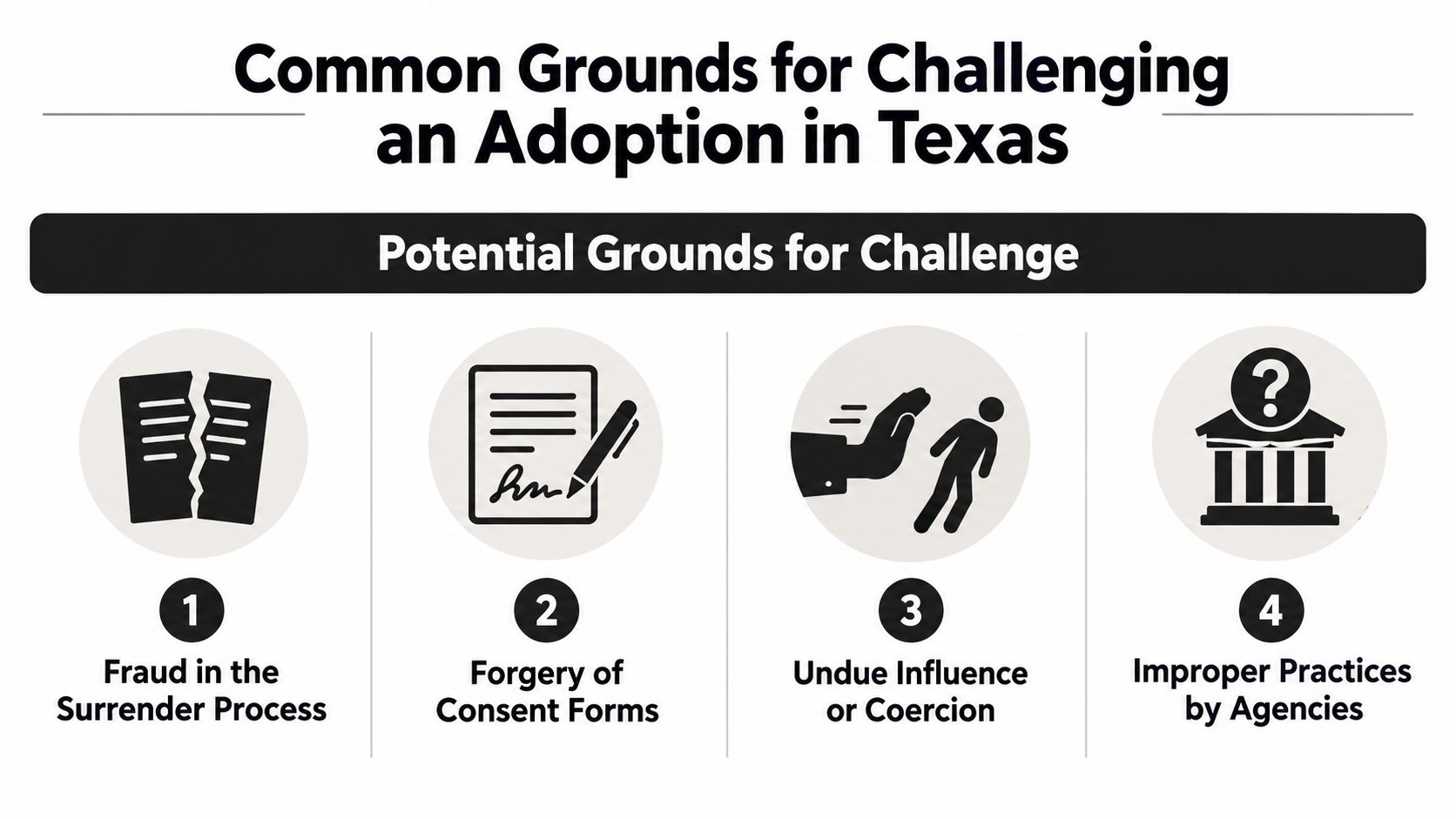
Common grounds for challenging an adoption in Texas
A family might describe a painful adoption outcome as “wrongful adoption,” but that phrase can cover several legal theories. A difficult placement alone is not enough. The evidence must connect a specific representation, omission, consent defect, or professional failure to a legally recognized injury.
Fraud and missing information
Fraud may exist when an agency, professional, or another participant knowingly gives false information or conceals an important fact. For example, an adoptive parent may receive medical records reporting no known significant condition, while the agency file contains contrary information. The parent still must show the misrepresentation, reliance, causation, and damages.
Nondisclosure raises a related question: did the person have a legal duty to provide the information? The law does not require anyone to predict every future difficulty. It does require a careful review of what information had to be disclosed, what was withheld, and whether the omission caused measurable harm. For a focused explanation, review what makes an adoption consent invalid in Texas.
Forged or invalid consent
A consent signature may be challenged if it was forged, obtained from someone without authority, or completed without required safeguards. Other issues can involve inadequate notice, the identity of a necessary consenting parent, or the child's participation when Texas law requires it. The consent rules, including the child's voice at age 12 deserve close review because one defect can affect the legal foundation of the proceeding.
Undue influence and coercion
Undue influence means improper pressure overcame a person's free choice. A birth parent experiencing homelessness, medical distress, isolation, or misleading counseling might later contend that consent was not voluntary. A court would examine the surrounding circumstances, including what was said, who attended, which alternatives were explained, and whether the person understood the legal effect of signing.
Texas courts considered coercion and consent disputes before “wrongful adoption” became common terminology. In 1970, the Texas Court of Civil Appeals decided Methodist Mission Home of Tex. v. N—— A—— B——, 451 S.W.2d 539, involving claims that surrender documents were void because of alleged undue influence. A St. Mary's Law Journal discussion of wrongful adoption in Texas connects that history with later legal analysis.
Agency and professional misconduct
An agency, attorney, evaluator, counselor, or other professional may face scrutiny for failing to follow required standards, making material misrepresentations, or mishandling records and disclosures. The appropriate claim depends on the evidence and the relationship between the parties. Preserving the paper trail can help distinguish an honest mistake from conduct that supports a legal remedy.
Unregulated custody transfers create a separate concern. Texas law may treat an informal post-placement transfer or rehoming differently from a traditional civil wrongful-adoption damages claim. The conduct can raise criminal or protective issues without automatically establishing a tort claim. A Texas family law discussion distinguishes unregulated custody transfers from classic wrongful-adoption claims. That distinction matters because the label used by a family does not determine the available remedy.
Statutes and deadlines for wrongful adoption claims
The most important deadline question is whether the case attacks the adoption order itself or seeks separate damages for misconduct. Texas Family Code § 162.012 bars a direct or collateral attack on a final adoption order after six months. In practical terms, a person generally can't wait until a dispute becomes severe and then try to undo the decree outside that window. The Texas case discussion of finality and limitations explains why early filing matters.
The timeline can be understood in two tracks:
- Final adoption order: The six-month period applies to direct or collateral attacks on the decree.
- Separate civil claim: Fraud, negligence, breach of duty, or another damages theory may have its own limitations period and accrual rules.
Discovery of a hidden problem doesn't automatically erase the finality rule. It may affect a separate claim, but a court will examine the legal theory, the date of the conduct, the date of discovery, and the relief requested.
Preserve evidence before memories fade
Keep the adoption order, pleadings, consents, medical records, home-study materials, text messages, emails, invoices, counseling records, and agency communications. Don't edit original messages or rely only on screenshots if the original account remains available. A lawyer can help identify which facts support a motion attacking the decree and which support a separate damages action.
If you're researching limitations issues generally, Texas exceptions to statutes of limitations may provide background, but only a lawyer reviewing the adoption record can assess how those rules apply to your situation.
Practical rule: If you suspect a defect, don't wait for the family conflict to resolve itself before getting advice. Waiting can turn an arguable claim into a barred one.
Legal remedies and the evidence needed
A parent who wants to undo an adoption order faces a different path from an adoptive parent seeking payment for losses caused by undisclosed information. The remedy must fit the legal theory. Courts separate relief that changes the legal record from relief that compensates measurable financial harm.
Damages for measurable losses
Texas law allows civil recovery in circumstances where an agency, professional, evaluator, or another responsible person fails to meet required disclosure duties. A nondisclosure claim still requires proof connecting the missing information to actual losses, such as medical treatment, specialized caregiving, or educational services. The Texas A&M scholarship discusses civil recovery for adoption nondisclosure, but the specific claim depends on the facts and governing law.
A diagnosis by itself does not establish damages. The record should show what information existed, who had access to it, what should have been disclosed, how the parent acted after receiving accurate information, and which expenses resulted from the undisclosed condition.
Useful evidence may include:
- Medical records: Physician notes, diagnostic reports, treatment histories, prescriptions, and explanations of when the condition became known.
- Educational records: Evaluation reports, individualized support documentation, tutoring invoices, and communications about needed services.
- Caregiving documentation: In-home care records, transportation expenses, therapy schedules, and descriptions of the child's daily needs.
- Agency communications: Emails, intake forms, disclosure questionnaires, counseling notes, and written statements about health or background.
- Expert opinions: Medical or educational professionals can explain causation, foreseeability, and whether claimed expenses relate to the omitted condition.
Equitable relief and the adoption order
A court may consider equitable relief in an appropriate case, but an adoption order carries strict finality protections. A request to rescind or attack the order must identify the legal authority, the available deadline, and the reason the court can grant that remedy. A damages action may remain possible even when changing the adoption record is no longer available, although the theory, timing, and proof still control.
This distinction matters because a custody transfer that occurred outside the regulated adoption process may raise different questions from a classic nondisclosure tort. The court may examine whether the facts involve adoption procedures, fraud or negligence, an unauthorized placement, or another custody arrangement before selecting a remedy.
Organizing the record
Create a dated chronology with three columns: what happened, who knew it, and what document proves it. This format helps counsel separate assumptions from evidence and identify gaps before filing. Keep original messages and records where possible, rather than relying only on screenshots.
If you need to send a signed authorization, notice, or document to counsel or an agency, a resource about online fax for one-off sends explains one practical option for a single transmission. Confirm the recipient's secure submission requirements first.
The strongest file connects the duty, the omitted or false information, the parent's reliance, the child's condition or placement event, and the resulting loss. Emotional harm matters to families, while a statutory nondisclosure claim often turns on documented financial causation.
Real-life scenarios of wrongful adoption challenges
An adoptive parent may receive a child's records after placement and find references to earlier medical evaluations that were never disclosed. The parent preserves the agency's original communications, obtains complete medical records, and asks specialists to explain the condition and likely care needs. An attorney may then assess whether a nondisclosure claim could seek medical, educational, or caregiving losses. The practical lesson is clear: preserve the file before asking the agency to explain the inconsistency.
A birth parent may later report that an agency counselor pressured her to sign surrender documents. She might say the counselor presented adoption as the only safe option, failed to explain alternatives, or allowed too little time for consideration. Counsel would examine counseling records, witnesses, communications, notices, and the circumstances of consent. Depending on the deadline and evidence, the possible path could include a challenge to the adoption order, a separate claim, or another proceeding.
Texas law also recognizes that custody transfers outside the regulated adoption process can raise different issues from a classic nondisclosure tort. A court may need to determine whether the facts involve adoption procedures, fraud or negligence, an unauthorized placement, or another custody arrangement. That classification can affect both the remedy and the proof required.
Neither scenario guarantees a result. A court applies the governing statute, weighs credibility, and decides whether the evidence meets the applicable legal standard. A troubling fact may be an important lead, but it is not automatically a complete claim. An attorney should review the full record, including what was disclosed, when it was learned, and which finality deadline may control.
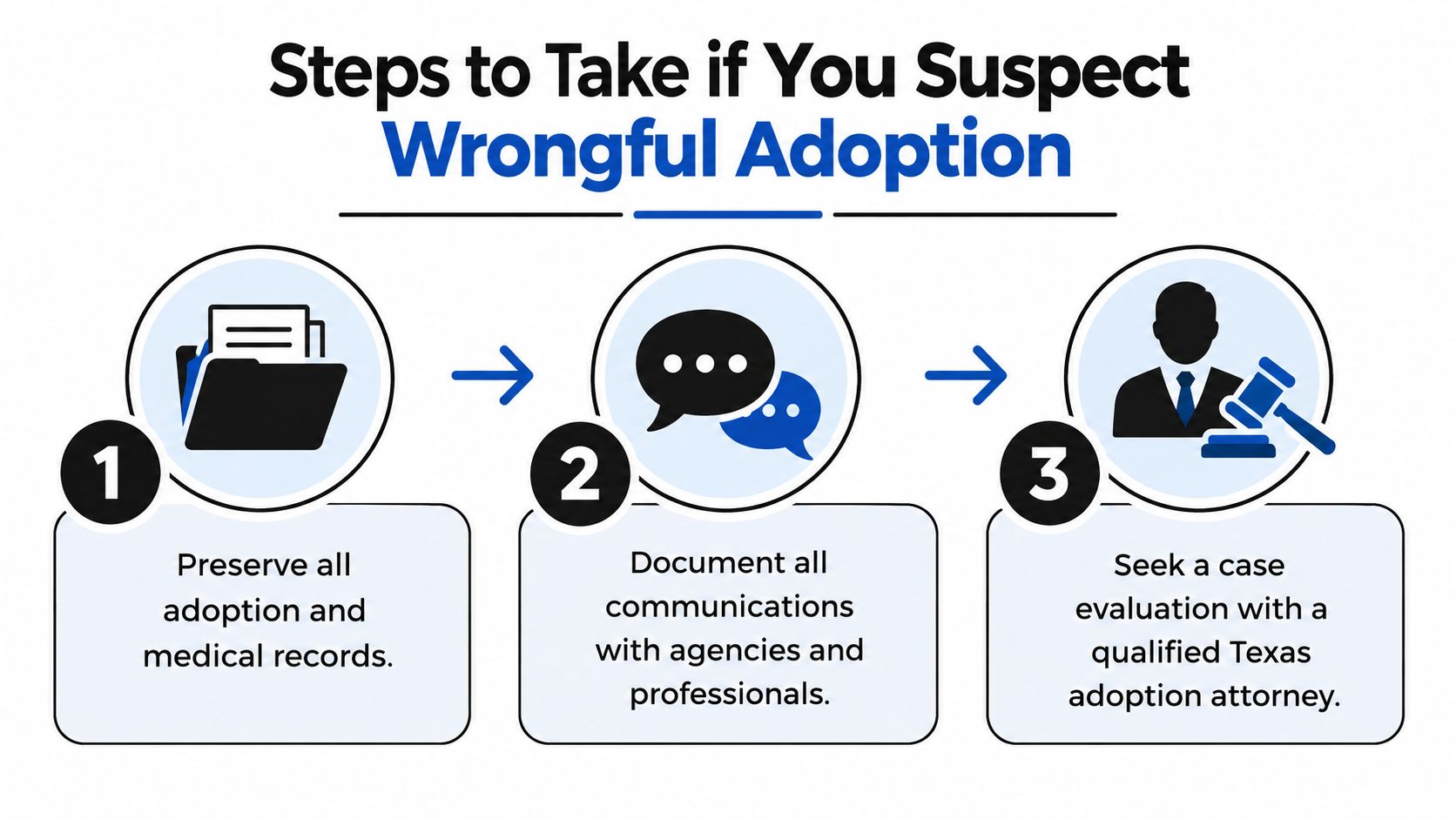
Steps to take if you suspect wrongful adoption
Start with preservation, not confrontation. An angry message to an agency may feel necessary, but it can create confusion about what was said and when. Save the original records first, then obtain legal advice about communications and next steps.
Step one preserve the complete file
Gather the adoption petition, final order, consents, termination documents, home-study reports, medical and psychological records, agency contracts, invoices, emails, text messages, and social-media communications. Ask medical providers for complete records rather than only summaries. Store copies in a secure location and keep the originals unchanged.
Write down when you first learned about the suspected defect. That date may matter for a separate damages claim, even though the finality deadline for attacking the adoption order remains a critical issue.
Step two build a communication log
Create a chronological log identifying:
- The speaker: Record the agency worker, counselor, evaluator, attorney, doctor, or family member involved.
- The statement: Summarize the representation without embellishing it.
- The setting: Note whether the statement appeared in writing, during a meeting, or in a call.
- The proof: Identify the email, text, report, witness, or record that supports it.
- The result: Explain what decision or expense followed.
Don't secretly record conversations. Recording rules can be complicated, and a lawyer can advise you about lawful documentation in your circumstances.
Step three obtain a focused legal evaluation
Choose counsel who understands Texas adoption, termination, consent, professional negligence, and limitations law. Bring the timeline and a short list of questions:
- Is the concern an attack on the adoption order or a separate damages claim?
- Has the six-month finality period expired?
- What evidence supports causation and financial loss?
- Which people or organizations may have legal responsibility?
- Should medical, educational, or forensic experts review the records?
- What immediate filing or preservation step protects the family's position?
A lawyer may recommend expert review, a records request, a demand, a petition, or a status hearing. The appropriate action depends on the evidence, the child's current safety, and the relief available.
This video may help families understand the importance of obtaining legal guidance before making major decisions:
Emotional support belongs in the plan, too. A child may need counseling, a birth parent may need trauma-informed support, and an adoptive parent may need help managing care while the legal review proceeds. Legal strategy and family healing can move forward together.
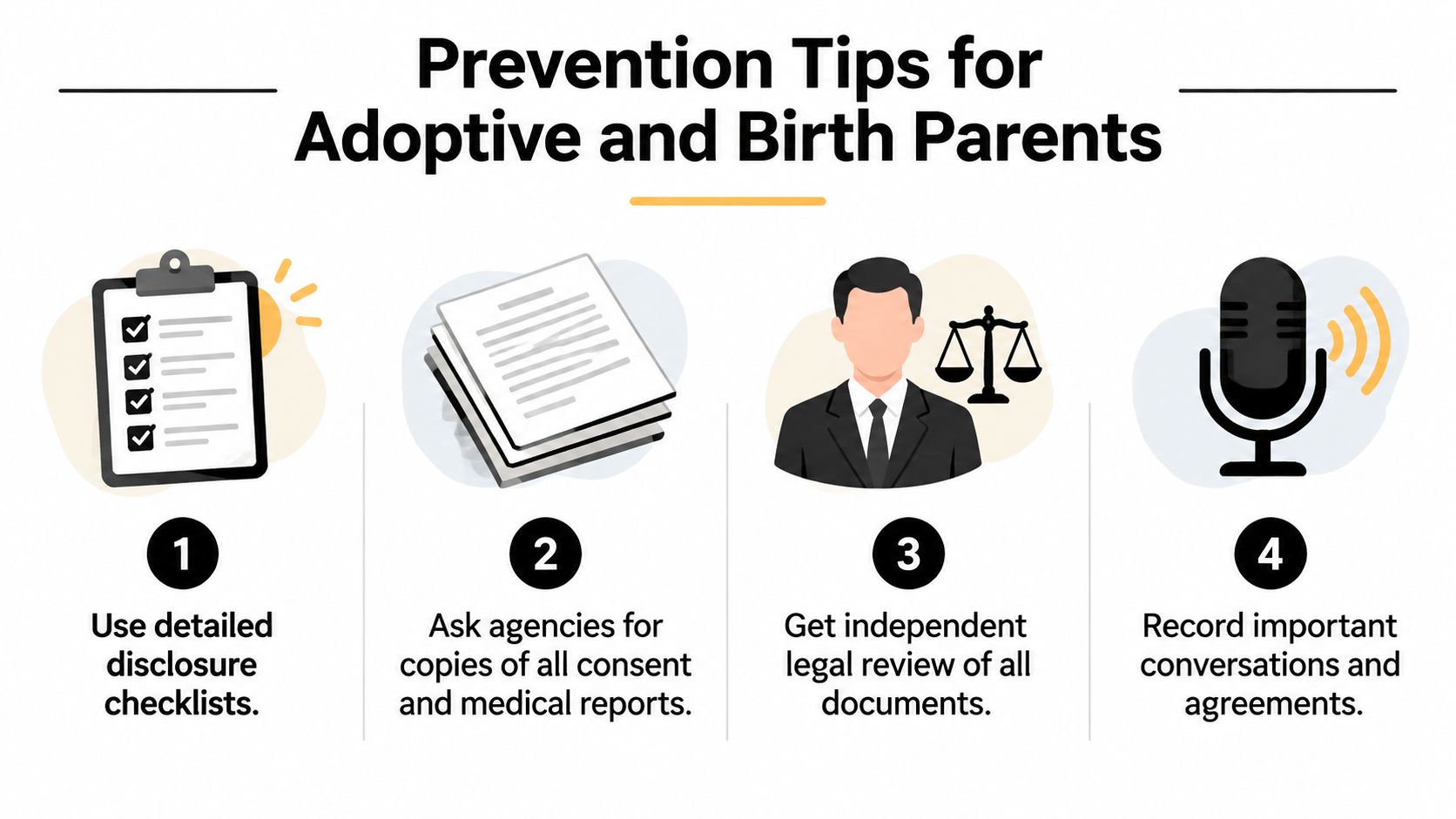
Prevention tips for adoptive and birth parents
Careful preparation before finalization protects more than paperwork. It helps adults make informed decisions and keeps the child's needs at the center of the process.
Make disclosure specific
Use a written checklist for medical, developmental, educational, family, and placement history. General statements such as “no known concerns” can create confusion later. Ask what records support each answer and request clarification when a response is incomplete.
Keep copies of every important document
Adoptive parents should request copies of medical reports, consent forms, evaluations, and agency disclosures. Birth parents should retain copies of counseling materials, notices, agreements, and signed documents. A complete file protects everyone if memories differ later.
Get independent legal review
An attorney representing the agency or another participant may not be your personal lawyer. Independent counsel can explain the legal effect of consent, termination, open or closed adoption agreements, and finalization documents in plain language.
Approach counseling and conversations carefully
Counseling should support informed, voluntary decision-making rather than pressure. If the parties want important conversations documented, they should agree on a lawful method first. A written follow-up email confirming what everyone understood can prevent later confusion.
Also verify that the agency or professional is properly authorized to perform the services involved. Families should ask who is responsible for each disclosure, evaluation, consent, and filing. Prevention doesn't remove every risk, but it makes the process more transparent and gives the child a stronger foundation for permanency.
Getting legal help from a Texas adoption attorney
Wrongful adoption matters often involve overlapping rules from the Texas Family Code, civil claims, professional duties, and court deadlines. A lawyer can organize the evidence, identify whether the requested remedy is available, and determine whether a filing must occur before the finality period closes.
Prepare for a consultation by bringing the final adoption order, all consent and termination documents, agency records, medical files, communications, and a dated summary of what you learned. Write down your main questions and explain what outcome you're seeking, whether that means financial recovery, correction of records, protection of the child, or review of the adoption order.
Families often begin their search through personal referrals, legal directories, and educational resources about how people find attorneys. The Law Office of Bryan Fagan, PLLC handles Texas adoption and guardianship matters, including stepparent, kinship, CPS-related, domestic, international, LGBTQIA+, and special-needs cases. The firm provides consultations for families seeking guidance at different stages of the adoption process.
The Law Office of Bryan Fagan, PLLC can review the records, deadlines, and consent or disclosure concerns involved in your potential wrongful adoption Texas claim. Visit Law Office of Bryan Fagan, PLLC to request a free consultation and discuss a clear legal path focused on your family and the child's best interests.
