
A parent can get a call, open a letter, or hear from a caseworker and suddenly realize the question isn't just about custody anymore. It's about whether the law says the parent-child relationship can continue at all. For Texas families facing adoption, CPS involvement, or a stepparent or relative placement, termination of parental rights is often the legal step that decides whether a child can move into a permanent home.
That's why this topic carries so much weight. A peer-reviewed study found that as of 2016, about 1 in 100 American children had experienced termination of parental rights before age 18, which shows this issue affects many families, not just a few isolated cases (study). In Texas, the process is governed by strict rules, and courts take the outcome seriously because it can clear the way for adoption while permanently changing a family's legal ties.
Introduction to Termination of Parental Rights in Texas
For many people, the first sign of trouble is a notice from court or CPS that sounds bigger than anything they've dealt with before. One parent may be trying to place a child for adoption, while another may be fighting to keep rights after a case has already started. Either way, the stakes feel personal because they are personal, and the law treats them that way too.
Termination of parental rights in Texas is not a paperwork shortcut. It is a court process under Chapter 161 of the Texas Family Code that can end the legal parent-child relationship and change who has the right to make decisions for a child. That's why hopeful adoptive parents, birth parents, stepparents, grandparents, and caregivers all need clear guidance, not guesswork.
The basic questions usually sound simple, but the answers are not. Who can file? What does a judge need to see? Why does one case end in voluntary relinquishment while another becomes a contested hearing? In Texas, those questions shape the path to adoption, guardianship, or reunification, and the right answer depends on the facts, the evidence, and the child's needs.
Core Concept of Termination under the Texas Family Code
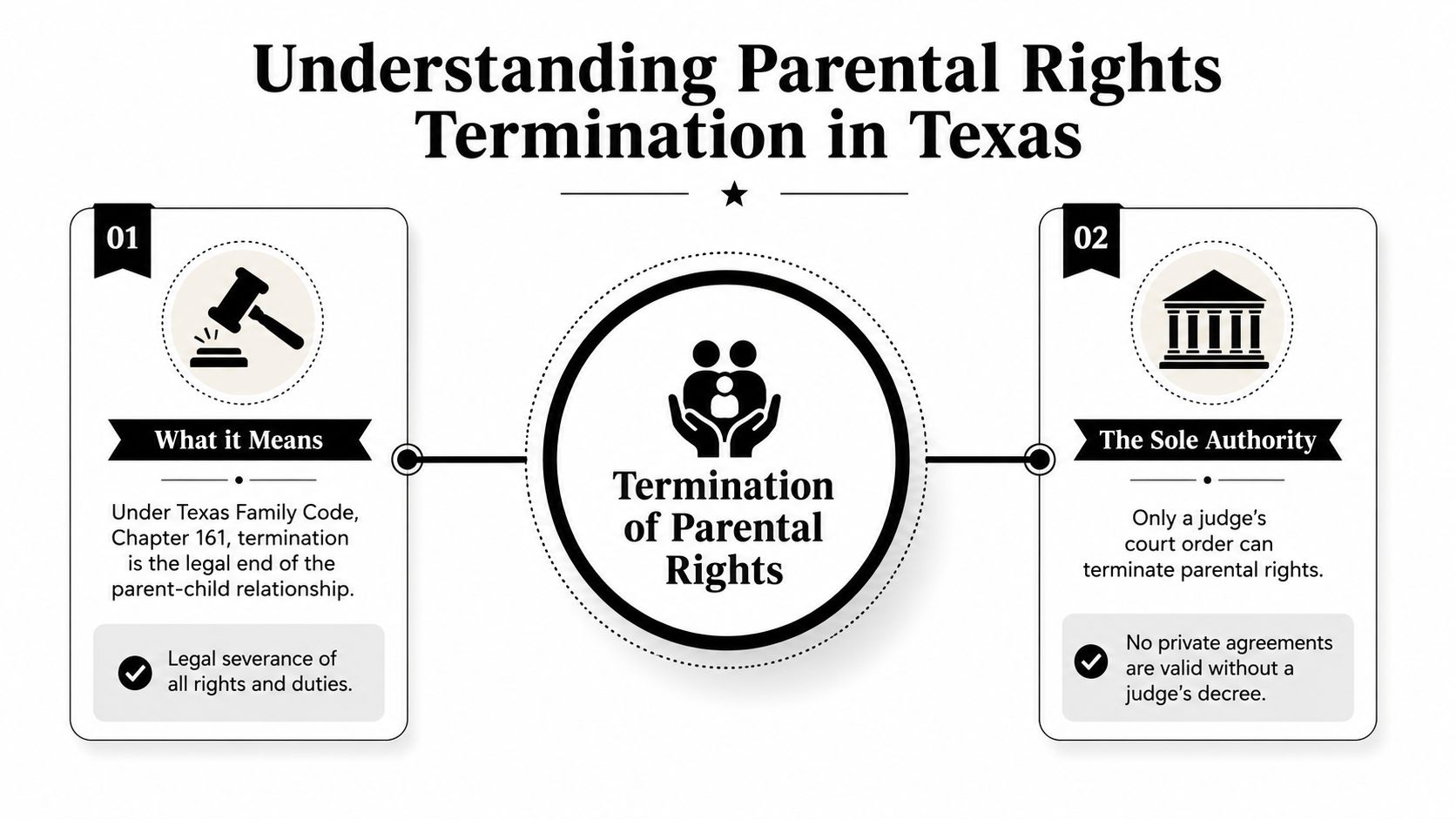
Parental rights in Texas are a legal bond that only a court can sever. Under Chapter 161, a judge can end that relationship only through a court order, whether the case is voluntary or contested. A private agreement, a signed waiver, or a family understanding does not change the legal status by itself, because Texas requires proof that reaches the clear and convincing evidence standard (Texas legal guide).
That standard is higher than the usual civil rule. The evidence has to leave the judge with a firm belief or conviction, not just a sense that termination would be easier or less stressful for the adults involved. In practical terms, Texas law asks for proof that is strong enough to support both the legal grounds and the child's best interest, especially in contested cases where the evidence may be disputed or incomplete.
When the record is thin, the case gets harder to prove. Courts often have to sort through school records, medical notes, witness testimony, service plans, and other documents that may point in different directions. That is one reason post-2025 statutory changes and the way courts handle contested proof matter so much. Judges still have to apply the same demanding standard, but they must do so in real cases where the facts are rarely neat or one-sided.
Who can start the case
Texas guidance says only certain people or entities have standing to file, including parents, relatives, caregivers, DFPS, and adoption agencies (Texas legal guide). That rule keeps the case connected to people who have a real legal relationship to the child. For readers who want to see how termination connects to adoption, the Texas adoption and the family code essentials for parents guide gives helpful background on how these rules fit together in family law practice.
Practical rule: if no judge signs an order, the parent-child relationship still exists, even if everyone in the family thinks the matter should be over.
This is the point many families miss. A case can feel settled emotionally long before it is settled legally, but Texas family law does not treat feelings as a substitute for a court order. The judge's role is to decide whether the statutory requirements have been met and whether the evidence supports ending the legal relationship.
Voluntary and Involuntary Paths and Key Aspects
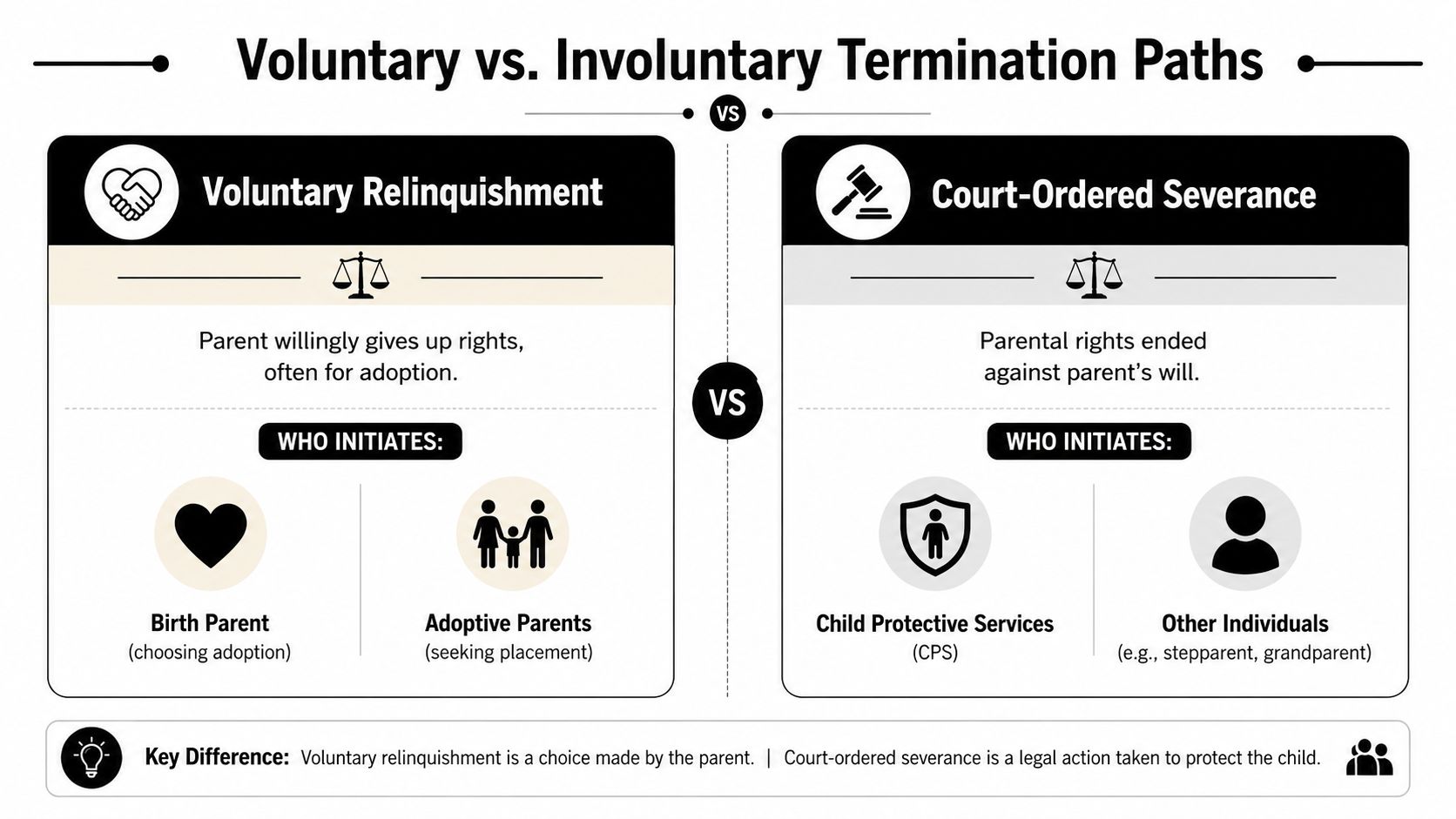
The easiest way to separate the two paths is to ask one question, is the parent choosing this outcome or fighting it? Voluntary termination usually happens when a parent agrees to give up rights so an adoption can move forward. Involuntary termination happens when a court ends rights over a parent's objection.
Voluntary relinquishment
A voluntary case often starts with a parent who wants the child to be placed with a stepparent, relative, or adoptive family. The emotional layer is huge, because this isn't just a legal signature, it's a life decision with lasting consequences. Texas still requires a court order, which means the judge must approve the result even when the parent is willing (TexasLawHelp).
Parents exploring this path often want to know whether a private surrender is enough. It isn't. If you're gathering background on the paperwork and court process, voluntary termination of parental rights is a useful companion topic because it shows how the legal process connects to adoption planning.
Involuntary termination
In contested cases, a parent may deny the allegations and push back hard. The petitioner may be DFPS, a relative, or another person with standing, and the court will then hear evidence about the alleged conduct, the child's safety, and the child's long-term welfare. In those cases, the fight is not just over whether something went wrong, but whether the law allows the state or another party to end the relationship permanently.
Some parents lose sleep over whether a single mistake will end the case. Texas courts don't look for a single bad day, they look for the statutory process, the proof, and the child's best interest.
Families who are comparing adoption pathways sometimes also need to think about counseling, healing, and support. For households affected by alcohol use, a guide to family healing from alcoholism can help frame the emotional side of separation and reunification decisions, especially when the legal case is only one part of a much longer family story.
Common Statutory Grounds under Chapter 161
Texas law lists 25 statutory grounds for involuntary termination, and the court still has to make a separate best-interest finding under the clear-and-convincing evidence standard. A judge does not end parental rights just because one ground is proven. The court must also decide whether termination serves the child's welfare, which is why contested cases often turn on both proof and context, not just allegations.
Some grounds are easier to understand in everyday language than in legal terms. Abandonment can mean a parent has stepped away from the child's life. Endangerment involves conduct that places the child at risk. Failure to support for one year usually points to a pattern of non-support, not a single missed payment. Texas law also recognizes serious criminal convictions, prior termination of rights to another child, controlled-substance endangerment, and incarceration that makes care impossible for two years.
What evidence often matters
Courts do not decide these cases by rumor. They look for records, testimony, and real-world behavior, such as missed visits, lack of support, unsafe living conditions, or facts showing that a child's safety has been compromised. The DFPS attorney guide notes that contested cases often turn on both the statutory ground and the separate best-interest analysis, and that endangerment is a common ground used by CPS (DFPS guide).
In practical terms, the evidence has to connect the dots. A parent's history may matter, but the court also looks closely at the current situation, because a termination case is not a guessing game about what might happen later. If alcohol use is part of the family story, a guide to family healing from alcoholism can help frame the human side of separation, recovery, and rebuilding while the legal case is still unfolding.
Texas legal guidance also reflects changes effective September 1, 2025, including updated rules for alleged fathers and evidentiary limits such as homeschooling not being enough by itself to justify termination. That means the law still has moving parts, and the proof that matters in a private adoption case may look very different from the proof in a CPS case (Texas law guide).
Why the law feels so detailed
The statute is detailed because termination is permanent. Texas law treats it as a serious legal severance, not a temporary custody adjustment. For a broader look at how courts can view parenting conduct, online behavior, and family-law disputes in context, Parental rights regarding OnlyFans offers a useful comparison.
Real-Life Scenarios Illustrating Termination Cases
A birth mother learns her newborn needs medical care that another family is ready to provide. She doesn't want to disappear from the child's story, but she knows she can't offer the stability the baby needs right now. In a voluntary case, the legal focus becomes whether the court can approve termination so the adoption can move forward, while still respecting the mother's informed choice and the child's need for permanence.
The paperwork is only part of that story. The emotional reality is often grief mixed with relief, because a parent may be making a loving decision that still hurts a great deal. For adoptive parents, the court order matters because it clears the legal path to future permanency and helps turn hope into a stable family structure.

A different case starts when CPS alleges neglect and the parent says the allegations are incomplete or unfair. The court then has to sort through testimony, records, and the parent's current conduct, not just the history that triggered the case. If the evidence doesn't clearly prove a statutory ground and best interest, termination shouldn't happen, even in a painful case.
That's why timing matters so much. A parent who waits too long to get legal help may miss the chance to challenge weak evidence or present proof of safe conduct, treatment, or family support. A relative or foster parent who wants permanency may need to understand why the case is still pending even when the child has been living safely elsewhere for months.
Legal Consequences Implications for Adoption and Custody Defenses and Appeals
A termination order changes the legal map for a family. Once the court signs it, the legal parent-child relationship ends, which means the parent no longer has the right to make decisions, ask for visitation as a parent, or claim the child as a legal child. For the child, that order can clear the path toward adoption by another parent or a family member, because Texas adoption cases usually need that legal break before permanency can be completed.
Relatives often ask whether an adoption can happen without ending the other parent's rights first. The answer depends on the family structure, the existing legal relationship, and the path the court is being asked to approve. A practical starting point is the guide on can you adopt a relative without terminating parental rights, which explains why the answer is not always the same in every Texas case.
What parents often defend
Contested termination cases rarely turn on one simple fact. A parent may say the alleged abandonment never happened, that support was provided in another form, or that the home was safe and getting better. Those defenses matter because Texas courts do not terminate rights on suspicion alone. They need clear and convincing evidence of a statutory ground and a separate finding that termination is in the child's best interest.
That standard matters in practice, especially in contested cases after recent statutory changes have made current evidence and current circumstances even more important. A judge looks at what can be proved in court, not just what people believe happened months earlier. The record has to show the statutory fit, and the child's welfare has to support the result.
Courts often face hard proof problems here. Family members may disagree about what happened, records may be incomplete, and a parent's progress may be recent enough that the court has to decide whether it is reliable or temporary. Parental rights regarding OnlyFans can raise separate family-law questions, but in a termination case the court still focuses on the evidence tied to Chapter 161 and the child's best interest.
Appeals and next steps
If the court enters a termination order, a parent may ask a higher court to review it. An appeal is not a fresh trial. The appellate court usually asks whether the trial judge applied the law correctly and whether the evidence met the required standard at the time of the hearing. That makes timing, the trial record, and the specific findings in the judgment much more important than many families expect.
A termination case can look like a custody fight on the surface, but legally it reaches much deeper. Once the order is signed, the family tree changes on paper and in daily life, and appeals can only address the case that was proved.
For families who want to understand how termination and adoption connect in a relative placement, the issue often starts with the legal path for permanency, not with a simple yes-or-no answer. For families unsure where to begin, The Law Office of Bryan Fagan, PLLC is one option for understanding how termination, adoption, and custody fit together in Texas. The firm works with families across the state and can help explain how the court process may affect next steps in a private, stepparent, relative, or CPS-related case.
Conclusion and When to Contact an Attorney
What is termination of parental rights in Texas? It's the court-ordered end of the legal parent-child relationship under Chapter 161, and it matters because adoption, custody, and family stability often depend on it. Voluntary cases and involuntary cases follow different emotional paths, but both require a judge's order, and both carry lasting consequences.
The most important legal takeaways are simple. Texas does not allow termination by private agreement alone. Involuntary cases require clear and convincing evidence, a statutory ground, and a separate best-interest finding. Recent statutory updates also show that the law continues to change, which makes current guidance especially important in contested cases.
If you're a birth parent trying to understand your rights, a relative exploring adoption, or an adoptive parent waiting for permanency, don't try to sort this out alone. A careful review of the facts can make the difference between a case that stalls and one that moves forward in a way that protects the child and respects the family.
A CTA for Law Office of Bryan Fagan, PLLC.
