
Maya is eight years old and lives with her grandmother in Houston. Since Maya's mother went to prison, her grandmother has handled school pickups, homework, dentist visits, meals, and bedtime. Yet an ordinary medical form can still become a legal problem when the required parental signature must come from a correctional facility.
Families in this position often feel two emotions at once. They're grateful the child has a safe home, but they're also worried that informal caregiving doesn't give the caregiver enough authority for school, medical care, travel, or long-term planning. Adopting a child whose parent is in prison in Texas may provide permanence, but incarceration alone doesn't automatically end parental rights.
The path depends on facts that are easy to overlook, including whether the child is in a DFPS case, whether the incarcerated parent will cooperate, whether another parent has rights, and whether adoption or guardianship better serves the child. Emotional support matters, too. Families working through separation and loss may benefit from this coping with grief guide for families.
The sections below explain Texas adoption routes, voluntary consent, involuntary termination, home studies, court filings, and the post-termination reinstatement issue created by HB 2926. The discussion is intended for grandparents, aunts, uncles, stepparents, foster caregivers, birth parents, and other relatives who want a clear path toward legal permanence.
When a Parent Is Locked Up and a Child Needs Permanence
A child can have a stable bedroom, regular school attendance, and a trusted caregiver, yet still lack an adult with authority to sign important documents. That gap often becomes visible during a medical appointment, school enrollment, counseling referral, or planned trip. A caregiver may handle every daily responsibility while still needing permission from an incarcerated parent or an order from the court.
A child needs more than a loving home. The child also needs adults who can make timely legal, medical, and educational decisions.
Adopting a child whose parent is in prison in Texas provides permanence through a legal parent-child relationship. It is one possible path, alongside guardianship or conservatorship. A family might choose adoption because the incarcerated parent voluntarily wants a permanent placement, or because the evidence supports involuntary termination and adoption is in the child's best interest.
The distinction works like the difference between caring for a vehicle and holding its title. Daily caregiving keeps the child safe and supported, but adoption changes who has recognized legal authority and creates a permanent family relationship. Guardianship or conservatorship can address authority while a parent works toward release or reunification, depending on the circumstances.
Texas courts can terminate an incarcerated parent's rights when the parent was convicted of criminal conduct resulting in confinement or imprisonment and cannot care for the child for at least two years from the date the termination petition is filed. Texas law lists 25 statutory grounds for termination, yet proving a ground does not end the analysis. The court must also decide, by clear and convincing evidence, whether termination serves the child's best interest. The Texas DFPS guidance on termination explains the statutory framework.
HB 2926 makes timing after termination especially important. A narrow post-termination reinstatement window can affect the child's legal status before an adoption is finalized. Families therefore need to understand how quickly the court process must proceed after rights are terminated, rather than assuming termination alone completes the adoption.
The purpose is to protect the child while respecting parental rights and family connections. That balance matters when the child still communicates with an incarcerated parent, or when the parent retains a possible path toward reunification. Families processing separation and loss can also use this coping with grief guide for families.
Three Texas Paths to Adopt a Child With an Incarcerated Parent
Most families begin by identifying who currently has legal custody and whether DFPS is involved. The same child might be raised by a grandparent in a private kinship case, placed with a licensed foster family through DFPS, or living with a stepparent who wants to make an existing family relationship permanent.
Relative or kinship adoption
A grandparent, aunt, uncle, or other qualifying relative may pursue an adoption under Texas Family Code Chapter 162, Subchapter B, particularly when the child has lived with that relative and DFPS isn't managing the case. The relative generally files the adoption petition, completes the required home study and background checks, and addresses consent or termination for each parent whose rights must be resolved.
This route often fits Maya's grandmother. She may already provide stable care, but the court still needs evidence about the home, the child's needs, the proposed adoption, and the legal status of both parents. A relative should gather the child's birth certificate, placement records, school information, medical records, and certified documents concerning the incarcerated parent.
DFPS foster-to-adopt
When DFPS is the child's managing conservator, the process follows the child welfare case plan and court orders. DFPS works toward reunification when appropriate, while also planning for a permanent placement if reunification cannot safely occur. After parental rights are terminated, DFPS evaluates and selects an adoptive family under the agency's procedures.
A foster caregiver may be considered, but placement does not guarantee adoption. The caregiver must meet licensing and suitability requirements, and the court still reviews whether adoption serves the child's best interest.
Stepparent adoption
A stepparent adoption applies when the person seeking adoption is married to a legal or biological parent who already has custody or conservatorship. The incarcerated parent's rights must be addressed, either through valid consent or a contested termination case. Texas law requires a parent who is the petitioner's spouse to join the adoption petition, while the other parent's rights must be resolved through the applicable consent or termination process.
For families comparing the broader process, The Texas Adoption Process Step by Step describes the six core stages of a Texas adoption from type selection to final decree. Relative caregivers can also review relative adoption information for Texas families before deciding which filing route fits.
| Route | Who Qualifies | Who Files | Best Fit |
|---|---|---|---|
| Relative or kinship adoption | A qualified relative caring for the child, usually outside DFPS conservatorship | The relative seeking adoption | Grandparents, aunts, uncles, and other kinship caregivers |
| Foster-to-adopt | A licensed caregiver or other approved family in a DFPS case | The prospective adoptive parent, with DFPS involvement | Children in state care whose case plan has moved toward adoption |
| Stepparent adoption | A spouse of the child's custodial or biological parent | The stepparent and required joining spouse | A stable family where the stepparent already performs a parental role |
How Texas Law Ends an Incarcerated Parent's Rights
Texas does not end parental rights because a parent is behind bars. The incarceration-specific ground, Texas Family Code §161.001(b)(1)(Q), focuses on whether the parent's criminal conduct and resulting confinement prevent the parent from caring for the child for at least two years from the petition date. The court must also find termination in the child's best interest.
The verified Texas court framework describes a case built around several connected questions:
- Was the parent knowingly engaged in criminal conduct that resulted in conviction and confinement or imprisonment?
- Is the parent unable to care for the child for the required period measured from the filing of the petition?
- Does the evidence show that the child needs termination rather than merely a temporary custody arrangement?
- Is termination in the child's best interest?
The petitioner may be DFPS or, in an appropriate private case, another person with standing. The evidence can include conviction records, incarceration records, release information, caregiver testimony, communication history, and documents showing how the child's needs have been handled during the parent's absence.
Why the best-interest finding controls
A court can find that the statutory ground is met and still decline to terminate if clear and convincing evidence doesn't establish that termination serves the child's best interest. Attorneys often organize the facts as a timeline of arrests, convictions, confinement, release dates, and any later criminal conduct. They then connect those events to child-specific concerns such as disrupted care, unsafe supervision, placement instability, or unmet medical and educational needs.
Imprisonment is evidence in the case, not the entire case.
Other statutory grounds may also apply, such as abandonment or endangerment, but a family shouldn't assume that adding allegations automatically strengthens the petition. Each ground must be supported by admissible evidence, and the court evaluates the child's safety, stability, relationships, and future needs.
The process can create demanding administrative work, from arranging service at a facility to collecting certified records and coordinating testimony. Some families use outside administrative support to handle family law calls, but a legal professional must evaluate the facts, plead the correct grounds, and present the case. Families can learn more about the legal framework through Texas parental-rights termination information.
Voluntary Consent vs. Involuntary Termination in Texas
An incarcerated parent may choose to support an adoption. Texas sources recognize that a person in jail or prison can work with a licensed agency, review adoptive family information, and make a voluntary adoption plan. The parent may also want continuing contact, such as updates or supervised communication, depending on the agreement and the child's best interests.
A voluntary path still requires careful legal procedure. Under Texas Family Code Chapter 162, a parent may sign an affidavit of voluntary relinquishment. The document must be completed in the manner required by law, and the parent must understand the permanent effect of signing. Facility access, identification, notarization, delivery, filing, and service all need attention.
Involuntary termination is different. The petitioner must prove a statutory ground, including the incarceration-related ground discussed above, and must prove by clear and convincing evidence that termination serves the child's best interest. The incarcerated parent receives legally required notice and may contest the case, participate through available procedures, and present evidence.
| Element | Voluntary Consent | Involuntary Termination |
|---|---|---|
| Parent's position | The parent agrees to relinquish rights | The parent may oppose the petition |
| Main document or proceeding | Statutory relinquishment or consent paperwork | Petition, citation, evidence, and adversarial hearing |
| Court's role | Confirms legal compliance and the effect of consent | Determines whether a statutory ground and best-interest finding exist |
| Main risk | A defective or uninformed document may create delay or challenge | The petitioner may fail to prove the required elements |
| Family consideration | Can reflect the parent's wishes and adoption plan | May be necessary when consent isn't available |
Incarceration doesn't automatically invalidate consent, but consent must be free and legally valid. A parent who wants adoption should receive independent advice rather than signing under pressure. A caregiver who hopes to adopt should also avoid treating a signed document as the final step until an attorney confirms that it satisfies Texas requirements.
Home Studies, Forms, and the Texas Court Process
A Texas adoption case becomes stronger when the family treats preparation as part of protecting the child, not as paperwork for its own sake. The court wants reliable information about the proposed home, the child's needs, the adults who live there, and the legal history surrounding the placement.
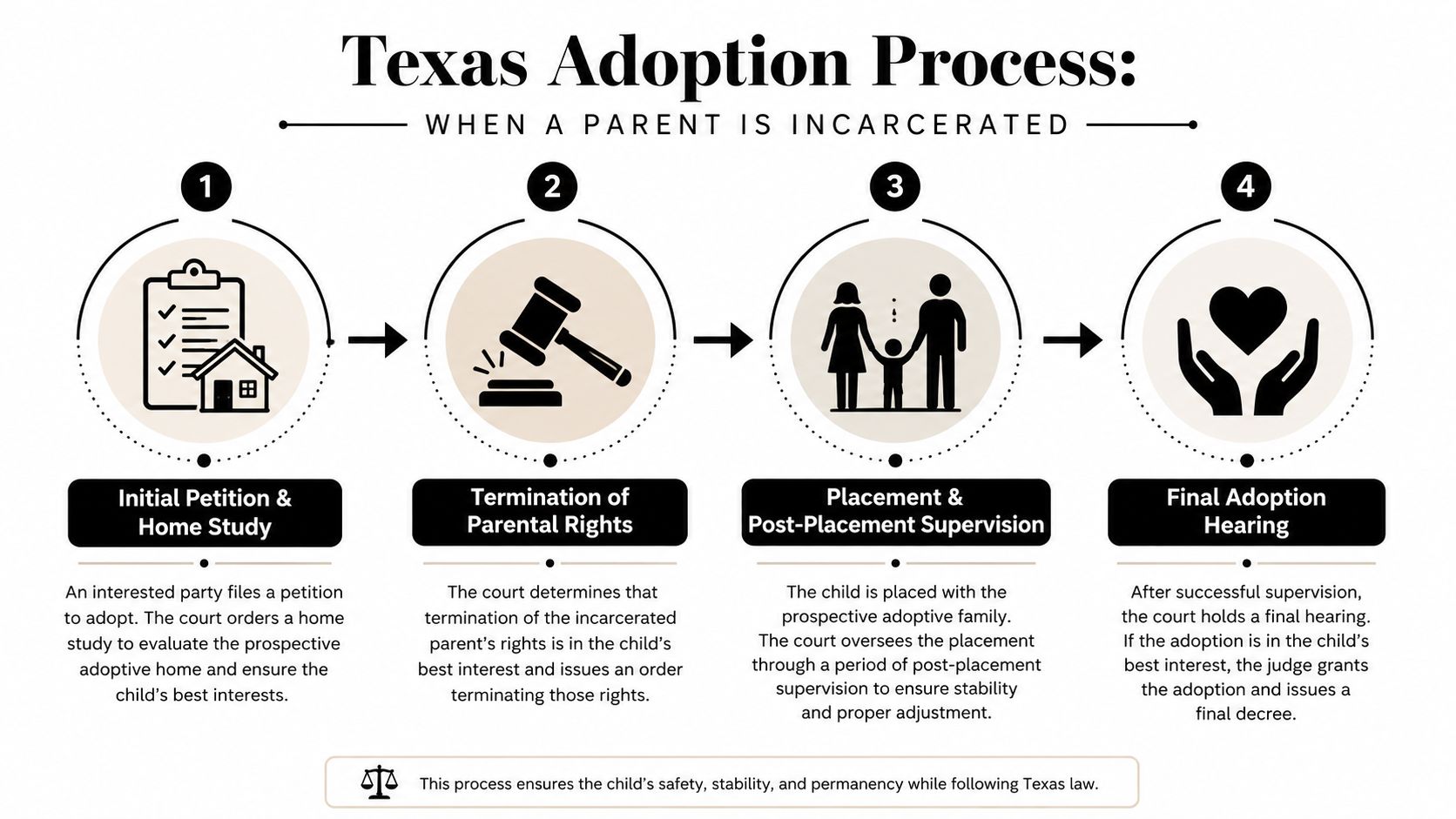
Step one, complete the home study
A pre-adoptive social study generally examines the household, relationships, finances, health, criminal history, and ability to meet the child's physical and emotional needs. The social worker may interview household members, inspect the home, and ask how the caregiver will handle the child's connection to the incarcerated parent.
Texas adoption procedure includes a pre-adoptive social study and post-placement reporting in many cases. The Child Welfare Information Gateway explains that a home study is completed before approval for adoption in Texas, and Texas law includes court review of placement suitability. Families can review Texas adoption home study requirements before scheduling the study.
Step two, assemble the filing record
The petition for adoption is only one part of the file. Depending on the case, the court may need the social study, health information, criminal-history records, fingerprint-based FBI checks, required background checks, and an affidavit of expenses. The caregiver should also collect the child's birth certificate, prior court orders, DFPS records when applicable, and proof of service or consent.
Prospective parents should disclose criminal history rather than hoping it won't appear. Texas guidance explains that some felony or misdemeanor histories can bar prospective foster or adoptive parents, while other offenses may lead to time-based restrictions or a risk evaluation. Violent or child-related offenses can create automatic bans under applicable rules.
Step three, file and provide notice
The petition is filed in the appropriate Texas court, often where the child resides or where venue otherwise applies. The incarcerated parent must receive legally sufficient notice unless a valid consent or court order changes the procedure. If DFPS or another party has legal rights in the case, that party must also be properly included.
The court may appoint or rely on professionals such as a social worker or CASA volunteer. Those professionals may speak with the caregiver, child, other household members, and the incarcerated parent. A caregiver should answer accurately and explain both the child's daily routine and the child's continuing relationships.
Step four, attend placement and finalization hearings
The court reviews the social study, required records, legal notices, and statutory compliance. Chapter 162 provides practical finalization rules. The adoption hearing receives preferential setting when the required social studies and criminal-history records are filed, the petitioner must attend, and a child age 12 or older must attend the hearing.
The judge's final decree creates the legal parent-child relationship. Before that order is signed, however, the case may still contain unresolved consent, termination, notice, or reinstatement issues.
The Reinstatement Window and Why Speed to Finalization Matters
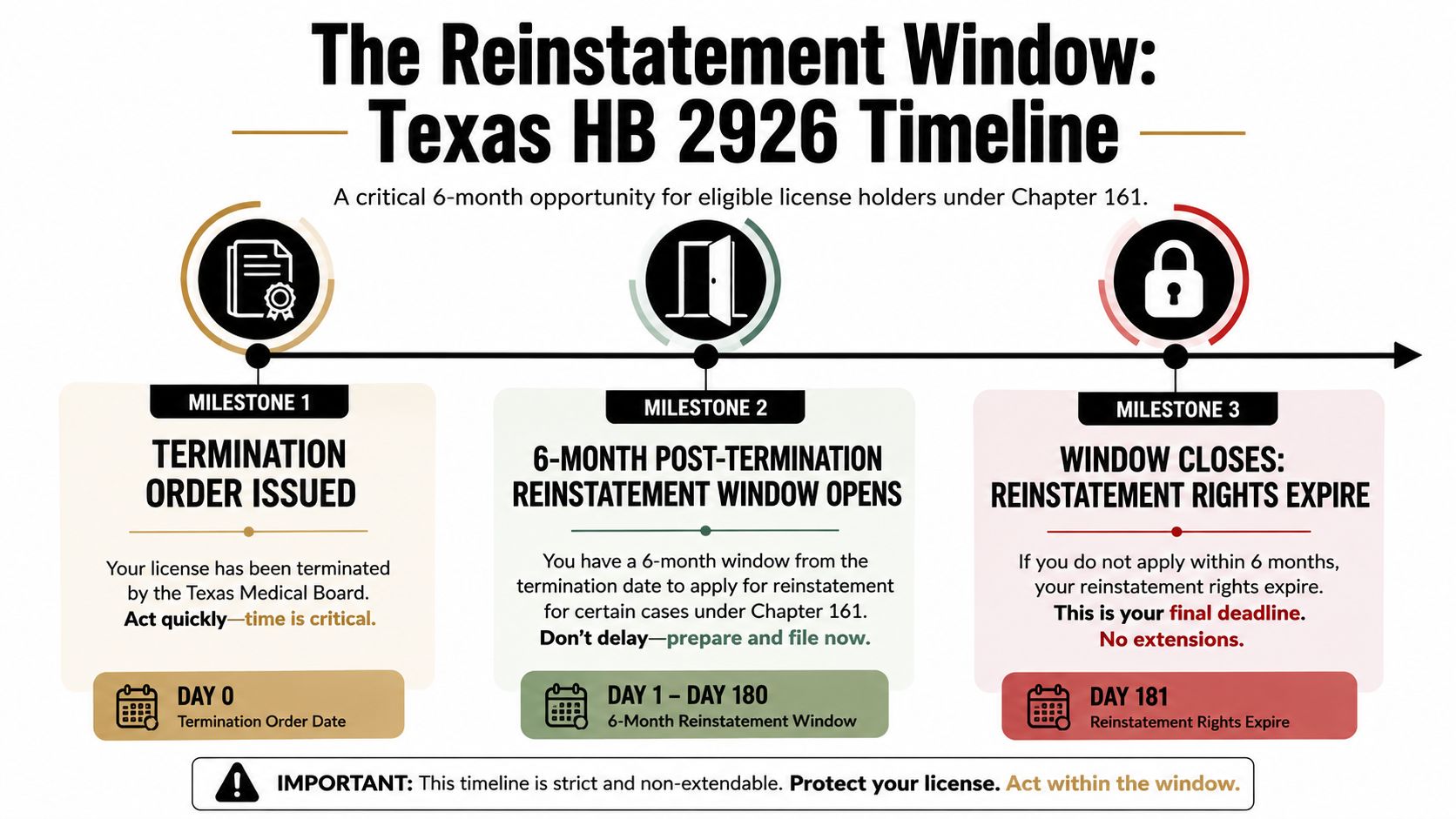
Many families assume that once a court terminates an incarcerated parent's rights, the adoption is protected automatically. That assumption can be dangerous in a DFPS case. Under HB 2926, some formerly incarcerated parents may petition to reinstate parental rights after the required period has passed, if the termination arose from a DFPS suit and other conditions are satisfied.
The verified Texas materials identify these conditions:
- The termination must have come from a DFPS case.
- At least two years must have passed.
- No appeal may be pending.
- The child must not have been adopted.
- The child must not be under an adoption placement agreement.
- DFPS must receive 45 days' notice before the parent files the reinstatement request.
The practical point is narrow but important. A reinstatement petition is tied to the period before adoption is finalized. Once the child has been adopted, the statutory opportunity described in the verified materials is no longer available on that basis.
What speed should look like
Speed doesn't mean rushing a child through an unsafe placement. It means removing avoidable legal delays after termination. The adoptive family and attorney should coordinate the social study, criminal-history records, required reports, hearing setting, and witness availability as early as possible.
A continuance caused by missing paperwork may preserve uncertainty. So may an unaddressed appeal, an incomplete adoption placement agreement, or confusion about whether DFPS remains involved. The family should ask for a written timeline that identifies what has been filed, what remains outstanding, and which event starts the next deadline.
The court still weighs the child's best interest. A parent's petition for reinstatement isn't automatically granted merely because it's filed. The court will examine statutory conditions and the facts supporting reunification. A caregiver should therefore avoid threatening or discouraging lawful contact and should preserve records that show the child's actual needs and stability.
Texas CJE materials updated in 2026 continue to identify HB 2926 as a significant part of family reunification planning. Texas post-termination reunification materials can help families identify questions to raise with counsel, but case-specific advice requires review of the actual orders and DFPS history.
Common Obstacles and When to Call a Texas Adoption Attorney
Families often expect the hardest part to be the parent's incarceration. In practice, procedure causes many delays. A facility may not receive service correctly, a relative may disagree about placement, a CPS history may contain unresolved facts, or a background check may raise an issue that must be addressed before the home study can move forward.
Some preparation is manageable without counsel. A caregiver can request the child's birth certificate, organize school and medical records, keep a communication log, and gather certified prison or court documents. Legal filings and contested hearings are different. A mistake in service or consent can affect the entire case.
| Common Obstacle | Recommended Fix | Attorney Needed? |
|---|---|---|
| Delayed or defective service on the incarcerated parent | Confirm the facility, identity, legal name, and service method before filing | Usually, especially if service fails |
| Relatives disagree about adoption | Clarify conservatorship, standing, and the child's best interests through counsel | Often |
| Out-of-state placement concerns | Address interstate requirements before moving the child | Yes before relocation |
| Unresolved CPS history | Obtain records and resolve safety findings before relying on the placement | Strongly recommended |
| Criminal-history red flags in the adoptive home | Disclose the history and determine whether a bar, time restriction, or evaluation applies | Yes when the record is complex |
| Disagreement over adoption expenses | Seek court approval before reimbursement or payment | Recommended |
| Last-minute consent or attempted withdrawal | Pause filing decisions and have counsel evaluate validity and timing | Yes |
| Contested termination hearing | Prepare witnesses, records, and best-interest evidence | Yes |
When an attorney should enter the case
Call a Texas adoption attorney before signing consent if the parent is uncertain, pressured, or asking for an informal arrangement. Call before filing if the case involves DFPS, another parent, prior termination litigation, interstate travel, or a criminal record in the household. Counsel can also help determine whether adoption is appropriate now or whether guardianship offers a safer temporary structure.
A grandparent shouldn't have to choose between protecting a grandchild and respecting the child's relationship with an incarcerated parent. The right legal plan can preserve safety, family unity, and clarity about who may make decisions.
The Law Office of Bryan Fagan, PLLC helps Texas relatives, stepparents, foster caregivers, and birth parents address consent, termination, home studies, guardianship, and final adoption hearings involving incarcerated parents. Visit Law Office of Bryan Fagan, PLLC to schedule a free consultation and discuss the child's current placement, the parent's legal status, and the next step toward a secure permanent plan.
