
Texas law does not give grandparents automatic priority to adopt a grandchild. Grandparents may still have meaningful standing, procedural advantages, and placement preferences, depending on the type of case.
You may be asking this after becoming the person who handles school mornings, doctor visits, meals, and bedtime. Perhaps your grandchild is staying with you while a parent works through recovery, faces incarceration, or cannot provide safe care. Family members may tell you, “You're the grandparent, so you'll be first in line.” That advice feels reassuring, but it doesn't accurately describe Texas adoption law.
The answer to “do grandparents get priority in adoption Texas” depends on which legal path applies. A private or relative adoption is different from a CPS kinship placement, and both are different from seeking custody or guardianship. Understanding that distinction can help you protect the child without making a rushed decision that changes your family's legal relationships permanently.
When Grandparents Hope Adoption Comes First
A toddler may spend most weekdays with Grandma because the child's mother is in recovery. The father may be largely absent. Grandma provides meals, transportation, comfort, and a familiar routine. Everyone may assume that if the parents eventually lose their rights, Grandma will automatically be first in line to adopt.
Texas law doesn't create that automatic priority. A grandparent's family relationship matters, but it doesn't override the legal requirements for adoption or the court's focus on the child's best interests. Texas courts must evaluate the proposed placement, the legal status of the parents, the evidence before the court, and whether adoption offers the child a safe and stable future.
The misunderstanding often comes from ordinary family expectations. Grandparents commonly serve as caregivers, and relatives may confuse Texas law with statutes in other states that expressly prefer grandparents in adoption decisions. Well-meaning advice from relatives can also blend together three different concepts:
- Adoption preference, which Texas doesn't grant automatically to grandparents.
- Relative or kinship placement, which can matter when DFPS or a court is deciding where a child should live after removal.
- Standing, which is the legal ability to file a case or ask a court to consider a request.
Those concepts are related, but they aren't interchangeable.
The practical rule: Being the child's grandparent may open a legal door, but it doesn't guarantee what happens after you walk through it.
This article separates the three tracks that most often create confusion: private or relative adoption, CPS kinship placement, and custody or guardianship. Grandparents can have meaningful procedural pathways and placement preferences, but the strength of those advantages depends on the facts and the type of proceeding.
The goal isn't to discourage you. It's to replace a painful assumption with a clearer plan. If you're caring for a grandchild today, you may have options. You'll need to identify the right option before deciding whether adoption is the permanent answer.
How Texas Adoption Law Treats Grandparents
A grandparent may have cared for a child for months or years, yet caregiving alone does not make that grandparent the child's legal parent. Texas Family Code Chapter 162 treats adoption as a formal change in legal relationships, not as an automatic reward for being family.
The process has two parts. First, the existing parent-child relationship must end through consent, relinquishment, or termination, unless a statutory exception applies. Then the court creates a new legal parent-child relationship with the adoptive parent.
That distinction matters at the kitchen table. A parent may agree that Grandma should provide daily care, but that agreement does not transfer parental rights. A grandparent also cannot file an adoption petition and bypass a living parent whose rights remain intact.
Consent and termination
The people whose legal rights are affected may need to give consent. Depending on the case, that can include a parent, managing conservator, or another person with legally protected rights. A child who has reached the applicable age may also need to consent.
If a parent refuses, the court must decide whether the facts support involuntary termination under a statutory ground, such as abandonment, endangerment, or failure to support. Meeting one ground is not enough by itself. The court must also find that adoption serves the child's best interest.
A grandparent's relationship with the child can provide evidence of family continuity, emotional connection, and a workable caregiving plan. It does not remove the need to address the parents' rights. Unless a recognized exception applies, adoption cannot proceed while a living parent's rights remain intact.
For a neutral overview of the Texas adoption process, see the discussion of the stages from choosing an adoption type through the final decree. You can also review grandparents' legal rights in Texas for related issues involving family relationships and legal proceedings.
Comparing the three legal tracks
The word “relative” can create confusion because Texas uses family relationships differently across proceedings. A grandparent's position depends on whether the case is a private adoption, a relative adoption, or a CPS kinship placement.
| Legal track | Grandparent's position | What the decision focuses on |
|---|---|---|
| Private adoption | Usually no special role unless the grandparent is the proposed adoptive parent or has another legal basis to participate | Required consents, parental-rights status, safety, stability, and the child's welfare |
| Relative adoption | The grandparent may file as a relative, but family connection does not guarantee approval | The child's relationship with the grandparent, caregiving plan, home environment, and permanence |
| CPS kinship placement | The grandparent may be considered as a relative placement when DFPS or a court decides where the child should live after removal | Safety, suitability, the child's needs, and whether placement with family is appropriate |
CPS kinship placement is a living arrangement decision, not an adoption decree. A grandparent may be considered for placement without becoming the child's legal parent. Later, adoption could require a separate proceeding addressing consent, termination, and best interest.
A relative adoption can offer some procedural treatment in scheduling, but that is a calendar advantage, not automatic priority or approval. The judge still applies Chapter 162 and decides whether the proposed adoption serves the child's best interest.
Grandparent Standing to Seek Custody in Texas
Adoption isn't the only way a grandparent can ask for legal authority. A grandparent may seek managing conservatorship, which is Texas terminology commonly associated with custody, but the first challenge is standing. Standing means the legal right to bring the case. Without it, a court may never reach the question of whether Grandma's home would be better for the child.
Texas Family Code Section 102.004 allows a grandparent to file an original suit seeking managing conservatorship only under specific circumstances. The statute requires satisfactory proof that the child's present circumstances would significantly impair the child's physical health or emotional development, or that both parents, the surviving parent, or the managing conservator consent to the suit. Texas also doesn't allow a grandparent to file an original suit for possessory conservatorship, which makes the path narrower than many families expect. These rules are reflected in the Texas Family Code provision on grandparent standing.
Standing is not the same as winning
A grandparent who clears the standing requirement still must prove that the requested order serves the child's best interest. The court may examine the child's safety, emotional needs, stability, relationships, and the ability of each proposed caregiver to meet daily needs.
Ordinary family conflict usually isn't enough. A parent's anger toward a grandparent, different household rules, or a disagreement about visits doesn't automatically establish significant impairment. A stronger case connects specific, current facts to the child's physical or emotional welfare.
Useful records may include school information, medical documentation, messages about caregiving, and proof of who has handled the child's daily responsibilities. Keep the information factual. A timeline showing what happened and when is usually more useful than a collection of angry accusations.
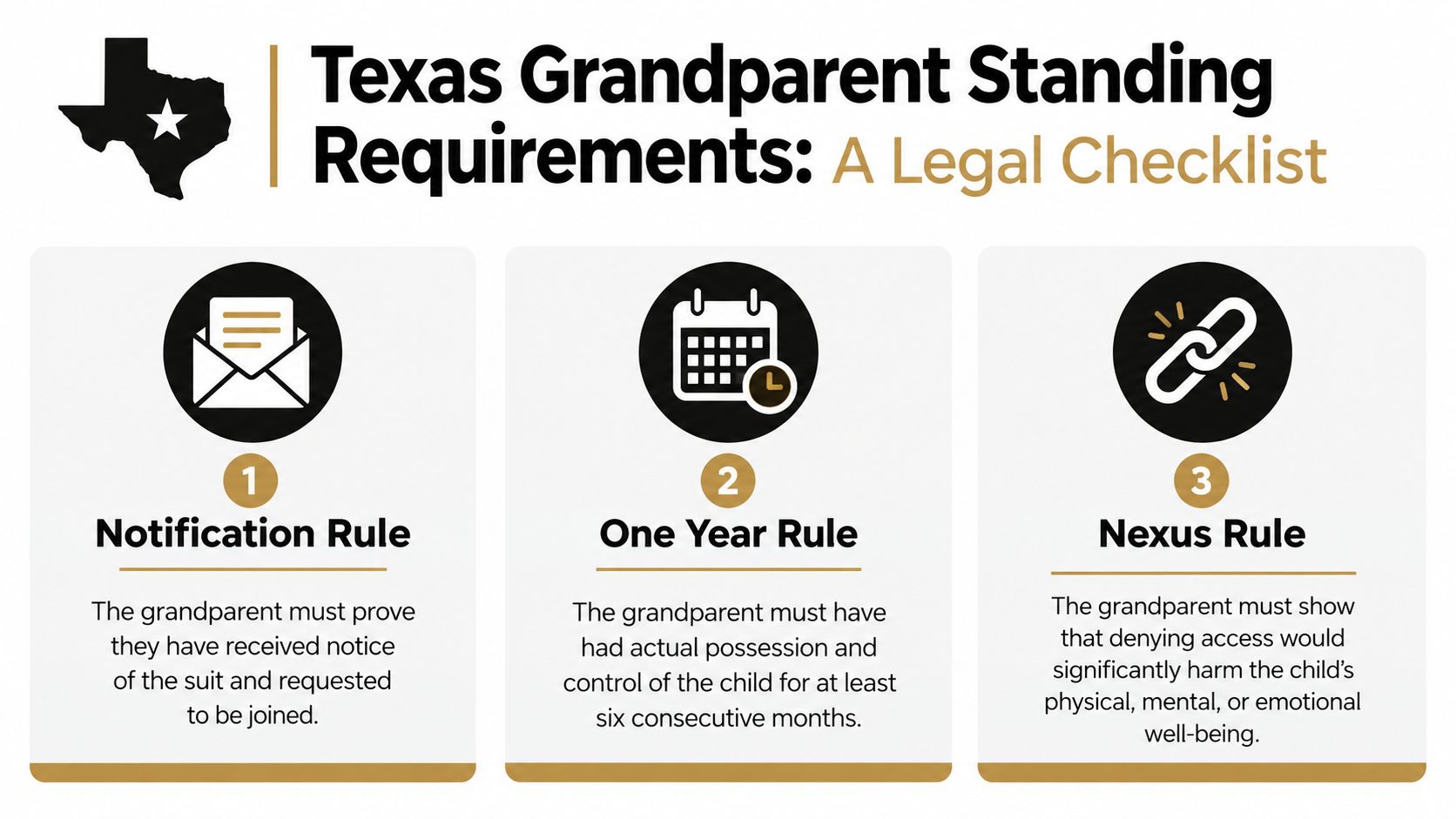
The standing rules can feel harsh, especially when a grandparent has been acting as the child's parent in everyday life. They aren't impossible to meet, but the court needs evidence that fits the statutory language, not only proof that the grandparent loves the child.
Private Adoptions, Relative Adoptions, and CPS Kinship Care
Grandparent preference appears most clearly in the placement stage of a child-welfare case, not as an automatic right to adopt. Keeping the three tracks separate helps families understand what the law is doing.
A private adoption usually involves an agency or attorney helping place a child with prospective adoptive parents. If a grandparent is not the person seeking adoption and doesn't have an independent legal basis to participate, the grandparent doesn't receive a special position just because of the biological relationship.
A relative adoption is different because the grandparent is the proposed adoptive parent. Texas law allows a grandparent to file an adoption petition as a relative. The family connection can be important to the court's best-interest analysis, but the grandparent still must address parental rights, required investigations, and the final hearing.
CPS kinship care begins after DFPS involvement and possible removal. Texas law requires the department to consider placement with a relative or another designated caregiver when that placement serves the child's best interests. The proposed caregiver must still pass background and criminal-history checks and complete a preliminary home evaluation. DFPS placement policy uses a hierarchy involving relatives, fictive kin, foster homes, and general residential operations, so a grandparent preference is strongest when officials are deciding where the child should live during the child-welfare case.
The tracks side by side
| Track | Legal Basis | Grandparent Standing | Home Study | Placement Preference |
|---|---|---|---|---|
| Private adoption | Adoption statutes and the particular placement arrangement | No automatic standing merely from being a grandparent | Requirements depend on the case and professionals involved | No automatic grandparent priority |
| Relative adoption | Texas Family Code Chapter 162 | Grandparent may file as a relative | The court still requires the assessments and records applicable to the case | Family relationship may support the best-interest analysis |
| CPS kinship care | Texas Family Code child-welfare provisions and DFPS policy | Grandparent may be considered as a relative caregiver | Background checks and preliminary home evaluation remain necessary | Relative placement is considered when safe and in the child's best interest |
A kinship caregiver may later pursue adoption, but placement and adoption are separate decisions. The first determines where the child lives. The second permanently changes legal parentage.
Families exploring this route can read Relative and Kinship Adoption in Texas for a focused explanation of the relative process. If CPS is involved, speak with DFPS promptly and obtain legal advice before making promises about permanent adoption.
Why Adoption Can End Grandparent Access
Adoption may protect a child through permanence, but it can also change the grandparent's independent legal connection to that child. Texas Family Code Section 153.434 limits a biological or adoptive grandparent's ability to request possession or access after both biological parents have died, had their rights terminated, or relinquished their rights, and the child has been adopted, or is pending adoption, by someone other than a stepparent. The statute is summarized in Texas guidance on adopting a grandchild.
That means a grandparent who previously had a close relationship, or even a court-ordered schedule in some circumstances, shouldn't assume that the relationship continues as an independent enforceable right after a non-stepparent adoption. The adoption decree changes the child's legal family structure, and parental rights receive substantial protection.
Why stepparent adoption differs
Texas treats stepparent adoption differently from adoption by an unrelated person. A stepparent adoption preserves an existing family connection through the remaining parent, so the statutory analysis does not operate in exactly the same way as a non-stepparent adoption.
This distinction matters when grandparents are weighing a permanent plan. If a child will be adopted by a stepparent, the access analysis may differ. If the child will be adopted by a non-relative, a grandparent should ask counsel whether a written post-adoption contact arrangement is possible and what legal force it would have. A post-adoption contact agreement in Texas may help families discuss expectations before finalization, but it doesn't turn an informal promise into automatic grandparent rights.
CPS kinship adoption doesn't guarantee lifelong independent access either. A grandparent may be the safe placement today, while a later permanency decision could move the child to a different adoptive home. Ask about the long-term plan early, especially if maintaining extended-family relationships is important to the child.
Choosing Adoption, Custody, or Guardianship as a Grandparent
Consider paternal grandparents caring for a child while both parents are incarcerated. The child is safe with the grandparents, attends school from their home, and calls them when frightened. The grandparents want to protect the child, but they also hope the parents can rebuild their lives someday.
Adoption may provide the greatest permanence, but it is also the most sweeping legal choice. It creates a new parent-child relationship and ends the legal relationship with the biological parents once the necessary orders are final. The grandparents would become the child's legal parents, with the authority and responsibilities that come with that role.
Custody, or a managing conservatorship order, may be more appropriate when the child needs protection and stability but reunification remains possible. The grandparents must still satisfy the standing requirements discussed above. If the court grants relief, the parents may retain certain legal rights, and the order can potentially be modified if circumstances change.
Guardianship can provide decision-making authority and day-to-day care while leaving residual parental rights in place. Guardianship proceedings are generally handled through probate courts under Texas Estates Code Chapter 1101. It may offer a less permanent structure, but it still carries court responsibilities and may require future review.
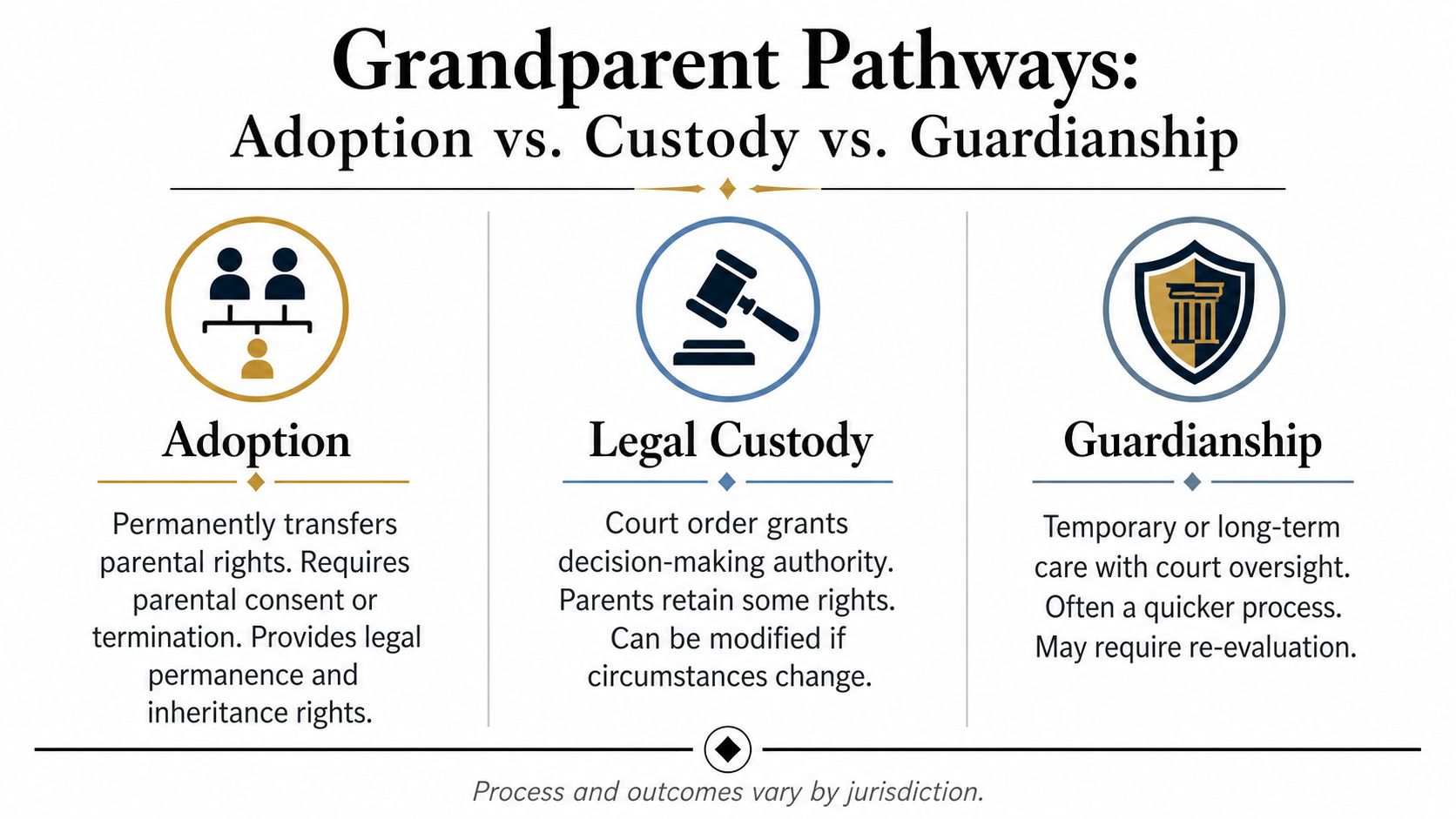
The right question isn't, “Which option costs less or moves faster?” It's, “Which legal arrangement protects this child while respecting the family's realistic future?” Adoption affects identity, inheritance, parental authority, and access. Custody focuses on care and court authority. Guardianship may provide structure without the same permanent transfer.
A careful attorney can help the grandparents compare the emotional and legal consequences before anyone signs a relinquishment or files a petition.
Practical Next Steps for Texas Grandparents
Legal uncertainty becomes more manageable when you work through the facts in order. Start with records, not assumptions. Your documents can help an attorney determine whether you're looking at adoption, kinship placement, conservatorship, or guardianship.
Build a clear caregiving record
Collect the materials that show the child's identity, daily life, and connection to you:
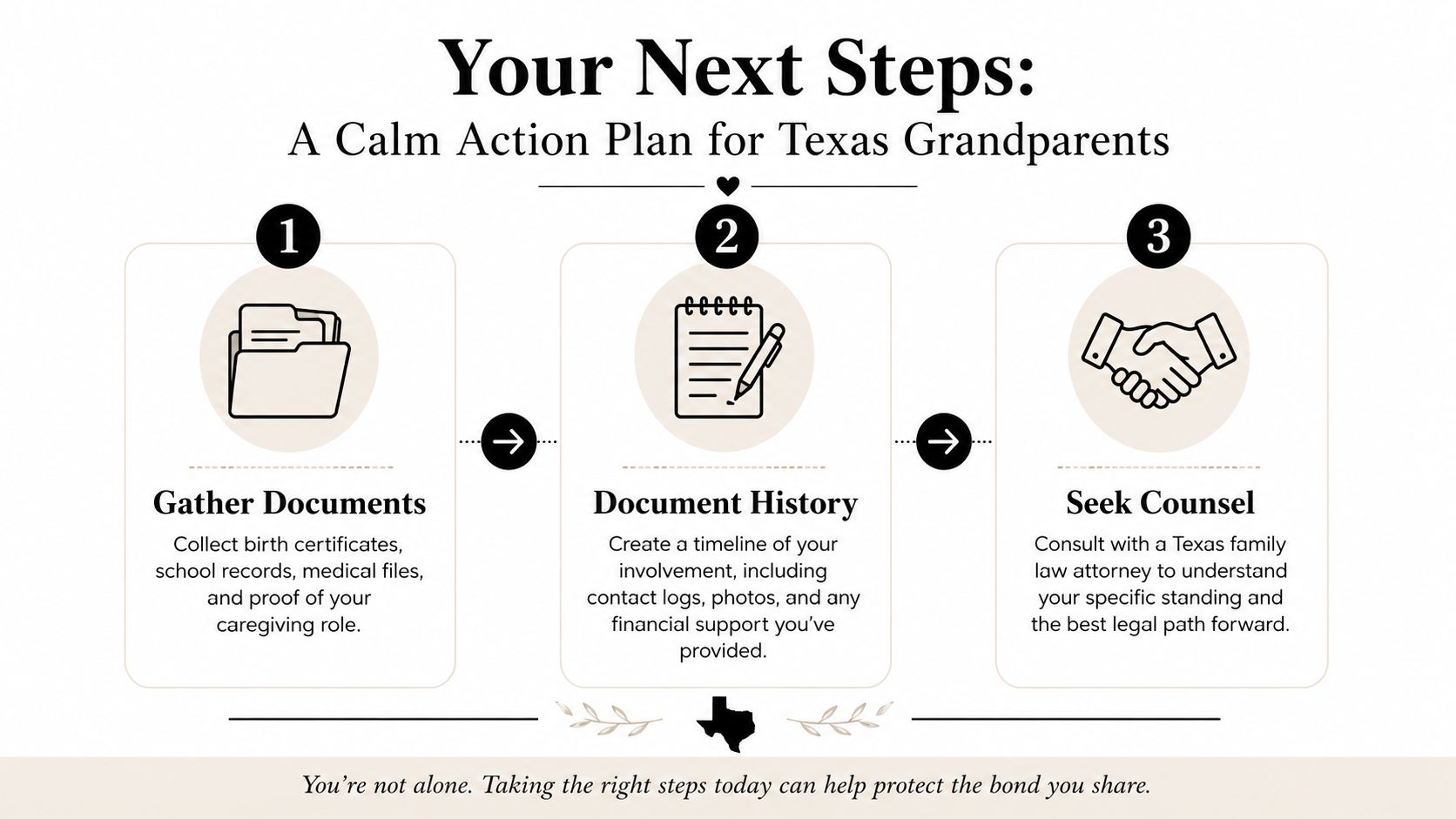
- Gather documents: Collect birth certificates, school records, medical files, and proof of your caregiving role.
- Document history: Create a timeline of your involvement, including contact logs, photographs, and financial support you've provided.
- Preserve communications: Save calm, child-focused messages about visits, transportation, school, health, and safety.
- Identify court involvement: Keep copies of CPS papers, safety plans, existing orders, and notices you've received.
If the child is already in state conservatorship, contact the local CPS regional office and ask how to request a kinship placement review. DFPS will still evaluate safety, background history, and the home. A family connection helps, but it doesn't replace screening.
Avoid preventable mistakes
Don't file a custody case before confirming that you meet the standing rules. Don't attempt a private adoption without addressing the living parents' rights. Ask counsel whether the Indian Child Welfare Act may affect the case, and don't ignore deadlines involving relinquishment, service, or hearings.
You should also avoid conduct that could look like interference with a parent-child relationship. Keep visitation logs, communicate respectfully, and follow existing orders. If maintaining records, organizing calendars, or handling correspondence becomes difficult, virtual legal assistants companies may be a useful administrative resource, but administrative help isn't a substitute for Texas legal advice.
The Law Office of Bryan Fagan, PLLC handles adoption and guardianship matters for Texas families, including relative, kinship, stepparent, CPS-related, and LGBTQIA+ adoption cases. Court self-help resources and legal-aid organizations may also help families understand filing requirements when private counsel isn't possible.
Common Questions Grandparents Ask About Texas Adoption
Can a grandparent adopt without the parents' consent?
Sometimes, but not because the grandparent is related to the child. A court may terminate parental rights without consent only when the evidence satisfies statutory grounds and adoption serves the child's best interest. A grandparent's caregiving history supports the overall picture, but it doesn't replace the termination process under Chapter 162.
Is a grandparent automatically preferred over another adoptive parent?
No. Texas doesn't grant an automatic priority right to adopt. Grandparents may file as relatives and may receive preferential procedural treatment in some adoption settings, but the judge still evaluates statutory requirements and best interests.
Does DFPS prefer grandparents over foster care?
Texas child-welfare law requires DFPS and courts to consider relatives when placement is in the child's best interest. Grandparents must still pass background and criminal-history checks and complete a preliminary home evaluation. Placement preference is strongest at the child-welfare placement stage, not as a guaranteed path to adoption.
What happens to child support after a grandparent adopts?
Adoption changes the legal parent-child relationship, so support obligations and existing orders need careful review. The effect depends on the orders in place, the termination proceeding, and the final adoption decree. Don't assume a support order ends or continues without asking an attorney to examine the specific case.
Can a grandparent adopt a child already adopted by someone else?
Generally, a grandparent can't replace an existing legal parent through a new petition. The current legal parent's rights and any required termination grounds would have to be addressed, and the court would still focus on the child's best interest.
How do visitation statutes affect grandparents?
Texas Family Code Sections 153.432 and 153.434 provide narrow routes for possession or access requests. Adoption by a non-stepparent can limit or extinguish those rights in the circumstances described above. Because timing and family relationships matter, a consultation with the Law Office of Bryan Fagan, PLLC or another Texas family law attorney can help you understand whether adoption, custody, guardianship, mediation, or a written contact arrangement fits your situation.
If you're caring for a grandchild or considering a relative adoption, the Law Office of Bryan Fagan, PLLC can review your family's facts, explain standing and parental-rights requirements, and help you compare adoption, custody, and guardianship. Visit Law Office of Bryan Fagan, PLLC to request a consultation and take the next step with a clear, child-focused legal plan.
