
Maria has raised her son largely on her own for four years. His father sends no support, rarely calls, and hasn't built a dependable relationship with the child. Now Maria is planning to marry someone who already acts like a parent and hopes to complete a stepparent adoption. Her question is painful but common: can Texas terminate an absent father's parental rights so the family can move forward?
The answer depends on the facts, the evidence, and the legal status of the father. Texas doesn't end parental rights automatically because a parent has been distant. A court must enter an order and find a statutory ground, then determine by clear and convincing evidence that termination serves the child's best interest under Texas guidance on terminating parental rights.
This guide explains the two main paths. The first is involuntary termination under Texas Family Code Chapter 161, when a parent objects or won't cooperate. The second is voluntary relinquishment, when the father knowingly signs the required legal document. Along the way, you'll learn what legal grounds may apply, what records can support your case, how the court process works, and what may happen after termination.
When an Absent Father Leaves You Searching for Answers
A parent raising a child alone often carries two separate burdens. There's the daily work of providing care, school support, medical attention, and emotional stability. Then there's the uncertainty created by a legal parent who appears only occasionally, contributes little or nothing, and still holds parental rights.
Maria's situation illustrates why this issue feels so urgent. She isn't asking the court to punish the child's father. She wants a clear legal structure for the family she's already building. Her future spouse is prepared to adopt, but an adoption generally can't proceed while the absent father's parental rights remain intact. Texas generally requires the legal relationship between the child and all living legal parents to be addressed before adoption, as explained in Texas Law Help's overview of termination before adoption.
A difficult relationship isn't the same as a legally terminated relationship. The court needs admissible proof and a signed order.
The first question is whether the father is a legal parent, an alleged biological father, or someone whose paternity has never been established. That distinction affects notice, registry requirements, and the type of evidence you'll need. Physical distance alone doesn't answer the question. A parent may live elsewhere and still maintain rights, while an alleged father who never takes required legal action may face different procedures.
If you're trying to understand the difference between an unknown father and an absent father, this resource on what happens if the biological father is unknown can help clarify the starting point.
The roadmap is steady and practical. You'll need to identify the legal ground, organize evidence, complete notice and service correctly, present the child's best-interest case, and understand the adoption or guardianship option that follows. Texas courts hear these matters carefully, and a documented case gives the judge something stronger than frustration or memory.
Texas Grounds for Ending an Absent Father's Rights
A father can live across Texas, stop answering messages, and still retain parental rights. Chapter 161 requires a specific statutory ground, proof by clear and convincing evidence, and a separate finding that termination serves the child's best interest. The judge must make those findings even when the father does not appear.
Abandonment and non-support
One possible ground applies when a parent voluntarily leaves a child without adequate support and remains away for at least six months. The evidence must show a pattern, not one missed visit or an unanswered call. A court may consider the father's contact with the child, financial support, efforts to preserve the relationship, and apparent intent to resume parenting responsibilities. The current Texas Family Code Chapter 161 sets out the statutory grounds and time requirements that control the case.
For example, a father who makes no meaningful contact, pays no support, and makes no effort to resume parenting during the relevant six-month period may fit an abandonment theory. The result can differ when he sends messages, pays support according to his ability, or faces a documented barrier to contact. The judge examines the whole record, much like assembling a timeline from separate pieces of evidence.
Texas also provides a separate one-year non-support ground. The proof must address whether the father had the ability to provide support and must cover the required period ending within six months before the petition is filed. A missed payment alone may not establish the ground. The court still must apply the statutory requirements and decide whether termination benefits the child.
Older versions of Texas law used different abandonment periods in some pathways, so the current statutory language and the facts within the required period should guide your petition.
Other possible routes
Chapter 161 includes grounds that may apply to facts involving incarceration, institutionalization, endangerment, or failure to respond to legal proceedings. The petition should identify the specific ground and connect each allegation to evidence. DFPS materials discuss endangerment and explain that a petitioner must prove both a statutory ground and the child's best interest with reliable evidence in the DFPS termination handbook.
A father may also voluntarily relinquish his rights by signing the required affidavit. That process differs from an involuntary case, where the court is asked to terminate rights despite the father's objection. The affidavit must be valid, voluntary, and properly filed. If he refuses to sign, the case proceeds through the involuntary process.
| Statutory Ground | Required Facts | Typical Evidence |
|---|---|---|
| Abandonment | Voluntary absence, inadequate support, and the legally relevant period | Contact log, support records, witness testimony |
| Non-support | Failure to support according to ability during the required period | Payment history, support order, income-related records |
| Other Chapter 161 grounds | Facts satisfying a specific statutory basis, such as endangerment or certain notice-related pathways | Court records, testimony, agency records |
| Voluntary relinquishment | A valid affidavit signed knowingly and voluntarily | Filed affidavit and court testimony |
| Best interest | Clear and convincing proof that termination benefits the child | Stability evidence, caregiving history, home information |
A plain-language explanation of Involuntary Termination of Parental Rights in Texas focuses on the central question: can the court terminate rights over the parent's objection? Unestablished paternity may create a separate issue, particularly if the alleged father has not registered or cannot be located. That question belongs in the notice and service analysis. It should not be treated as automatic proof of abandonment.
What to Gather Before You File the Petition
Before filing, build an evidence binder that tells the story in dates and documents. A sympathetic account matters, but a judge needs proof that can be admitted, tested, and connected to a statutory ground.

Start with identity and court records. Gather the child's certified birth certificate, documents identifying the father, and any records showing that the parents were unmarried when the child was born. Include certified copies of child support orders, custody orders, protective orders, or prior family court findings.
Create a reliable contact history
Keep a chronological log of calls, texts, emails, letters, and attempted visits. Record the date, method, result, and any response. Save the original messages when possible instead of relying only on a summary. Voicemails, unanswered messages, and communications in which the father refuses support may help show a pattern, but context matters.
Financial records should stand on their own. Collect child support payment histories, bank records, receipts, and information showing requests for support. If you believe the father had the ability to contribute, preserve facts supporting that position without guessing about income.
Social media screenshots may help show that the father was active in other parts of life, but they don't automatically prove legal abandonment. Preserve the account name, date captured, and surrounding context. Avoid editing screenshots in a way that makes authenticity harder to establish.
Organized records turn a painful history into a clear timeline.
You should also prepare evidence about the home the child would live in after termination and adoption. A proposed parenting plan, school information, medical involvement, household routines, and testimony about the prospective adoptive parent's role can help the court evaluate stability and best interest. The judge isn't deciding whether the adults are frustrated. The judge is deciding what legal arrangement protects the child.
For families collecting information before an attorney meeting, an intake form for family law can help organize names, dates, prior orders, and the issues that need attention. Also determine whether the alleged father may have registered with the Texas Paternity Registry. The Texas paternity registry resource explains why that search belongs in the preparation stage.
Finally, identify one or two witnesses with firsthand knowledge. A caregiver, relative, teacher, or other person who directly observed the father's absence may provide useful testimony. Don't rely on broad statements such as “he never cared.” Specific observations, supported by records, are more useful.
The Texas Court Process, Step by Step
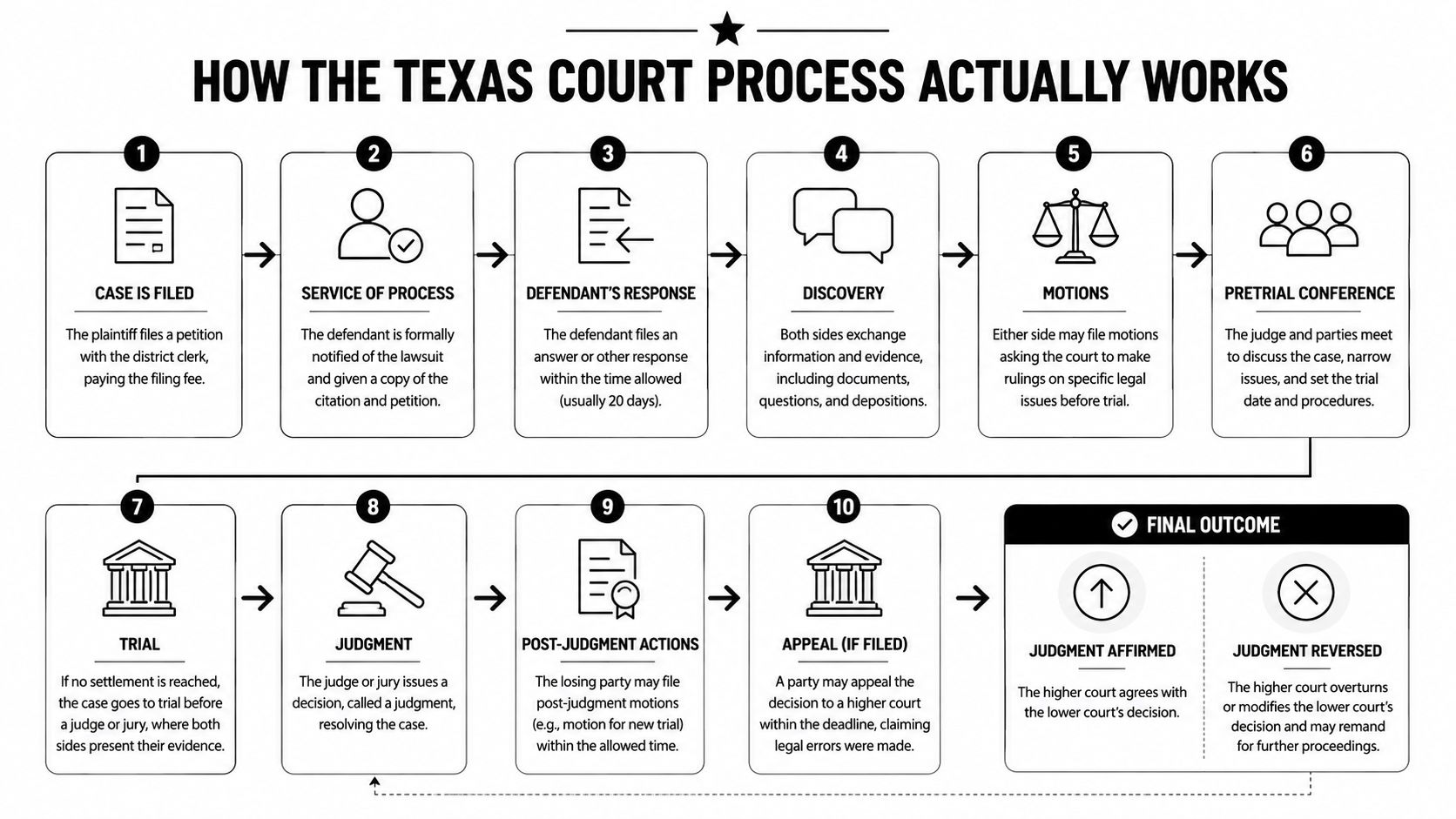
A Texas termination case starts with an original petition filed in the proper court. The petition identifies the child, the parents or alleged parents, the statutory grounds requested, and the request for a best-interest finding. Filing location depends on circumstances such as where the child or a parent lives, and local rules may affect filing and hearing procedures.
Notice comes before judgment
Before a judge can decide the case, the father must receive legally sufficient notice, unless the court authorizes another method after the required search and procedures. Personal service may be available if you know where he lives or works. If he cannot be found, the court may consider publication or another authorized method. You must show the efforts made to locate him.
The Texas Paternity Registry can matter when an alleged biological father has not established legal paternity. A timely registrant must receive notice of the termination or adoption proceeding. Texas law also provides specific rules for registry nonregistration and the child's age. If the child is over one year old when the petition is filed and the alleged father has not registered, the petitioner may proceed when due diligence cannot locate him. Related rules may apply when the child is under one year old, subject to statutory notice requirements. Chapter 161 of the Texas Family Code governs these service and notice procedures.
A court may appoint an attorney ad litem or guardian ad litem for the child. That person may interview the child, review records, and make a recommendation about the requested order. The child's interests may differ from either adult's preferred outcome, so the appointment gives those interests an independent voice.
Hearings and the final trial
After filing and service, the court may set an initial hearing, status conference, or pretrial conference. The judge may address incomplete service, registry notices, discovery, appointed counsel, and the evidence required for trial. These settings function as checkpoints. They do not replace the final decision.
Termination cases proceed to a bench trial before a judge, rather than a jury trial. The petitioner presents documents and witnesses. The other parent may challenge the allegations, and the judge decides whether a statutory ground and the child's best interest have been proven by clear and convincing evidence. The judge must sign a final order.
Silence, nonparticipation, or a missed hearing does not automatically end parental rights. The petitioner still must satisfy the legal requirements and establish the requested ground with admissible proof.
A recent Texas Supreme Court decision has been reported as holding that a court cannot terminate parental rights on its own initiative after the State abandons its request. The decision highlights the need for proper pleadings, standing, due process, and proof, especially in CPS-related or contested cases. The Texas Supreme Court termination update discusses that development.
What Can Happen Once the Case Is Filed
Once the petition is filed, the case may take several directions. The father might cooperate, contest the allegations, remain impossible to locate, or participate only through a court-appointed attorney. Your evidence and the child's best-interest circumstances remain important in every path.
| Scenario | Father's Response | Typical Timeline | Key Evidence Needed |
|---|---|---|---|
| Voluntary relinquishment | Signs a valid affidavit | Often more direct, but court approval is still required | Affidavit, identity records, best-interest evidence |
| Contested termination | Appears and disputes the ground | May require discovery, hearings, and a bench trial | Contact history, support records, witnesses, exhibits |
| Unknown whereabouts | Cannot be personally served after diligent search | Service issues can extend the case | Search documentation, registry records, proposed publication |
| Child representation | Guardian ad litem or attorney ad litem participates | Depends on appointment and court schedule | Household information, child-related records, interviews |
Voluntary agreement
If the father signs an affidavit of voluntary relinquishment under Texas Family Code 161.002, the case may proceed without a contested evidentiary fight over his objection. The court still must review the legal documents and determine whether the requested termination and any adoption serve the child's best interests.
Contested response
If the father is served and appears, expect a full hearing on the alleged statutory ground. He may argue that contact existed, that support was provided, that he lacked the ability to pay, or that termination isn't in the child's best interest. The court will weigh the evidence instead of treating absence as conclusive.
Diligent search
If service by publication becomes necessary, keep every record of the search. The court may scrutinize efforts to locate the father through known addresses, relatives, employers, registry information, and other available leads. A default judgment may be requested, but it still depends on valid procedure and proof.
The emotional side matters, too. Keep adult conflict away from the child and document visitation issues calmly. A practical co-parenting visitation tip may help you communicate and preserve records without escalating tension.
Pitfalls That Quietly Derail These Cases
A petition can describe years of absence and still stall over a procedural mistake. Texas courts require proof that the father received legally sufficient notice, that any paternity registry issue was addressed, and that the requested statutory ground and best-interest finding are supported by evidence.
Service and registry mistakes
Due process is a foundation of the case. Sending papers to an old address without recording reasonable follow-up may leave service open to challenge. Asking for publication before completing a careful search can prompt the judge to require more work. Registry notice adds another checkpoint when the father may be an alleged biological parent who has not established paternity.
Evidence gaps
Memories of missed visits matter, but scattered records may not show a continuous pattern. Build a timeline from messages, calendars, school or medical records, returned mail, and support records. Child support arrears may support a statutory ground, yet they do not by themselves establish every required fact, such as ability to pay, the relevant period, or the child's best interest.
Termination is decided by the court, not created by a parent's silence. A waiver, missed appearance, or unanswered message does not replace admissible proof under Chapter 161.
Before the hearing, ask whether every required legal box has proof behind it.
Use this review list:
- Confirm identity: Determine whether the father is a legal parent or alleged father.
- Check notice: Document personal service, registry notice, or a court-approved alternative.
- Match facts to law: Tie each record to the exact statutory ground you plead.
- Prove best interest: Describe the child's stable caregiving arrangement, safety, and future needs.
- Prepare witnesses: Choose people with firsthand knowledge rather than repeated family opinions.
- Follow court orders: Meet every setting, appointment, and filing requirement.
- Protect the child: Keep testimony factual and the child outside adult disputes.
These steps cannot promise a result. They can prevent avoidable defects and give the judge a clear record to evaluate. If the evidence does not fit a statutory ground, reassess the petition before filing rather than expecting the hearing to fill the gaps.
After Termination and Toward Your Family's Next Chapter
A signed termination order changes the legal framework, but it may not complete the family's larger plan. If a stepparent is ready to adopt, the next stage usually involves filing an adoption petition, addressing any required home study or report, completing the supervisory period, and attending the final adoption hearing. Texas adoption courts may review interviews, home conditions, and relationships within the household, while stepparent cases may qualify for a home-study waiver in some circumstances. The Texas adoption process overview explains these court evaluations.
Adoption isn't the only option. Permanent managing conservatorship, kinship care, or grandparent guardianship may fit a family that needs stable legal authority without creating a new parent-child relationship. The right choice depends on the child's needs, the caregiver's goals, and the legal rights that remain.
After the hearing, request certified copies of the termination order. Ask Texas Vital Statistics about updating the child's birth record, and notify schools, medical providers, and the child support agency of the changed legal status when appropriate. Keep copies of every order and filing with the child's permanent records.
For families asking whether adoption can proceed without the father's consent, this guide to adoption without father consent in Texas offers a focused starting point. A consultation can help you decide whether termination, adoption, conservatorship, or guardianship best supports the child and preserves family unity.
The Law Office of Bryan Fagan, PLLC helps Texas families evaluate absent-parent termination cases, prepare evidence, address service and paternity-registry requirements, and move from a final termination order toward adoption or guardianship. Visit Law Office of Bryan Fagan, PLLC to schedule a free consultation and discuss a clear legal plan for your child's next chapter.
