
A hospital room is quiet after the visitors leave. A birth parent may be holding a newborn, reviewing placement papers, and wondering whether signing an affidavit will end every legal connection immediately. An adoptive family may be preparing a home while asking a different question: when will the child's future become legally secure?
Voluntary relinquishment of parental rights in Texas is a serious decision, but you don't have to face it without clear information. Texas law uses formal documents, waiting periods, witnesses, court review, and best-interest findings to protect children and parents during adoption planning. The sections below explain what the affidavit does, when it may be revoked, how the court process works, and how the rules fit private, agency, stepparent, kinship, and CPS-related adoptions.
What This Moment Means for a Texas Family
A birth mother sits in an adoption agency office in Houston with medical paperwork, placement information, and an affidavit in front of her. She may feel relief, sadness, fear, certainty, or several of those emotions at once. Across town, a biological father may be standing outside a courthouse with paperwork in his hand, trying to understand whether signing means he'll never have a legal role in his child's life again.
Those feelings deserve room. Relinquishment isn't just a form. It can affect legal decision-making, custody, support responsibilities, inheritance, and the child's path toward adoption. A parent who's considering it should have time to ask direct questions and understand every consequence before signing.
Texas treats voluntary relinquishment as a formal legal process under Family Code Chapter 161, not as a private agreement between adults. The Texas State Law Library's explanation of termination of parental rights describes the affidavit process, including execution safeguards and revocation rules. Those safeguards help create a predictable adoption pathway while reducing later disputes about consent.
A signed paper deserves a careful answer to one question: What legal result will this document create today, and what will still require a judge's order?
The timeline can feel confusing because several events happen close together. A newborn placement may involve the child's birth, the post-birth waiting period, affidavit execution, possible revocation rights, court filings, a termination hearing, and later adoption finalization. Agency and private placements may also involve different people, documents, and court deadlines.
Understanding the sequence is a form of care. It helps a birth parent make an informed choice and helps an adoptive family avoid treating placement as the same thing as final adoption. In every path, the child's safety, stability, and long-term well-being remain central.
What Voluntary Relinquishment Really Means in Texas
In plain English, voluntary relinquishment is a formal written act in which a parent gives up legal rights and responsibilities so another person or agency can pursue adoption. The affidavit is prepared under Texas Family Code Chapter 161, signed by the parent, witnessed, and verified before an authorized officer. It isn't a handshake, a text message, or a private promise between relatives.
The process is different from several arrangements families sometimes confuse with relinquishment:
- Informal placement: A parent may allow relatives or another family to care for a child, but that arrangement alone doesn't terminate parental rights.
- Temporary guardianship: Guardianship can address care and decision-making without creating the same legal result as termination and adoption.
- Custody modification: A court may change possession, access, or conservatorship while the parent-child legal relationship continues.
- Involuntary termination: The state or another party may ask a court to terminate rights without the parent's voluntary consent. That is a contested court process, not a voluntary affidavit.
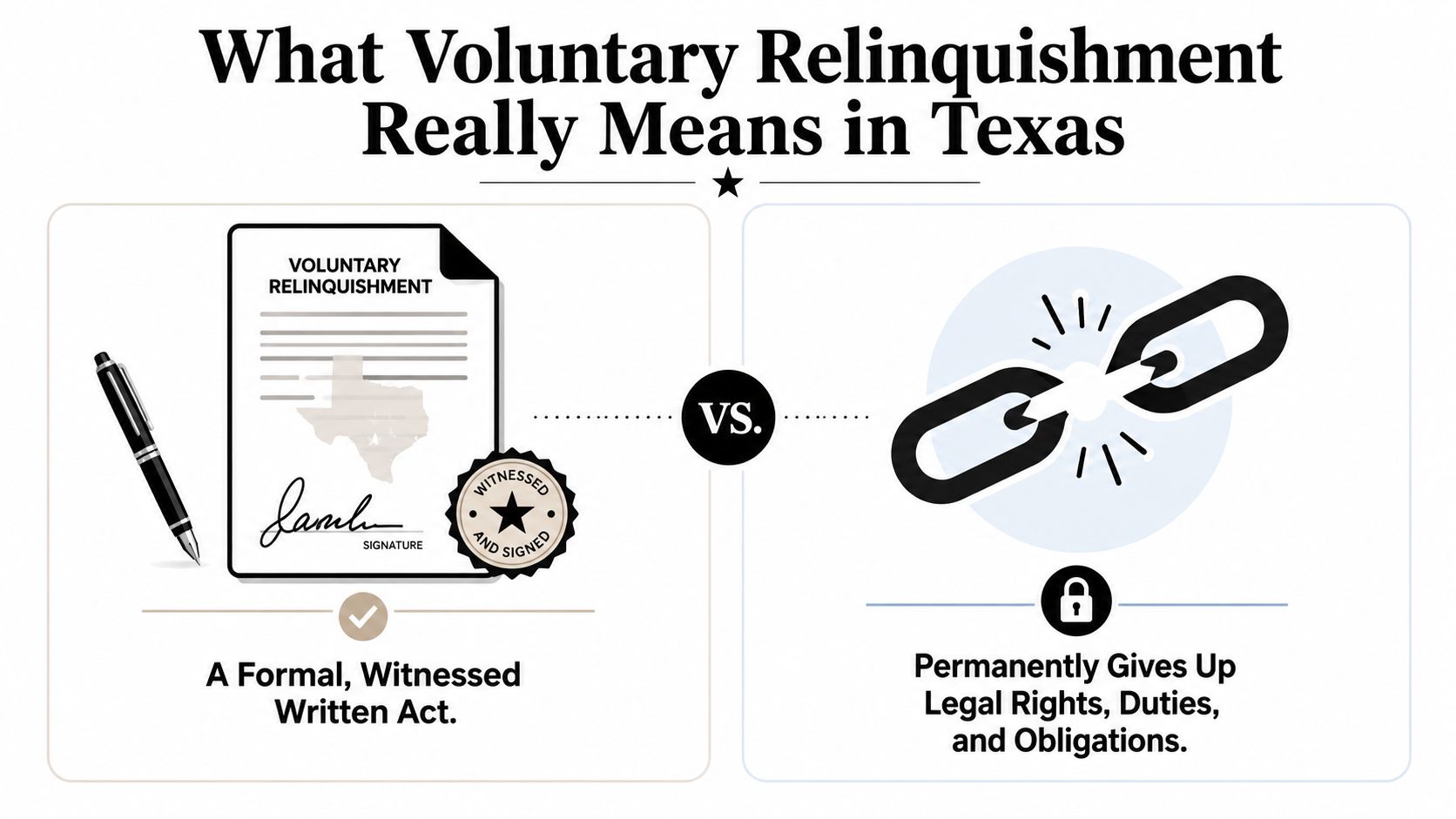
The most important distinction is timing. Signing the affidavit does not, by itself, permanently end the parent-child relationship. Texas Law Help explains that a judge must sign a termination order before parental rights are permanently ended, and that Chapter 161 governs the termination process. Adoption generally cannot move forward to finality until termination has been completed through the court.
The affidavit also needs specific statutory information. Texas law requires identifying information about the child, information about the other parent's status, support-related disclosures, and a statement addressing the child's best interests. These details help the judge evaluate whether the consent is informed, voluntary, and legally sufficient.
A parent shouldn't sign because another adult says the document is “just for placement.” Placement and termination are separate legal steps. If you're unsure whether a document is an affidavit of relinquishment, a custody agreement, a waiver, or another filing, have a Texas adoption attorney review it before you sign.
Who Can Sign and How the Affidavit Works
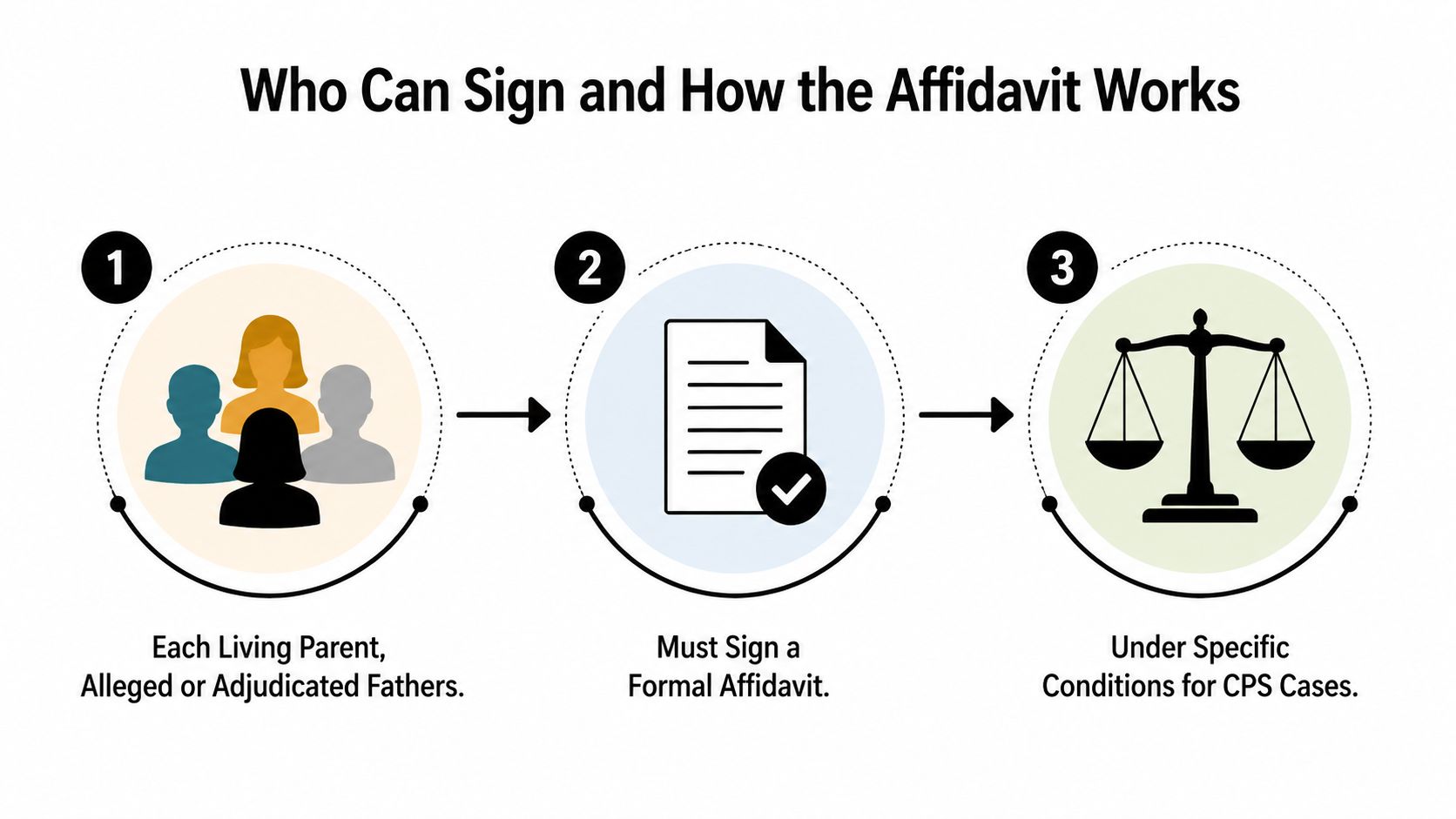
The affidavit is designed for a parent who is voluntarily consenting to the legal process that may lead to termination and adoption. Depending on the situation, that can include a living birth parent, an alleged father, or an adjudicated father. CPS-related matters can involve parents of older children as part of a broader permanency case.
The document must satisfy several formal requirements. Texas Family Code Section 161.103 requires the affidavit to be signed after the child's birth, and the statutory minimum waiting period is 48 hours after birth. It must be witnessed by two credible persons and verified before an officer authorized to administer oaths. The requirements are summarized in the Texas Family Code provisions on affidavits of voluntary relinquishment.
A Dallas birth mother, for example, may give birth on a Monday morning. She can't sign the newborn's affidavit before the required post-birth period has passed. During that time, she should receive the required information, understand available alternatives and counseling information, review the proposed placement, and ask questions about revocation and court termination.
The affidavit may identify the prospective adoptive parent, depending on the placement and document used. It also needs clear statutory disclosures, including the child's identifying information, the status of the other parent, support obligations, and a best-interest statement. Leaving a required field unclear or incomplete can create problems later.
In a Lubbock kinship matter, a stepparent or relative may already be caring for the child. That caregiving relationship doesn't replace the affidavit requirements. The adults still need to determine which parent must consent, whether paternity issues exist, and how the termination case will connect to the adoption petition.
Some affidavits can be made irrevocable for a stated period, while others contain revocation terms that control the parent's options. Read the document carefully before signing, and review whether a Texas affidavit of relinquishment can be revoked with counsel. Families dealing with a spouse's biological child can also review Stepparent Adoption in Texas for context about how that adoption path works.
How Long Before Relinquishment Becomes Final
Texas relinquishment has more than one clock. The correct answer depends on the affidavit's language, the child's placement, the parent's legal status, and the court's action. That's why a parent shouldn't rely on a verbal statement that rights are “already gone” or that revocation is “always available.”
The central rule is simple: the affidavit begins the legal process, but the judge's termination order ends the parent-child legal relationship. The Texas statute addressing revocation and relinquishment mechanics helps show why the wording and timing of the affidavit matter.
| Affidavit or court path | What the clock means | Practical point |
|---|---|---|
| Default revocable affidavit | If revocation terms aren't clearly stated, Texas law makes the affidavit revocable only until the 11th day after execution. | A parent must identify the deadline and the required method for revocation immediately. |
| Stated irrevocable period | For a private placement, an affidavit may be made irrevocable for a stated period of up to 60 days. | “Irrevocable” describes the affidavit's revocation status, but it doesn't replace the court's termination order. |
| Termination order | A judge signs an order terminating the parent-child relationship. | This is the court action that permanently ends parental rights, subject to the legal limits that apply to the case. |
The 48-hour post-birth rule comes first in a newborn case. The parent can't execute the affidavit before that period has passed. After signing, the revocation framework depends on the document and circumstances. Fathers may have different issues involving alleged paternity, established paternity, notice, or failure to establish a legal relationship, so a mother's affidavit may not resolve every parentage question.
Hospital placement can make the calendar feel compressed. The child may leave with a prospective adoptive family while the legal case continues. An interstate placement can add another layer because the parties may need to coordinate approval before the child crosses state lines. That coordination can affect planning, but it doesn't turn the affidavit into a final termination order.
For adoptive parents, placement is an important event. Court finalization is a separate legal milestone.
The safest approach is to write down the birth date, execution date, stated revocation terms, filing date, hearing date, and any interstate approval requirement. An attorney can then compare those dates to the actual affidavit instead of applying a general rule that may not fit.
The Court Process From Filing to Termination Order
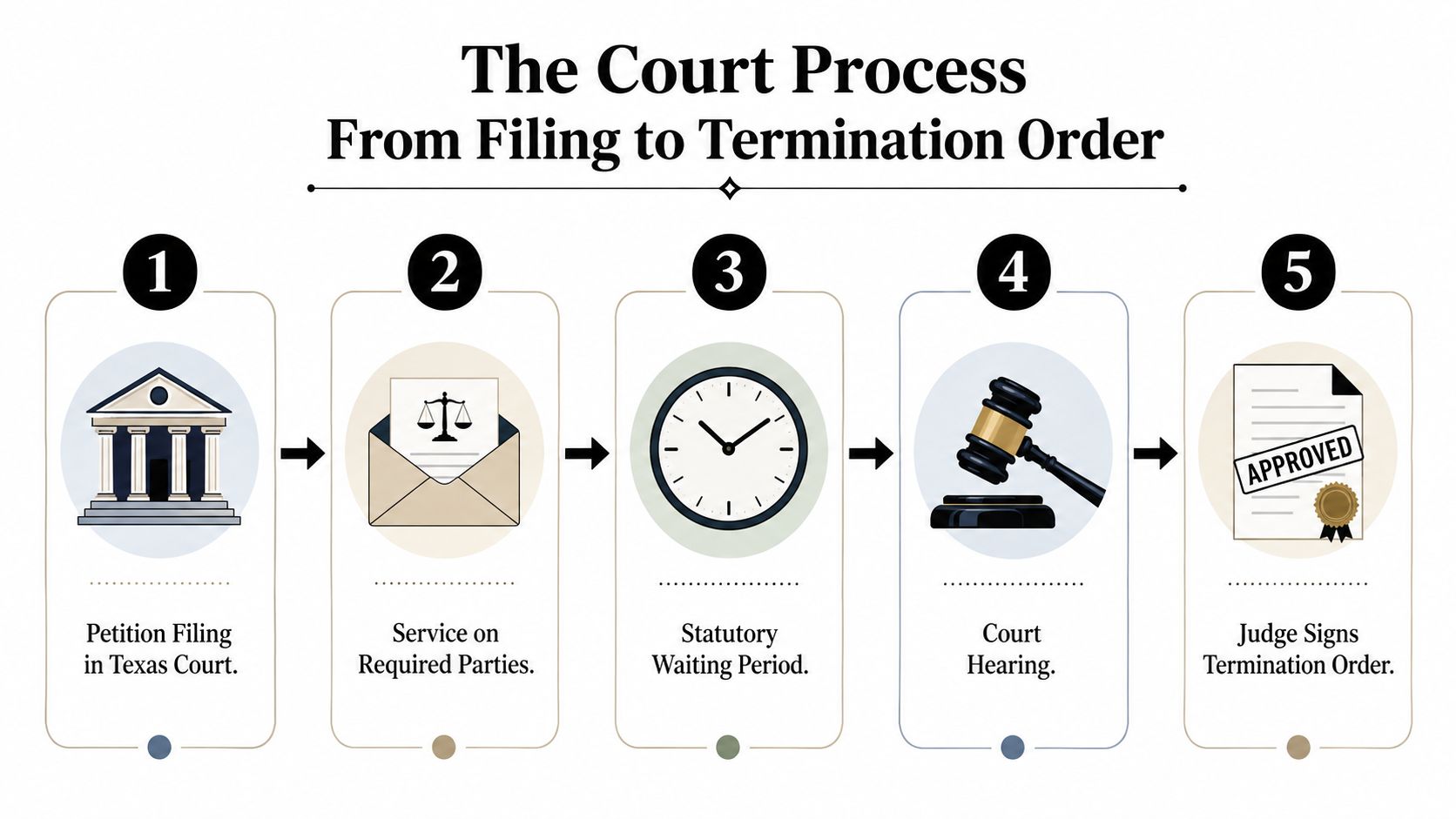
After the affidavit is signed, the termination case still needs to move through court. A petition is filed in a Texas court with jurisdiction, and the parties must address notice and service requirements. The court needs a lawful basis to decide whether the requested termination should be granted.
The process commonly involves these stages:
- Petition filing: The person or entity seeking termination files the appropriate pleading and supporting documents.
- Service and notice: Required parties, including a non-relinquishing parent when applicable, must receive legally sufficient notice or service. If a parent can't be located, the court may require additional steps before proceeding.
- Waiting and document review: The affidavit must be handled according to the applicable statutory timing rules. In many cases, the affidavit needs to be on file for 11 days before the hearing, while a qualifying irrevocable affidavit may affect whether a hearing is required.
- Termination hearing: The judge reviews the affidavit, testimony, disclosures, parentage questions, and the child's circumstances.
- Termination order: If the legal requirements are met and termination serves the child's best interest, the judge signs the order.
A child may receive a guardian ad litem or attorney ad litem when the court determines that representation or an independent voice is needed. These appointments help the court examine the child's interests rather than treating adult agreement as the only issue.
Chapter 161 and Chapter 162 work together. Chapter 161 addresses termination. Chapter 162 governs adoption and allows the court to provide for adoption after a valid termination. A Texas appellate decision discussing that procedural connection is available through Texas case law on termination and adoption.
The exact path varies. A private infant adoption may coordinate the affidavit, placement, service, and adoption petition. A stepparent or kinship adoption may involve an existing family relationship and questions about the absent parent. A CPS case may include the Department, a service plan, permanency decisions, and separate court oversight. A missing parent doesn't disappear legally because locating them is difficult. Counsel must address notice, registry, service, or other court-approved procedures.
For a plain-language overview of the termination stage, families can also review what termination of parental rights means in Texas.
How Relinquishment Fits Into Different Adoption Paths
The same Texas affidavit can appear in very different family stories. A birth parent may choose an agency placement for a newborn. A father may consent so a stepparent can become the child's legal parent. A grandparent may seek adoption after providing long-term care, while CPS may be managing the case through a permanency process rather than a private placement plan.
Consider these representative situations. In an agency adoption, the agency may coordinate counseling, disclosures, placement, and court filings. In an identified private adoption, the birth parent may know the prospective adoptive family. In a stepparent adoption, the child may already live with the stepparent, but the other legal parent's consent or termination still has to be addressed. In a kinship case, family familiarity may ease daily caregiving while leaving parentage and court requirements unresolved.
| Adoption Path | Who Signs | Default Clock | Court Hearing |
|---|---|---|---|
| Private infant placement | The consenting birth parent or parents, subject to parentage rules | The affidavit's stated revocation terms or the default rule | Usually part of the termination process |
| Licensed agency adoption | The parent or parents consenting to agency placement | The affidavit controls, including any irrevocable period | Usually coordinated with termination and adoption filings |
| Stepparent adoption | The parent whose rights must be terminated or who consents | The applicable affidavit and court timeline | Termination and adoption proceedings are connected |
| Kinship or relative adoption | The parent or parents whose rights are being addressed | The document's terms and court schedule | Court review remains necessary |
| CPS-related adoption | Parents in the CPS case, when voluntary consent is appropriate | Runs alongside the Department's permanency process | The court addresses termination and the child's permanency |
The child's location before signing also depends on the case. A licensed agency, prospective adoptive family, relative, or Department may be involved under different legal arrangements. Families should avoid assuming that physical care answers the legal question.
If adoption isn't the right decision, a parent may want to browse alternative family planning options while discussing lawful choices with a qualified professional. For families pursuing a direct placement, private adoption in Texas involves careful coordination of consent, notice, placement, and court requirements.
Common Pitfalls and Misconceptions to Avoid
A relative may say, “Just leave the baby with us.” A parent may agree in a text message, sign a casual note, or hand over medical records. Those actions can show intent or create practical confusion, but they aren't a Texas affidavit of voluntary relinquishment and don't themselves terminate parental rights.
The post-birth timing rule also matters. A newborn affidavit can't be signed before 48 hours after birth, as reflected in Texas Family Code Section 161.103. Signing too early can undermine the document and create delay when the court needs reliable proof that the statutory requirements were followed.
Other warning signs deserve immediate attention:
- Blank disclosures: The affidavit must include required information about the child, the other parent, support obligations, and the child's best interests. Missing or unclear information can create litigation risk.
- Unclear revocation terms: If the document doesn't clearly state the revocation rules, the default legal rule may apply, leaving a parent with only until the 11th day after execution to revoke.
- Confusing termination with adoption: A termination order ends parental rights. It doesn't mean the adoption has already been finalized.
- Assuming the mother's signature resolves paternity: A father's legal status, notice, and registry issues may still need attention. A carefully completed maternal affidavit can't automatically eliminate a separate parentage problem.
- Treating irrevocability as immediate finality: An irrevocable affidavit can limit revocation, but the court still must enter the termination order.
A parent who regrets signing should act quickly. Don't wait for a hearing notice or assume the deadline is flexible. Give an attorney the exact affidavit, execution date, birth information, and court papers so the available options can be evaluated from the documents themselves.
Your Next Step Toward a Confident Decision
This decision deserves both compassion and precision. The legal safeguards aren't designed to punish a birth parent or slow down a hopeful adoptive family without reason. They exist to protect informed consent, prevent avoidable disputes, and support a stable outcome that serves the child's best interests and preserves family unity whenever the law and circumstances allow.
Birth parents can use this short preparation list:
- Get independent legal advice: Ask an attorney to explain the affidavit before signing, especially if someone else prepared it.
- Mark the dates: Record the child's birth date, the earliest lawful signing date, the execution date, and every stated revocation deadline.
- Review every disclosure: Confirm that the child's identity, the other parent's status, support information, and best-interest language are complete and understandable.
- Ask about life after signing: Discuss counseling, communication expectations, placement updates, and what the court order will mean.
- Bring every document: Include hospital papers, agency forms, notices, paternity records, and proposed adoption documents.
Adoptive parents should prepare in parallel:
- Confirm the placement pathway: Identify whether the case is private, agency-based, stepparent, kinship, or CPS-related.
- Coordinate required evaluations: Complete the home study and other adoption prerequisites applicable to the case.
- Address every parent: Ask counsel how notice, service, paternity, and registry questions affect the petition.
- Track the court case: Placement doesn't replace termination, and termination doesn't replace adoption finalization.
- Plan for the child's continuity: Organize medical, emotional, educational, and family-relationship information in a way that supports the child over time.
A Texas family law attorney can review the specific affidavit, explain the 48-hour, 11-day, and 60-day rules that apply, and coordinate Chapter 161 termination with Chapter 162 adoption requirements before anyone takes an irreversible step.
The Law Office of Bryan Fagan, PLLC helps birth parents, adoptive parents, stepparents, relatives, and CPS-related families understand affidavits, notice, termination orders, and adoption finalization. Visit Law Office of Bryan Fagan, PLLC to schedule a free consultation and discuss your Texas family's facts, deadlines, and next legal step.
