
You're at the kitchen table with a home study folder, medical papers, school records, and questions no checklist seems to answer. Perhaps you're preparing to adopt a child, helping a relative pursue kinship adoption, or trying to understand what information a birth parent can provide. The family code 162.007 health, social, educational, and genetic history report can feel like another court form, but it serves a much larger purpose.
Texas treats this report as a lasting record about a child's background. It can help the court evaluate the adoption, help adoptive parents make informed health and educational decisions, and give the adopted person important information about identity and family medical history later in life. Missing records and complicated family structures can make the process harder, but they don't mean you're out of options.
What the HSEGH Report Is and Why Texas Requires It
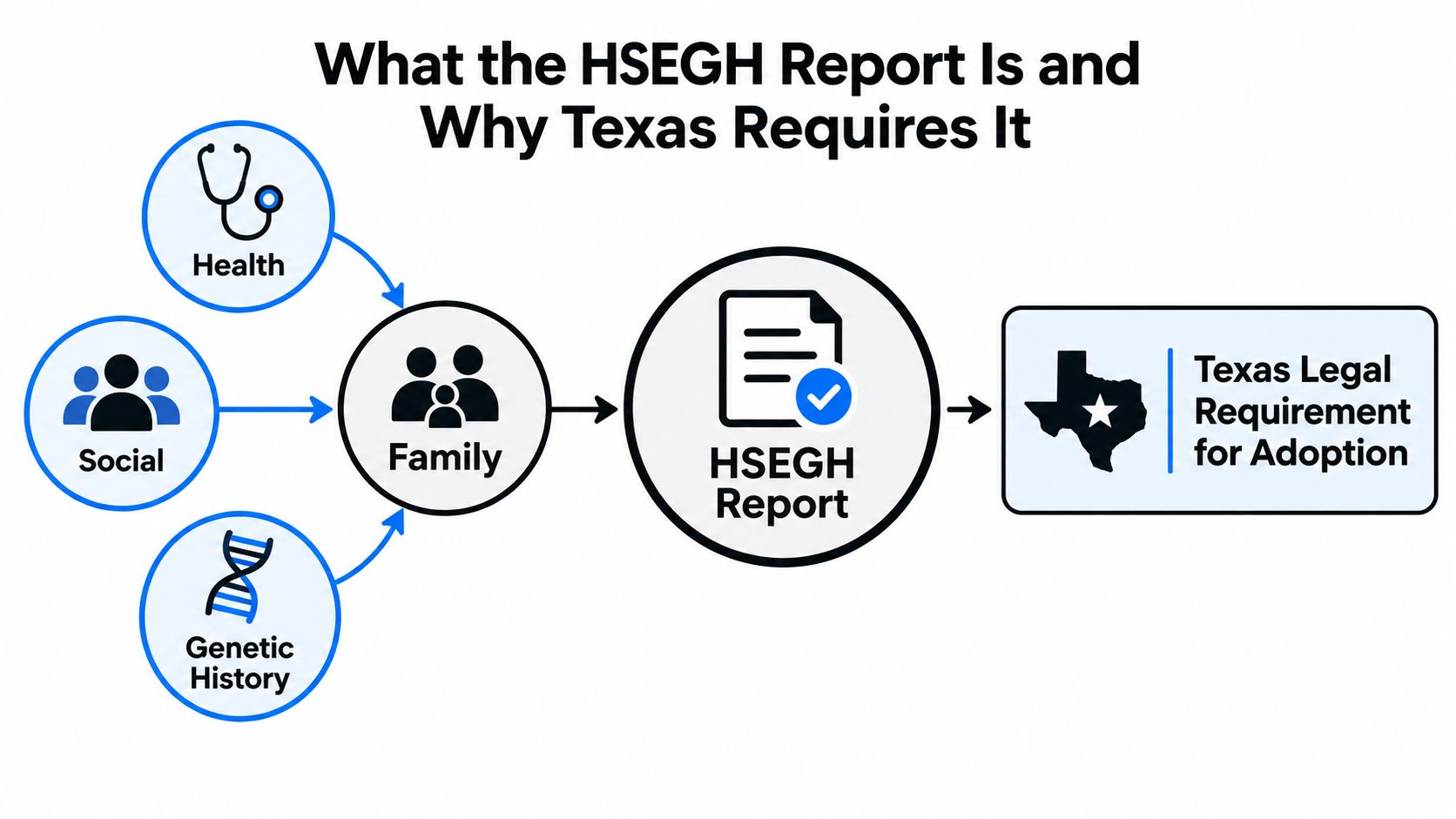
A family may first encounter the document as the Health, Social, Educational, and Genetic History report, often shortened to the HSEGH report. Section 162.007 of the Texas Family Code requires the report to gather the child's available health, social, educational, and genetic history before adoption. Texas Family Code §162.007 is the central content rule.
The name tells you what belongs inside:
- Health history, including medical information and treatment needs.
- Social history, including the child's relationships, care, and experiences.
- Educational history, including learning and school information when appropriate.
- Genetic history, including family medical patterns and inherited conditions.
This isn't meant to be a vague biography. It's a structured disclosure package assembled from available records, interviews, and reliable information. A court may use it while reviewing the adoption. The adoptive family may rely on it when choosing doctors, seeking services, or answering a child's questions. Years later, the adopted person may need it to understand family origins or provide useful information to a treating physician.
Why the report lasts beyond finalization
Texas law gives this record long-term importance. The report must be retained for 99 years from the date of adoption. Texas Family Code §162.006 therefore treats the report more like a durable medical and family-history repository than a temporary case file.
That long life changes how families should approach preparation. A rushed placeholder may create confusion years later, while a careful report can preserve context that a child may otherwise lose. Families organizing medical information may also find a medical record summary guide helpful for understanding how to arrange records clearly.
Section 162.007 establishes what the report must contain. Other provisions in Chapter 162 address related issues, including timing, exemptions, and the people responsible for signing or submitting adoption documents. For a broader explanation of how these rules fit into the adoption process, review this Texas adoption and the Family Code essential guide for parents.
Practical rule: Treat every entry as information your child may need, not just paperwork the court may approve.
The Four Pillars of the Report Explained
A strong HSEGH report connects four kinds of information. Each pillar answers a different question, and together they give the child and family a more usable history.
Health history
Health information may include current and past conditions, medications, allergies, immunizations, hospital care, surgeries, developmental concerns, and physician contact information. Hospital delivery records and pediatric charts can be especially useful because they may identify information that a short agency summary leaves out.
A sparse entry might say only “no known conditions.” A fuller entry explains what records were reviewed, what information was unavailable, and whether follow-up is recommended. It should distinguish a confirmed diagnosis from an unverified concern.
Social history
Social history describes the child's early environment and relationships. Depending on the available information, it may address prenatal care, substance exposure, caregivers, siblings, placements, family relationships, and significant changes in the child's life.
For example, “multiple placements” gives little context. A better record identifies the known placement sequence, the source of that information, and any documented effects on the child's adjustment. Birth parents and relatives may hold important details that never appear in a medical chart. Families can review related disclosure issues in this guide to medical and financial disclosures Texas birth parents must provide.
Educational history
Educational history may include school records, attendance information, early intervention records, learning assessments, speech services, individualized education programs, and teacher observations when the child's age makes those records relevant.
A report shouldn't imply that no educational history exists just because the child is young. It can explain that formal school records aren't available and identify early developmental information instead. For an older child, omitting an IEP or assessment can make it harder for the adoptive family to continue needed support.
Genetic history
Genetic history concerns the family of origin. It may include known hereditary conditions, recurring illnesses among biological relatives, ethnic background, and family patterns such as heart disease, diabetes, or mental health conditions when those facts are reliably known. This is different from reporting the child's own diagnosis, which belongs primarily in the health section.
| Pillar | What It Covers | Typical Evidence Sources |
|---|---|---|
| Health | Conditions, treatment, medications, allergies, and immunizations | Medical charts, hospital records, physicians, caregivers |
| Social | Prenatal background, caregivers, placements, and relationships | Agency records, interviews, caseworker notes, relatives |
| Educational | Learning, development, school services, and assessments | Schools, IEPs, early intervention providers, teachers |
| Genetic | Family medical patterns, hereditary conditions, and background | Biological relatives, family questionnaires, medical charts |
The pillars should agree wherever possible. A medication listed in one record should be compared with the child's current medical information. A reported family condition should be identified as confirmed, reported, or unknown. Most adoptions also require resolving parental legal rights first, which is why Termination of Parental Rights Before Adoption is a necessary first step in most adoptions.
Who Prepares the Report and When to File It
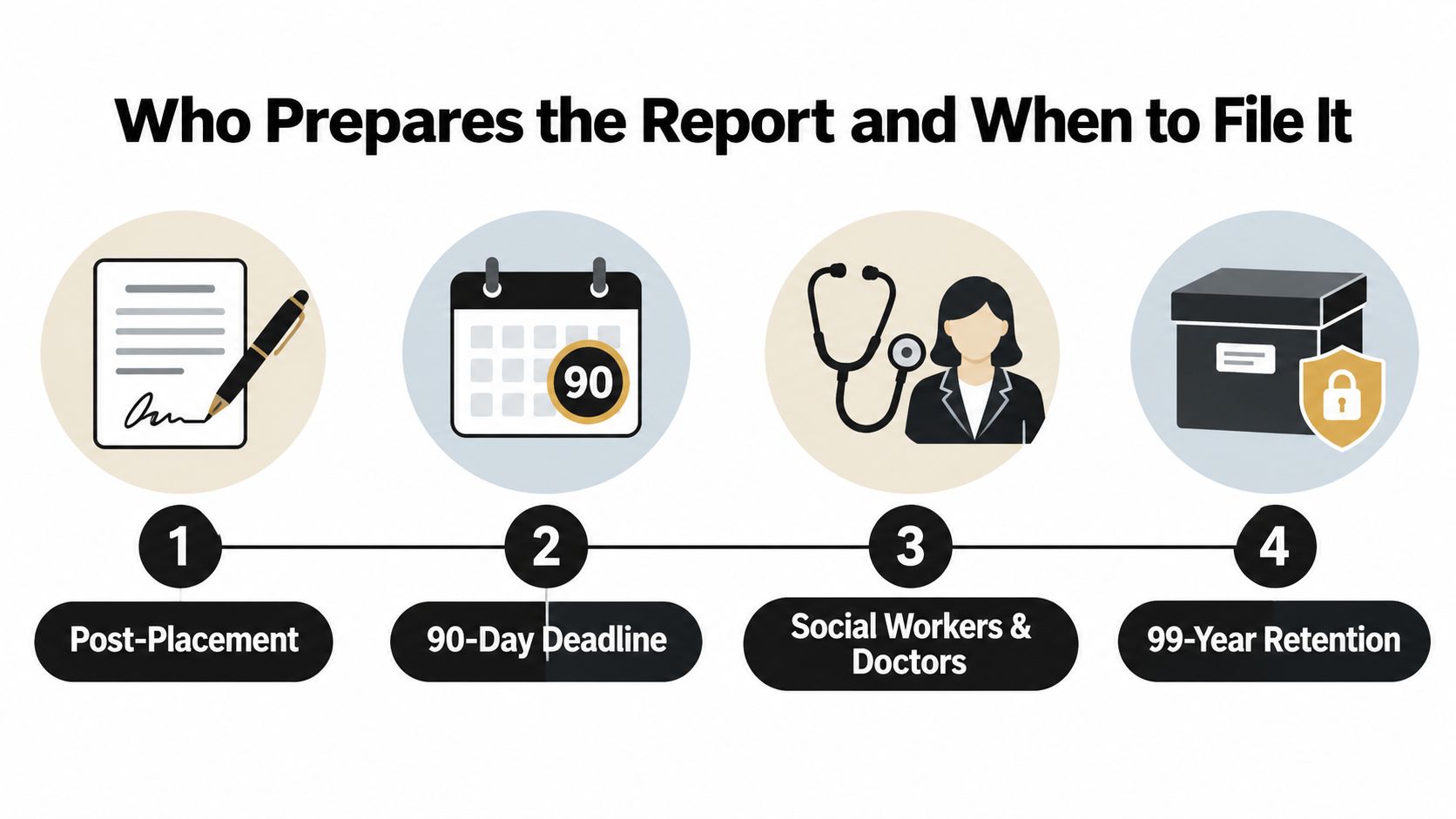
The person who compiles the HSEGH report depends on the adoption pathway. A licensed child-placing agency may prepare it in an agency adoption. A professional involved in the adoptive home study may gather and organize information. In some private or kinship matters, the court may identify the reporting party.
The preparer's role is to compile and verify available information. That role differs from a biological parent's responsibility to disclose known history. One person may gather documents, while another supplies family medical information or explains prenatal circumstances.
A workable timing sequence
Families should ask these questions early:
- Before placement, what information must be disclosed or collected for this adoption?
- After placement, what report must be completed and submitted before the final hearing?
- Before finalization, has counsel reviewed the report for missing categories, contradictions, and signatures?
- After filing, how will the sealed record be preserved and how can later updates be handled?
Texas retention rules give the report lasting significance. Because the record is retained for 99 years, accuracy matters to the child, future medical providers, and descendants, not only to the court reviewing the adoption. The statutory retention requirement appears in Texas Family Code §162.006, which should be read alongside the content requirements in Section 162.007.
A family law office may also use administrative support to organize records, track requests, and prepare a clean file for attorney review. This overview of virtual assistants for family law offers background on that type of support.
The HSEGH report is one part of a larger adoption process that may include a home study, consents, termination proceedings, placement supervision, and a final hearing. Families can learn more about the home study through this guide to what a home study for adoption involves.
When Records Are Missing or Biological Parents Are Unavailable
A missing record doesn't automatically make an adoption impossible. It does mean the file should show what happened, what was requested, and why the information couldn't be obtained.
A biological parent may be unavailable because the person cannot be located, has died, refuses to participate, or never had reliable information. Texas guidance recognizes that a court may waive the HSEGH report when biological parents cannot be located and insufficient information exists. That is a narrow situation, not a general excuse to stop gathering records. Texas Children's Commission guidance emphasizes the importance of documenting the circumstances.
Build a record of good-faith efforts
Counsel may help assemble evidence such as:
- Hospital delivery summaries.
- Agency summaries with protected information removed.
- Medical or school records already available.
- Interviews with former caregivers, caseworkers, or relatives.
- Affidavits describing attempts to contact a biological parent and obtain records.
Contradictions deserve attention rather than concealment. If one source reports a family condition and another says the condition is unknown, the report can identify both sources, explain the conflict, and attach supporting material. A clear statement that information is uncertain is more useful than presenting an assumption as fact.
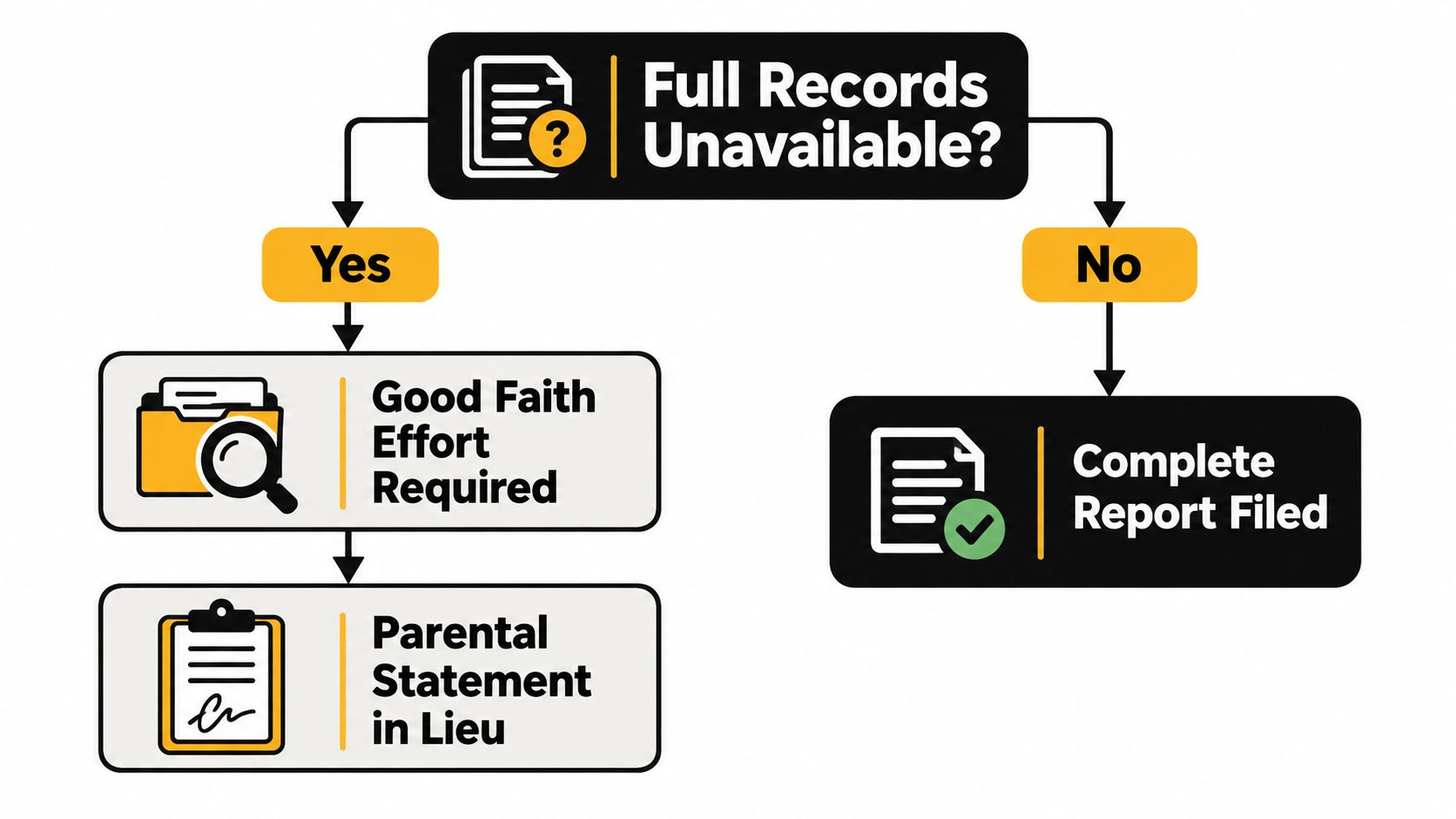
An incomplete report with an honest explanation is different from an incomplete report that gives no explanation.
The child's best interests remain central. Adoptive parents shouldn't feel responsible for facts they couldn't obtain. Their responsibility is to help create a truthful, careful record and to seek legal direction when a waiver or supplemental filing may be appropriate.
Exempt Placements and How Waivers Compare Across Texas Counties
The exemption question often confuses families because a relationship may sound similar to another relationship legally, while the filing requirements differ. Texas law confirms that the HSEGH requirement doesn't apply to adoptions by a grandparent, aunt or uncle, or stepparent. Texas Family Code §162.005 provides the statutory exemption framework.
A statutory exemption and a court-ordered waiver aren't the same. An exemption applies because the placement fits the law. A waiver generally requires the family to ask the court to excuse the report under limited circumstances and support that request with evidence.
| Placement Type | Statutory Exemption | Report Required | Typical County Practice |
|---|---|---|---|
| Grandparent adoption | Generally exempt under the listed relationship | Often not required under the exemption | Clerk may still request exemption-related paperwork |
| Aunt or uncle adoption | Generally exempt under the listed relationship | Often not required under the exemption | Counsel confirms the relationship and local filing requirements |
| Stepparent adoption | Generally exempt under the listed relationship | Often not required under the exemption | Other adoption documents and investigations may still apply |
| Adult adoption | Requires careful review of the applicable pathway | Depends on the facts and court direction | Local forms and judicial expectations can vary |
| Second-parent adoption | Family structure requires individualized legal analysis | May be required unless an exemption applies | Counsel reviews parentage, consent, and county procedures |
| Non-exempt private or foster adoption | No listed relationship exemption | Generally required | Agency or designated preparer compiles the report |
County clerks may ask for different supporting forms or explanations when a family claims an exemption. A kinship placement can also change over time. A relative who first provides care may later pursue adoption under a pathway that doesn't fit the exemption list. LGBTQIA+ families and second-parent adopters should receive advice based on their actual legal relationship and court filing, not on a general assumption about family structure.
Adult adoption also deserves separate attention. The parties may have a long relationship, but the court still needs the correct documents and legal basis. If the placement is not clearly exempt, ask counsel whether a report, waiver request, or other filing is appropriate before setting the final hearing.
A Practical Checklist for Preparing Your Report
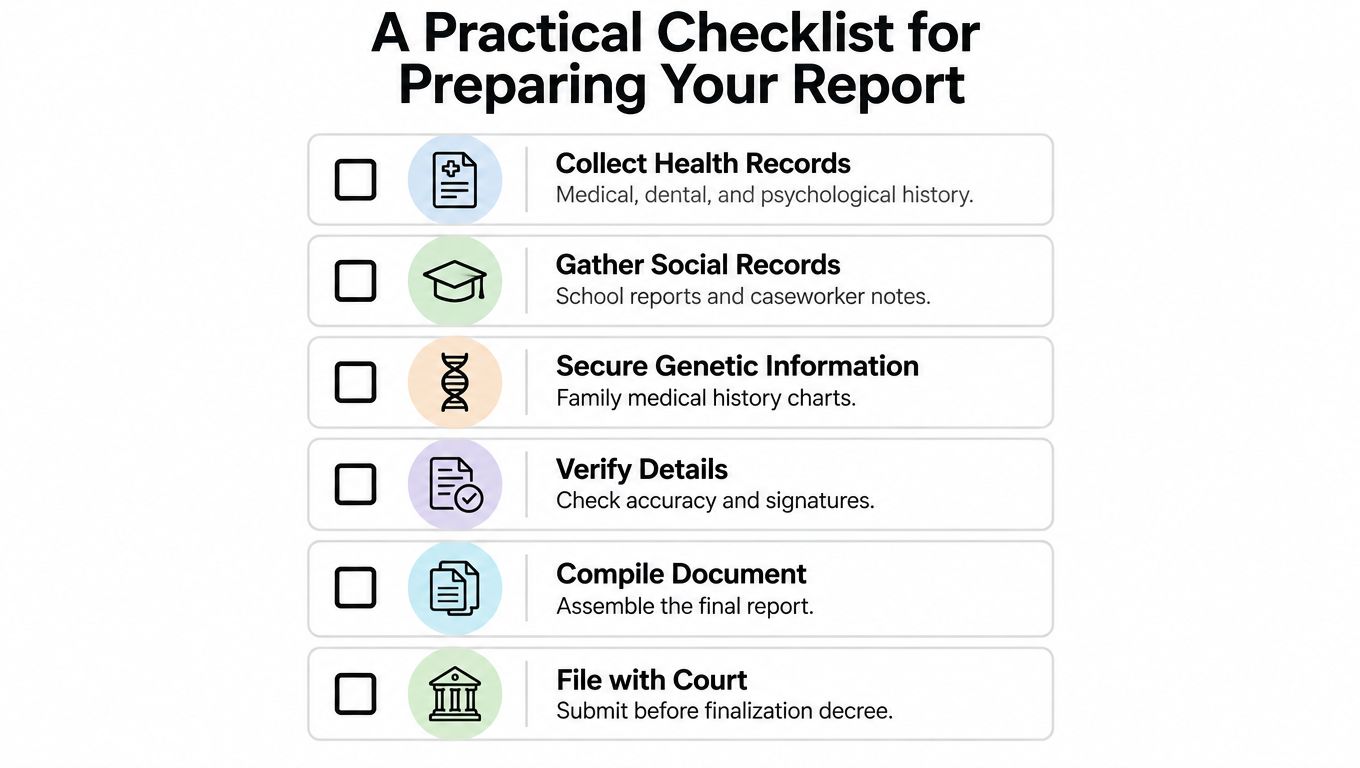
Use a working folder, whether paper or electronic, and label every item by child, date, source, and category. Don't wait until the final hearing is scheduled to discover that a hospital or school still has an unanswered records request.
Collect the underlying material
- Health records: Request hospital delivery records, immunization history, pediatric notes, dental records, psychological evaluations, growth charts, medication lists, and known allergies.
- Social records: Gather caseworker notes, placement histories, caregiver information, prenatal details, sibling information, and relevant agency narratives.
- Educational records: Request school reports, early intervention documents, learning assessments, attendance information, and IEP materials when applicable.
- Genetic information: Ask for family medical history from biological parents, relatives, agency questionnaires, and available medical charts.
Verify before filing
Read the report against the source documents. Check names, dates, relationships, diagnoses, and the difference between confirmed information and family recollection. Ask pediatricians, social workers, former foster parents, and other appropriate people to clarify unclear entries.
Then complete a final quality review:
- Confirm that each of the four statutory areas has an entry or a clear explanation of unavailable information.
- Compare dates across attachments and correct inconsistent timelines.
- Identify contradictions instead of deleting one version without comment.
- Confirm required signatures, notarizations, or certified copies with counsel and the clerk.
- Assemble addenda so later readers can tell what was part of the original report.
- File the report through the required court process before finalization when applicable.
The report should protect privacy while preserving useful facts. Don't circulate sensitive medical or genetic information casually. Give records to the attorney, agency, or court personnel responsible for the adoption file, and ask how confidential materials should be labeled and submitted.
A Family Story of Putting the Report Together
The Martinez family matched with a two-year-old girl through a private placement. At their first meeting with the adoption attorney, they brought a folder full of documents but no clear sense of what belonged in the HSEGH report.
The attorney helped them sort the material by category. The birth mother provided available prenatal information and answered questions about family medical history. The family requested immunization and early developmental records from a former caregiver, while the placing agency supplied a genetic background questionnaire and its available social history.
One detail required care. A man's name appeared in an older note, but the attorney confirmed that paternity had never been established. The report didn't identify him as a legal or biological parent without support. Instead, the file included the relevant explanation and preserved the underlying record.
The pediatric records arrived after the first draft. The attorney added them as a medical records supplement, checked the dates against the existing summary, and marked uncertain family-history statements as unconfirmed. The family chose confidential filing for the sensitive information and reviewed the completed report before the hearing.
When the judge signed the adoption order, the Martinez family felt relief, but the careful work had another purpose. The retained report gave their daughter a clearer medical and personal history for the future, even though some questions remained unanswered.
Frequently Asked Questions and How We Can Help
What if the biological parents are unknown or uncooperative?
Begin with a paper trail. Keep copies of requests, search efforts, agency messages, returned notices, and substitute records. If a parent cannot be located or will not provide information, explain the specific efforts made and identify the gaps. A court may consider a waiver in circumstances recognized by Texas guidance, but the judge needs facts, not a general statement that records are missing.
What if genetic history is unavailable?
Ask the placing agency, relatives, former caregivers, and medical providers for reliable information. Record who was contacted, what was requested, and which answers could not be verified. Mark uncertain statements clearly instead of presenting guesses as medical facts. After adoption, give newly discovered information to the child's healthcare providers and ask counsel how a supplement or legally permitted update should be preserved.
Is the report confidential?
Adoption records are handled confidentially, but access depends on the record, the requester, and the law governing that request. An adopted adult, descendant, physician, or another authorized person may follow a different process. Before promising that records will be released, contact the clerk or counsel to identify who may request access, whether consent or a court order is required, and where the request must be filed.
Can the report be filed after placement?
Information may be gathered before placement and finalized after placement, but the report must be ready within the schedule that applies to the adoption and court. Ask your attorney to confirm the filing deadline, required attachments, and whether the clerk wants corrections filed before the final hearing. A report that is complete on paper can still cause delay if it reaches the court in the wrong format or at the wrong time.
Can errors be corrected after adoption?
Sometimes a correction, supplement, or medical update is possible, but sealed records can limit the available process. Compare the draft with the underlying records before finalization. Keep documents that support any later request, including dated medical records and written explanations from agencies or providers.
What if the family structure does not fit usual examples?
Kinship, second-parent, LGBTQIA+, adult, foster-to-adopt, and changing family arrangements can raise different questions about the report and any exemption or waiver. Before filing, ask counsel to confirm in writing which statutory exemption, if any, the petition relies on and what supporting evidence the local clerk requires. That written check can prevent a family from preparing for one filing path while the court expects another.
The Law Office of Bryan Fagan, PLLC helps Texas families organize HSEGH information, address missing records, and prepare for court proceedings with the child's best interests in view. Schedule a consultation to discuss your report and next steps, or visit Law Office of Bryan Fagan, PLLC for adoption and guardianship guidance.
The Law Office of Bryan Fagan, PLLC can help identify report requirements, review available health and family-history records, and address exemptions, waivers, or missing information before finalization. Contact the firm to request guidance specific to your Texas adoption.
